RSS
Menampilkan postingan yang diurutkan menurut tanggal untuk kueri philosophy. Urutkan menurut relevansi Tampilkan semua postingan

Obama Did Not 'Save the Auto Industry': My Reply to the Myth-Peddlers

Via RightWingNews I read this piece by Michelle Malkin called The Autoworkers Obama Left Behind that I think is important for you to remember in the face of the propaganda that the Obama administration is going to churn out:

The White House fairy tale about the Happily Ever After Auto Bailout is missing a crucial, bloody page. While President Obama bragged about “standing by American workers” at a rowdy United Auto Workers meeting Tuesday, he failed to acknowledge how the Chicago-style deal threw tens of thousands of nonunion autoworkers under the bus.

In a campaign pep rally/sermon billed as a “policy speech,” Obama nearly broke his arm patting himself on the back for placing his “bets” (read: our money) on the $85 billion federal auto industry rescue. “Three years later,” he crowed, “that bet is paying off for America.”...

...The bailout pain was not distributed equally. It was redistributed politically.

Bondholders standing up for their property and contractual rights got shortchanged and demonized personally by the president. Dealers and suppliers faced closures based on political connections and lobbying clout, rather than neutral efficiency evaluations. And as I first reported in September 2010, in the rush to nationalize the auto industry and avoid contested court termination proceedings, the White House auto team schemed with Big Labor bosses to preserve UAW members’ costly pension funds by shafting their nonunion counterparts.

These forgotten nonunion pensioners (who worked for the Delphi/GM auto parts company) lost all of their health and life insurance benefits. Hailing from the economically devastated Rust Belt — northeast Ohio, Michigan and neighboring states — the Delphi workers had devoted decades of their lives as secretaries, technicians, engineers and sales employees. Some have watched up to 70 percent of their pensions vanish. They’ve banded together to seek justice in court and on Capitol Hill under the banner of the Delphi Salaried Retiree Association.

Through two costly years of litigation and investigation, the Delphi workers have exposed how the stacked White House Auto Task Force schemed with union bosses to “cherry pick” (one Obama official’s own words) which financial obligations the new Government Motors company would assume and which they would abandon based on their political expedience. Obama’s own former auto czar Steve Rattner admitted in his recent memoir that “attacking the union’s sacred cow” could “jeopardize” the auto bailout deal....

...As ebullient UAW officials hooted and hollered on Tuesday, Obama smugly attacked Republicans for “anti-worker policies” and their “same old you’re-on-your-own philosophy.” The Delphi workers know better: One union’s government-subsidized, government-manipulated “success story” is the rest of the workforce’s nightmare.
In Michigan, I daily hear the meme that "Obama saved the auto industry," and it bothers me, because in spite of so many factually wrong aspects of that statement people still believe it and are going to vote on it in November. The truth matters.

It matters that the TARP program was sold to the public and passed by Congress to save our banking industry, and then was turned into a slush fund to bail out politically favored industries and businesses. George W. Bush proposed saving GM and Chrysler, and I didn't agree with it then- there were two many questions as to why those companies were picked to be saved by taxpayer cash, why smaller companies didn't receive bailouts of their own, and the effect that bailing out a few companies would have on the rest of the larger un-bailed out economy. Still, Bush's program was small and would follow established laws and standards for bankruptcy, so it was bad, but not corrupt.

It matters that President Obama then took Bush's program and expanded it and turned it from a 'bailout to save the auto industries' into a 'government takes over GM and gives half of it to the union and gives Chrysler a lot of cash to get bought by an Italian company.' And rather than simply giving the money out as a loan with conditions, like Bush was going to do, Obama and his officials instead made far more daily decisions and played political games with the closing of dealerships and who got pensions- they played political games at a time when our nation was facing a deep crisis. That was gangster capitalism at its finest.

It matters that General Motors Corporation then went bankrupt, taking down thousands of properties and ruining whole communities, while dealerships were shuttered and thousands lost their jobs. This was 'you're-on-your-own' philosophy at work, only now instead of it being free people making free decisions on their own, it was Obama and his officials who decided who would be 'on-their-own' and who would get government help and support. Even today, the company that the government had the most contact with and control over- General Motors- lags its competitors who had less of the stink of government on them and less Obama influence. That matters.

In this coming election, it is going to be hard work to correct those who spin the lie that "Obama saved the auto industry", but we need to, because the truth is out there.

  • Digg
  • Del.icio.us
  • StumbleUpon
  • Reddit
  • RSS

An Inside Look at Oval Office Decision Making Under Obama

Often on Facebook and in comment sections of news articles and through conversations with friends I hear people say "What could President Obama done differently?" To answer that question, we would need some sort of insider view on what options Obama was presented with and to hear exactly what his decision making process was. We'd need some memo's or something that would detail all the paths not taken by President Obama, paths that might have led our nation back to prosperity or prevented the massive deficits that will destroy our children's futures or would have helped encourage businesses to grow and invest.

Such memo's, showing all the options that were there, together with some insider analysis, would be invaluable to answering the question "What could President Obama done differently?" Thankfully for us, that information exists, and has been looked at by The New Yorker's Ryan Issa. Americans for Prosperity sums up what just exactly goes down in the Obama White House and the decision-making of soon-to-be-one-termer President Obama:

Recently, the New Yorker’s Ryan Lizza released White House memos showing President Obama’s advisers contemplated multiple options for the original so-called stimulus package. The President’s advisers, including economists Larry Summers and Christina Romer, argued that multiple areas of the economy needed federal stimulus. Despite the advisers’ agreement that the President should engage in some type of big government intervention, the economists and the President differed greatly in their approach to dealing with the economic crisis. The memos reveal that the centralized planning inherent in big government stimulus is not quite the rational process that the Left would like us to believe, but rather a messy amalgam of competing political interests from individual planners.

Decision makers in Washington DC, like President Obama and his advisors, believe government planners can spend money more wisely than the private sector by finding specific areas in the economy where injecting federal funds can presumably improve economic prospects. They draw this so-called “targeted, temporary, and timely stimulus” from the economic philosophy of John Maynard Keynes. Instead of waiting for the free market to sort out economic problems, Keynesians believe that the government must intervene.

However, as economist F.A. Hayek observed, the knowledge required to direct the economy is too vast for any individual (or collection of individuals) to acquire. Hayek diagnosed presumptuous bureaucrats as suffering from “The Fatal Conceit”: they implement programs on the assumption that they know just what they were doing and exactly how the economy would respond. This self-deception is clearly observed in the White House’s plan for the stimulus.

During the planning and negotiations in 2009, President Obama proposed building a national so-called “smart grid” which would allow energy to flow more efficiently. It was, as Ryan Lizza puts it, Obama’s version of the Hoover Dam. But Obama’s advisers disagreed with the President’s “moon-shot initiative,” which they felt would only look good in headlines but lacked economic sense.

Lizza explained that advisers like Christina Romer had to have a “frank” conversation with the President: the smart grid was too expensive and not likely to produce short term economic benefits. Besides, Romer and Summers had plans of their own. Both proposed granting billions of stimulus dollars to states who were dealing with their own budget crises. Even these advisers, however, differed on how they thought the remaining stimulus funds should be spent. Summers preferred a more limited package with targeted spending in different areas of government. Romer, on the other hand, requested an even larger package with a different vision for the stimulus.

And yet, President Obama persisted with his politically-popular moon-shots. The President proposed a project for high-speed trains; a plan favored by Congressional Democrats. But the President’s advisers pushed back with the same argument: bailouts for struggling states were a better alternative for the economy. The President also differed with his advisers over the stimulus package’s price tag. In as attempt to control the costs of the runaway package, the President had to make a choice: give Congress high-speed trains and add in about $40 billion in Congressional “pork-barrel” spending, or cut $60 billion in stimulus that his advisers said would be more effective (the aid to states). The President showed how politics destroys the so-called virtue of government planning by choosing to give Congress its requested $60 billion in pet projects, including the high-speed trains – a direct example of how the stimulus package wasted (at least) $60 billion in taxpayer dollars.

Lizza’s stimulus memos expose the inherent flaws in any centralized planning effort. Hayek’s argument against centralized planning was not simply that it was an unfavorable method of governing, but that it was logically unworkable. Even though brilliant people worked on the stimulus package, people like Christina Romer who has a Ph.D. from MIT, none of them could possibly complete the impossible task gathering the necessary information to direct the economy. The economy is just too complex for government to direct. Their plans were pitched to the American people as objective solutions, but they really represented the individual (and in the President’s case, politicized) interests of the planners at the table.

The result? A stimulus package that failed to achieve the goals that even its own creators set out for it.
The President made bad decisions. He's on the ballot in 2012. Michigan and many other swing states will decide his fate. Vote the right way.

  • Digg
  • Del.icio.us
  • StumbleUpon
  • Reddit
  • RSS

Obama: Does He Opposes republicanism?

Let's not forget the big picture during this primary season- defeating President Obama's attempt to hold on to political power. This is not a partisan issue- I don't suggest that Obama needs to be defeated merely because he is a Democrat or a liberal or a progressive or whatever- but rather this is an issue about putting someone in the White House who is better at getting out of my way.

I'm great a working hard, creating wealth, making my own decisions in my life, living with my own mistakes, and producing goods and services for our great nation- and so are you. All you require to be prosperous, happy, and free is a government which protects your life through national defense and police services and the like, a government which protects your liberty and freedom by making sure that enemies without and within do not gain the ability to order you around, and a government which protects your happiness by making sure that the property you do earn you keep. You are all great Americans.

And yet, President Obama does not think that you are great Americans- he thinks that you make bad decisions, that you don't understand how a baby could ruin your life, and that you are not creating the right sort of property or spending your property in the right way. And this dangerous man with these dangerous attitudes has become President of the United States of America and is now using the power of that executive office to take away your liberty and freedom and property and make your life a little less full.

You've felt it, just like I have, over the years and getting worse over the last three- that feeling like people don't matter any more, like peoples lives are inconsequential, and that feeling that our world is a little less alive. It is not surprising that you've felt this way- as government has gotten bigger and more powerful and more in control with more aspects of your lives this impersonal and vast institution has dehumanized us and treated us as numbers and taken away from our life, liberty, and property.

President Barack Obama supports this dehumanizing and confiscating and controlling philosophy because he does not think that you are all great Americans.

Jay Cost on Saturday touched on these ideas in his blog post, where he spoke about just exactly what sort of person Obama was, what his vision of the world was, and why opposing him rises beyond simply a partisan or jobs or improving economy thing- it is a real battle of vision for the future for America- one in which the individual is great and free and prosperous, or another one in which the individual is a slave to the state and controlled by the state and prosperous only as much as the state lets them be.

Here is part of Jay Cost's blog post, from the Weekly Standard, called What's So Bad About Obama?

...Obama is not “radical,” at least not in the way we usually define the concept. But that actually points to the big the problem with this president and his worldview. The progressive ideology dating back to the turn of the last century, and in which Obama is comfortably situated, was never really about overturning the established order, but rather in co-opting it...

... the hallmarks of the First New Deal – were all about grand bargains between government, labor, farmers, and capital owners. The point was to draw all classes to the bargaining table, with the meeting chaired by the progressives, naturally. So it goes for modern-day progressivism. Both Clintoncare and Obamacare did not try to implement “socialized medicine,” but rather strike a grand bargain that would encompass all of the “stakeholders” to manage the nation’s health care...

...Obama has not set out to destroy capitalism. He is no socialist in the traditional sense of the word. He is not interested in controlling the means of production, as Marx put it. He’s happy to let commerce and industry remain in private hands, but that does not mean he's a free market advocate in any politically relevant sense of the phrase. He wants the free market to do its thing, so long as the government can socialize an ever-greater amount of the profit, and also take an intimate role in managing the private sector to “socially beneficial” ends....

...The principal reason for this opposition is that there has always been more than a whiff of anti-republicanism to the progressive agenda. Just consider the name "progressive," which implies a social, epistemological, or moral vanguard -- hardly the hallmark of true republicanism. And what one person views as “socially beneficial," another may rightfully call political patronage. For instance, the New Deal was full of payoffs – small and large – to Democratic constituencies....

...And so, the Democrats’ grand dreams of a “Fair Deal” always stink of unfairness to conservatives in the republican tradition... And Barack Obama, the president who promised to bring change to Washington, has been a very diligent patron to his party's extensive list of clients. On item after item, the topline claim to benefit the national interest is regularly belied by the particularism of the fine print. Klein mentions three items in particular in his column – the auto bailout, the financial reform bill, and the health care bill – that were all justified on purely nationalistic grounds, but peel off the top layer and the stench of clientelism will overwhelm you. To this list I would add the stimulus bill, the jobs bill that Obama proposed in the fall, and the cap-and-trade bill. Liberals look upon them all as fulfilling a great national purpose, but republicans (small "r") see massive payoffs to core Democratic groups.

If you want to understand the seething anger on the conservative side of the aisle, this is what you need to appreciate: It’s not just that Obama is a big government guy in the progressive tradition, which conservatives have opposed for more than a century. It’s also that he’s a client guy, meaning that his idea of big government inevitably has special payoffs hidden in it somewhere. And more than even this, he's a boundless client guy in what should be an age of restraint. Payoffs to party clients are one thing when the economy is growing at a four percent rate per year; that is a situation where the times are so prosperous that government patrons are really just drawing upon the national surplus to satisfy their partisans. But when the economy is growing at less than two percent per year, barely enough to keep up with population growth, paying off party clients is actually like robbing from Peter to pay Paul. And while Obama and congressional Democrats have put off that bill -- in the form of our trillion-plus deficit -- conservatives are not fools. They know they'll be asked to pay up sooner or later, and with a stagnant economy that means less money in their pockets, in part because the president wants to hold together his voting coalition.

That's what's so bad about Obama.
Let's get past all of our past labels- Republicans and Democrats, Romney vs Newt, establishment vs anti-establishment, Tea Party vs Occupier, right vs left, conservative vs liberal- and realize just exactly what the battle is about today: republicanism vs dictatorship. This 2012 is about returning power back to the people of our nation by empowering them as individuals to make lives, be free, and earn property. Obama opposes that desire, and that is what is so bad about him and why he must be defeated in 2012 and his vision of government rejected with extreme manliness.

Jay Cost is the author of Spoiled Rotten: How the Politics of Patronage Corrupted the Once Noble Democratic Party and Now Threatens the American Republic.

  • Digg
  • Del.icio.us
  • StumbleUpon
  • Reddit
  • RSS

New White House Director is a Community Activist who Worked for Bill Ayers?

Via Big Government, Bill Ayers Apostle Appointed White House Education Initiative Director:

Jose Rico has been named the new director of the White House Initiative on Educational Excellence for Hispanics, a key position that could help close the achievement gap between white and minority students. But if his history is any indication, his influence may do more harm than good.

Perhaps most troubling is Rico’s connection to unrepentant domestic terrorist Bill Ayers and communist radical Mike Klonsky through the Chicago-based “Small Schools Workshop.” The “Small Schools Workshop” was founded by Ayers and Klonsky. According to a U.S. Department of Education biography, Rico worked for the Small Schools Workshop some 6 years... Rico’s CPSalumni.org bio... describes his time in Chicago working as a “community organizer.”

...Does it matter that an apostle of anti-American radicals like Ayers and Klonsky is now in such an influential position? Is it unfair to judge him by the company he kept for six years of his professional life? Perhaps his academic record will show a positive impact on students and could overcome any shocking associations he has?

Sadly, that’s not the case. During Rico’s tenure as principal of the Multicultural Arts High School, student performance was 584th out of 640 high schools in the state. And despite its low teacher-to-student ratio (less than 14-1) and Ayers/Klonsky-inspired “small school” philosophy, Rico’s school managed to produce a paltry 56% graduation rate. The Chicago Tribune reported the school “did not meet federal education standards.”

Why appoint someone with such a dismal track record to such an important position? Apparently Chicago connections (Rico is also a personal friend of Michele Obama) are more important that his professional performance. Being an apostle of Obama’s personal friends Ayers and Klonsky apparently doesn’t hurt, either.
Some of you may know that I have personally met Bill Ayers, and that that experience may have indirectly led to me losing my first job in education. I had a long interview with Larry Elder on this issue last year, and I've posted a briefer version of my experience on my blog (see my post My Experience Meeting Bill Ayers).

Jose Rico, as a community organizer who was immersed for many years in the filth that is Bill Ayers educational philosophy, is a poor choice to lead any sort of national initiative, but he likely shares the same educational ideology of Obama, and that is why he was picked. Bill Ayers, who founded and designed the schools that Jose Rico worked in, felt that teachers should use their classrooms to promote radical, leftist, communist values.

And Ayers vision of education is Obama's vision of education. Obama pushes a radical, leftist, communist vision of education that I talked about on my post Break Down Class System in Education by Moving to the Right, not the Left?:
But being the deeply liberal institutions that they are, schools always arrive at the same and incorrect conclusion of how to break down this class system. Schools and the educational world pushes that all students should be equalized by going through education at the same pace (one grade per year), that every student should graduate at the same exact time with the same exact number and sort of classes, that the pace and level of education that is delivered in the classroom should be directed at the average (or even the least) student in the room, that the curriculum that is taught in schools must be exactly the same, that the funding of the school systems should be exactly the same, that classes must be large groups of students all moving at the same pace, and that teachers should be paid the same (or have pay scales that advance the same for everyone, whether they are an effective teacher or not).

The solution that liberals have devised to break down the class system in the education world is a leftist one that attempts to redistribute and equalize effort from those who have it to those who don't- the leftists in education try to use schools to transfer to those students who don't the natural intelligence, curiosity, industry, effort, leadership, communication, writing skills, the right opinions, the right mindset, or whatever that the others students do have. And the result is predictable- an educational establishment that achieves less results with more resources consumed, that falls further behind when measured against the past or other nations, and that does not give students the knowledge and skills to succeed in the future.
President Obama, Jose Rico, Bill Ayers, Saul Alinsky, and others are radical, leftist, communists who should not be in positions of power over our children's education. Help me remove them from their positions and replace them in 2012 by voting against them.

  • Digg
  • Del.icio.us
  • StumbleUpon
  • Reddit
  • RSS

The Sweet Smell of Success Starts at Home part 2


Success Starts at Home
The fact is that school success starts at HOME. (Read part 1 in this series here or on my blog at the Lifetime channel.) This is a cross post one week after this part 2 blog appeared on Lifetime last Tuesday.

You can say,


"Oh, Vicki, you don't understand, I have this problem or my child has an LD."

Two of my three children have "learning differences" and I refuse to call them disabilities because my children can learn and they are smart - they just learn differently than their classmates. It is my job to help their teachers and to help them see their own genius. Yes, all of my kids are honor roll or headmaster's list and they have worked for every moment. But we haven’t arrived anywhere and this road is paved with sweat, tears,and a whole lot of determination.

I’ve gleaned 10 points from my own parenting philosophy and those I’ve seen work as I teach students every day and will continue to share these over the next few posts. Certainly parenting is never this simple as just following 10 points but this can give us talking points from which we can move forward.

10 Tips for Starting Student Success at Home (1-3)

1- Let your goal be to help your child learn and find his/her strengths.
Be positive. Don’t let your tired-ness at the end of the day prevent you from your most important job: being a parent. Learn how your child learns. Learn about your child’s interest. No guidance counselor can replace a good parent who knows her child.

Sometimes it means sacrificing an A to learn a bigger lesson in life. (For example, if a child cheats you should let them take the zero and reap the consequences than advocate to have the zero dropped.)

2 - Guide Homework don’t Do Homework.

NEVER do their homework FOR them. EVER.

Guide them to do their homework so that they can become efficient and successful and so that eventually they don't need you.

We help our children but when we do our child’s homework FOR them, we are sending them the message that we think they cannot do it. But when we don’t see that they have a planner then we’re telling them homework isn’t important.

Just because your child’s teacher didn’t give a worksheet or report doesn’t mean that your child has no homework. Studying should be a consistent part of their schedule, particularly if your child has a learning disability.

We have the Home Routines app with a daily routine on my son’s iPod touch.  (See the routines in the photos.) This lets him own his routine.

For example, memorizing math facts was tough for two of my children. For the last two years we’ve worked on math facts on my son’s iPod touch every day using the Math Flash Cards app. Now, we use Rocket Math on my ipad and he loves it. We are learning states and capitals and we use Stack the States on my iPad to help him learn them. Each of these things are part of his routine every day (except Saturday.)

When I’m struggling with how to help my child learn, I typically research on iear.org (iEducation apps review) or ask my teacher friends on Twitter or the educators on #ipadchat hashtag on Twitter.


3- If you have a problem with a teacher,  handle with care, privately.
Keep the conversation between you and the teacher if possible.
 
I will not undermine a teacher or principal with my words at home because I know that children do not have filters and my words will be echoed in theirs in the classroom and it will negatively impact their success. Children are mimics.

As a teacher, I’ve heard a parent tell me something and heard those same words out of their child’s mouth the next day. If the parent was disrespectful to me and the child echoes the words, it has now become a problem in the classroom.  Wise parents help their children stay positive by insulating them from their communications with the teacher. There are also two sides to every story and wise parents know this.

Get both sides of the story.
All of my sisters and my Mom are teachers. I'll never forget the story from one of my sisters about a middle school student who turned in  a poem beginning:

"I must go down to the seas again, to the lonely sea and the sky,
And all I ask is a tall ship and a star to steer her by..."

She gave the child a zero only to have the Mom call for a conference. The Mom brought her son, the handwritten poem and herself trouncing into my sister's  room and smacked the poem onto my sister's desk like someone playing in the last round of slapjack.

"My child wrote this poem and you ARE going to give him credit. Son, tell your teacher who wrote this poem:"

"Me. I wrote it." He mumbled sheepishly.

"My son doesn't lie and he wrote this poem. Now what are you going to do about it."

My sister got up from her desk, walked over to the corner and  quietly slid out a book. She opened to a page with the poem Sea Fever by John Masefield and opened it beside the poem.

"If your child wrote this poem he is not only a genius, he is a mind reader because his poem is in this book and was written by John Masefield."

"All I know is if he says he wrote it he did, and you should give him credit."

The Mom never backed down but my sister never did either. The child kept the zero but was taught by his Mom that it is OK to lie.

Children lie. Adults lie. And your children know that the biggest threat to their perceived self-preservation and status quo is if you actually start talking to their teacher. Get both sides of the story before painting yourself in a corner.

I know many teachers that tell parents in open house:

"If you give me the benefit of the doubt and don't believe everything your child says about me, then I won't believe everything your child says about you. Let's communicate."

They are children. Sometimes they are right. Sometimes they are wrong. It is your duty as a parent to do due diligence.

Advocate with Care
I also know that when I continually monopolize an administrator or principal’s time on an ongoing basis that I will become a nuisance and could harm my child in the classroom.  

I can harm my child if I try to be a guardian angel hovering over my child every moment. I may be a guardian but I'm no angel and I have to let my children learn to live life.

You can be an advocate. You can explain without complaining. You can speak out on behalf of your child. When you argue with a teacher it is most often the child who loses.

My children aren’t perfect. We’ve had some great teachers and have had some not so great teachers. With my children who have LD’s I’ve had to “go to bat” to get accommodations. There is a balance here.


Part 3 of this series will appear on my Lifetime blog sometime today. I do this so some of you may join us over there who are interesting in parenting topics.

  • Digg
  • Del.icio.us
  • StumbleUpon
  • Reddit
  • RSS

Building Technology Villages-AproTech Ghana

In the spirit of various initiatives that focus on indigenous self-sustaining DIY philosophy's.We spotlight The Appropriate Technology Centre (‘the Centre’) a brainchild of Kofi Sam covered earlier. The centre's recently proclaimed manifesto makes a number of observations and contentions:
Uncle Joe's roofing sheet fabrication facility
At first glance,there’s nothing extraordinary about the shed sitting next to Uncle Joe’s mud brick home in the coastal Ghanaian village of Atabadze.Inside there’s a certain familiarity about the clutter – tools propped up against stacks of roofing sheets and machinery – the kind of organized chaos you’d find in tool sheds and workshops anywhere in the world. But the sheer ordinariness of it of all belies the fact that this is the birthplace of a remarkable and important technology.Those roofing sheets – Uncle Joe made them,out of local river sand,using only his own ingenuity and the electric vibrating table in the corner – he made that too.
Uncle Joe is an innovator.He has brought his community something they never had before:a roofing material that is both sturdy and affordable.Before his intervention,his neighbours had a hugely unsatisfactory choice between using expensive,often imported, manufactured materials, or local unprocessed thatch, at a fraction of the price,but at the cost of durability;there was no middle ground.But Uncle Joe was not so sure this was necessarily a matter of ‘either or’; why couldn’t there be an alternative that was both manufactured and local, he wondered.
So he set about answering his own question,experimenting with local environmental inputs and different manufacturing processes.And through his efforts he developed a process to produce roofing sheets from river sand – a sturdy,high quality product The poor need opportunities to generate income and work themselves out of poverty manufactured from a sustainable local resource. To produce these sheets,Uncle Joe even had to build his own electric vibrating table,a vital piece of machinery that blends the sand with a small quantity of cement (added as fixative),enabling the mixture to set.All in all,an unlikely triumph of innovation considering the poor infrastructure and extremely limited availability of capital and manufacturing know-­‐how in his rural locality.
Uncle Joe is a prime example of the creativity and dynamism that are blossoming in Africa; one of the manyindividuals and communities championing innovative technologies that,by mobilising local resources to provide essential goods and services,and create income generation opportunities for the poor,can deliver sustainable and equitable ‘grassroots’development across the continent.And yet his story also illustrates the uphill task they face.
For all the originality of his idea and his dedication to implementing it,Uncle Joe cannot currently make ends meet manufacturing tiles – he simply cannot afford to hire the labour he needs to produce viable volumes.Without capital,his operation will not reach a level at which the technology can really impact the livesof the poor.
In conclusion
For the global development community (donors,NGOs,etc) Uncle Joe’s story is one of opportunity: it highlights an opportunity forthem to create the opportunities the rural poor need to work their way out of poverty.To date the governmental and multilateral institutions with the resources and clout to change the lives of those living in poverty have favoured...To make meaningful inroads into poverty reduction in Africa,the development community must foster the growth of robust local industries that mobilise the continent’s substantial environmental resources to meet local needs and create opportunities.Technologies like Uncle Joe’s manufacturing process are the foundation on which such industries are built,and donors should support their development,whether by investing in the entrepreneurs pushing innovative local solutionsor by providing the tools and training rural communities can use to unlock the developmental potential in their local environment.
More here

  • Digg
  • Del.icio.us
  • StumbleUpon
  • Reddit
  • RSS

My Reflections from the GOP Debate on the Economy at OU

As many of you know, I am from Michigan, and actually live very close to Oakland University, so I was very excited about the Republican Presidential Primary debate that was recently held there regarding the economy and jobs. As a teacher, the way that I approach this debate may be a bit different than some- I imagine in my mind my students- who are learning about government but are coming from a weak background and years of liberal indoctrination- asking me about the debate and wanting me to give my thoughts on it as an impartial political scientist and also as a hip and cool and connected to the youth high school government teacher.

This debate was one of the better ones that I have watched, and I believe it demonstrates the depth and maturity of the GOP field of candidates. While Democrats focus on demagoguery and constantly throw out rhetoric and boilerplate language about hope and change and doing things different, the GOP field from top to bottom displayed in this debate depth of knowledge on a range of issues facing our nation on to the topic of the economy and jobs. Their answers were candid, focused on the points addressed to them, and they took time in their answers to really try to get their points across. There appeared to be much less 'game-planning'- they weren't trying to 'score points' or 'do anything', but were instead doing a great job answer the questions and trying to convince the American people why they would make a great President of the United States. The moderators did a good job too- asking tough questions but staying away from the 'gotchya' questions that really annoy me as a viewer.

To me, the field has clearly separated after this debate into three candidates who are clearly head and shoulders above the other candidates, each having unique strengths and each having a good shot at winning the nomination. The three that I see emerging after this debate are Mitt Romney, Newt Gingrich, and Hermain Cain. I'll come back to those three in a moment after considering the other candidates on the stage.

John Huntsman should drop out of the race- he is not the sort of Republican that the Republican Party is looking for or needs this election. In too many of his answers he asserted that he personally knew what the right size of banks should be, or that he could 'right-size' industries, as if he knows what the 'right size' industries should be. He is trying to come off as a sort of GOP caring and trusting candidate, but I don't think people are looking for a hug and a shoulder to cry on this election- they should be looking for leadership and competence to fix the blunders and mistakes of the past administration, and Huntsman does not represent that in any way. He adds little to the discussion and should drop out.

Rick Santorum is a nice enough politician, but his desperation for attention is bothersome to me and he clearly is a one-trick pony. Most of the other candidates listened to the other candidates and bounced off their ideas, but it appeared at times if Santorum was in his own little world, hearing only what he wanted to hear while bouncing up and down whining 'look at me.' His self-promotion was annoying. And government should not pick winners and losers in our nation, even if you think that winner should be manufacturing- that sort of mentality is what got our nation in the mess it is in right now. He's a nice guy, but not President, and also should drop out of the race.

Rick Perry, I hate to say, should also bow out of the race at this time. I really wanted to like Perry- I heard him speak on Mackinac Island at the GOP Leadership Conference and walked away impressed, but he is clearly out of his comfort zone in running for the President of the United States. Yes, not remembering what department he wanted to axe is embarrassing, but it was more than that- his answers on a range of issues were boilerplate and the kind of stuff that I find trite and shallow and lacking in specifics of sophistication. I thought that he would be able to take what he did in Texas and communicate how he would bring that model to our whole nation, but it increasing appears as if he doesn't fully understand or isn't able to communicate what that model is or how he can bring it to our whole nation. He has been measured, evaluated, and found wanting- he is a good Governor of the State of Texas, but I feel nothing more, and should exit stage right now.

Ron Paul I also feel should drop out of the race, although I understand him staying in the race- he still adds something to the discussion and gives the GOP candidates still in the race someone to agree with and disagree with. He is good at stirring the discussion and is a great legislator- although he is not going to the nominee for President because he lacks leadership and executive qualities that are needed to be President of the United States. During this debate he looked good- restrained, having a good time, and trying to teach America views and policies- but in other debates on foreign policy or family values he looks lost, and sometimes in this debate and others he fell back on 'conspiracies' and little black men to explain away our issues and problems. You need a guy like Ron Paul in Congress and running for President- but he should not be the nominee for President.

Michelle Bachman really impressed me- she has really gotten a lot better and a lot more comfortable up there on stage and she now looks like she belongs. She showed depth of understanding on a range of issues and was able to approach issues with a more complex understanding that I am looking for in a President- I liked her stance on lower taxes, on having everyone pay a little something in taxes, reforming healthcare, and focusing on how our spending problem is what is leading to a rising China. She was good and I'd like to see her stay in the race and continue to improve- but I don't think she should be the GOP's nominee. On too many issues, she simply fell back to being critical of Obama rather than articulating a clear position of her own, and I felt at times like she was quoting from articles that I had read on the major newspapers or heard on talkshows rather than being a President. She is a good Congresswomen and commentator- but not yet Presidential.

Hermain Cain did not impress me. 9-9-9 is not the answer to every question that our nation faces- it may be a bold reform plan, but it will not address every issue facing our nation and can't be the answer to every question that he is asked. For example, when asked on how he would get along with Democrats, he tried to answer that that wasn't important and that was important was passing 9-9-9- that's naive and misguided, because there are going to be Democrats in the House and Senate still after 2012 and 2014, and they aren't even going to give 9-9-9 a chance, and most Republicans aren't either. This guy is living in a dream world if he thinks he can just blow by those sorts of questions and shout 9-9-9 at people, and to me this speaks to the fact that Cain has never been in politics and has never run a government and has never had a position of leadership working in an environment where the other side hates his guts and will do anything possible to stop or sabotage his plan. In addition, on a range of answers he lacked knowledge of the details and issues- and this was domestic policy, his strong suit, not foreign policy, where he is very weak indeed in spite of the fact that foreign policy is a huge part of being President in our nation. He's a likable guy and easy-going- but I'd rather have as President a rude and stiff guy who knew what he was doing and could approach complex issues with complex and knowledgeable policy options. Hermain Cain would make a good Senator, but not a good President- increasingly I feel like the GOP likes him because he's the GOP's version of Obama- a weak on details, likable, easy-going fellow who can get off some good lines but has no experience and leadership and will be quickly overwhelmed with how boring and immense the office of the President is.

Newt Gingrich was the candidate that I was very happily surprised by. The best thing about Newt is that he doesn't let the liberals and Democrats frame the debate or control the direction of the debate- if he were the opponent of Obama I really think he would go after the guy and fight the battle on his terms. He has a stunning command of the issues and the complexity of the issues, easily referring to policies adopted by other nations and other areas as examples of what the United States should do while also drawing on history and economics concepts and philosophy with ease. His ideas about firing Bernake, auditing the Fed, reforming Freddie and Fannie, pushing Medicare to the states, expanding FSA's, giving more young people choices in Social Security, reforming student loan programs, and making America more competitive are all great ideas that the Republican party should and can get behind. Newt is a legitimate contender for the nomination, I feel, and would make a good (although wonkish) President of the United States, holding his own against the other party and executives from other nations, pushing for policies that would be innovative and creative to tackle the challenges that America faces in the 21st century. Obama might look for inspiration to FDR and the Great Depression of the 1930's- but Newt is a bold thinker looking ahead and pushing for new policies that could move America into the future. I think he would be a great addition to any ticket the GOP put forward.

Mitt Romney with this debate should have solidified his spot as the front runner. His knowledge of the issues and comfort with attacking problems with sophistication is only surpassed by Gingrich; his ability to attack Obama and roll of 'red-meat' lines that the base likes is surpassed only by Bachman; his experience as an executive and record of success in government is surpassed only by Perry; and his moderation and appeal to all-important middle-class voters is only surpassed by Huntsman. But put together all of these assets, combined with his general positive nature and range of experiences and Presidential look, and he makes a good nominee for the Republican Party. Not the best one- but on a lot of levels, a better nominee than McCain or Dole or Ford or Goldwater was, and comparable to others too. I believe that he speaks to the 'silent majority' in America that is always the key to winning elections- conservatives might not like this and might want him to be fully owned by the conservative movement, but the 'silent majority' of slightly right middle-class moderates is the group that really determines the President in our nation, and we'll need to win over that group to win the Presidency, and Romney can do that. Frankly, I don't know why conservatives hate him so- he was against the bailouts, against the auto bailouts, wants government to follow laws and processes, wants a flatter and broader tax base with less deductions, will cut the deficit, believes in federalism, talked about injecting the free market more into healthcare policies, and said that he'd push for more free trade. Oh, I know he also talked about keeping in place a safety net for the poor- but so did Ronald Reagan. And he was the only person who talked about he moral reasons for balancing the budget- about how it isn't right to pass that sort of debt down to our children. And he knew what sort of levers and buttons to push as President to get China to 'cheat' less in international trade while the other candidates didn't. I'm not endorsing him at this point- but there is a lot to like about him from this debate.

The best thing is that all of the candidates- from RINO Huntsman to libertarian Paul and everyone in between- all want to lower taxes, all were against the bailouts, all wanted to get rid of Obamacare, and all wanted to expand energy production in the United States. Right there, we know that whomever the nominee is, they will be a better President than the Democratic nominee, Barack Obama, and will make America a better place for us to live, a more free nation for us to live in, and will create and protect our prosperity better.

UPDATE: Welcome readers from The PJ Tatler and from The Hill! While you are here, please take a moment to look around my site and check out some of my other posts or look through my archives and read anything that catches your interest. Bookmark my site or link to it on your own or subscribe by email and become a regular reader!

  • Digg
  • Del.icio.us
  • StumbleUpon
  • Reddit
  • RSS

3 Gifts to Make Your Holiday a Jolly-Day

from Serenity in Design Blog
Nippy air. Football playoffs are here. One Act play competes today. The Fall Festival is Saturday (and so is the SAT.) Looking ahead to Thanksgiving (where there are 60 people to feed) and then Christmas (some shopping to do.) It is easy to just plain old lose hope.

Lose hope?!?!?

Live through it or enjoy it?
I can go through this time one day at a time and just let it come what may and live through it. Or, I can look ahead, plan ahead, pace myself and go through with a grin on my face and a hidden secret that I've decided to enjoy this holiday season.

I have two teenagers and an elementary age child. These teenagers won't be home much longer. By now I should have mastered how to truly relax and enjoy these times but the truth is, I say on the edge of hyperventilation most of the time. I really do.

Some think teachers have it easy.
So many people think teachers have it easy. A shorter work schedule. Holidays off. And perhaps there are a few souls who do live like this. But then, there are the Mama's and Grandmama's and busy Dad's and Grandad's who teach. Those brave souls who live life full tilt. In addition to our own babies, we choose to adopt the children of others into our hearts and lives and love on them.We decide to help them find their strength and never give up on them even when they've given up on themselves.

I remember when I was in the business world and was bone tired from a conference or event and would drag into work. I'd have my secretary move my appointments, "so I don't have to see anybody" and I'd immerse myself in one of those solo tasks that needed to happen in the quiet solitude of my office with the door closed. As tired as I was, soon, I'd have my music playing and would be making progress on something meaningful to me.

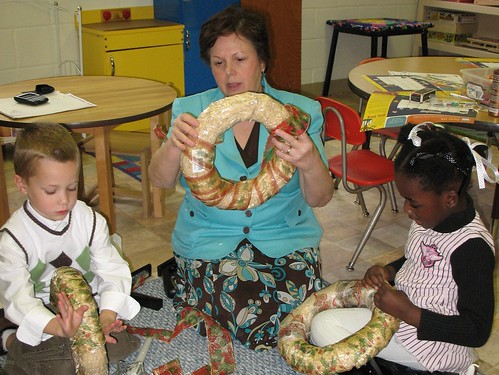
Lynn assisting with wreath_0765c
by Hoyasmeg on Flickr

Never alone.
Now, I come into school dead dog tired and I have to make the Herculean effort to get my attitude up, my chins (yes I said chins ;-) up, and my heart up to give 100% to these kids. Honestly, sometimes I wish I could just put on a movie and some teachers do that. But I have things to do and so do these kids. Some say "you do it to yourself" but really, I have to live this philosophy of teaching and be it or I'm just a fake. We do projects and work together doing things that have meaning.

Today is my tough day. I basically have 7 straight periods with my room full of kids - 5 classes and a study hall but during the study hall I also have a class of current event kids to help with a simulation/ game. Last period every kid in high school has study hall so my room will be packed with "Miss Vicki" dropping from their lips like tobacco juice from major leager's mustache.

I won't be a major leager - I'll be major beleagered. But then I have to grade. I stayed yesterday till 5:15 pm grading and just can't seem to get caught up. I like to comment on their blog posts (every one of them) and write notes.I want to give them the chance to do corrections, otherwise, the grade I give is a wasted opportunity to LEARN.

So, here's to you teachers.

You are FAN-tastic and I'm your fan.

I love the old spiritual

"Nobody knows the trouble I've seen
nobody knows my sorrow." 

(great rendition here by the late great Louis Armstrong - good for a listen today)

Somebody knows the trouble I've seen
But you know what, in our case, somebody DOES know the trouble we've seen.
Other teachers, we get it. Sure, every circumstance is different and nobody's trouble is quite the same trouble. But teachers are your best audience. They understand. Lean on them.

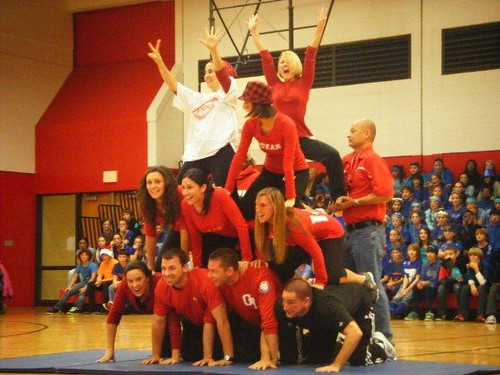
TEACHER PYRAMID
Teacher Pyramid by Photographic memories, July 2011


You don't have to be alone all the time. I do think it is wise to steer clear of office gossips especially during the holidays.

You have enough of your own worries, you don't need to have worries of others on your back.


Gossipers are people who don't have enough life of their own so they decide to mess in the lives of others. No time for that, "mess."

But somebody does know.

Make Your Holiday a Jolly-day
So teacher, I'm asking you to give yourself the gift of a good attitude this season. That is the gift that truly keeps on giving because it multiplies back to you. When you give the gift of a good attitude to your classroom, they give it right back. Sure, you've got a lot of work to do but you can do it in a pleasant way.

To some of you, the thought of being jolly in this season stinks. You miss family members or what used to be and you're not happy about going through another holiday alone. You are literally hurting. I'm sorry.

Realize that you may be jolly but that others may be hurting. But the best way, I've found to lift my own spirits is to do something for others. Reach out to another person. Sign up to help at a food kitchen at Christmas. Sign up to DO SOMETHING for another person. There are tons of places on Christmas Day or Thanksgiving Day that NEED YOU.

I have a sign I inherited from my Mom that says "no whining." I have to admit, I have a problem with that sometimes. Especially as tired as I am right this moment at 6:51am getting ready to sprint off to school for a parent teacher conference.


3 Gifts to Give Your Heart This Season
1 - I'm going to decide that I'm going to give myself the gift of a good attitude.
2 - I'm going to avoid office gossips and getting into any gossip myself this season.
3 - I'm going to intentionally reach out and do things for other people this season.

As we say in South Georgia "bless your heart." And remember that a sure fire way to bless your own heart is to bless others.

  • Digg
  • Del.icio.us
  • StumbleUpon
  • Reddit
  • RSS

Higher Order Thinking and Discipline: Two things Education needs NOW!

Seth Godin, author, change maker
Seth Godin is not God. I don't think he pretends to be but sometimes I think those that read his work don't realize who he is. He is a natural born gift writer / rebel who has made his own rules and had is own career. He is one of a kind. That is great. We need more Seth Godins.

In a recent post, Seth makes a great point that we are going Back to (the wrong) school and that we are educating kids for 1925.

Agreed. Totally.

I agree with this statement.

If you do a job where someone tells you exactly what to do, they will find someone cheaper than you to do it. And yet our schools are churning out kids who are stuck looking for jobs where the boss tells them exactly what to do.

But there is also some sort of insinuation I read into the post that the problem is having teachers/ educators in authority.

Let's make a line here that needs to be very clear:


We need to be promoting higher order thinking.

Memorizing is at the bottom. We aren't teaching problem solving. We're not teaching anything of lasting substance when we continue to see if kids can memorize. We just aren't.

Seth is on the money when he says that the testing environment has put us on the race to the bottom. I'm glad he's saying it.

Kids need to be problem solvers. They don't need to be told what to do at every moment. They need to know how to figure things out. This is exactly why I don't teach point and click software and handle it more holistically. We've already used more than 30 software programs to solve problems in my Computer Applications class as we customize the experience to the individual and the things we are trying to create.

We also need to have a respect for authority in place so we can have safe places to learn.

The one insinuation that I see in this discussion all over the place is the idea we should disregard authority. There is a big difference between questioning what a person in authority says and the fact that a person in authority has authority.

The lack of discipline in schools is one reason that many of my teacher friends are quitting. I know of one local school that talked to teachers about putting bullet proof glass in every classroom to protect the teachers. How about protecting the students? If teachers are afraid, how about the poor scrawny kid who won't go to the bathroom all day because he's afraid of bullying?

As a society, we don't trust people in authority. We don't trust organizations in authority. We've had a complete erosion of the belief in authority.
Never mistake a teacher in authority for a dictatorship.

Right now many of those in authority in education have led us down the wrong path as a country. So, it is understandable. But let's turn our eyes to the kids for a moment.

The danger of Selective Authority
Many parents have advocated a principle of "selective authority." Selective authority looks like this

"I'm going to learn from you because you can give me something" or
"I'm not going to learn from you because I don't like you." 

What results is punk football players who are very coachable but have no integrity and keep getting in trouble with the law. This problem is everywhere.

This type of philosophy means if a kid can convince Mom and Dad that "my Lit teacher doesn't like me" and the kid knows that suddenly anything I do to that lit teacher is excused and encouraged.

WRONG.

The "rights" of a few who don't deserve it

Rafe Esquith in his book,Teach Like Your Hair's on Fire: The Methods and Madness Inside Room 56,  talks about an incident where a group of fifth graders were interrupting their fifth grade graduation with profanity and trash talk. Rafe removed them from the proceedings and was promptly told by the principal that everyone "has a right to graduate" and that the could do nothing about it.

No! Those kids should get a diploma but they should not have the right to completely ruin the graduation for the other students.

Schools and principals who tolerate such misbehavior look impotent, incompetent, and totally backwards!

Do we encourage disrespect?
PROBLEM. The problem in many schools is that it is impossible to even teach lower order industrial age thinking because our society has so worshipped the young that we are encouraging a total disrespect for authority.


We all have bosses. We all have laws to follow. Lots of times we don't like the boss or the laws but we have to follow them anyway. We need to follow people we don't like sometimes so we can be successful in life. We can respect their authority even if we don't care for them as a person.

We can also be a renegade with cool ideas in the classroom and beyond if we have empowering teachers to bring that out of us. I can be empowering and still have my classroom management act together.


Show up and Keep your Promises
A young man at Walgreen's yesterday was talking to me. He was missing the first half of his family reunion because the manager could not get anyone to work for him. He was at work anyway. I was very impressed and told him so. He said,

'My Momma raised me right. I need to show up where they are counting on me and keep my promises."

Respect for authority does not mean subservience, slavery, or even the worst case, abuse. It means that we have guidelines. It means we treat each other with respect and have character.
Scott Filmer's Photography Journal

We need yellow lines.
We have guidelines like the yellow line in the middle of the road.

Thank goodness for the yellow line in the middle of the road. It is that guideline that keeps us all safe. We need them in school too!

No Discipline Problems
I've had a few discipline problems in my career but not many. Typically, I have to fill out a discipline form once or twice a year. That is because my principal is exceptional at handling discipline. He is consistent (writing up his own son for not having a hair cut) and treats everyone fairly.

I am free to teach. There were times, I admit, under another principal that it wasn't so pleasant. When  discipline is maintained we have freedom to learn.

Appealing versus Arguing
Authority does not mean that a person is always right. The first day of class I always say something completely, totally WRONG. Something everyone knows is wrong. The kids now know my reputation and so they get it more often than not, but I always say.

"This is my classroom and we will work together to learn, but that does not mean that I know everything. I'm wrong quite a bit. You've just let me say something you know is wrong. Why did no one stand up to me? What is the right way to disagree when a person in authority says something is wrong?" (We discuss.) Then I end with, "This is OUR classroom. We learn from each other. If you disagree with me, I respect you if you disagree respectfully in a way that helps me and the others learn and I will treat you the same way. It is ok to make mistakes and sometimes I will say things to make you think that I may or may not agree with. I want your brains and your thoughts not just your blind acceptance of what I say. But you can know that if I do say something wrong like I just did that I will always correct myself in that same class period - you can trust what I say, but I needed to prove a point to you today. Say what you think not what you think I want you to say."

Note that I don't make this a habit to do this very much because I want students to trust what I say. If I say something wrong, I always admit it pretty quickly so they know that I knew it was wrong. I don't think it is a good practice to just "lie" all the time to confuse kids. But to do it once to make a point and to say I intentionally did it is OK.

There is a difference. In this case, I've preserved my authority. My "yellow line in the middle of the road" type authority while also making my classroom a safe place for open dialog, discussion, and learning by everyone.

Our Current Students aren't ready for 1925 work in some cases
A close family member employs some of those "1925 labor workers" as he works in a factory. The problem is that many of the workers he gets aren't even fit for that. They don't know how to show up on time and only 20% of them know fractions. (They ask where the bubbles are for the answers and are told that in the real world you don't have 4 answers for every question.)

Right now, the current public education system, at least down here in South Georgia doesn't really even produce good factory workers. Yes, it is broken, yes we need to fix it.

We need people who can keep their promises. Who can be productive. Who aren't just robots who test well.  We also need students who know basic math and fractions in the real world where there are no bubbles.

We need to improve and change how we are teaching but we also need to restore the guidelines and accountability that keep us safe. According to Maslow's heirarchy of needs - if a student is hungry and feels unsafe they aren't going to learn. Yes, we need to improve our teaching but to have good teaching we also need good discipline.

The danger of the rebellion against "industrial age do what you are told" education is that some people ARE not going to realize that the scripted, step by step teaching, worksheet mentality, and memorization mantras are the problem and in fact will think it is having discipline, order, and guidelines that are the problem.

Seth Godin on Education
So, as smart as Seth Godin is, take his posts on education for what they are. Very well written big-picture critiques of the big-picture problems in education and not a prescription for how to fix education. Honestly, I'm not even sure that some of our current education "leaders" are prepared to fix those problems as they have a self-interest in preserving the current systems that have gotten us where we are.

Whatever the solution - restoring order and discipline and SAFETY is an important part of improving any school. It is called "learning environment" and it is a top indicator of a successful school.

In Conclusion
Let's promote higher order thinking but to get there we do need consistent discipline and respect for authority back in our schools.

Remember your noble calling, teacher. Remember that those who critique a system are critiquing a system.

There are many amazing teachers out there and most likely you are one of them. No one can take away your nobility but when you act beneath yourself, you alone can give away that nobility. Let's teach anyway as best we can until people realize that the Freedom to Teach is one of the best things they could give teachers.

____
Unless noted otherwise, photos are from iStock Photo.

  • Digg
  • Del.icio.us
  • StumbleUpon
  • Reddit
  • RSS