RSS
Menampilkan postingan yang diurutkan menurut relevansi untuk kueri world is flat. Urutkan menurut tanggal Tampilkan semua postingan

Tears on the Keyboard

Photo by rent-a-moose on Flickr
This global collaboration thing isn't easy. This morning there are tears on my keyboard. Tears of heartache for a teacher who is giving everything she has to help her tiny town see the world and help students break out into a globally competitive marketplace.

Yet she has been shut down because:

"No one else is doing this in our state, so why should we?"

Here are some words I wrote her just now:

I'm heartbroken with  you and for you, my friend. What else can I say but push through - this too shall pass. You're leaving a legacy. We can look back and know that Thomas Edison invented the light bulb but as he failed 99 times you know he had to cry on his soldering. He had to. He had to wonder if it would ever work just right - it worked and he illuminated the world.

When we get this right - it too shall illuminate our world in powerful ways. We cannot stop but have to improve.
Earth Island Rising
This is the struggle of moving into this arena. The struggle of connecting. So many people see the islands but don't see that these islands are connected by the cabling running under a sea of change. The seafloor is rising and we are becoming one big blue and white swirly island of interconnected people: Earth Island.

But this is PART of being an innovator and it is not easy. We had a parent one time accuse us of being terrorists because students collaborate with countries in the Middle East. We've been accused of being everything.

Everything that a local community hates about that faceless enemy "out there" that is another race, another culture, another country over there somewhere else that somehow is wanting to come through the computer to take things away from those living in isolation and denial that the world is connecting and that those who understand how to connect have the advantage.


Success is a Connection
Success is no longer a location but rather, success is a connection. Being connected can overcome barriers that miles cannot block. Not location, location, location. Connection. Connection. Connection.

If you innovate you know what I'm talking about and it is OK. Yes, times are tough. But we don't come out of tough times by "marching in place" -- advance -- advance. When money is scarce the advance no longer comes by spending the extra coins in our pocketbook but through the sweat and tears that provide the fuel. Honestly, sometimes blood and sweat is a more turbo-charged fuel than money: both together can be powerful but also quite rare.

What Do you Teach Your Children?
Do I ever wonder if it is worth it? Do kids understand it? Do parents appreciate it? Of course.

But I teach my own children this year - one is in my grade 9 and the other in grade 10 and I'm teaching like a madwoman because my time is short and my own children HAVE to know this.

Here's the litmus test. If your own child was in the class you are teaching what would you be doing? Well, my children are in my classes and I'm doing Flat Classroom, Digiteen, NetGenEd, and every technology I can get my hands on.

Tears may be on my keyboard but fire is in my heart to do right by my own children... and yours.

So, back to writing this Flat Classroom book even though I am deflated and my heart hurts right now for my friend. My heart hurts because she is wounded and so am I. Yet, this is part of being a leader and doing the right thing. Company is lonely on the bleeding edge but it is so funny how many people want to claim you without paying the price or really knowing what it is like.

Get up and get moving!
Friends, if you're one of us crying on the keyboard-- wipe your tears. Stop it right now. Get up and get to work. We've got work to do.

Who do we think we are that the tough things in this world would all of a sudden become easy?

Do we think we have some right to be coddled or have an easy life here?

We need to get over ourselves and know that hard work is hard work.

Positive change requires positive effort and constant reinvention. It also requires knowing that we will be criticized, misunderstood and that by putting ourselves out there that we can become the topic of debate as our field moves towards better best practice. There will be those who will try to jump in at the end and "steal the formula." Who cares.

This will be a life journey well traveled if we travel it with people who work hard at work worth doing. This, my friends is work worth doing.

Remember your noble calling, teachers. May tears never extinguish the spark in our hearts to make this world a better place one student at a time.

dedicated to my friend, Suzie Nestico - you are my hero. Keep the faith and keep going. I'll see you when I keynote at PETE&C in a few weeks.
Enhanced by Zemanta

  • Digg
  • Del.icio.us
  • StumbleUpon
  • Reddit
  • RSS

Dreams When We're Awake

This excerpt from our January 2012 Flat Classroom Book was written on a plane returning from Qatar and the first Flat Classroom conference. January 2009. I'm printing the full text here as editing is forcing me to cut it down for the final book! There are a few times in my life, I tell my husband, that I feel like I've put my "gutts on a page." This vision from this plane ride has in it a lot of what I do. Oh that you could see this too!

I am nestled amidst the quiescent heaps of jetlagged tourists, businessmen, families, and a mom with one colicky golden haired baby while contentedly listening to Van Morrison about 20,000 feet above the border between Iran and Iraq pondering the meaning of life. 
The lady two seats up is watching Eagle Eye (a movie) with Arabic subtitles. The man beside me left his seat a while back to remove his Arabic garb and put on a pair of comfortable black flannel sleeping pants. Katie, my exhausted student from south Georgia USA snuggles against a window that, if open, would show her Eastern Europe approaching at a pace of 500 miles an hour.

And that is really how I feel at this moment, with the rush of oncoming air; a vision is coming upon me for what this flat world truly means.
In my whole life, I have never seen what I saw this weekend. I daresay any peacekeeper on earth would sob at the sight of students from the US, Qatar, Syria, Ethiopia, Pakistan, Oman, Iraq,  India, Australia and so many other places laughing contentedly together in the midst of Qatar’s famous market, the Souk. 

Flat Classroom Conference - Qatar 2009
Lounging in chairs at Haagen Daaz, the students laughed, told jokes, switched intermittently into various greetings in different languages, and pronounced each other’s names like native speakers.
“John! Yaksan! Katie! Ahkmed! Tayler! Latecia! Steve! Muhammad! Violet! Sonwalbie!” 

Are these students the cosmopolitan types who travel the world and already know lots of people? Well, not necessarily. Among the students are mine from rural South Georgia, students from rural Australia, inner city Houston, the deserts of Oman, inner Ethiopia, Pakistan, and some who’ve traveled the world. More eclectic than the music on my iPod, representing not one curriculum or type of school – US public and private, IB, British Curriculum – these students were as diverse a group of kids I’ve ever seen together in my life.  

The sight of such a group, many in the native garb of their country – colorful hats, shoes, and western jeans – made many stop and stare.  Who are these people?  Who are these kids?  What has happened that such a site should occur out in the open in plain sight in a Middle Eastern market? Is it a dream?

Some women strolled by in black, not visible except for their eyes wide in interest and wonder. Children with gold-flecked eyes pointed. Our students continued to laugh and have fun, oblivious of the spectacle they were making.  

I haven’t blogged what I’ve seen as of yet, because somehow I thought I’d feel a stewardess tug on my sleeve and tell me it was time to deplane in Qatar. Surely, I wasn’t awake. I still do not know what has happened. We will not know until we see reflections on the Ning and watch these kids grow up.

All I know is what I saw.

The flattening of the world means that we can build bridges for the children of tomorrow to walk across.

We wouldn’t be here if it weren’t for one blog post and one comment.

After students wrote reflections on Thomas Friedman’s chapter on finding your passion from his book The World is Flat, Julie Lindsay in Bangladesh read my blog post summarizing their work, and sent me comment. And then, the world started flying at me at over 500 miles per hour. That was almost three years ago and now; I sit on a plane at 20,000 feet contemplating students from around the world laughing in a Middle Eastern Market, wiping off the tears that have fallen upon my gold wedding band.

Stereotype bashing.

That was what one group of students said that we were doing at the conference. They had been assigned to teams purposefully as they entered a project based conference experience – not allowed to be on the same team with a member of their school. The students envisioned the future of education with proposals that would harness social media for learning and for improvement of global social issues.

Without that first email, first blog post, first Flat Classroom project, Thomas Friedman finding Julie’s blog and our project through some random search on the Internet, the many bloggers who’ve linked, talked about it, passed along information on the project, voted for it, and been a part of it -- these students would have never I repeat NEVER have made it to Qatar. I doubt they would have known of its existence!  

We’ve had this dream of a conference for such a long time; a conference as the next step of linking up classrooms from various walks of life and of building relationships to work with one another across the world.  

For, if we are to solve the global issues we have, we are going to have to link up good people working in many places from around the world WHERE THEY ARE. And to do this, we must be together sometimes to cement those relationships – to strengthen those bonds.

Change takes time. It takes baby steps.  

The defining moment for me came last year when my mother was diagnosed with cancer. On several occasions, I had debated NOT going to Qatar. Being from rural Georgia, I had SOOOO many people tell me I was “crazy” and “why couldn’t you just be a normal person and have the conference in Atlanta. Why go to Qatar?”  “ What if you don’t come back?”

Every time I looked at my three kids, despite the assurances of safety in Qatar and the fact that an attack has been quite some time ago, I reconsidered going. When my headmaster, Ross Worsham, looked at me with incredulity when first I took it to him, I reconsidered again.  Thank goodness for my supportive, amazing, husband, Kip: the best friend and closest companion of my life and my innovative, wise headmaster who researched the facts for himself to make the decision for us to go.

Then, in November, I had to tell the Flat Classroom teachers about Mom’s situation, they are my dearest friends! I’ll never forget it, we had about seven of us on the Elluminate weekly teacher’s meeting and we were nearing the end of the meeting. I told them about Mom and put my mike on mute as I choked back the tears.
I don’t know what he wrote in the chat – I’ll have to look at the transcript, but Salim al Busaidi from near the gleaming deserts of Oman wrote me a one sentence message. I wish I could remember what it was. But that one sentence of peace and good wishes, coming from him, a Muslim male in the Middle East, to me, a Christian woman in the US, was so kind and so touching that a light switch flipped in my heart, and I knew that it was going to be OK.  

It was going to be OK because I knew that if there was one person like Salim in the Middle East that there must be more.  

And that, my friends, is how we build bridges. We build them through the little ropes coming out of the back of our computers into the wall that travel under our oceans and through our skies into the little ropes or through the air into the computers of our colleagues across the world.  
Flat Classroom Students from Oman.
We connect, one person at a time to build trust. Now we must now connect classrooms one at a time.
There is no more time for the mindless debates of where a school is going to “put” this in their curriculum. Such virtual and eventually face-to-face connections are one of the most essential ingredients in a successful modern education.

Greta from HSBC bank (a major sponsor of the first conference) and I were talking about the workforce in general and how difficult it is for businesses to have workers who are problem solving, big-picture focused employees who do not have to be supervised. Our schools are producing hordes of students who know how to memorize facts and do what they are told. These students have to be retrained and many cannot be.
We have thoughts, but I’m on a plane at 20,000 feet and now over England. Julie is back in Qatar finishing up her school day and we have a lot to talk about.

But now, I think I will don my sleeping mask, put in my earplugs, and quietly slumber, dreaming of seeing such things as I saw this weekend again one day. And imagine the impact that each of these students will have when they go back home.

Talking to Paul McMahon over dinner, I told him – what I want is to be part of a grassroots movement of teachers to improve education from the bottom up.

To be a part of YOU, the teacher who loves working with students. To help YOU learn something and learn something from YOU in return. To stay in the classroom as long as I can and bask in the enjoyment of doing great work that is worth doing – the noblest of callings. All I really want to be is a teacher and a Mom.
I am so grateful to my God to have the privilege of being a teacher and also part of a movement to improve our world from this generation onwards by using technology not just to spread music and culture but to spread hope, understanding, knowledge, and learning.

You can call me an idealist but, colleagues; I wasn’t an idealist going into the conference. We knew it would either be a disaster or a dream but that if we didn’t take the risk, we’d never know if it could be done.

And now, my friends, as we fly over Stockholm, and we rush on, I shall dream and know that when I am roused from my slumber, that the best dreams are the ones you see when you’re awake

  • Digg
  • Del.icio.us
  • StumbleUpon
  • Reddit
  • RSS

Elearning and global competency #flatclass #globaled 12/29/2011

  • A website that is for teams and is free for up to 30 members in a workspace. We are looking for work flow software for Flat Classroom so this is a neat one to try out. Lifehacker mentioned it as an underhyped app of 2011 because they think it is so great. It is definitely something for those who are interested in global collaboration to test out.

    tags: education flatclass

  • Having an interesting conversation about collaboration versus cooperation. Here, Cynthia Sandler reflects on the difference:

    "before this project I would have said that of course it matters, collaborative being superior to cooperative.  After the project, however, I am wondering how significant the difference really is.  I see that there was more discussion and perhaps critical and creative thinking within the collaborative group.  They probably got a lot out of the process of this project and continued to hone their interpersonal and intrapersonal skills  However, the project assignment was asking for a particular product, not grading the process, so I would say that the groups who divvied up the work did some great critical and creative thinking by deciding that that would be the most effective and efficient way to get the job done.  "

    My own thoughts are:
    "I think this is a great point about cooperative and collaborative. Both can create great outcomes, that is sure. In this case, you're not teaching collaborative skills, so cooperative or collaborative would be fine for either, however, in Flat Classroom we do want the students to specifically know how to collaborate so we do care. Of course, the argument always comes up, "but it looks fine, you shouldn't care if we collaborate." I think the struggle is that school seems to encourage cooperation not collaboration and so they should learn it somewhere. There are certainly struggles with this."

    Please feel free to share your discussions on the original Ning post.

    tags: flatclass globaled education cooperation collaboration

  • A school project about what it means to be a citizen. I'm looking to see if students are actually interacting with other classrooms (which is what needs to happen) but it looks like they are using Schoology so perhaps they are. It is important to not just talk to the world or at the world but to talk WITH the world.

    tags: education flatclass globaled

  • Abby Falik was turned away from the Peace Corps and created a post-high-school program called Global Citizen Year. This next year they will be traveling to Ecuador, Brazil and Senegal where they will teach or translate English, help farmers with internet resources or help local teachers use search engines for lesson planning. The price tag is close to 30K but I think global experiences like this are going to increase for a world that is beginning to value the global competency that comes from travel and participating in global collaborative experiences (like Flat classroom.)

    tags: globaled flatclass education

  • A TED video from a fourth grade teacher who is helping fourth graders understand world peace. Very inspirational.

    tags: flatclass education globaled

Posted from Diigo. The rest of my favorite links are here.

  • Digg
  • Del.icio.us
  • StumbleUpon
  • Reddit
  • RSS

Filtration Fever Hits China (and US)

You can't visit China without seeing the western influence there. Our tour guide had a Justin Bieber haircut that he had proudly made himself. Chinese who cannot speak English can sing in perfect Bieberese "Baby, Baby, Baby..." Ah, Bieber Fever is Everywhere.

 Government Snow
But, the government is everywhere too. In the sky, on the ground, everywhere.

The government made it snow on Saturday of the Flat Classroom conference. Snow?

Flat Classroom Conference 2011 - February Beijing, China

As I met Julie Lindsay the lead organizer for the conference, I commented how odd it was that it snowed that day. She laughed in her lilting sort of way
"Ah, the government made it snow last night, it is no big deal." 
Others from Beijing verified this.
"I can see the snow cannons, they fire them near my house and seed the clouds," said Julie.

Others said that this is a frequent occurence in Colorado and Utah where they need snow. I'm not sure but something in me gets upset at governments controlling the weather.

But it shouldn't be surprising as filters have a whole lot of influence on the weather inside the computer screens. They can cast government snow upon the seeds of discontent and revolution. The can just cast snow upon any and all collaboration by chilling the pipes upon which such collaboration flows.

Yes, China is blocking Google services
I can confirm beyond a shadow of a doubt that China is aggressively blocking Google services. When I arrived in China in February, it was during the time when Middle Eastern unrest was spreading and I could not check my gmail for the first two days even behind my well-selected VPN. Google Docs was unstable as well.

She Who Shall Not Be Named
In fact, we had one young lady named Jasmine and because the government was so heavily filtering the word "Jasmine" (the Jasmine revolution) we renamed her on our wiki and in our projects to keep from losing our wiki. Our behind the scenes joke was that Jasmine was "she who shall not be named" as we did not want to speak the word.

The Company Who Shall not Be Named
Now, my friends in China are quietly moving to yahoo accounts just in case they cannot get back into their gmail. Even with VPN's, Western expatriates are cut off from most Google services: docs, calendars, especially gmail. Unstable and unusable.

Keeping it Flat Anyway
Yes, this has put a hitch in things for Flat Classroom - an organization of global collaboration for students that we have kept decidedly apolitical. We are about teaching. Teaching technology, asychronous collaboration, online leadership skills. We believe that you can't have excellence in education without global collaboration. Period. And yet, when things happen like this it can set us back.

This is nothing new. We will press forward. 

The Great Firewall of China
From what I understand, China has 7 firewall centers as part of their "Great Firewall of China" and these firewalls have been locked down tighter and tighter over the past few months.

Filtration Fever
in China
Despite the influence of entertainment, right now, not only can my Chinese friends not read this blog but now, they cannot read my email.

David Truss, Pair a Dimes Blog
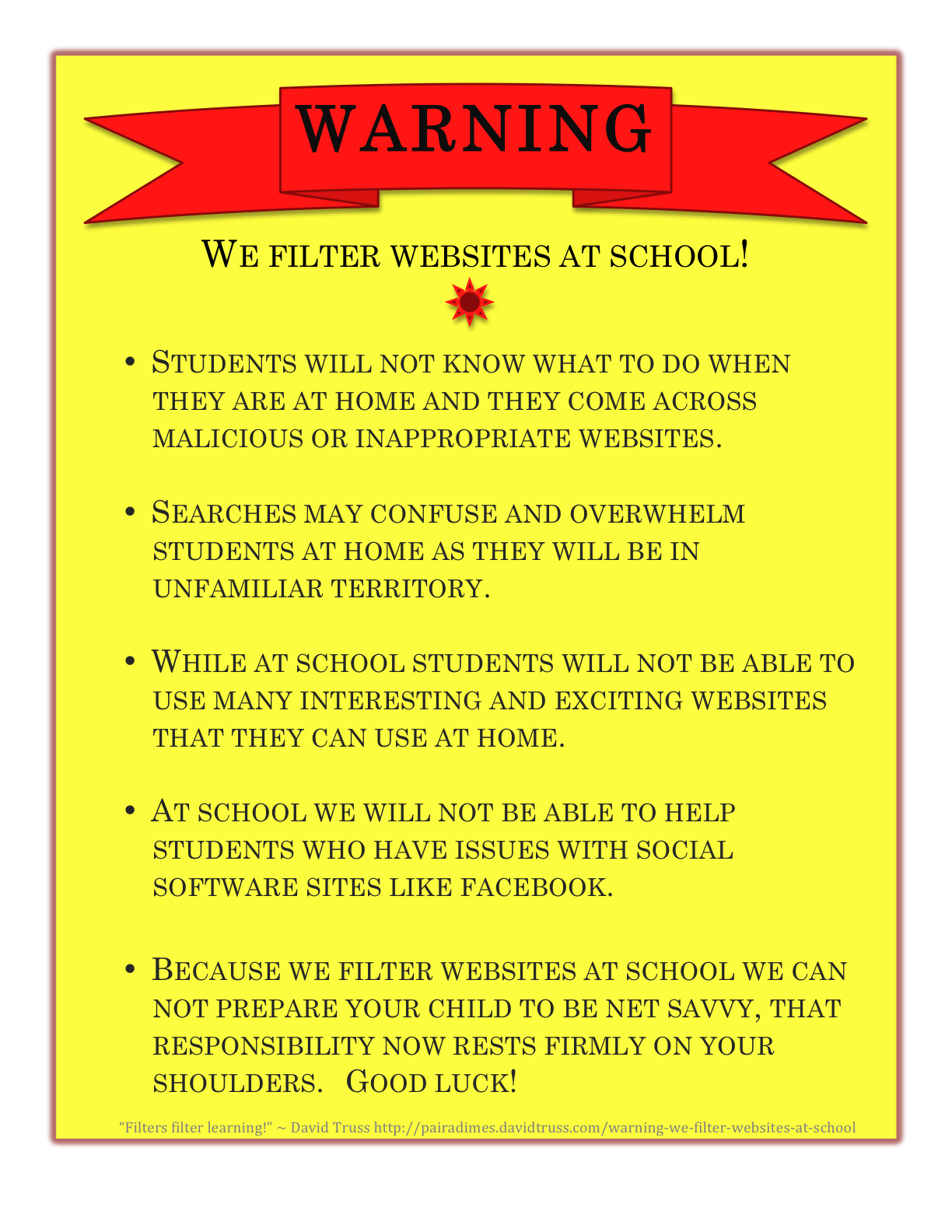
But to segue, here are some words from my friend David Truss in China along with a picture he suggests people in schools with Filter Fever hang in their foyer:

"The Students Live website provides a number of different ways to connect and interact with the Olympic reporter student bloggers. However, we live in China which filters a lot of social software websites and so these were the options that my Grade 9 teacher was confronted with:
Facebook: BLOCKED

Twitter: BLOCKED
YouTube: BLOCKED

Blogspot Blogs: BLOCKED

Flickr: (recently) BLOCKED (again)

I had to use my VPN to bypass the Chinese filter in order to cut and paste the blog post, mentioned above, into an email so that my teacher could read it in his class. A potential global ‘conversation’ reduced to a reading, confined to a classroom. Frustrating!

Now here is the thing… I chose to move to a country where a lot of sites get blocked. I can’t imagine what it’s like for teachers in the ‘free world’ that have their own school districts do this to them!"

in the US
We in the US cannot look down our trusty 1Gbps Internet connections at our Chinese friends.

I can tell you from experience, the two toughest places to collaborate IN THE WORLD are: any school in China and US public schools.

Thank God for the progressive US schools, public and private, who collaborate anyway and that we have many of them in our projects. These schools are usually characterized by extraordinary leadership who understand  that:

YOU CANNOT HAVE EXCELLENCE IN EDUCATION WITHOUT GLOBAL COLLABORATION.

What do schools block?
Like China, most US public schools won't allow unblocking of even one Ning - even educational ones like Digiteen, Flat Classroom, or NetGen. They put our emails from us to the teachers into their blacklist filters and teachers can't even get started. Joining a Google Group or Google calendar at school is out of the question.

They won't allow kids to wiki because "people write porn on wikis." (Yes, I had a school that said that.) Sad.

Some teachers have to create non-school emails and accounts and do work from home to make global collaboration happen in the classroom. Their filters are that locked down and no method exists for unblocking anything.

I think that we have to look at our practices and our filtering here in the US very closely.

Filter fever is a symptom of fear. We all see clearly what China is afraid of.

But what on earth are US public schools afraid of?
  • Are we afraid that our kids might learn to work with someone from another country? That is a business requirement. 
  • Are we afraid that we might have to shuffle our work day to work with someone from another time zone? We are surrounded by oceans that soak up the time zones and need to work through this.
  • Are we afraid of a future where we can no longer keep prosperity on our shores by the boundary of our country? We already live in a world where money flows through the Internet and can shift the GDP of whole countries in a day due to websites hosted in country.
Personally, I'm afraid of a future built upon a generation that has been cut off from one another. Students are the greatest textbook ever written for each other. Open the book. Make it happen.

Every Student Collaborates
Filter out the smut but please, we should be able to allow meaningful global collaboration with students all over the world for EVERY US public school system. It can be done inexpensively or for free - the only cost is to move outside our comfort zone.

We work so hard measuring if each individual child is learning that we forget to see if they can work together at all.

In this day of budget cuts, this is something we can do to invest in our future that won't cost a lot of money and will pay huge dividends in future generations. Most students are woefully unprepared for this. Don't say "they are already connected now on Facebook." It simply isn't applicable to the professional environment where they are headed.

Collaborate or be unemployed.

We Love Our Walled Window boxes?
I love my country (the US) and it disheartens me to know that our very future lies in collaborating with countries like India and China and all of the world and we continue to "wall our gardens."

The problem is that I'd hardly call the technology ecosystems at most schools a garden - they are probably more like a windowbox if anything. Some would even say windowdressing as their internal networks languish unused with kids forgetting passwords and not logging in for months.

Let me repeat the motto of our Flat Classroom Conference: there is no excellence in education without global collaboration.

The question is NOT: "What are we keeping out?"  The question should be "What are we letting in?"

Remember your noble calling teachers, administrators, ed tech leaders. Few such callings are as noble as this: to promote students working together in the K12 level so when they grow up we have a world that can work together. Promoting collaboration and collaboration from the bottom up.
Enhanced by Zemanta

  • Digg
  • Del.icio.us
  • StumbleUpon
  • Reddit
  • RSS

10+ ways to engage with the Flat Classroom pedagogy and people

 Excellence in education includes global collaboration. No doubt about it, students are the greatest textbooks written for each other. 


This fall is the 5 year anniversary of our Flat Classroom projects. Amazingly, in that time, more students and educators have collaborated together through this program than live in my tiny hometown of Camilla, Georgia! 


Global collaboration is never about one person or one organization but has become a movement in many places and through many websites. It is our goal with the Flat Classroom projects to be the best and helping students and educators understand the power of true asynchronous collaboration with as much synchronous as we can get in. The concept of merging classrooms in excellence, collaborative learning experiences is our aim and we believe most of our classrooms are achieving that.


So, you are excited about the possibilities and want to join in? Here are some ways. 


Teachers in the classroom:
See application information in press release by scrolling down.

  • High School - Flat Classroom project and/or NetGen Ed to teach your students about the emerging trends in technology with experiential knowledge as well as authentic research and video creation. Read more.
  • Middle/ early high school - Digiteen project for experiential digital citizenship research (run through our nonprofit) Read more.
  • Elementary - A week in the life elementary project. Read more.
  • Flat Classroom Certified Teacher Program. We will run 3 of these in the 2011-2012 school year using our new book, Flattening Classrooms, Expanding Minds. Designed as a rigorous challenge, based process, you will emerge with a project designed with a group of your classmates.  Read more.
  • Submit your collaborative writing story. If you are using collaborative writing in the classroom, share your story. My second book is on collaborative writing and it will be published with Eye on Education. We've set up a website so you can share your story for review to include in the book. Anything I write will never just be my story but yours too! Please share!
 Anyone
  • International book club starting February 1st using our new book on the pedagogy of global collaboration in the classroom. Ben and Neil at @engaginged are going to help us run this book club. Sign up now.
  • Run a book club with your own group and let us know so we can plan to interact with you, if possible.
  • Flat Classroom mini-conference at ASB Unplugged in Mumbai, India in February 2012. Bring students or join us for the workshop. Julie, Vicki, and Kim Cofino will be leading workshops for students and teachers at this event.
  • Sign up to review our book. While we only have a few copies available, we are taking applications for: a) bloggers/ influencers who would like an advance copy of the book to review and b) people who make purchasing decisions and would like an advance copy for potential integration into courses or pd. 
  • Support us. We have a non-profit that runs our Digiteen project and provides scholarships to students to our Flat Classroom workshops. Feel free to support our organization if it fits with your personal mission.
  • Read the book. Sign up to get a notice when the book comes out. If you just want to know when the book hits the shelves, mailboxes, and ebook readers, you can fill out the form on our book homepage to have this come to you.
  • Read stories of global collaboration. Our Flat Classroom certified teachers and project organizers have a lively tumblr blog sharing stories and things to do with global collaboration. You'll want to follow it. http://flatclassroom.tumblr.com/
  • Join the conversations. We have a Facebook page for announcements and an intimate Facebook group where we plan and talk. Our Flatclassrooms Ning is also a core component of our certified teacher program and the online sharing hub for our new book. Our #flatclass hashtag is also a place where we will share conversation about the pedagogy of global collaboration in the classroom and content around the book. We are also on Twitter at @flatclassroom @digiteen @netgened

<hr>
Current Press Releases for our Projects
Flat Classroom Project Applications Now Open
Applications are invited now for a selection of internationally recognised and award winning global projects run by Flat Classroom® to start in September 2011. Co-founders Vicki Davis and Julie Lindsay are excited to be offering these opportunities for classrooms globally to connect, co-create and learn together in a carefully designed and supported digital environment.

The Digiteen™ Project explores digital citizenship through interaction and provides an opportunity for students to not only talk about digital citizenship, but experience via online connection, collaboration, shared research and presentation. It also has an action project component where a classroom designs an action to be carried out in their own school community and then shared back to the global partnership.

The Flat Classroom® Project is designed to develop cultural understanding, skills with Web 2.0 and other software, experience in global collaboration and online learning, awareness of what it means to live and work in a flat world, while researching and discussing the ideas developed in Friedman's book.

The ‘A Week in the Life...’ Project aims to join Elementary School classrooms globally with a view to exploring what life is like in each area/country through discussion, sharing and collecting multimedia to create final products together. The curriculum focus is Interdisciplinary, how we live, how we communicate, cultural understanding and awareness.

Entry to a each project is via application and subscription. In order to help meet the subscription price, teachers can apply for a limited number of sweat equity positions as ‘lead teachers’.

All details for each of these outstanding projects can be found linked from the Flat Classroom® website. We welcome inquiries to fcp@flatclassroom.org


<hr>
Flat Classroom Certified Teacher
read the Full details at http://tinyurl.com/flatclassteachercert

Aims of the course 
The Flat Classroom® Certified Teacher course aims to train educators to be able to manage a global collaborative project built upon best practices of student collaboration and co-creation as modeled in the Flat Classroom projects including: Flat Classroom, Eracism, NetGenEd, Digiteen™, and ‘ A Week in the Life...’ projects. It also aims to provide an opportunity for those interested in managing a Flat Classroom Project in the future as part of the lead teacher program beginning in March 2011 to develop skills and experience with all facets of the project.
 
Certified Flat Classroom® teachers will become leaders in global collaboration within their schools and internationally and will be sought as partners by those planning global collaboration because of their proven competencies in the technology, technopersonal skills, and best practices of effective global collaborative projects. Those who earn this designation will have proven their competency through this rigorous course.

Structure
The course will run for approximately three months. Participants will be involved with one or more of the Flat Classroom projects and also complete the “Flat Classroom Fifteen” challenges as will be in the upcoming book (January 2012 launch, Pearson Education) on global collaboration from Julie Lindsay and Vicki Davis, ‘Flattening Classrooms, Engaging Minds’. Participants will have exclusive access to private content from the authors and co-creators of the project as part of this program.

FC Certified Teacher 11-2, the following timeline is applicable:
  • Application Deadline: September 15
  • Online Teacher Information meeting before September 15
  • There are Twelve Weeks to this course, September 19-December 9
  • There are NINE Modules to complete
  • Each module has Flat Classroom® Challenges and Personal Journal work to complete
  • There will be an online meeting for each module held in Elluminate
  • Participants will get time beyond the 12 weeks to complete all process journal and unit work
  • Graduation: January 2012
In addition:
  • FCCT 11-3 November 2011 - March 2012
  • FCCT 12-1 March - June 2012
Application Process
Educators and education leaders are invited to apply for a course according to the deadlines and starting dates as listed above.

Application Form: http://tinyurl.com/flatclassteachercertapply

Inquiries: fcp@flatclassroom.org
Related Blog Posts

  • Digg
  • Del.icio.us
  • StumbleUpon
  • Reddit
  • RSS

Be an Expert Advisor or Judge for Flat Classroom or Net Gen! Sign up Now!

Embedding professional development can be as easy as volunteering to judge or serve as an expert advisor for one of our Flat Classroom projects. We mentor you, share rubrics, and bring you into the project as one who can observe closely what is happening.

Being a judge and/or an advisor on a Flat Classroom project is excellent PD and also helps you understand the project better, leading in many cases to teachers putting students into the project the following year.  We also encourage teacher-educators to build this into their course and encourage pre-service or in-service teachers to participate.

Flat Classroom projects have students studying the trends in Thomas Friedman's book, the World is Flat - updating his information and mashing it up with current research to produce a wiki chock-full of information and learning experiences. Then, they create final videos on their topic and outsource part of their video to their partners. Expert advisors mentor students on the wiki-creation process. Judges review and judge the video portion of the project.

The NetGenEd project is run once a year and mashes up the Horizon Report and Don Tapscott's NetGen Norms from his book Grown Up Digital producing a powerful, authentic research wiki on today's hottest trends as they relate to this generation and written by this generation. This is an intense project and one that always teaches us a lot!


We have THREE amazing projects happening right now:

We need Judges and Expert Advisors to sign up NOW. All information is on the sign-up form, leading to wiki links.
http://tinyurl.com/flatjudge2011


We look forward to hearing from you via the online form, and will be in touch again very soon.
Enhanced by Zemanta

  • Digg
  • Del.icio.us
  • StumbleUpon
  • Reddit
  • RSS

Wiki Wiki Teaching: The Art of Using Wiki Pages to Teach (Remix)

In this four part series, I cover tagging, review building a PLN with an iGoogle page, notes on wiki editing, and end up with Leadership notes. This is taken from a blog post for my ninth graders. This is an update to my first blog post: Wiki Wiki Teaching: The Art of Using Wiki Pages to Teach but truly represents most of my current thinking on wikis.

How to Information:

Wiki Editing
We met with the [Digiteen] teachers this week and this is where many students stare numbly at the screen and don't know what to do. You are doing "authentic" research - this means that you can't really go on some web page and copy information and have it be accurate. You can't google "individual awareness" and find what you need. Don't try - you are wasting your time. Here are guidelines for how you should spend your class time. I use this when I'm working on projects.

1) First 5 minutes of class - Read and Respond.

  • Review your PLN to respond to discussions on the wiki and questions or MEANINGFUL wall posts on the Ning. You could use the chat to see if someone is online from your group but DON'T leave the chat up unless you want to ask me questions in there. It can distract you and you have work to do. Multitasking is a myth - you will pay attention to one thing and not another.
  • Answer people every day on the wiki discussion tab!
    This brings another point - when you see someone leave a message on the wiki ANSWER THEM. One of the best gifts you can give a group is to let others know that someone is out there! We are communicating ASYNCHRONOUSLY which means NOT at the same time. This is a challenging form of communications. The leaders online are those who engage and communicate. Sure, a person will see that 15 or 20 people have READ their discussion but when no one responds, it doesn't feel real - in fact, it is worse, they will think

    "OK, so I left a message and NO ONE IS ANSWERING - either I'm not important or they don't care."

    Every day I should see you commenting and leaving messages on the discussion tab of the wiki. EVERY day that you edit. This is part of being a good digital citizen - to communicate with online teams. Engage with them. You will see that a multiplier effect kicks in - the more you communicate, the more others communicate and then you end up with an engaged, fun group to be in. This doesn't happen if everyone waits for everyone else to do something. This is called the bystander effect - the more people watching something happen - the less likely each individual is to step in and do something about it. Speak up. Engage. Connect!

    Why do we care about working with people around the world?
    Right now you are working on a digital citizenship document that people around the world will read. Tomorrow you may be a scientist editing the Encyclopedia of Life or working on the cure for cancer or writing a collaborative business plan with your partner who lives in a time zone 12 hours away! This is important for your future and the future of our world - we HAVE to be able to work with people in different time zones.
  • Review the current Research and news and see if you should add it to your wiki.
2) Time in Between. Read and Write
Here are some tips.
  • Look at your wiki and read your topic.
    • Errors. Are there any obvious grammatical, punctuation, or glaring errors? (Fix it.)
    • Repetition. Is anything repeated unnecessarily. (Consolidate it.)
    • Missing Links. Do you see any places that really need links? (Add them. See tips on hyperlinks below.)
    • Copyright issues. Does anything look plaigarized or need re-wording? (Edit it.)

      Take Ownership. This is OUR wiki page not yours, not theirs, not any one persons but it belongs to the group - work as a team and reach out. If you change a lot of things, leave a message. If you see it, it is your responsibility to edit it!

  • Look for content that needs to be added.
    • Missing? From your research or common knowledge is there anything left out of this section? (Add it.)
    • Confusing? Does this information make sense to the average person who knows very little about technology? If it confuses you it will confuse others. (Clarify it.)
    • Proper Place? Read the other sections of this wiki page. Does this section add to that information? Is anything repeated too much? (Put it in the right place- you can edit multiple sections - this whole wiki page belongs to all of you.)
    • Summarized at Top? Does the summary at the top of the page reflect what you've put in your section? (Add it.)
    • Included in the Guidelines? Do the digital citizenship rules reflect what you've put in your section?) (Add to them.) Are the recommendations accurate? (Work on them and discuss them if they are controversial.)

  • Look for contextual hyperlinks to be added.
    • In Context. Hyperlinks should be CONTEXTUAL or part of the paragraph in context. (You shouldn't put the full URL unless it is in a citation it should be PART of the paragraph.)
    • Emphasize Important Words. Is the word essential to your topic? (Hyperlink it the FIRST time it occurs to a page that gives a good definition and is a good SOURCE of information.)
    • Eliminate Distracting Hyperlinks. If the word is emphasized will it distract from the purpose of the page? (i.e. if a page is on digital netiquette I'm not going to link to a country's name about that country - it is not related to the page at hand unless it is a research study about netiquette related to that country.)
    • Proper Nouns. Is the word the first occurrence of a proper noun that is central to the discussion in this section? (link it - this includes software, websites, and people, etc.)
    • Watch for Dead Text. Teachers look for "dead text" as you should on Wikipedia. this is text w/ no citations. (We say "dead text is a dead giveaway" that students haven't researched and cited sources. Teachers and researchers will look to make sure that a paragraph is cited and true or if someone just made it up.)
    • Concisely used. Less is more online. Never say "To find out more click here.
    • Links to a good source. Make sure the source you are linking to is a good source of information and not just the first link you come to.

  • Look to see how you should cite sources.
    • Contextual hyperlink - Linking happens to clarify a topic as above and should be done to cite your source.
    • Citation - In addition to linking a CITED source - if you quote something directly you must also CITE your source with a formal citation. This INCLUDES all photos and videos, research studies. This is done with numbers according to our project citation guidelines.

  • Look to see how you should EDIT.
    • Less is more. The flaw in past digiteen wikis is they are TOO LONG (some could say that about this blog post ;-)) Information is repeated because students don't want to edit each other's work. Edit, make it concise. Fix things!
    • If you see it fix it. IF you see a mistake it is your responsibility to fix it. Remember that different forms of English exist around the world, make sure it is really a mistake (i.e. analyze vs. analyse. program vs. programme) Typos and grammatical mistakes shouldn't live for very long on an active wiki. If teachers see it we know that the students on that wiki aren't editing well.
    • Put things in their place. Look at the wiki page as a WHOLE - where is the best place to say something. Teachers have the ability to look at the userid's of those who edit. If you edit, no matter where, you WILL get credit - even if it is "out of your section." 
    • See the big picture. This whole page should flow as if written by one person even though it is around 80 or so students. Everyone working together can give it unity.
    • One voice. Never use "I" on this - who is I? There are 80-100 of you on the page. Blogging is for "me" but wiki-ing is for "we."
3) Last 5 minutes of Class Recap and Write
  • Recap what you did, ask questions. Post them on the discussion. The discussion tab should be a dialog that keeps work moving along. Not everyone is going to be as active or progressive as you are and hints of where they should start will help!
  • Why Recap? This keeps the communication going and lets others know that you are "there" and working. They see edits but they do not know who is editing. Your discussions mark you as a leader, someone who is engaged and working, and a good team member. This habit will see you well. Not everyone knows how to see who is editing and contributing. The Recap closes your day. It is also a starting point for you to help you remember where you left off.
  • A good recap. Include what you did today, other things you think need to be done, and where you plan to pick up next time. If you're going to be offline for a while, let others know. If you're done with the project, let them know as well.
4 Posts in this Series (Will link them after completed.)
Part 1 - How to Tag Properly
Part 2 - Building your PLN and RSS Feeds.
Part 3 - Editing Wikis and Placing Hyperlinks
Part 4 - Web 2.0 Leadership


Enhanced by Zemanta

  • Digg
  • Del.icio.us
  • StumbleUpon
  • Reddit
  • RSS

Excited to announce Kindle Kids Corner eBook Review Blog with Kindle Nation Daily

Attribution Some rights reserved by Xelcise

Mrs. Betty Shiver, Westwood's curriculum director and I been working on this project with Stephen Windwalker, the Kindle Nation Daily ebook guru. (See eBook Revolution where I recommended his blog.) We "met" sometime in February through an email. He writes my "go to" blog for free ebooks and reviews.
Those of you who follow me know that first (like Julie Lindsay and I did with Flat Classroom) we start SMALL and work out the issues and plan for scalability and then move to add a few more before we move to large-scale scalability. (i.e. 800 kids on a wiki project like we do w/ Flat Classroom.) 

I expect this will be the same. So, follow the blog (http://kids.kindlenationdaily.com) and send it to your friends and librarians. For now, I encourage you to have your students post their own review of the book as a comment or ask questions of the students who wrote the review. Let's get the conversation between kids, librarians, and teachers going about books. When we scale, people who have participated and show their adeptness with online media may be a factor. (Face it - blogs are blocked in many schools so we need to know if you can converse.
If you are interested in participating in the future, please fill out  this form.It is great to see people who are interested having content from real students and I know others have done this but I guess it is my time to "learn how."


NEWS RELEASE
For immediate release

Kindle Nation Daily and Local School Announce Launch of New “Kindle Kids’ Corner” Blog to Help Kids Find Great eBooks

Camilla, Georgia USA (March 7, 2011) — Camilla, Georgia school, Westwood Schools and Kindle Nation Daily blogger Stephen Windwalker announce a cooperative effort to launch the Kindle Kids Corner Book Review blog  (http://kids.kindlenationdaily.com). Westwood Students in grades 2-8 will be writing bi-weekly book reviews for Windwalker’s Kindle Kids Corner, a spinoff for kids from his popular Kindle Nation Daily blog targeted to adults.

“One thing many of us love about the Kindle is that it instantly expands the number of books at our fingertips from whatever we have in our homes or our school libraries to, literally, millions,” said Windwalker. “With the launch of the Kindle Kids’ Corner blog, we’re hoping that kids will help other kids find entertaining and appropriate ebooks and get a little writing experience in the process.” 

Westwood Schools technology program, led by leading educational blogger, Vicki Davis (Cool Cat Teacher Blog - http://coolcatteacher.blogspot.com), has received many awards for their global collaborative efforts including the Flat Classroom project featured in Thomas Friedman’s book The World is Flat, and the NetGenEd project coordinated with Leading author, Don Tapscott. Vicki’s blog has received numerous awards including the 2008 International Edublog Award for Best Teacher blog and is co-author of a book on global collaboration in the classroom to be published by Pearson Publishing in January 2012.

“As we move to bring leading global collaborative efforts of all kinds to every student at Westwood, this is a natural progression for us,” says Davis. “We want our students to actively use social media to improve their lives and the lives of others and blogging is a unique form of writing distinct from the traditional essays written in classrooms.”

    Ross Worsham, Headmaster, says, “The Internet is an incredible opportunity for our rural students to shine both nationally and internationally. We may play for state in Football but in our technology program our playing field is the world.”

    This program will be led by curriculum director, Betty Shiver and piloted by middle school teacher, Deana Rogers and elementary teacher, Andrea Stargel. The first posting was from student Dru F. about the book The Last Night by Hilari Bell.

    Windwalker, a former teacher, brick-and-mortar bookseller, and publishing executive, began writing books and blog posts about the Kindle the first week it was launched in November 2007, and his Kindle user’s guide was the number-one bestselling book in the Kindle Store in 2008. Kindle Nation Daily is located on the web at http://www.kindlenationdaily.com/ and Windwalker can be reached via email at kindlenation@gmail.com.

Westwood Schools is a private K-12 school located at 255 Fuller Street in Camilla, Georgia where “every child is a winner.” The school was founded in 1971. For information, call (229) 336-7992 or visit www.westwoodschools.org. 

# # # #

For more information on the Kindle Kids Corner blog, contact kindlenation@gmail.com

Enhanced by Zemanta

  • Digg
  • Del.icio.us
  • StumbleUpon
  • Reddit
  • RSS