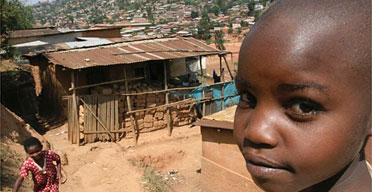
Expectation of rapid economic improvement soon in Africa seems counter-intuitive at this time, especially given its symbolic role as the negation of ‘white’ superiority. Black people have played this role for centuries as the stigmatized underclass of an unequal world society organized along racial lines; and never more than now, when American and European dominance is being undermined by a shift in the balance of economic power to countries like China, India, Brazil and, within its own region, South Africa. Rather than face up to a decline in their economic fortunes, the whites prefer to dwell on the misfortunes of black people and on Africa’s apparently terminal exclusion from modern prosperity.Failed politicians and aging rock stars, such as Blair and Bono, announce their mission to ‘save’ Africa from its presumed ills. It all goes to reassure a decadent West that at least some people are a lot worse off than themselves.More here
Africa’s Moment has Come
Fighting corruption, Trustlaw
via the Corruption Blog
- Spread the culture and practice of pro bono work around the world, connecting those who need legal assistance with lawyers willing to work at no cost
- Offer a one-stop shop for news and information on good governance and anti-corruption issues
Related articles
- The World Bank and the Hotbed of Corruption (psipsychologytutor.org)
- Raymond Baker: As Anti-Corruption Day Passes, a Look Back at 2010 (huffingtonpost.com)
- Expanding the global fight against corruption (thehill.com)
An interactive map of the celebrity recolonization of Africa.
Much has been said of celebrities taking an interest in Africa. Celebrities like Oprah, Madonna, Brad Pitt and Angelina Jolie, Danny Glover and, of course, Bono, have pusued a wide range of Africa-related causes and initiatives to mixed response here and elsewhere in the media. For their March/April issue Mother Jones magazine has put together a fun interactive map outlining which American celebrities have been most involved in which African countries.More here
Related articles by Zemanta
- Madonna, Mercy & Lourdes In Malawi (PHOTOS) (huffingtonpost.com)
- Map Of The Day (andrewsullivan.theatlantic.com)
Rhee Fired DC Teachers Without Evaluations
Despite what Chancellor Michelle A. Rhee's termination letters stated that DC teachers were evaluated by their local school principal, some DC teachers were fired without ever being evaluated as we heard on WJLA, channel 7 yesterday on the 5 p.m. news.
When Rhee signed off on the terminations of 21 teachers @ Columbia Heights Education Campus (CHEC) given the standardized test scores as reported on The WaPo site- it leaves me wondering whether Principal Maria Tukeva ever cheated in some back room. How is it that the entire middle school teaching staff at CHEC were all ineffective ? Based on The Washington Post's 'Fixing DC Schools' report on line, there were only approximately 32 teachers in total at the middle school level.
How is that the entire special education department at Ludlow Taylor elementary school where Carolyn Cobbs is principal were terminated ? Was the whole department ineffective ? Stories like these and many others defy probability and reason and suggest to me that it's not about removing ineffective teachers.
Some of us are determined to ensure that due process of law occurs. A committee is being formed now to secure representation for many of our DC teachers who have been wronged. We are in search of of an experienced labor attorney willing to represent a class of DC teachers pro bono.
If you can help in any way, please contact: savedcteachers@gmail.com
(posted by The Washington Teacher)Video courtesy of wjla.com
The Need to Speak Up
Chandran Nair writes in the FT about the need for Asians (ditto Africans) to speak up robustly on matters that directly impact them:
As globalisation changes the world, having a worldview of Asia that is essentially shaped by western outlooks and prejudices is not just narrow-minded, it is also potentially highly dangerous. It is a view that sees economic advances by Asian countries as threats and Asian business practices as inferior. We saw this with Japan in the 1980s. We are seeing it again today with China and India.Ory Okolloh in a similar vein states that:
Such an outlook alienates Asian leaders, encouraging them to take nationalist positions in response. What is needed is the emergence of a confident body of Asian intellectual leaders. Not ones who speak on behalf of Asia as a whole – that leads to the kind of “Asian values” nonsense that we heard far too much about in the 1990s.
I’m tired of the Bono’s and Sach’s of this world articulating my views as an African. It’s one of the reasons I’m very quick to respond to media requests for interviews, profiles, etc. (I really could be a media slut) - I think it’s important for Africans to get our views out thereShe wonders whether:
“Will No One Let Africa Speak for Itself?
The Development Jet-Set
Rasna Warah writes (reg reqd) in the Nation:
THOSE OF US WHO HAVE worked for, or are working within, the development industry are familiar with the many poverty-reduction conferences, seminars and workshops that we have to attend as part of our work, or for what development professionals like to call “networking opportunities”...The “hottest” topics on the international development agenda these days is Africa...I mean the Africa that development professionals love to dwell on – the poverty-stricken, disease-ridden Africa that is being managed by kleptomaniacs and dictators...IN OTHER WORDS, THE AFRICA that is the raison d’etre of the international development industry, the one that makes Bono, Bob Geldof, Madonna and Angelina Jolie shed real tears...At almost all poverty-reduction seminars and conferences, the word “poverty” is used interchangeably with the word “Africa”. To some extent, this association is justified. Africa has the largest proportion of people living in extreme poverty (over 40 per cent), and 34 of the 50 poorest countries in the world are African...Countries that have managed to reduce poverty have done so through improving economic management, adding value to their products, increasing investment in infrastructure, specialising and investing in key profitable industries, making distribution of wealth and services more equitable, and ensuring that governance structures are accountable and sustainable.
Unfortunately, these issues are rarely discussed at poverty-reduction seminars and conferences.
photo courtesy of the bbc
Africans to Bono: 'For God's sake please stop!'
Many of Africa's best and brightest become bureaucrats or NGO workers when they should be scientists or entrepreneurs...We let a well-intentioned Irish rock star, a Jewish-American economist, and their Hollywood cohort become the voice and face of Africa
Rwanda and Leapfrogging
Alex Steffen writes about Rwanda's Leapfrogging Vision 2020 project goals:
Transforming a nation's society and economy while building from scratch a new infrastructure is no mean feat. In some places, it may be that it simply can't be done in any short-term way, as Bono and the TED team learned in Ethiopia and some American entrepreneurs are finding in parts of Rwanda. Then, too, some of the kinds of problems that face many developing countries in adopting technology are particularly severe in Rwanda. The essential question is can basic improvements, from democracy-building to movement-building to transparent governance to the creation of a free press to the provision of essentials be better delivered in a nation with a focus on employing new technologies.via WorldChanging
Myth: More Foreign Aid Will End Global Poverty
ABC News reports on the Myth that "...foreign aid will cure poverty...". Reviewing various statements by celebrities from Bono to Angelie Jolie and supported by Jeffery Sachs, June Arunga states "...You look like an angel if you have all these poor people behind you," she said. "Of course, they'll be smiling. Who wouldn't be smiling if they've just been given stuff? But that's not real life...she wonders why Americans waste money on foreign aid to Africa … when many politicians just steal it..."
A letter to Bono
Jagdish Bhagwati in a letter to Bono characterises the problem of "absorptive capacity" as it relates to Aid and Africa."...will aid be used productively or will it be wasted?..." He also brings to attention the phenomenon known as the "aid curse""...when aid was provided, the recipients were likely to reduce, rather than increase, their own savings efforts..."
Via Zoo Station
Africa: From Victimhood to Agency
John Lonsdale critiques the thinking of Africa as an enduring victim, he suggests the rebuilding of African higher education as a necessary first step.
"...How far are the professed “friends of Africa” – scholars, students, activists – to blame for the mix of everyday indifference and latent fear, tempered now and again by pity? What can we do to repair our failures in representation? Perhaps it would be to do what best serves our own professional interest: regard African colleagues as allies in a common cause, and repair the failures in African higher education that so diminish the African ability to speak to the rest of the world as intellectual equals, expert witnesses in their own cause, full citizens of our one world...Why do we need celebrities to enlist our attention? What Bob Geldof and Bono have done is marvellous (the Nobel laureate economist Amartya Sen tells me that Geldof proved to be a sharp student of development economics in the telephone tutorials Sen gave at the popstar’s request in 2004). But there are also two dangers in the “celebritisation” of Africa’s needs:
- the sense of guilt that Geldof and Bono arouse in their audiences may prove fleeting and ineffective – when it is important that the G8 and the European Union need to be subjected to intellectually sustained and politically creative scrutiny
- the image of the secular saint flatters the self-regarding, even racist, European image as the heroic dragon-slayer riding to the rescue of a voiceless and helpless African continent, trapped by poverty, ignorance and disease
Via OpenDemocracy
Aid is Not the Answer: CK Prahalad
CK Prahalad comments that China and India "...represent 900 million people in poverty, a larger number than the entire population of Africa. There are about 600 million in Africa who live on less than $3 per day. Why, then, do China and India evoke fear and anger, while Africa elicits pity and guilt?...Despite the magnitude of their respective poverty problems, China and India may have a chance of meeting the Millennium Development Goals established by U.N. Their economies are following the lead of other countries that have raised their populations into a middle-class economic base. For example, between 1975 and 2004, GDP per capita in South Korea increased fourfold. Over the same period, Malaysian incomes rose threefold.
On the other hand, in those decades, per capita incomes in Nigeria declined by a tenth. Why? During the period 1955-2004, the West and multilateral institutions invested more than $1 trillion in aid and subsidies in emerging economies. But poverty persists. It would seem, therefore, that we need to challenge the role of aid and subsidies in promoting sustainable economic development. If poverty cannot be eradicated with humanitarian handouts alone, what is the alternative?...The G-8, led by Tony Blair and supported by Jeffery Sachs and Bono, believe that debt relief and a doubling of aid from rich countries to poor, especially in Africa, is the way to go. A less popular alternative focuses on the involvement of the private sector in poverty alleviation through the development of market-based ecosystems.
Irrespective of which route we take, we need to build an infrastructure to deal with poverty. There is an implicit aid overhead. According to Prof. Sachs, out of every dollar of aid given to Africa, an estimated 16% went to consultants from donor countries, 26% went into emergency aid and relief operations, and 14% went into debt servicing. How much of the remaining 40% escaped corrupt officials to benefit the intended recipients is not known..."
Via NextBillion
Listening to Africans for a Change
Moeletsi Mbeki recently stated that "...The best way to keep Africans poor is to continue handing money to political elites who suppress development...the Marshall Plan pulled Europe and Japan out of the doldrums that followed WWII because it was driven by the principles of strengthening democratic institutions and free markets. Most African aid, however, has been provided under the erroneous assumption that strengthening the state will lead to development...Concerts and conferences help focus attention on Africa’s extraordinary economic and health-related problems. Even Bono’s group, DATA (Debt, AIDS, Trade, Africa) demanded that rich nations open their markets, quota and duty free, to African exports, remove agricultural subsidies that hurt African farmers, and allow African nations to harness the power of trade in their own way to maximize poverty alleviation and economic growth...",CFACT.


![Reblog this post [with Zemanta]](http://img.zemanta.com/reblog_e.png?x-id=85fccb0d-9a13-496d-b484-986888ea3827)