
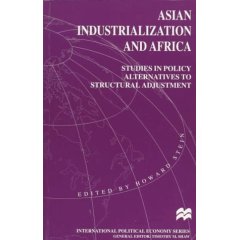
 Reviewed by Saha Santosh, Asian Industrialization and Africa is a collection of essays that offer a "directional" approach to achieving industrial growth within the continent. E. Wayne Nafziger's case study states the following:
"...Japan learned a lesson in the 1870's that many contemporary African countries have still not learned or only learned recently:that importing replicas of Western institutions and capital intensive technology may exacerbate unemployment and balance of payments problems if the local country lacks the capital and skills needed...Meiji Japan imitated,borrowed from, and modified techniques and approaches from advanced Western economies. Aquestion today is: Can Sub-Saharan Africa be as successful emulating,borrowing, and adapting innovations and procedures from the West and Japan?If anything, the contemporary Sub-Sahara has to be even more cautious than Meiji Japan in importing foreign capital and technology. Since present-day Sub-Saharan countries are even more technologically backward relative to the most technologically advanced economies than Japan was relative to the West in the late nineteenth century,it is probably more difficult to adapt technology to local conditions and indigenous production.For example some foreign productivity-raising textile technologies available to early developing Japan were labor-using while most technologies for today's latecoming Sub-Saharan African countries are labor-saving..."
Asian Industrialization and Africa


Mazrui, African Intellectuals and Values
Kofi Akosah-Sarpong writes:
Prof. Ali Mazrui’s address at the 30th anniversary celebration of the Dakar, Senegal-based CODESRIA on the theme “Intellectuals, Nationalism and the Pan-African Ideal” reveals the growing talks, African-wide, about the implications of the African culture and the continent’s development process. The central theme of Mazrui, currently Chancellor of Kenya’s Jomo Kenyatta University of Agriculture and Technology, address is twofold. Why African intellectuals are mediocre and why this informs their inability to appropriate Pan-Africanism ideals into Africa’s development process. I would prefer why African elites have not being able to appropriate African cultural values into Africa’s development process as other elites in other parts of the world have done in their development process.
Using the East African region as a continental reference, Mazrui, known globally as one of Africa’s leading thinkers, reveals how undemocratic political climates undermined Africa’s intellectual growth, and how, by extension, this impacted on the continent’s development process. Unlike other ex-colonies, such as Japan, of which Mazrui used greatly as an example to show how African elites failed to match their Western education with their African values in both their intellectual development and the continent’s progress, the trouble with African elites and the continent’s development process is that, the elites play with ideas are not informed by Africa’s innate, indigenous values or ideas by rather the Western ideas that they have had in formal schools.
Mazrui himself shows this contradicting and confusing state of the African elites in this statement: “Uganda had for Head of Government a person who had changed his name because of admiration of the author of the great English poem, Paradise Lost. Obote became Milton Obote out of admiration of John Milton.” While in the spirit of universal intellectuality Obote could admire Milton, his admiration for a non-African poet and the fact that he is a Head of State, may have let Ugandan and African youth to admire more non-African elites than indigenous Ugandan and African elites. The central issue here is role model, values, and inspiration in the development process. In this sense, Obote did not deeply help the growth of African values and her progress. If Obote had done so, and by implications of Mazrui’s own account of the mediocrity of African intellectuals, and greatly touted a non-African value not because he was educated in Western paradigms but, like most African elites, because either he did not understand African values deeply enough or was mesmerized by Western values or did not respect African values or was confused about African values in relations to the continent’s progress.
Still, Mazrui’s argument that “The capacity to be curious and fascinated by ideas has to start early in the educational process. The spirit of intellectualism has to be nourished from primary school onwards, but it can die at the university level if mediocrity prevails,” reveals that the problem of Africa’s intellectual growth is not only at the university level but also at the primary school level; where the values, images and examples which are heavily European-centred are formed. So, if the African primary education system is heavily Western structured, it flows and grows to the high school level, and then later to the university level; thus sowing a culture of mediocrity, in terms of African values not predominantly dictating the intellectual life of the African child early enough. It is in this sense, that Ghana’s Dr. Y.K. Amoako, the former UN Economic Commission for Africa executive secretary, has observed that Africa is the only region in the world where foreign development paradigms dominate her development process. Not only does this indicate that Africa’s development process is not “culturally close” to Africans, but also a revelation that African elites are mediocre in both their intellectualizing and their direction of the continent’s progress.
This has made the African elite mediocre in their own innate environment and in their development process struggles. The mediocrity has come about because Africa’s elites do not think deeply from within Africa’s values first and the enabling aspects of their colonial legacies second in the continent’s development process. Mazrui himself testify of the Japanese elites doing so in their country’s development process. “In this connection it is worth bearing in mind important differences between the westernization of Africa and the modernization of Japan after the Meiji Restoration of 1868. Japan’s original modernization involved considerable selectivity on the part of the Japanese themselves (“Western Technique, Japanese Spirit”). The whole purpose of selective Japanese westernization was to protect Japan against the West, rather than merely to submit to western cultural attractions. The emphasis in Japan was therefore on the technical and technological techniques of the West, rather than on literary and verbal culture. The Japanese slogan of “western technique, Japanese spirit” at the time captured this ambition to borrow technology from the West while deliberately protecting a substantial part of Japanese culture. In a sense, Japan’s technological westernization was designed to reduce the danger of other forms of cultural dependency.”
This process should starts from childhood to adulthood based on a curriculum skillfully cast in African values first and any other borrowed ones second; more especially, in preparing African elites’ minds at an earlier stage: from primary and high schools levels. It is in this process that African elites, from their early formation to their university crystallization, will be “culturally close” to the African society, will be culturally close to the African’s progress in the continent’s development journey. By not being culturally close to the African society, African elites could not undertake the Japanese cultural selectivity in relations to their colonial legacies and the enabling aspects of the global culture, and, have, therefore, become both heavily technologically and culturally dependent upon the Western world despite their superb innate culture having huge technological and cultural values for progress. Writes Mazrui, “The nature of westernization in Africa has been very different. Far from emphasizing western productive technology and reducing western life-styles and verbal culture, Africa has reversed the Japanese order of emphasis. Among the factors which have facilitated this reversal has been the role of the African university as a vehicle of Western influence on African culture.”
The challenge for African elites today is how to overturn the contradiction they have caused in Africa’s progress by thinking first from within African values first, by matching African values with the enabling aspects of their colonial legacies and the global values, and by intellectually linking this “to the wider world of scholarship and science.”
What the World Needs Now
Just got this email from Julie Lindsay with a list of schools coming to the Flat Classroom Conference in Beijing the end of February. This is very exciting!
- Changchun American International School
- Guangzhou Nanhu International School
- RDFZ Xishan School
- International Academy of Beijing
- Hua Shi Yi Fu Zhong High School
- Tsinghua High International School
- Yokohama International School, Japan
- International School Beijing
- Gyeonggi Suwon International School, Korea
- Western Academy Beijing
- Beijing City International School
- Beijing Normal University
- University of Nothern Iowa, USA
- Livingston American School, China
- Al-Azhar Islamic Senior High School, Indonesia
- Dalian Maple Leaf Foreign Nationals School
- American International School of Guangzhou
- Dulwich College Beijing
- Kaohsiung American School, Taiwan
- Shanghai American School
- British School of Beijing -Shunyi Campus
- International School of Tianjin
- International School Yangon, Myanmar
- Cebu International School, Philippines
- Nanjing International School
- British School of Beijing
- The Illawarra Grammar School, Woolongong, Australia
- Nishimachi International School, Japan
- Stonehill International School, Bangalore, India
- International School Bangkok, Thailand
- Shekou International School
- Yew Chung Intern. Beijing
- Harrow International School Beijing
- St Andrew's Cathedral School, Sydney, Australia
- Westwood Schools, Georgia, USA
- Minerva Special Needs School, Australia
- Kristin School, Auckland, NZ
- Vientiane International School, Laos
- Teda International School
- St. Michael's International School, Japan
- Osama Bin Zaid School, Oman
- Senri Osaka International School, Japan
Our students need so much but they also need each other. They have an uncanny desire to relate. Let's social-network their learning in powerful ways.
I believe that those coming understand that the world is changing and they want to be part of it. In fact, so many of the schools coming are coming because of Twitter, Blogging, and Social networking. Pretty much all of the speakers involved came in to the program through our network.
Project based conferencing as we do it with very very short speeches (when they are given - we call them Flat Learning Action Talks or FLATs) and several projects that run through the conference is still a somewhat "experimental" method of conferencing in the eyes of many. But for those who have seen it in action it is tremendously powerful and transformational.
Wish you call could come - meanwhile, feel free to join the Conference Network and participate virtually. We'll send out instructions through the Ning.

Absorptive Capacity contd.
Reuben Abraham follows up on the absorptive capacity debate "...since the Marshall Plan worked, surely a similar initiative will work in Africa too. Well, let's look at the numbers first. If this idea were in fact true, Africa would have been well developed by now, given the trillion dollars that have been poured into the continent in the last 50 years (by way of comparison, the Marshall Plan consisted of $13 billion worth of assistance, or $130 billion, once you adjust for inflation). In fact, most of Africa is substantially worse off today than when aid first started to flow in. Instead, the money has been frittered away on such development projects as clearing the jungle in the middle of the Congo to build a new runway on which the Concorde could land to ferry Mobutu and his family to Disneyland and France. No prizes for guessing where the money to clear the forest, lease the Concorde etc came from.
So, what is the difference between post-war Europe and Africa which explains this discrepancy? Well, it links directly to the absorptive capacity issue. Japan, Germany etc were well functioning countries with solid institutions (legal system, education system, banking system etc) before they were visited by the horrors of the war. So, an infusion of capital could be put to use easily and efficiently to rebuild the institutions destroyed by war. It was simply a matter of getting trained teachers or bankers back to work, rather than training an entire cadre from scratch. By contrast, when the Belgians left the Congo, there were exactly 17 college graduates in a country the size of western Europe. To imagine that a country with 17 college graduates could absorb large infusions of aid (without any institutions in place) just because Germany and Japan (which were superpowers before the war) did so is bordering on the insane..."
via Zoo Station
US Elected Officials Know Little of Social Studies
From PrairiePundit comes this post commenting on the recent poor performance on a civics and history test by US public officials:
PrairiePundit thinks that he may have blundered into an explanation of how liberalism works- it requires an ignorance of history and economics to survive. This may also explain our recent election- a recent Zogby poll indicated Obama voters were grossly ignorant of facts related to the election campaign. And liberals think they are so smart!US elected officials scored abysmally on a test measuring their civic knowledge, with an average grade of just 44 percent, the group that organized the exam said Thursday. Ordinary citizens did not fare much better, scoring just 49 percent correct on the 33 exam questions compiled by the Intercollegiate Studies Institute (ISI).
Among the questions asked of some 2,500 people who were randomly selected to take the test, including "self-identified elected officials," was one which asked respondents to "name two countries that were our enemies during World War II."Sixty-nine percent of respondents correctly identified Germany and Japan. Among the incorrect answers were Britain, China, Russia, Canada, Mexico and Spain.Forty percent of respondents, meanwhile, incorrectly believed that the US president has the power to declare war, while 54 percent correctly answered that that power rests with Congress.Asked about the electoral college, 20 percent of elected officials incorrectly said it was established to "supervise the first televised presidential debates."In fact, the system of choosing the US president via an indirect electoral college vote dates back some 220 years, to the US Constitution.
The question that received the fewest correct responses, just 16 percent, tested respondents' basic understanding of economic principles, asking why "free markets typically secure more economic prosperity than government's centralized planning?"
UPDATE: Not to toot my own horn, but I got a 97%- guess I'm smart too, maybe even smart enough not to be ignored by smarty-pants liberals?
UPDATE 2: The Corner has a good take on the results of this test- think about this:
There seems to be the idea that all the affirmative-action history we're feeding kids (black studies, women's studies, black women's studies, etc.) is a supplement to learning the basics, which they'll somehow absorb no matter what. Instead, the ISI civic literacy test suggests that such instruction is actually crowding out the fundmentals of history and civics. Other than the Declaration's reference to "life, liberty, and the pursuit of happiness," the two highest scores — i.e., the ones the largest number of people got right — relate to Susan B. Anthony and to MLK's "I have a dream" speech. The 80 percent who got those right compares to fully one-third who didn't know that Germany and Japan were our enemies in WWII, half who didn't know the three branches of government, and nearly 80 percent who didn't know that "government of the people, by the people, for the people" came from the Gettysburg Address. And elected officials scorced even lower than the general public. OK, I shouldn't be surprised, but it seems to me that students shouldn't even hear the words "Susan B. Anthony" until after they've recited the Gettysburg Address from memory and after they've proven they know who was on the losing side of the greatest war in human history.
Barack Obama's Wagyu Steaks
Is it me, or has anyone else noticed the large number of stories in the media about Obama and his family living it up on the taxpayer time? Obama bought new limo's, wanted new helicoptors, redecorated the White House, etc. His wife was on TV yesterday talking about her new dresses and new arms (gym membership and personal trainer). And it seems like every week he is throwing another party or benifit, dancing in a new tuxedo at some fancy event. And then I came across this story.
The President hosted a cocktail party last month, to celebrate Obama's victory, and served steak to the assembled liberal Democrats in attendence. Pretty innoncent stuff. The man deserves a good steak- he is President after all, and nothing satisfies a man like an American-corn fed cow from the Midwest, cooked up perfectly. Sadly, this man doesn't eat that- he eats Wagyu steak, from Japan, that costs $100 a pound and is flown in (using jet fuel) from overseas:
Obama celebrates the House passage of the economic stimulus bill by holding an outrageously expensive dinner party. When you are re-distributing the most wealth in history why not celebrate in style. And so they do. Obama is serving Wagyu steak to House and Senate leaders.
What is Wagyu steak you might ask? The reason you might ask is that likely you have never seen it. It can cost $100 a serving. That is likely to be beyond the average person's budget. But Obama and our top legislators, showing they really don't have a clue about how the average person lives, feast on Wagyu steak after passing the largest spending bill in history. Apparently when they are spending tax payer money, budget is not on their minds.
Wagyu steak comes from Wagyu cattle and is from Japan. It is expensive because these cattle live a pampered life until they are butchered. They are fed well and given beer and daily massages to help keep them happy and hungry even in the heat of summer. They also receive rub downs with Saki, Japanese rice wine, to keep their hides soft. The meat is well marbled with soft flavorful fat.
In a time of economic crises one would think Obama and the legislators would have more sense. Are these legislators that are feasting on outrageously priced steaks the same that berated the auto company executives for their excesses in flying corporate jets to testify before Congress? Why are they not held to a similar accounting.
What's wrong with them eating good old fashioned Angus beef? I've had great steaks for $15. Of course, I had to pay for it myself.
UPDATE: While I was writing this post, I saw that today Obama surprised his daughters with a new swing set- isn't that nice? He is living it up and personally getting a lot of benifits from being President.
End All Energy Production?
On Wednesday, August 6, 2008 I wrote:
As I listened to Obama talk about his energy visions for the future, I imagined what it would be like to live in a world that is cured of it's oil addiction- a world where there is no power generated by fossil fuels, and instead water and wind power the world. Ahh, indeed- the change we need... windmill from ancient Rhodes, waterwheel from Roman Spain...After two years of an Obama Presidency and Democrats in Congress, it appears that the world’s chief sources of large-scale energy production — coal, oil and nuclear power — all are becoming increasingly unsafe and unproductive, possibly moving us back to the future of windmills and waterwheels. Liberals and Democrats have seized on the Upper Big Branch coal mine explosion in West Virginia, the Deepwater Horizon blowout and oil spill in the Gulf of Mexico, and the unfolding nuclear crisis in Japan, to dramatize the dangers of conventional power generation and push for more regulation, taxes, and government control over these industries while simultaneously diverting large amounts of taxpayer money to politically-connected companies who dutifully pray at the alter of the Green God.
The winners of this war on coal, oil, and nuclear are the Al Gore's of the world, who make big money selling government false promises and inefficient power generation, and every set-back or disaster in the coal, oil, and nuclear world are met with happy glee from the government agents transferring wealth from productive, job creating energy businesses to unproductive, job killing green energy politically-connected firms.
The continued support for Democrats marks the beginning of the end of energy production and the voluntarily suicide of a nation's ability to power itself, on a level not seen since the Xhosa Prophetess Nongqawuse convinced her tribe that it must destroy all their crops and kill their cattle so that they might progress as a society and be more powerful and happy. Sadly, much like Al Gore, following the advice of Nongqawuse only resulted in a calamity of staggering proportions for the Xhosa people, as it will be in our nation if we don't continue to drill for oil, mine for coal, and build nuclear reactors.

Wealth Creation and Freedom

"...When men are free to develop their self-interest, when they are free to use their minds in pursuit of what will make them happy, better their lives the wonderful creativity of the mind glows...the mind is the incubator of prosperity it is a costly ignorance to subject it to any form of coercion, as such coercion will paralyse productivity. The system of free minds, freemen and free market is a system of prosperity, growth and wealth creation...Wealth is actually created when enterprising individuals discover new ways to use existing resources. Since the possibilities of human creativity is infinite, then wealth too must be limitless. One idea leads to the next so one invention leads to the other.via IPPA
The amount of wealth a nation has or produces does not depend mainly on the availability of natural resources, instead it is dependent upon human resources, the self-determined thoughts and creativity of its populace. The realization that natural resources does not limit creation of wealth is a very liberating one. For instance Switzerland and Japan have little or no mineral resources, while Nigeria and Mexico are greatly endowed with mineral resources, yet people in Switzerland and Japan are more comfortable that those in Nigeria and Mexico..."
photo courtesy freemarket.net
Daily Education & Technology News for Schools 03/31/2011
-
interactive online game to help students see the "impact of smart money decisions."
-
For every crane you make, oshkoxh will donate clothing to the children of Japan.
-
ScreenCastle | One Click Screencasting
Easy Screencasting tool. This is super simple and from camtasia. WOW!
-
Screencasting-Presenter: Lorna Costantini - Classroom 2.0 LIVE!
A link of a screencasting webinar that came to me. If you want to record the screen, this webinar by Lorna Costantini is one that can help you.
-
Talk about a great grant! Tony is giving time aboard his boat to a "subgenius" in return for dinner with his family as a grant. I LOVE this idea. What if more of us did this! Wow! Thinking I could talk to Dad about our lodge at the shed and offer a week of quiet time away to a subgenius of my own.
I love this! -
Student-Centered Learning Environments: How and Why | Edutopia
As is typical of Edutopia, this is a masterful aggregation of articles about student-centered learning.
-
Kids Teaching Kids - The Vision
With recent coverage in the Huffington post, this platform where kids teach kids is supposedly taking off - let me suggest they buy a proper domain name first instead of a weebly url, but besides that - this echoes what the students "invented" in past conferences - whether it was "Aha" (Amateurs Teaching Adults) or programs where kids would help each other - they want to do it and are already helping each other on Facebook through IM as it is.
-
Needlebase - Twitter List Creators Who Love @RWWGeo
Marshall K is using Needlebase to build some pretty fascinating Twitter lists. This was a group of list makers who love RWWGEo the most.
Owl.ly reports in Hootsuite is trying to do something similar although it doesn't have near the detail. -
A website that marshall K uses to aggregate and compile information. I want to understand how he uses it. Here are many of the public database this service aggregates. This is delving more deeply into data and something that our students have to get to. Past just the surface of "a verbatim Google search" into making meaning of the data.
It looks like this is an important tool for researchers - particularly those researching things pertaining to technology and the ecosystems that are emerging in so many places.
Teachers - I promise you could do some fascinating data aggregation and excel mapping projects with the databases on this page - no sign up required.
Mead Surveys World Challenges and Predicts Trouble?
Often overlooked on this blog and others is foreign policy. Those who follow the War on Terror in Iraq and Afghanistan usually only do so as a reflection on US domestic policy. Events in North Korea or Georgia serve only to give citizens of the United States a chance to test responses by political actors. Few really truly appreciate that importance of foreign policy, but it was foreign affairs that dragged our nation into the War on Terror, the Cold War, Vietnam, Korea, WWII, WWI, etc. It was foreign policy that led to crisis in the Balkans, Rwanda, Somalia, etc. It was foreign policy that opened up markets to our products.
Walter Russell Mead never losses sight of foreign policy and its importance and today put together an excellent article that surveys the major challenges facing the world. Here are some highlights from his article Things Fall Apart, via The American Interest:
...There are times when the ideas of the world’s rulers and the institutions through which they govern are adequate to the needs of the era, and there are times–like the present–when they are not. It is not just the Obama administration that seems mentally and even culturally unprepared to understand much less to guide the events now sweeping through the world. In Brussels, Beijing, Moscow, Tokyo and Delhi — to say nothing of Washington – leaders seem equally clueless, equally committed to outmoded, inaccurate approaches to the issues of our time...Mead also touches on Japan ("a pale shadow of its former self"), India (scandals, poverty, political chaos), Israel, Turkey, etc. His conclusion is one that I also echo:
Europe
...The European Union is perhaps the most feckless of the world’s power centers. Its currency is built on a foundation of hopeful assumptions that haven’t panned out: for example that countries as disparate in culture and situation as Greece, Germany, Finland, Ireland and Italy can all live happily under a common currency. There has been no shortage of warning signs for the last decade: there was no secret about the housing bubbles in Ireland and Spain. The falsity of Greek statistics was well known, as were the imprudent habits of its governments and the dysfunctional nature of its economic culture....
...Meanwhile, Europe continues its relentless failure to manage urgent challenges at home and abroad. The Europeans are unwilling (and in some cases, unable) to make the investments that would keep NATO strong; the continuing refusal to take Turkey’s application for EU membership seriously further and decisively marginalizes Europe in the Middle East. Wishful thinking cannot substitute for policy when it comes to the question of immigration, and Europe’s deepening demographic crisis ensures not only a future of population decline but of economic decline and welfare state bankruptcy as well...
China
...Europe is not the only place where leaders don’t measure up to the problems. Although China is not as democratically governed as Europe, on the whole the technocrats of Beijing have handled the last twenty years better than the bureaucrats of the EU. Nevertheless Beijing is confronting a confluence of economic, environmental and social challenges that pose problems which even China’s leadership is unlikely to overcome. Arguments about China’s currency undervaluation, while real, miss the main point: Whether China revalues the renminbi or not, its model of rapid growth based on manufactured exports is reaching fundamental limits... Rising raw material prices combined with consumer fatigue in the malls is squeezing the profitability of Chinese industry just as workers are demanding higher wages. Meanwhile, food price inflation in China is triggering mass anxiety and the financial system appears vulnerable to the kind of bubbles that have wreaked such havoc in the West....
China’s problems go beyond economics. Chinese public opinion, smarting from what it sees as two centuries of humiliation, and now elated by (overblown) press reports of China’s rise, wants its government to follow a more assertive and even aggressive foreign policy. Disputes with Japan, Korea and Vietnam over offshore islands stir deep currents of emotion, and public opinion judges the Chinese government by its ability to prevail in these disputes.
...Looming environmental disasters threaten China’s future, with issues of water, air quality and the usual environmental devastation that accompanies communist governance on a massive scale already taking a toll. The consequences of the one-child policy threaten a demographic disaster as an aging Chinese population will place a growing burden on a society not yet affluent enough to support it...
Russia
Emerging from the sordid shadows of the Soviet Union, Russia faced four great challenges. It needed to come to terms with the horrors and failures of the past, recognizing the enormous evil that Russia both suffered and inflicted during the Soviet period... It has failed, and Russian life and culture remain poisoned by the residue of unrepented horrors and uncomprehended crimes.
...Second, Russia needed to build a modern and competent state that in turn could provide the framework for a new economy and a new society... but with every passing year the critical failure of the Putin presidency to build the stable institutions and solidify the rule of law that a genuinely strong Russian state would require becomes more clear — and more costly....
...The third task, of building the kind of capitalist economy that could provide its citizens with dignity and affluence, has also been left undone. There is no one who thinks that the rule of law is secure in Russia, or that investors (foreign or domestic) have any real security for their investments....
...The fourth task, of finding a suitable world role for a new Russia, has also been decisively botched. Russia has no real friends anywhere in the world; there are those it can bully and those (a much greater number) that it can’t...
I hope and pray that the generations of today will not know the sick despair of September 1939; if we are to avoid that kind of fate under even uglier circumstances, we need to start demanding more of our leaders — and of ourselves.For those interested, check out some books by Walter Russell Mead such as Special Providence: American Foreign Policy and How It Changed the World, God and Gold: Britain, America, and the Making of the Modern World (Vintage)
 , or Walter Russell Mead.

Obama Clearly is Spending Under $200 Million a Day for His Latest Vacation to India
Based on figures from a 1999 report by the GAO, Bill Clinton's trip to Africa cost $42.8 million dollars. He took 1,300 individuals (not including the Secret Service) and was gone 12 days. That works out to roughly $3.57 million a day. Based on this information, we can take some guesses at how much President Barack Obama's upcoming trip to India is going to cost US taxpayers.
First, Obama will only be traveling around Asia for 10 days (3 days in India, rest in Indonesia where he grew up, South Korea, and Japan), so let's lower the cost down to $35.7M. But he is taking over 3,000 people (including Secret Service), so let's guess on the lower side and just double the cost, to give us a price tag of $71.4M. Let's now adjust for inflation from 1999 to today- that will give us a price tag of about $91.07M.
It is reasonable to assume that the Taj Mahal Hotel, where Obama plans to stay, is considerably more expensive than wherever Clinton stayed in 1999, and it is also reasonable to assume that the cost of moving warships off the coast of India for protection and hiring people to knock down coconuts so they don't fall on the President's head are costs that Clinton did not incur. Plus, we know that President Obama and his wife and retinue have a taste for the finer things (see my post Barack Obama's Wagyu Steaks) that Bubba did not really flaunt. Obama will probably try to get in a round of golf while he is there or maybe take in a cricket match, so add those costs to the total too. I'm not an economist, I think it would be reasonable to put a price tag on this trip of $200 million.
So the White House is correct and the Republicans are wrong. It is not going to cost US taxpayers who are battling a recession $200 million dollars a day that we don't have to send the President on a globe-trotting trip with all his buddies to live it up in 5-star hotels. It will only cost us $200 million overall.
For fun, check out Trillion with a T: How to Spend $1,000,000,000,000.00.

Facets of Lagos
 Image via Wikipedia
The rate at which Nigeria's population has increased, and continues to increase, is staggering. In 1950, 10 years before it gained independence from Britain, 34 million people lived here. The UN believes there are now almost 150 million Nigerians; it has become the world's eighth most populous country, bigger than Russia or Japan. Between now and the middle of the century, only India will add more people to the world's population. If you want to see what it means to live in the middle of a population explosion - the kind of generational leap in size that happened in London in the 19th century and New York in the 20th - Lagos is the ideal place. Where, I wondered, do all the extra people go?...[continue reading]Meanwhile in the Economist's 'The City of More' travelogue piece, the writer states:
...my first impression of the verdant city was of explosive energy tempered by impressive urban development...The government fails to provide essential services, from infrastructure to education, so the market fills the gap. Lagos is a highly-functioning libertarian dystopia where you can get anything if you have the naira, and the tens of thousands streaming from the country can eke out a living alongside prospecting multinational yuppies. The Wild West model will never yield sustainable social or economic development, but in Lagos it’s the only game in town.

Obama Bows to Chinese Communist President
President Obama did not bow, tilt his head, lean over, or make any motion that resembles a bow when he met the leaders of America's top allies and friends. But he did bow and scrape and act like an obsequious doggie when he met a despotic king, an emperor of a nat
 ion that fought us in a world war a generation ago, and the ruler of a communist nation. Obama believes that the United States should now willingly prostrates itself before the rest of the world, because, not only is the United States is a country like any other country, but we are worse, because we have so much for which to apologize, and thus he bows to foreign leaders (but not to foreign leaders who are our friends and allies). Obama is not a humble man- just the opposite, he is very arrogant and believes strongly in himself- but he is willing to humble himself to tyrants and dictators, and that will not make our nation a stronger and better place.
Here is Obama bowing to the the Communist Chinese President Hu Jintao, via the AP.
Also keep in mind that President Obama has also bowed to Burger King. The photo of that is here.
Reflections from High School World History Students
As many of you know, in addition to teaching AP Government, Military History, and US History, I also teach World History (yeah, I know- 4 preps!). At the end of each year that I have taught World History, I have my students do a capstone project or final project that requires students to integrate, interpret, analyze, synthesize, and link together different ideas, concepts, people, and events from world history.
It's not a complicated project. First, I take all the important words from our course, including people, places, events, concepts, and terms, and put them on a list and then randomly sort them. Then I break the list up into 10 separate groups. Students are to pick one word from each group. Then they are to create a timeline that demonstrates the relationship of the words through time. Then they are to write a paper linking together all of the words into a coherent and comprehensive essay that hopefully displays some sort of big understanding of history, religion, science, government, economics, social structures, etc. The theme drives which words are chosen and that in turn drives the timeline and essay.
Reading through the essays written by my regular World History High School students, I was struck by the wisdom that even high school students sometimes can exhibit.
One student wrote about an interesting pattern that she saw after looking back on world history- she wrote about the long history of anti-Semitism that stretched from burning Jews in the Middle Ages to the Holocaust to events of today (for this example, she used the biased coverage of the Gaza boat controversy). Another high school student wrote that one pattern he saw was the continuing struggle of freedom vs tyranny, even in countries that seemed to have had it figured out- he pointed out that at various times in history freedom has seemed to have won, but then later tyranny rose up and overwhelmed freedom (examples used were Greece, Rome, Germany in 1920, Japan in 1910, and the USA today), demonstrating how fragile and fleeting freedom really is. Another student pointed out how it has been such a long struggle for women's rights in our world, and documented all the progress that we have made, but ended her paper by concluding that our society still doesn't treat women equally (as an example she used the Sarah Palin Boobgate controversy). Another one of my high school students pointed out that history is always seems to be more of the same- that although there are the occasional true revolutionaries (Locke, Socrates, Newton, Einstein, Da Vinci were the examples used) that turn things on their head and advance ideas that are brand-new, most of history has been filled with more of the same- people promoting old theories as new or recycling bad ideas all over again (Marx, Lenin, Mao, Hitler, Napoleon, and Obama were all used as examples).
People lose hope in our next generation, feeling that the years of public schooling and liberal indoctrination that goes on in those facilities has created a group of people who are somehow less than future generations. But they are wrong- students today, just like students in the past, are as smart, hard-working, intuitive, and creative as previous generations, as long as the previous generations get out of the way and let them be all that they can be. Have hope- after a year of going through World History, you can clearly see that students recognize the big themes that are out there, and I'd be more than happy to have them as voters someday, provided they are not crushed, demoralized, and further indoctrinated by those previous generations.
The Rising Threat of Fascism: Egypt, Iran, Syria, and Other States
Anti-semitic. Nationalist. Socialist. Corporatist. Totalitarian. Idolizing and exaltating violence, war, and militarism. Emphasizing spiritual renovation, 'better' education, instilling of a will to dominate, and creating national comradeship through the mandatory national military service.
Egypt today is all of these things. Iran is all of these things. The Gaza Strip and West Bank are these things. Syria is these things. These elements are becoming popular in Turkey and Saudi Arabia and Pakistan. These elements swirl through Iraq and Afghanistan. And these are increasingly coming to define the Middle East region.
This is not new. The above elements that I used to describe what is happening in the Middle East are the same exact elements that form the core of fascism.
Fascism did not die with World War Two; it was a very popular ideology that had believers around the world, even here in the United States, and just because the fascist powers of Germany, Italy, and Japan were defeated did not mean that fascism would disappear as an ideology and political alternative to classical liberalism or honest socialism. It did not go away- rather, it changed its name and its focus and attempted to disassociate itself from the worst fascists that were out there, but it did not go away. For many years, the United States and its allies fought for and openly pushed classical liberal ideals on the world, driving fascism into the shadows where it lurked, corrupting socialist movements and swaying liberal governments to its siren call of a 'third way' between life and liberty and death and tyranny.
Fascism though is once more rearing its ugly head, singing its song that if only the people would unite behind certain ideals- be they a united community of Muslims preaching nationalism and death to Jews in a corporatist economy, or a divided nation rallying behind a demagogue who promises change and hope while creating a union-government-big business partnership, or Germans smarting from a dehumanizing loss in WWI seeking out Volk through a third way economic program based on environmentalism and postmodern values. Fascism is still going strong today, luring people into adopting it, working with it, and even preaching it in their own little ways, all while vehemently rejecting it just because it isn't spoken in German and this isn't 1940 and because their own mind shrinks back in horrified rejection over the accusation that perhaps what they really are advancing is fascist.
This isn't really new ground for me to cover- longtime readers of my blog will remember my other posts on fascism such as Fascism Healthcare, The Third Way: Obama and Fascism, State Capitalism, Crony Capitalism, Corrupt Capitalism ..., Wikipedia Description of Fascist Sounds Like Someone I Know, or The World According to Obama.
What is new to me is the dawning realization that the Middle East is going fascist, that the people of Israel are in grave danger, and that appeasers hold positions of power around the world and are going to let atrocities, rapes, rocket attacks, land grabs, condemnations, and rebukes occur. And we must fight this new fascism.
For more information about fascism, read Liberal Fascism: The Secret History of the American Left, From Mussolini to the Politics of Meaning.
UPDATE: It is stunning to me the lack of education demonstrated by the teachers and their allies in Wisconsin. There are so many signs about this whole Wisconsin budget battle thing where they make their opponents out to be fascists and have sign after sign with a mustache drawn on the Governor of Wisconsin to make him into some sort of Hitler. Not only is it uncivil and disgusting, it is shocking illiterate and uneducated about what exactly fascism is. Making it so that public employees (who are hired and fired by the government and who have an entire civil service commission set up to supervise them) can not unionize and collectively bargain is not something that any fascist at any point in history even thought about, unless you view unions to be communist and argue that fascists hated communists? I doubt this is it- no, rather this is just another effort to disguise just exactly what fascism is and water down the word so that when you see real fascism- like the kind I believe you see signs of in the Middle East and elsewhere- you won't recognize it and therefore attack and condemn it.

Predictions of the Future from Doug Casey
One of my sister's passed an article on to me where Doug Casey, a highly respected author, publisher and professional investor, predicts three possible futures. These futures are of what the world will look like 20 years from today (2031). Casey bases his projections on facts, research, and sound analysis, and while all three are possible and I encourage you to read the entire article, the second one to me is the most plausible and likely and so it is only that one which I will excerpt below:
MIDDLE CASE – FACTS ARE IGNOREDAgain, I highly encourage you to read the entire article, which lays out the methodology and background and reasoning behind the predictions and also lays out the other possible futures.
The world’s governments continue under the delusion that printing massive quantities of paper money will solve problems when, in fact, printing lies at the base of the problems. Most currencies lose most of their value. Some lose it all. This destroys the most productive people in society, the middle class, who produce more than they consume and save the difference... in currency.
And it injures successful corporations that have billions, or even tens of billions, in cash. Few of their managers know what to do with such sums other than to hold currency; at best they’ll buy their own and other companies' stock. The result is a stock market boom in the midst of a grim depression. But only one person in a hundred will be in a position to benefit from it, because most will be living too close to the edge, and the stock market will be the last thing on their minds. The destruction of capital sets technology back quite a bit in the U.S., Japan and Europe. Chindia increases its relative strength.
The U.S. government, believing it has both the obligation and the ability to “do something,” redoubles its control of the economy. Price controls and capital controls are the order of the day. Petroleum products are rationed. Enforcement of new regulations is assigned to a new agency, the “Economic Recovery Administration,” which resembles the TSA in most regards – except it has many plain-clothes employees, to better ferret out violators.
People think increasingly of politics as the way to get what they want. More and more Americans move abroad – although things are deteriorating in most places in the world. Poor, backwater countries offer the best opportunities because their governments are either weak, or corrupt, enough to allow new economic activity.
Doug Casey has written The International Man: The Complete Guidebook to the World's Last Frontiers. For Freedom Seekers, Investors, Adventurers, Speculators, and Expatriates and
 Lies, damn lies & dirty lies: How to get rich by understanding big government & the media.
Africa Rising
The shops are stacked six feet high with goods, the streets outside are jammed with customers and salespeople are sweating profusely under the onslaught. But this is not a high street during the Christmas-shopping season in the rich world. It is the Onitsha market in southern Nigeria, every day of the year. Many call it the world’s biggest. Up to 3m people go there daily to buy rice and soap, computers and construction equipment. It is a hub for traders from the Gulf of Guinea, a region blighted by corruption, piracy, poverty and disease but also home to millions of highly motivated entrepreneurs and increasingly prosperous consumers.
Over the past decade six of the world’s ten fastest-growing countries were African. In eight of the past ten years, Africa has grown faster than East Asia, including Japan. Even allowing for the knock-on effect of the northern hemisphere’s slowdown, the IMF expects Africa to grow by 6% this year and nearly 6% in 2012, about the same as Asia...[continue reading]
The New Titans
The Economist reports:
The developing countries also have a far greater influence on the performance of the rich economies than is generally realised. Emerging economies are driving global growth and having a big impact on developed countries' inflation, interest rates, wages and profits. As these newcomers become more integrated into the global economy and their incomes catch up with the rich countries, they will provide the biggest boost to the world economy since the industrial revolution...Rising exports give developing countries more money to spend on imports from richer ones. And although their average incomes are still low, their middle classes are expanding fast, creating a vast new market. Over the next decade, almost a billion new consumers will enter the global marketplace as household incomes rise above the threshold at which people generally begin to spend on non-essential goods. Emerging economies have already become important markets for rich-world firms: over half of the combined exports of America, the euro area and Japan go to these poorer economies. The rich economies' trade with developing countries is growing twice as fast as their trade with one another.via Emergic
Daily Education & Technology News for Schools 04/19/2011
-
Writing Better Blog Posts: What You NEED to Know | The Edublogger
Excellent post from Sue Waters about writing better blog posts.
-
24 free kindergarte apps from kindergarten.com Download all 24 of these apps. (From The Edcational Technology blog) by jonathan Wylie.
-
Scholastic: Best in Tech Today | Livescribe Education
I love my livescribe pen and agree with this review even if it is posted on the Livescribe website.
-
iAdvocate for iPhone, iPod touch, and iPad on the iTunes App Store
Free iAdvocate app to help parents who have children with learning disabilities advocate for them. It is a start and worth testing. Plus it is free!
-
School of Education launches new free mobile app to assist parents, advocates
New Mobile phone app from Alan Foley of Syracuse University - called iAdvocate designed to help parents advocate for their child with learning disabilities.
The app has 3 sections: strategies for parents, information and links, and simulated conversations to help guide parents. I hope that my friends who work in this area will test and post their reviews. If you do, let me know and I'll feature you in the daily spotlight! ;-) -
QR Codes, Electronic Devices,Nonprofits, and Concert Etiquette | Beth’s Blog
Ecellent blog post on the use of QR codes in nonprofits from social media nonprofit guru - Beth Kanter. Tons of potential here!
-
10 Futuristic Inventions in Wearable Tech — Life Scoop
A fun discussion topic with technology students, this blog post about futuristic inventions in wearable tech includes buttons that are really mp3 players, a dress with room for a sim card that makes it funciton as a mobile phone when you lift your wrist, and the one I want -- the Massage Me Massage Video game - that makes a game out of having someone massage your back! (Oh yeah!)
This would be a great area to review and then have students invent their own. -
Money Lessons: A Guide to Financial-Literacy Resources | Edutopia
Financial literacy resources. Curriculum directors and math teachers at all levels should take time to read this article from edutopia.
-
Another One Bites The Dust: Yahoo To Kill Buzz On April 21
Google video. Delicious. Now yahoo Buzz - their "digg" site. what else?
-
Congress, Can You Spare a Dime? A Teacher Makes the Case for the National Writing Project | Edutopia
Great things have come out of the national writing project. Their research is wonderful and many of them have taught me a lot in the hallways and byways of conferences around the world. It is a shame to see this go. Read more about this project so you can share your 10cents with congress - that is all it would take per child to keep it going.
-
Apple Launches iPad School Donation Program - Edudemic
Donate your "old" generation 1 ipad to schools through apple.
-
The Evolution of Classroom Technology - Edudemic
Fascinating Evolution of Classroom Technology over at Edudemic (hat tip Stephen Downes.) Look at how many of these technologies are still here in some forms. All I can think as I read about halfway down is the ah so lovely smell of that mimeograph paper!`
-
Apple Sues Samsung Over Galaxy; Are Other Tablet Makers Next?
Apple suing samsung over galaxy! With the iPad 2 in dwindling supply because of the components made in the affected area in Japan, I guess apple is trying to keep others out temporarily while they are rushing to find another supplier.
-
Another book review from one of our 8th graders. We are looking to add some more schools over the next few months. Fill out the info form on the bottom left of this page.
This is a great website for finding books that kids like.
Ghanaian/African Food is Good for You
 Kofi Akosah-Sarpong reports on Courage Quashigah's campaign for a return to traditional foods:
He argues for,
Balanced nutrition by consuming healthy traditional Ghanaian food, as a bulwark against “preventing ill health,” is as vital as curative measures in the face of severe inadequate health infrastructure. Such observation comes in the face of similar admonitions in Japan, a country admired by Ghanaians for their ability to mix their traditional values with the dominant Western neo-liberal ones in their development process...The lessons here are that Ghanaian indigenous foods, with its heavy emphasis on green vegetables, like the famed healthy Arab/Mediterranean foods, are among some of the healthiest in the world.