RSS
Menampilkan postingan yang diurutkan menurut tanggal untuk kueri oil curse. Urutkan menurut relevansi Tampilkan semua postingan

Quick Hits

  • Digg
  • Del.icio.us
  • StumbleUpon
  • Reddit
  • RSS

The Fuel Subsidy Removal Protests for Dummies

Jeremy Weate writes:
...the lived reality of citizens of the Nigerian state is that it provides little or no security, no infrastructure, no education and no employment opportunities (apart from mostly McJobs in the civil service). Everywhere in Nigeria, the basic elements of civilised existence have to be taken care of house-by-house, compound-by-compound. You must sink your own borehole for water, buy, install and fuel a generator for power, hire security guards to keep the wolves from the door, pay school fees to ensure your kids get a half-decent education because the public school system is in perpetual meltdown. And to earn enough money to get through the day, you must hustle.

The breakdown of a standard tax and political representation based social contract between citizens and the state in Nigeria is almost entirely a result of the past few decades of the so-called ‘resource curse’. Earning billions of dollars each year from crude exports, the Nigerian government has no need to rely on tax from individuals or local companies; tax and royalty payments from the international oil companies (as well as historically, loans from international financial institutions) have been sufficient to fund the annual budget at all levels of government. For the past few decades, cheap fuel has therefore been the only form of social contract between ordinary Nigerians and the state and the principle lever to control inflation during times of rising oil prices. With most Nigerians subsisting on US$2 or less, subsidised fuel has also been a survival mechanism, making life only just bearable.
More here

  • Digg
  • Del.icio.us
  • StumbleUpon
  • Reddit
  • RSS

A Scientific Black Swan? And the potential implication for Oil producers

Three decades ago the then Saudi Arabian Oil Minister Sheikh Zaki Yamani was quoted as saying that “The Stone Age did not end for lack of stone, and the Oil Age will end long before the world runs out of oil.” Ever since there have been false dawns on how if at all this would come about. The ever receding but endlessly promising nuclear fusion; renewable's in all forms ;silver bullet crackpot theories derided as 'junk science'. The list goes on and on...
In the past few months however one of those 'junk science' approaches along a number of parallel but somewhat related tracks seems to be re-emerging and gaining credibility (not that it ever went away). This science of LENR and or Cold Fusion (yes that Cold Fusion) is gaining traction and the attention of the US Defense Department amongst many others,something it seems is about to break. From the increased boardroom appointments at Blacklight Power (they choose to not characterize their process as CF) to the fact that 60 Mins is about to profile the resurgence of Cold Fusion one can discern the beginnings of a potential phase transition-A Technological Black Swan.
The potential implications for the oil dependent commodity producing countries-Nigeria,Gabon et. al. if this all came to pass might be construed as catastrophic (they derive over 90% of their revenues from black gold).More sensible folks should beg to differ though,if anything the removal of the Oil Curse would be a godsend for societies that hitherto have been warped and stunted in their socioeconomic development,chronic sufferers of the Dutch Disease or worse.
Update: watch full 60 minutes clip below.


Reblog this post [with Zemanta]

  • Digg
  • Del.icio.us
  • StumbleUpon
  • Reddit
  • RSS

Quick Hits

Chido Makunike dicusses Asia's tainted attitudes towards Africa.-Cheetah Index
Which Way Nigeria puts the spotlight on Judicial corruption.
The Curse of Oil contd-SMH
Abdul-Nasser Alidu takes another look at privatization
Kofi Akosah-Sarpong writes about promoting the African Way-Patriotic Vanguard
Nigerian Muse argues against fuel subsidies.

  • Digg
  • Del.icio.us
  • StumbleUpon
  • Reddit
  • RSS

“Aid is a bigger curse than oil”

Amity Shlaes comments at Bloomberg:

In a recent paper(pdf), scholars Simeon Djankov, Jose G. Montalvo and Marta Reynal-Querol surveyed data from more than 100 countries over four decades. They also found that aid tends to supplant growth and makes countries quantifiably less democratic. They compared aid with petroleum wealth. Based on their research, they determined, ``aid is a bigger curse than oil.
via African Loft

  • Digg
  • Del.icio.us
  • StumbleUpon
  • Reddit
  • RSS

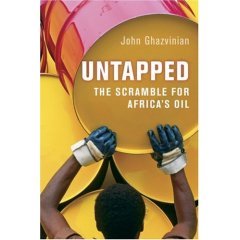
Untapped: The Scramble for Africa's Oil.

Slate reviews Untapped: The Scramble for Africa's Oil. by John Ghazvinian and asks four questions:

Does oil-producing Africa live up to the hype? Why is it impossible to buy bananas in Gabon, when they grow in profusion in the nation's virgin rainforest? Can an underdeveloped country like São Tomé and Príncipe learn from other nations' mistakes and avoid the "curse of oil"? What effect does the establishment of an oil-company compound in the middle of Chad have on the neighboring land and people?

See the answers here

  • Digg
  • Del.icio.us
  • StumbleUpon
  • Reddit
  • RSS

The Curse of Oil

John Ghazvinian focuses on the Nigerian version of the resource curse:

The problem, in a nutshell, is that for fifty years, foreign oil companies have conducted some of the world’s most sophisticated exploration and production operations, using millions of dollars’ worth of imported ultramodern equipment, against a backdrop of Stone Age squalor. They have extracted hundreds of millions of barrels of oil, which have sold on the international market for hundreds of billions of dollars, but the people of the Niger Delta have seen virtually none of the benefits. While successive military regimes have used oil proceeds to buy mansions in Mayfair or build castles in the sand in the faraway capital of Abuja, many in the Delta live as their ancestors would have done hundreds, even thousands of years ago—in hand-built huts of mud and straw. And though the Delta produces 100 percent of the nation’s oil and gas, its people survive with no electricity or clean running water. Seeing a doctor can mean traveling for hours by boat through the creeks.
via 3quarksdaily

  • Digg
  • Del.icio.us
  • StumbleUpon
  • Reddit
  • RSS

The Resource Curse

The [African] blog wars writes about the 'Resource Curse':

It is widely suspected that the ‘curse’ is largely caused by the effects of over-dependence on resources. Governments, perhaps believing resources will never run dry (in their time), fail to wean economies off these commodities. One of the consequences of this is that in times of high prices, the real exchange rate rises making local industries less competitive, while encouraging borrowing as it becomes relatively cheaper to do so.
The danger though is when prices fall, exchange rates fall and debt repayments soar, and this is after industries have contracted, which dramatically decreases tax revenues. Sure, taxes could be pushed up to compensate, but this wouldn't do much for competitiveness.
Over-dependence is the big issue though. Botswana still gets 70 percent of its export revenues from diamonds, while Burundi, Rwanda and Uganda all earn more than 50 of their export earnings from coffee. Looking west to cotton producing nations, the picture isn’t really any better. And, then, of course, there’s oil, which earns Nigeria 95 percent of its export income. Perhaps part of Chad’s defection to China was because the Asian giant is more likely to be able to buy all of Chad’s oil than Taiwan is.

The [African] blog wars

  • Digg
  • Del.icio.us
  • StumbleUpon
  • Reddit
  • RSS