
AllAfrica reported via the Champion the welcome establishment of Nigeria's 1st commodity exchange(The Abuja commodity exchange)."...ASCE which would trade in spot transactions for high quality grains such as white and yellow maize, soyabeans, cowpea, benniseed and millet, as well as cassava and sorghum.In the light of the development the exchange has invited commodity brokers and warehouse and assaying firms to partner with it in the areas of dealership and warehousing..."The Nigerian SEC should take note of the success deregulation has brought the derivatives industry in India .Broader based competition and demutualisation is needed in the exchange industry as a whole,private industry should be encouraged to step in and begin the process of establishing more regional exchanges in markets across the board. Whither the Aba stock exchange, Ibaden Cocoa exchange, Abakaliki Yam exchange et. al ?


'Riches to Rags' the commodity dead-end

Once perceived as an icon of progress in Africa thanks to wealth from its copper mines, today over 75 per cent of Zambia's population lives below the poverty line...Khadija Sharife recounts the country’s ‘riches to rags’ story – a story that is being repeated in former resource colonies across the continent, which although ‘politically liberated’ have ‘remained economically chained’.More here
Even Russia's Medvedev rails against commodity dependence.

Africa's continuing Commodity Trap
Africa Focus analyses the continents commodity trap:
"...most African countries have been losing market shares in commodity exports to other developing countries, while at the same time most have been unable to diversify into manufactured exports. Africa's difficulties in maintaining market shares for its traditional commodities derive from its inability to overcome structural constraints and modernize its agricultural sector, combined with the high cost of trading. Africa has not been able to increase the productivity of its agriculture because of a combination of factors, including land tenure and small-scale farming, rudimentary technology and policies that reduced the role of state institutions in innovation and investment in the sector. As a result, it has lost its competitive advantage in producing cocoa, tea and coffee vis-a-vis the new and more competitive producers in Asia and Latin America..."
Commodity Resource - African Footballers
More here...there's something distasteful about an economic system that means the best players from Africa, if they're to be properly remunerated, have to move to a different part of the world to perform for western Europe's benefit. That's true of other parts of the globe, of course, but the economic imbalance isn't as stark and, elsewhere, doesn't have the same awkward echoes of colonial exploitation.
Image courtesy of orble
Talk of a new slave trade is unhelpfully emotive, but there is an unpleasant traffic in vulnerable and often naive young players, and it seems hard to deny that the demands of the European market have shaped the tactical development of African football. Tom Vernon, who runs an academy near Accra in Ghana and scouts for Manchester United, speaks of the "Pape Bouba Diop" template: having seen the success of big, muscular west African players, clubs go to west Africa looking for more big, muscular players and so that sort of player is prioritised, something that in part explains the dearth of west African creative players in the decade between Abedi Pelé, Jay-Jay Okocha and Kanu and the emerging generation of Kwadwo Asamoah, Dede Ayew and Gervinho.
It even suits the football administrations of individual countries within Africa to pretend that all is well, that things are developing. Not to do so, after all, would be to admit failure, and to do that would be to risk the sinecures that bring wealth, prestige and influence. The myth of Progress is sustained by a conspiracy of the complacent and the self-interested.

We must breed tigers in Africa
Matthew Lockwood writes on the need for non-standard remedies in Africa, he states "...What Africa needs is to shake off its dependence on primary commodity exports, a problem underlying not only its marginalisation from world trade but also its chronic debt problems. Many countries rely today on as narrow a range of agricultural and mineral products as they did 30 years ago, and suffer the consequences of inex orably declining export earnings. Again, the campaigners' remedy - to improve market access for African exports to Europe and America - is wide of the mark. While imperfect, various preferential schemes already give the poorest African countries excellent market access.To understand how Africa might diversify we must look elsewhere, to the experience of east and south-east Asia. Not only have these countries revolutionised their trade performance in the last four decades to become world leaders in everything from clothing to computers, they have also achieved the holy grail of broad-based growth. The "Asian miracle" has seen countries poorer than their African counterparts in the 1960s virtually eradicate $1-a-day poverty today. If you really want to know how to make poverty history, it is this transformation that you must grasp..."
Higher Prices for Cocoa and contd. Commodity Dependence
G. Paschal Zachary on the advent of higher prices for cocoa and the consequent higher income for farmers:
Shouldn't the farmers be exploring ways collectively or otherwise to add value to their primary product? The irony of having to purchase chocolate derivatives in the West for usage back on a continent is simply inexcusable 50 years after independence.Image via WikipediaThe benefits to African farmers should be significant over time. Unlike some other crops, new gardens can require years of planning and labor. Existing trees are subject to blight and aging and must be worked intensively to maintain yields. When I visited Ghana’s cocoa-growing region a year ago, I was struck by the prosperity of farmers I met but also the relative inflexibility of growing cocoa. Expansion of output is hard to achieve. Inputs, such as fertilizers, are expensive and are used less than they should be by non-organic growers. New trees take years to reap fruit. Field labor is surprisingly costly. Producers also fear a glut; they can benefit from stagnant production too...[continue reading]


Daily Education and Technology News for Schools 12/25/2011
-
Cool Cat Teacher Blog: 5 Fantastic Things to Do Over Winter Break
Blogged: #education 5 Fantastic Things to Do Over Winter Break http://t.co/urPRT9u7
-
The Tevatron's enduring computing legacy | iSGTW
A fascinating article on the mind blowing influence the Tevatron particle accelerator has had (and will have) on technology and the world we know it. This will be required reading for my computer science students when we return in January.
-
How Smartphones Are Changing Photography: The Numbers Are In | Gadget Lab | Wired.com
27% of photos taken this year were taken on smartphones.
I am not sure why schools are banning cell phones and buying cameras. -
Pudding vending machine tells kids to scram
No undoing for you! Face scanning uses the measurements between your eyes and a few other dimensions to determine if a person is old enough to buy something out of the machine. But the fact that it is put on a jello pudding machine is pretty funny to me. Guess junior will need an older sibling tonget that jello for him. Humor aside, there could be use for this in areas served by kids and adults although kids do get around obstacles when they want to.
-
Facebook and iPhone Lead Way on Klout's Top Topics of 2011 Lists [INFOGRAPHIC]
This infographic from Kliut depicts the most popular conversations and people on Twitter. No doubt,MIT is a hub for pop culture. But there are great microconversations happening in education using this site so don't let the trivial steer you away.
-
How to Recalibrate Your iPhone’s Home Button to Make it More Responsive
So, you want your iPhone home button to behave like it did when you got it. This very simple tip is spreading like wildfire through the iPhone networks and just involves a simple recalibration with the power off switch. Try it if you are having trougble or if you have had your iPhone or iPod touch for a while. Very cool.
-
As some of you experience Microsoft's super cool Kinect system for the first time, you'll be thrilled to know this tool is being used in school as well. Here, my go to Microsoft blogger And dear friend Alfred Thompson gives an overview of Kinect in education.
-
Paul Stacey writes an excellent overview of Open Education (hat tip Stephen Downes edcurator extraordinaire) that is a great read for those trying to keep their finger on the pulse of the very rapidly changing landscape of education.
-
Esther Wojcicki: Give Yourself A Free University Education at University of the People
University of the people, a site offering free degrees in business administration and computer science continues to gain momentum as leading the effort to "democratize education." Things are underfoot that will radically change the expensive landscape known as higher Ed. The bottom line is that universities without solid online platforms won't be ready for the changes they will need to made. Their greatest commodity will be excellent teachers who can now be beamed from one end of the planet to the other. This crazy upheaval in education is only beginning and the competition is no longer limited by geography.
-
Zoo tool is a new bookmarking tool that is more visual. I am a huge Diigo fan but this tool is worth a mention.
Rising Investor confidence
The FT continues its focus on the fund landscape within the continent:
Signs of a more favourable investment climate are emerging as economies strengthen and diversify, fuelled by the commodity price boom and lower debt levels, currency stability improves and fiscal governance begins to tighten...Many challenges still face the investment community and each country needs to be assessed separately in terms of risk, political instability and economic drivers. Many African countries do not have stock exchanges yet and those that do are largely typical of frontier markets, lacking in liquidity and ease of trading. But their number has grown dramatically in the past few years, as has the number of companies listed.
As yet there is no internationally recognized pan-African index, although this may change as the local stock exchanges grow.
#. Best Buy Cheap An Empty Sky Best Price
An Empty Sky Lowest Prices
Buy in Cheap Price Shopping Online !! See Lowest Price Here Cheap An Empty Sky. This Store is the best place to buy cheap An Empty Sky. If you want to buy An Empty Sky in the best price, try to see specail offers or read the best customer reviews from this page. That can help you to make easy decision to buy this product. This product Shipped and Sold by Amazon Shopping Store. Usually ships in 1-2 business days This item ships for FREE with Super Saver Shipping. Order The Best price From This Page - Read more Informations by Click at the Big Links.
|
| |||||||||||||||


Overview An Empty Sky 
Cecil Clemenzi grew up in a Cleveland suburb where he was taunted and bullied from early childhood through adolescence. By the time he graduated from NYU and landed his first job as a runner for the New York Commodity Exchange, he was on his way to becoming an emotionally fragile yet surprisingly determined floor trader. One morning, following a freeze in Florida that sends the price of Orange Juice futures sharply higher, he loses everything in just one trade. Cecil blames another more successful floor trader for his loss and is determined to inflict as much retribution as possible on him. First, through one of his 'connected' relatives, Cecil tries to have the trader's daughter killed. Then he goes after some of his closest family friends. Finally, consumed with paranoia once he realizes his nemesis is now ruthlessly seeking his own revenge, he embarks on a desperate yet somewhat comical road trip that takes him to Laramie, Wyoming, where he unsuccessfully tries to start a new life. Alone, confused, and very afraid, he decides to go back home and meet his fate.
Available : In Stock. | |
 | |
FREE with Super Saver Shipping Usually ships in 1-2 business days | |
|
Unlock Africa's migrant fortune
 Image via Wikipedia
Many factors have contributed to this upturn. Emerging-market demand has pushed up commodity prices. Urbanisation has given rise to a dynamic informal sector. Improved governance, higher food production, increased inter-regional trade, debt cancellation, better use of official development assistance (ODA), and thriving telecommunications and housing markets have helped as well.
But transfers from the African diaspora stand out as the most significant contributing factor. A study commissioned by the Rome-based International Fund for Agricultural Development indicates that more than 30 million individuals living outside their countries of origin contribute more than $40bn annually in remittances to their families and communities back home. For sub-Saharan African countries, remittances increased from $3.1bn in 1995 to $18.5bn in 2007, according to the World Bank, representing between 9% and 24% of GDP and 80-750% of ODA...[continue reading]

The Promise of Railway Transportation
 StockMarketNigeria writes about the benefits of Railway Transportation:
The first phase of the Lagos-Kano railway line project is to cost $8.3 billion, of which $2 billion of the amount has already been obtained as a soft loan from the Chinese government. The numerous benefits of the project as announced by the president includes:
· Utilization of local raw materials as much as possible,
·Increase in traffic of goods and passengers around Nigeria,
· Retaining the top rating of important commercial cities like Lagos, Aba and Kano as key commodity-trading points in West Africa,
· And, reduction of road accidents in Nigeria
via GlobalVoices
Outages Stifle a Boom
 The WSJ reports:
Unreliable power poses a major constraint on the region's economic development. Much of sub-Saharan Africa still operates largely on the margins of the global financial markets, isolating it from the economic turmoil buffeting the developed world. Booming commodity prices of the past few years, however, have made the region attractive to foreign investors. Now the electricity crisis is damping their enthusiasm.
"It's one of the biggest concerns for the business community," says Vivien Foster, the World Bank's lead economist on sustainable development in Africa
Ngozi Okonjo-Iweala
 Nigeria's Finance Minister Ngozi Okonjo-Iweala is representative of a new type of African leader.A reformer and technocrat commenting on Nigeria's Oil based economy she stated "...The fact also that you have a natural resource-based economy that is highly dependent on one commodity - oil. I think that is not the best thing that has happened to us as a country because it is difficult to apply the resources that come from this natural resource in a way that takes into account this complexity or groups, religion and so on. And I don't think that the country can really move forward until a good formula is worked out to be able to apply the country's human and natural resources in the best way possible that can be accepted by everybody as being fair...any development in the country has to take into account the need to diversify from oil. I don't think the country can really move forward unless we are able to find a way to develop other sources of income or find other sources of growth for the economy apart from oil...Thus there are two issues - one, applying the resources that we have appropriately and secondly finding means to diversify the economy, which is very vital. And part of managing the resources that we have appropriately is also trying to deal with the enormous burden of debt which the country has, that amounts to $28 billion..."In a paper presented at the The Global Economic Governance Programme she listed the continuing challenges facing Nigeria they include Sustainability,Vested interests,Quick results and Globalization.
China and India: What's in it for Africa?
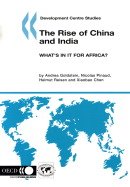 A summary of the OECD publication "The Rise of China and India - What's in it for Africa" makes a number of points:
In order to avoid being trapped into the unpromising corner of vulnerable, capital-intensive and high-risk raw material dependence, resource-rich Africa will have to balance the need to match the promotion of job-rich sectors with the desire to capitalise on a windfall gain generated by higher commodity prices. Monetary authorities will have to lean against the real currency appreciation in order to avoid burdening industries competing with imports, and exporters outside the resource sector. Central banks need to be supported by fiscal authorities, which are required to limit public spending on services and construction to keep non-tradables prices in check.Investment abroad of export proceeds will further insulate the local economies from ‘DutchDisease’ effects.
Furthermore, in low-tech activities like clothing or footwear, growing FDI into China and India is likely to crowd out investment in Africa, although geography and preferential tariff treatment may still provide some African countries with a competitive edge. Head-on competition, however, is unlikely to be the main channel through which the Asian drivers impact on FDI flows into (and out of) Africa.
Nigeria's Oligarchs
The FT reports
When the military ruled Nigeria, it was the generals who boasted most of the fattest bank accounts. They were careful to keep these far offshore. By contrast, eight years of civilian rule has seen the emergence of a cabal of business tycoons whose net worth amounts to hundreds of millions of dollars and in some cases far more...Big business and some of the banks are heavily invested in the political system, just as politicians and government appointees are invested in the Nigerian banks and businesses making money, he says. There are significant changes, however, in the way Nigeria’s newly mega-rich are deploying their wealth. In the past, the wealth was hoarded in banks abroad. Today, it is mostly being poured into business enterprises within Nigeria...Among those Nigerians already in Africa’s big league, five names regularly crop up, led by the merchant-turned-industrialist Aliko Dangote. When complete, the many cement factories his Dangote group is building – or has bought from the state – will give him overwhelming dominance in domestic and potentially regional markets. Mr Dangote also dominates the distribution of sugar and salt and the manufacture of flour products. He was among the beneficiaries of the sale of the two dilapidated state-owned oil refineries in the days before Mr Obasanjo relinquished power.
Also in that deal was Femi Otedola. A licence to import and distribute diesel has given his company, Zenon, control over a commodity on which businesses depend to run generators in the absence of reliable power from the grid. Two bankers close to Mr Obasanjo, Jim Ovia of Zenith bank and Tony Elumelu of United Bank of Africa, also feature among the super-rich. Their banks have wrestled for the largest slice of government business and for ascendancy in the top industry tier.
Catalysing South-South Knowledge Sharing
From Iconnect:
The South-South Experience Exchange Facility is a new multi donor trust fund that promotes the idea that the development successes in one country can be replicated in another. The trust fund has identified other areas suited for this financing including managing commodity windfalls; developing efficient tax systems; adapting to new technologies; creating social safety nets that benefit the poor; and trade integration and investment climate...[continue reading]
#. Buy Lowest Discount !! Get Cheap Price An Empty Sky For Sale
An Empty Sky Best Buy Cheap
Buy Lowest Price !! See Lowest Price Here Cheap An Empty Sky. This Store is the best place to buy cheap An Empty Sky. If you want to buy An Empty Sky in the best price, try to see specail offers or read the best customer reviews from this page. That can help you to make easy decision to buy this product. This product Shipped and Sold by Amazon Shopping Store. Usually ships in 1-2 business days This item ships for FREE with Super Saver Shipping. Order The Best price From This Page - Read more Informations by Click at the Big Links.
|
| |||||||||||||||||||||||


Overview An Empty Sky
Cecil Clemenzi grew up in a Cleveland suburb where he was taunted and bullied from early childhood through adolescence. By the time he graduated from NYU and landed his first job as a runner for the New York Commodity Exchange, he was on his way to becoming an emotionally fragile yet surprisingly determined floor trader. One morning, following a freeze in Florida that sends the price of Orange Juice futures sharply higher, he loses everything in just one trade. Cecil blames another more successful floor trader for his loss and is determined to inflict as much retribution as possible on him. First, through one of his 'connected' relatives, Cecil tries to have the trader's daughter killed. Then he goes after some of his closest family friends. Finally, consumed with paranoia once he realizes his nemesis is now ruthlessly seeking his own revenge, he embarks on a desperate yet somewhat comical road trip that takes him to Laramie, Wyoming, where he unsuccessfully tries to start a new life. Alone, confused, and very afraid, he decides to go back home and meet his fate.
Available : In Stock. | |
| |
FREE with Super Saver Shipping Usually ships in 1-2 business days | |
|
Learning from Mauritius
More hereMauritius's GDP has grown faster than 5 percent annually for almost 30 years. Surely, you think, this must be some "trick." Mauritius must be rich in diamonds, oil, or some other valuable commodity. But Mauritius has no exploitable natural resources. Indeed, so dismal were its prospects as it approached independence from Britain, which came in 1968, that the Nobel Prize-winning economist James Meade wrote in 1961: "It is going to be a great achievement if [the country] can find productive employment for its population without a serious reduction in the existing standard of living. … [T]he outlook for peaceful development is weak."Image via Wikipedia
As if to prove Meade wrong, the Mauritians have increased per capita income from less than $400 around the time of independence to more than $6,700 today. The country has progressed from the sugar-based monoculture of 50 years ago to a diversified economy that includes tourism, finance, textiles, and, if current plans bear fruit, advanced technology.


African Bond Markets: The time is Ripe
Jerome Booth writes in Yahoo finance:
Africa's lack of globalization is evident in its unbalanced financing structure. State-controlled aid money dominates public finance in Africa in spite of improvements in macroeconomic policies, spreading democracy, and supportive commodity prices. Recent growth in local currency debt issuance is welcome, but foreign demand is rapidly exhausting local capacity to absorb selling, with potential destabilizing macroeconomic implications if issuance continues unabated. Meanwhile, Sub-Saharan Africa remains the last great region of the world not to issue external sovereign bonds at all...Potential corporate bond issuance in Africa is maybe 10 times the sovereign (government) financing needs, but – and here is the rub – without a sovereign bond curve, the potential corporate issuers cannot issue as they cannot price sovereign risk. The bond market has far more capacity to finance Africa's development needs than aid, but bond markets need to lend to governments first. A balanced financing structure would replace aid-financed central government budget support with global bonds to sit alongside moderate local currency issuance and conventional aid flows.