RSS
Menampilkan postingan yang diurutkan menurut relevansi untuk kueri pambazuka. Urutkan menurut tanggal Tampilkan semua postingan

Pseudo-Intellectuals in the 'Poverty of Ideas'

In Pambazuka:


What constitutes an intellectual in the South African context?’ asks Leslie Dikeni in this week’s Pambazuka News, ‘Who is an intellectual and who isn’t?’ In an extract from a new book of essays, ‘The Poverty of Ideas’, Dikeni separates the ‘real intellectuals’ from a new breed of ‘pseudo-intellectuals’ that have emerged in recent years: The ‘celebrity intellectual’, the ‘commercial intellectual’, the ‘policy analyst’ and the ‘new gender activist’...[continue reading]

  • Digg
  • Del.icio.us
  • StumbleUpon
  • Reddit
  • RSS

Paul Biya: 25 Years and Counting...

Dibussi Tande analyses the sit-tight ineffectual Cameroon presidency.

Paul Biya failed to transform his nationalistic and progressive political vision into reality. By the end of the 1980s he had jettisoned all the key principles of his "New Deal" doctrine that had won him widespread national support and international acclaim early in his presidency...Unlike Ahmadou Ahidjo who was able "to frustrate somewhat the appetite of Northerners in order to stabilize his personal power" by carefully "cultivat[ing] ties with every ethnic group and [by] placat[ing] all the provincial elites with access to state resources," Biya "demonstrated less ability to control corruption and rent-seeking than Ahidjo had." He therefore allowed the "Beti barons" to increase "rent-seeking, corruption, and patronage beyond what Ahidjo ever allowed," and in the process, established a political system based on "ethnoclientelism".

via Pambazuka

  • Digg
  • Del.icio.us
  • StumbleUpon
  • Reddit
  • RSS

Combating Cultism

In Pambazuka Kola Ibrahim and Ayo Ademiluyi offer solutions for fighting cults in Nigerian Universities:

What is needed to tame the monster of cultism across the campuses is to build a genuine mass based student movement that will be a counterweight to cultism. In this regard, the ban and proscription of student unions on many campuses is a deliberate attempt by the authorities of the tertiary institutions to give a free hand to cult groups which are controlled by them to strafe off genuine student activists. This is why campaign against attack on democratic student unionism must be championed by students across campuses...[continue reading]

  • Digg
  • Del.icio.us
  • StumbleUpon
  • Reddit
  • RSS

Electoral systems and institutions; Political asset or liabilities?

From Pambazuka, The Kenyan Section of the International Commission of Jurists (ICJ Kenya) and the Konrad Adenaur Foundation invite contributions to be published in a Special Issue on Electoral Systems Reform in Sub Saharan Africa:

It is increasingly becoming a trend in Africa, that, whilst elections are supposed to anchor and ensure sustainable growth in democracies, in countries such as Kenya and Zimbabwe, elections have become a liability. Instead of institutionalising democracy, they have fueled political instability. Consequently, the essential question is: to what extend do electoral systems and institutions in Sub Saharan Africa turn into political assets and / or liabilities?

  • Digg
  • Del.icio.us
  • StumbleUpon
  • Reddit
  • RSS

The Bear and the Dragon

Stephen Marks writes in Pambazuka about Russia and China's competing interests within the continent:

In Africa, the Russian state seems far more ‘upfront’ about pursuing its grand geopolitical projects than the more cautious and patient Chinese. Russia’s private sector too is prepared on occasion to operate with an unashamed directness where others might be more diplomatic." While all eyes are on China's growing influence in Africa, Stephen Marks argues that Russia's Russia's bear is quietly intensifying its hug...[continue reading]

  • Digg
  • Del.icio.us
  • StumbleUpon
  • Reddit
  • RSS

Changing Development Discourse in Africa

Issa G. Shivji argues that:

The state itself has to be reformed and restructured. The despotic colonial and the authoritarian post-colonial state cannot play a popular developmental role. Its limits have been reached. The reformed state must have its roots in the people and must seek legitimacy from the people. It must seek a new social consensus and build its legitimacy not only on the economic terraindevelopment – but also on the political and legal terrain of popular participation, freedoms, rights and stable constitutional orders...Africa has to go beyond liberal to social democracy which would address not only the question of formal equality but that of social justice and equity as well...The experience of the liberalisation of the state over the last couple of decades does not inspire confidence or hope. Popular democracy, grassroots democracy , local democracy, new democracy, etc. are the new concepts being discussed and debated.

via Pambazuka

  • Digg
  • Del.icio.us
  • StumbleUpon
  • Reddit
  • RSS

Dictatorship more dangerous than climate change

Alemayehu G. Mariam writes in Pambazuka:

The inconvenient truth about Africa today is that dictatorship presents a far more perilous threat to the survival of Africans than climate change. The devastation African dictators have wreaked upon the social fabric and ecosystem of African societies is incalculable.
More here

  • Digg
  • Del.icio.us
  • StumbleUpon
  • Reddit
  • RSS

Deconstructing Culture in Africa

Wangui wa Goro writes in Pambazuka:

Most worryingly, is the fixing of tradition as something staid that will never change and which condemns the majority into servitude or slavery. For me, culture should answer the question whether it can promote and deliver democracy, equality and social justice for the majority. A pro-people culture would bode well for peace, justice and democracy in Africa; a culture that would enable a re-engagement with the self that has been lacking - a re-engagement with our neighbours and the world in ways that are powerful and which would yield tremendous wealth, enjoyment, creativity, learning and exchange.

Via NaijaBlog

  • Digg
  • Del.icio.us
  • StumbleUpon
  • Reddit
  • RSS

How to reinvent Ethiopian politics

Alemayehu G. Mariam writes in Pambazuka:

The current state of affairs in Ethiopia calls for the reinvention of politics in the democratic opposition, by disconnecting from the self-destructive politics of the past and overwrought politics of the present, and connecting to a new politics of the future which transcends partisanship, ethnicity, ideology, language, region and so on. This reinvention requires several things: A paradigm shift in political thought and behaviour, a radical change in perspective, a new approach and lexicon for political communication and a redefinition of the issues within a broader national agenda. It calls for politics that is ‘compassion-centred’ and pragmatically oriented to creatively solving the entrenched problems of governance.
More here
Reblog this post [with Zemanta]

  • Digg
  • Del.icio.us
  • StumbleUpon
  • Reddit
  • RSS

Rejuvenating the Mozambican knowledge factory

Luca Bussotti writing over at Pambazuka:

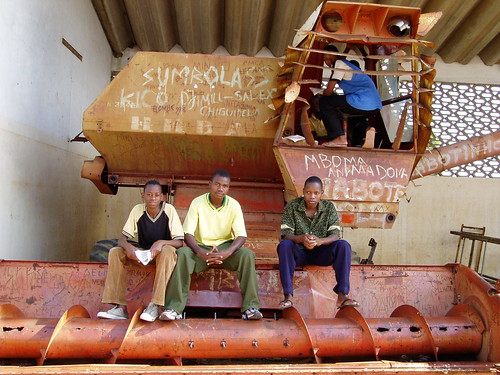
Students at Escola Agrária in Chokwé
CC Afronie
Firing up the local production of knowledge is crucial to escaping the ‘industry of development
He goes on to say:
...it appears rather obvious that few people have an interest in promoting local knowledge and knowledge in general as a key to exiting structural dependence. Rather, as Mozambican sociologist Elísio Macamo wrote, the ‘industry of development’ continues to work, and it doesn't seem to be in the interest of the leading classes to get rid of it.
More here

  • Digg
  • Del.icio.us
  • StumbleUpon
  • Reddit
  • RSS

Resource Cursed-Equatorial Guinea

Map of Equatorial Guinea
Image via Wikipedia
Tutu Alicante and Lisa Misol write in FP:
Imagine a tiny country flush with oil money, where the wealth per person is on par with that of Spain or Italy. Now picture a place quite the opposite, where nearly two-thirds of the population lives in extreme poverty and infant and child mortality rates are on par with those of the war-ravaged Democratic Republic of the Congo...impossible as it sounds, these two sentences describe the same place: Equatorial Guinea, a West African country home to roughly a half-million people. Earlier this month, the country's president, Teodoro Obiang Nguema Mbasogo, marked the 30th anniversary of the coup that brought him to power.
More here
via Pambazuka
Reblog this post [with Zemanta]

  • Digg
  • Del.icio.us
  • StumbleUpon
  • Reddit
  • RSS

Zimbabwe and Land Reform

Jeremy Cronin writes in Pambazuka News:

"We are told, for instance, that ‘land reform’(in Zimbabwe) did not succeed because the British failed to meet their financial obligations as agreed in the Lancaster House negotiations. But what kind of heroic anti-imperialist liberation movement is this? Can you imagine the Cubans arguing two decades after their revolutionary breakthrough that they had not implemented land reform because the US refused to subsidise it? President Mugabe’s demagogic ‘anti-imperialism’ is not an anti-imperialism that seeks to defend the interests of the peasantry, the workers (insofar as any remain employed) and the progressive professional and middle strata of Zimbabwe’s society (and indeed of our region). It is a pseudo anti-imperialism that seeks to defend the narrow interests of a rentier capitalist elite within Zanu-PF and the upper echelons of the state. It is a stratum that is entirely parasitic on state power. State power is used to pillage for the purposes of primitive accumulation. And remember, much of the recent socio-economic crisis in Zimbabwe dates back to the pillaging ‘peace mission’ to the DRC in the mid-1990s, which ended in bankruptcy and defeat for a once professional and proud Zimbabwean army."

  • Digg
  • Del.icio.us
  • StumbleUpon
  • Reddit
  • RSS

Debt, Despots and Domination

Chris Ngwodo writes "...we should realize that the current prominence of debt relief in international circles is driven by much more than altruism...debt relief is aimed at altering the social climates that support the spread of extremism and terror all over the third world without altering the global economic balance of power...ongoing campaign for debt relief must be articulated from the perspective of its moral economy. Much of those debts are odious because they were incurred by dictatorships which were unrepresentative of the masses now groaning under the debt burden...debt relief must be accompanied by the institution of justice in the global economic system. The pious hypocrisy of the west in championing free markets in Africa while maintaining subsidies and guarding its own markets strategically is obvious...The willingness of so many western countries and banks to receive stolen funds is as criminal as the original theft itself. The debt issue should be tied to the repatriation of Africa's stolen wealth that has been piling up in foreign vaults...African nations must look inward and tackle decisively the culture of graft that is destroying governance and impoverishing their people. It would be profound to see past leaders and government operatives being put on trial and convicted for economic crimes, theft and embezzlement..."
Via Pambazuka News

  • Digg
  • Del.icio.us
  • StumbleUpon
  • Reddit
  • RSS

Côte d'Ivoire: Descent into hell

In Pambazukablog accounts of the crisis in Ivory Coast:
cc Wikimedia
‘The fog of war clouds everything for the moment; it's impossible to tell who is responsible for what -- and against whom. But it's important to look at all sides of the fighting, because when the dust settles, Cote d'Ivoire is going to be torn apart.’
Enhanced by Zemanta

  • Digg
  • Del.icio.us
  • StumbleUpon
  • Reddit
  • RSS

Open Society Initiative for West Africa

"...OSIWA is dedicated to supporting the creation of open societies in West Africa marked by functioning democracy, good governance, the rule of law, basic freedoms, and widespread civic participation. OSIWA believes that it best serves by sustaining catalytic and innovative initiatives that add value to the efforts of West Africa's civil society. OSIWA seeks to collaborate with advocacy groups, like-minded foundations, governments and donors..." OSIWA recently launched the West Africa Democracy Radio (WADR)"...conceived to be the hub of a West African network of public, private and community radio stations, creating an avenue for networking between the radio stations and a channel for dialogue among the peoples of the respective countries they serve...",Pambazuka.

  • Digg
  • Del.icio.us
  • StumbleUpon
  • Reddit
  • RSS

Environmental Determism

Jason Hickel writes in Pambazuka:

The correlation between environment and development is indeterminate; there are many regions in the world with hostile geological and climactic characteristics that have nonetheless managed to keep from descending into inveterate poverty. Second, the theory focuses on what Africa lacks rather than what Africa has, being – among other things – vast natural resource wealth in the form of unprecedented petroleum reserves and mineral deposits. The question should not be what to do in the absence of resources, but how existing resources get used, how they are distributed, and who pockets the profits.
More here
Reblog this post [with Zemanta]

  • Digg
  • Del.icio.us
  • StumbleUpon
  • Reddit
  • RSS

Revive traditional law systems

In Pambazuka Ronald Elly Wanda makes a case for re-instituting the indigenous institution of traditional jurisprudence:

Ronald Elly Wanda
Since flag independence in the 1960s, African governments have been in a rush to normalise authoritarian rule and human rights abuses under the auspices of maendeleo (development) and economic growth. A short stroll in any African village today confirms that the globalised Western culture of justice delivery or innovation that most African leaders seem to trust has not improved the well-being of our local communities or delivered justice for them. On the contrary, it has often blocked viable indigenous innovation of cultures and suffocated African justice. Here in East Africa, cultures of innovation have largely accrued from the jua kali (informal), and not the formal sector. Indigenous cultural innovations have also been at the centre of development in most highly indebted poor countries (HIPC), such as in Uganda or its slightly richer sister Kenya, notably because of wanainchi (citizens) exceptionally limited access to capital.
As such, when it comes to delivering justice in Africa, we ought to revise our priorities by doing away with existing preconceived ideas that might have worked within the European cultural setting. They have clearly not worked in the face of the socio-cultural heritages of African societies, and neither has the opposite, the Africanisation of Western concepts of justice delivery.
More here

Enhanced by Zemanta

  • Digg
  • Del.icio.us
  • StumbleUpon
  • Reddit
  • RSS

From Activism to Politics

Kayode Fayemi writes"...The most practical way to link individual choice to collective responsibility is to participate in the institutions that influence our lives. We must ensure that formal and informal institutions are democratised and given more responsibilities for exercising state power...Renewing our democracy through the strengthening of institutions and public participation increases our collective capacity to tackle the major problems facing our society – with a corresponding achievement of individual contentment even as we pursue the common good..."
via Pambazuka News

  • Digg
  • Del.icio.us
  • StumbleUpon
  • Reddit
  • RSS

"Conspiracy of Silence"

Raila OdingaImage via WikipediaRaila Odinga the Kenyan PM recently stated:

"The African Union has fallen short, failing to condemn brutal regimes and sham elections, including the second round of elections in Zimbabwe. This has now become the norm."But we should not be surprised at the AU's failure to stand up for democracy, many of our nations' leaders have some skeletons rattling loudly in their cupboards," Odinga said...[continue reading]

via Pambazuka
Reblog this post [with Zemanta]

  • Digg
  • Del.icio.us
  • StumbleUpon
  • Reddit
  • RSS

Lessons for African leadership

Yao Graham of the Third World Network writes in Pambazuka:

...in the face of the global crisis many African governments are looking only outwards towards their ‘development partners’ rather than exploring the opportunities for deepening regional and continental cooperation and integration. The IMF is offering its pernicious advice that not much needs to change and there seem to be many in African leadership ready to listen. Meantime in the global North, pages are being torn from the rulebooks by which African economies have been run from Washington...[continue reading]

photo courtesy of the BBC

  • Digg
  • Del.icio.us
  • StumbleUpon
  • Reddit
  • RSS