
 Nigeria's Finance Minister Ngozi Okonjo-Iweala is representative of a new type of African leader.A reformer and technocrat commenting on Nigeria's Oil based economy she stated "...The fact also that you have a natural resource-based economy that is highly dependent on one commodity - oil. I think that is not the best thing that has happened to us as a country because it is difficult to apply the resources that come from this natural resource in a way that takes into account this complexity or groups, religion and so on. And I don't think that the country can really move forward until a good formula is worked out to be able to apply the country's human and natural resources in the best way possible that can be accepted by everybody as being fair...any development in the country has to take into account the need to diversify from oil. I don't think the country can really move forward unless we are able to find a way to develop other sources of income or find other sources of growth for the economy apart from oil...Thus there are two issues - one, applying the resources that we have appropriately and secondly finding means to diversify the economy, which is very vital. And part of managing the resources that we have appropriately is also trying to deal with the enormous burden of debt which the country has, that amounts to $28 billion..."In a paper presented at the The Global Economic Governance Programme she listed the continuing challenges facing Nigeria they include Sustainability,Vested interests,Quick results and Globalization.
Ngozi Okonjo-Iweala


The Resource Curse and Democracy
In a paper Leonard Wantchekon & Nathan Jensen
...present empirical evidence suggesting a robust and negative correlation between the presence of a sizeable natural resource sector and the level of democracy in Africa. We argue that not only is resource abundance is an important determinant of democratic transition, but also partially determines the success of democratic consolidation in Africa. The results illuminate the fact that post-cold war democratic reforms have been successful only in resource poor countries such as Benin, Mali, and Madagascar. We argue that resource-rich countries such as Nigeria and Gabon can become democratic only if they introduce strong mechanisms of vertical and horizontal accountability within the state.More here(pdf)
![Reblog this post [with Zemanta]](http://img.zemanta.com/reblog_e.png?x-id=7606f7c9-ef0a-48ab-b276-ab473ad72b7d)
Getting Resource Extraction Right
Paul Collier writes in ANSA:
...as the radically different trajectories of Botswana and Sierra Leone illustrate, growth based on resource exports is critically dependent upon the quality of public choices. A long chain of decisions has to be got right, not just once but repeatedly for a generation. The upstream part of the decision chain involves reconciling strong incentives for prospecting with capturing as much as possible of the resource rents for society. This requires overcoming acute problems of agency, of time-inconsistency, and of asymmetric information. As the Niger Delta and the Gulf of Mexico demonstrate, it also requires the effective restraint of environmental damage.More here
The downstream part of the decision chain is about harnessing revenues for sustainable growth. Resource revenues need to be treated distinctively: they come from the depletion of a natural asset and should be substantially offset by the accumulation of other assets. The only European model of prudent use of resource revenues is Norway, but the Norwegian model is inapplicable for Africa. Norway has more invested capital per member of the labour force than anywhere else on earth, whereas Africa has less. Hence, whereas it is appropriate for Norway to accumulate foreign financial assets, Africa needs to invest domestically

"Extracting Intelligence from its People"
Thomas Friedman writing in the NYTimes, contrasts the oil based economy of Iran and the knowledge based society of Israel. African natural resource obsessed countries should take note,In Israel:
The economy is exploding from the bottom up. Israel’s currency, the shekel, has appreciated nearly 30 percent against the dollar since the start of 2007.
The reason? Israel is a country that is hard-wired to compete in a flat world. It has a population drawn from 100 different countries, speaking 100 different languages, with a business culture that strongly encourages individual imagination and adaptation and where being a nonconformist is the norm. While you were sleeping, Israel has gone from oranges to software, or as they say around here, from Jaffa to Java.
Meanwhile:
Iran has invented nothing of importance since the Islamic Revolution, which is a shame. Historically, Iranians have been a dynamic and inventive people — one only need look at the richness of Persian civilization to see that. But the Islamic regime there today does not trust its people and will not empower them as individuals. ...Iran’s economic and military clout today is largely dependent on extracting oil from the ground. Israel’s economic and military power today is entirely dependent on extracting intelligence from its people. Israel’s economic power is endlessly renewable. Iran’s is a dwindling resource based on fossil fuels made from dead dinosaurs.
Quick Hits
Sierra Leone's tourism promise and more-Tony Blair
Barclays Bank up to more fishy stuff?
A bid to strengthen Think Tanks.
Is corruption in Nigeria's DNA?
A tour of Nairobi.
Writing off sovereign debt and hampering growth-Thompson Ayodele in the Telegraph
Can we rein in the destabilizing effects of Natural Resources? Perhaps with the Natural Resource Charter contends Paul Collier.
Taju Tijani asks, where are the Black British Millonaires?
How Corporate America Really Views Africa.
The Guardian compares their Katine village project with MVP's. They should take a look at the Working Villages and learn from the successes of Songhai Centre.
Plowing the Sea
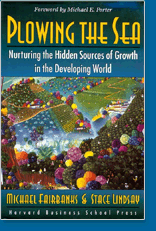 In Plowing the Sea "...Michael Fairbanks and Stace Lindsay argue that the tremendous advantages developing nations have in natural resources, inexpensive labor, and fertile soil have actually kept these nations poor. Their advantages — easily imitated in other areas around the world — have not been sufficient engines for growth. Billions of dollars have been spent to eradicate poverty; still these regions remain as dependent as ever on volatile natural resource exports and foreign aid. Plowing the Sea is the authors’ attempt to unearth and nurture the hidden sources of growth — knowledge, innovation, and human capital — that remain untapped in developing countries..."
via On The Frontier
Thanks Gilbert Porku!
Why America Declines and the 2012 Decision
Victor Davis Hanson wrote an article last week that was powerful and insightful called America in Decline? I have pondered on it over the last couple days, and think that the most important piece of the article was the reasons why America is declining and whether or not this will continue. Read the whole article, but here is the part to ponder the most:
Consider the following areas in which America is said to be in trouble, but in fact could easily surmount the present difficulties.Victor Davis Hanson may be an expert with a slew of degrees and be a member of the Hoover institution, but you don't have be a genius to see his point- that policies that liberals, Democrats, progressives, 'moderate' Republicans, and others are pushing on debt, energy, national security, immigration, and entitlements are bad DECISIONS- they are policies that are based on false assumptions regarding human nature and the role or abilities of government and they are policies based on theories of economics (Keynesian) or the environment (AGW) that are unproven at best and dangerous at worst.
Debt. In 1999 Americans worried about the specter of paying off the debt and transmogrifying to creditor status. There are trillions of dollars produced annually in this country; it is a matter of redirecting the economy from consumption to savings, and to wealth creation from redistribution. The years 2004-2005 seemed bountiful when the federal budget was a mere $2.3 trillion. Go back to those spending levels and the administration could more or less balance the budget. If we had a leader willing to cut expenditures and ignore the furor, we could pile up surpluses rather quickly. The present fiscal policy is a choice to embrace redistribution and decline, not a result of innate unproductivity, resource depletion, strikes, and factional strife.
Energy. Known reserves of natural gas just keep getting larger. The amount of oil in the Dakotas, in Texas, in Alaska, and offshore climbs too, even as cars are getting more efficient and new hybrids become more practical. There is enough natural gas (and its derivatives) to quite easily power a quarter of our fleet for a century or more. Should Americans have a president who wished to drill, utilize natural gas as a transportation fuel, and downplay subsidizing "millions of green jobs," the nation could do wonders on the energy front. Each barrel produced here rather than imported from Saudi Arabia means more money, more jobs, and enhanced national security. Asking other governments to pump more oil, whether Brazil or Saudi Arabia, even as we insist that drilling and supply have no effect on prices, shows that Americans prefer to become more indebted and dependent. Again, that is a choice, not a fate.
National security. Despite all the talk of al Qaeda, the Bush anti-terrorism protocols—derided and then embraced and expanded by Obama—coupled with the terrible toll we took on Islamists in Anbar, Iraq, and in Afghanistan, have meant that radical Islam is far weaker than it was in 2001, and we far stronger. Osama bin Laden is now dead; and his organization in disarray. We are still spending less than 5 percent of GDP on defense. If we were to develop a strategic, consistent policy of bestowing our alliances and friendship on those who shared either our values or our notion of security, we could easily regain our strategic preeminence, rather than "leading from behind."
Immigration. Close the border, before addressing other immigration issues. We should institutionalize employer fines, finish the fence—and predicate legal entry into the US not on race, nearness to the border, or the number of relatives in America, but on skills and capital. America would experience a renaissance if it were to end 500,000 illegal entries and replace them with 250,000 legal entries based on education and expertise, not national origin, proximity, or family connection. Immigration could be one of our greatest strengths, rather than a continual effort to bolster political constituencies. Apparently, self-supporting, highly educated, confident immigrants from all regions of the globe are not this administration’s natural constituents, and therefore of no value politically.
Entitlements. Whether we adopt the Simpson-Bowles commission’s analysis, raise the retirement age, or follow Rep. Paul Ryan’s recommendations, there is a little discussed truth: with reasonable reforms, we can make Social Security solvent and still support retired citizens in finer fashion than was true ten years ago. Borrowing to spend is a mood, a state of mind, not a death sentence.
But these policies had real effects, bad effects that have weakened our nation and moved us closer to tyranny and father from liberty and freedom. The road to bad policies are always paved with good intentions, so those who are pushing these policies are not bad people and those who are opposing these policies are not necessarily good people- but the point remains that society is not advanced when power and authority and responsibility is moved away from people to a far-distant bureaucrat who is given wealth and sustenance by taking it from the labor of others through taxes or fees or whatever.
But these policies can be reversed by other policies, policies that emphasize life, liberty, and the protection of property. These sort of policies are usually pushed for by Republicans, particularly libertarian and conservative members of the Republican Party, who are aided and supported by other Republicans and moderate or conservative Democrats. It is to the Tea Party or right wing of the Republican Party that our nation must look to for leadership, to their policies, however imperfect they are, to overturn the bad policies of the past.
On debt, energy, national security, immigration, and entitlements, the Democratic Party is pushing for the wrong policies and the Republican Party is pushing for the right (or the less-wrong at least) policies.
Read the whole article- it is very good, and I have only touched on a portion of it.
#. Best Buy New Bamboo: Architecture and Design For Sale
New Bamboo: Architecture and Design Lowest Prices
Cheap Price !! Lowest Price Here For Buy New Bamboo: Architecture and Design. This Store is the best place to buy cheap New Bamboo: Architecture and Design. If you want to buy New Bamboo: Architecture and Design in the best price, try to see specail offers or read the best customer reviews from this page. That can help you to make easy decision to buy this product. This product Shipped and Sold by Amazon Shopping Store. Usually ships in 1-2 business days This item ships for FREE with Super Saver Shipping. Order The Best price From This Page - Read more Informations by Click at the Big Links.
|
| |||||||||||||||



Overview New Bamboo: Architecture and Design 
Available : In Stock. | |
 | |
FREE with Super Saver Shipping Usually ships in 1-2 business days | |
|
#. Best Buy New Bamboo: Architecture and Design Best Price
New Bamboo: Architecture and Design Deals Sale on Best Price
Cheap Price !! Lowest Price Here For Buy New Bamboo: Architecture and Design. This Store is the best place to buy cheap New Bamboo: Architecture and Design. If you want to buy New Bamboo: Architecture and Design in the best price, try to see specail offers or read the best customer reviews from this page. That can help you to make easy decision to buy this product. This product Shipped and Sold by Amazon Shopping Store. N/A This item ships for FREE with Super Saver Shipping. Order The Best price From This Page - Read more Informations by Click at the Big Links.
|
| |||||||||||||||
Overview New Bamboo: Architecture and Design
Available : In Stock. | |
| |
FREE with Super Saver Shipping N/A | |
|
"The Bright Continent" by Dayo Olopade
The Bright Continent will report a phenomenon that is not new but has been overlooked: that people are Africa’s most abundant natural resource, and that a long tradition of individual resourcefulness, creativity, and straight hustling is the best hope for the continent’s social and economic development.The book takes inspiration from the massive failures of the traditional aid industry—and from the promise of the guys selling Christmas trees in Lagos traffic.


#. Buy Lowest Price !! See Lowest Price Here Cheap New Bamboo: Architecture and Design On Best Price
New Bamboo: Architecture and Design Lowest Prices
Buy in Cheap Price Shopping Online !! See Lowest Price Here Cheap New Bamboo: Architecture and Design. This Store is the best place to buy cheap New Bamboo: Architecture and Design. If you want to buy New Bamboo: Architecture and Design in the best price, try to see specail offers or read the best customer reviews from this page. That can help you to make easy decision to buy this product. This product Shipped and Sold by Amazon Shopping Store. Usually ships in 1-2 business days This item ships for FREE with Super Saver Shipping. Order The Best price From This Page - Read more Informations by Click at the Big Links.
|
| |||||||||||||||
Overview New Bamboo: Architecture and Design
Available : In Stock. | |
| |
FREE with Super Saver Shipping Usually ships in 1-2 business days | |
|
Environmental Determism
Jason Hickel writes in Pambazuka:
The correlation between environment and development is indeterminate; there are many regions in the world with hostile geological and climactic characteristics that have nonetheless managed to keep from descending into inveterate poverty. Second, the theory focuses on what Africa lacks rather than what Africa has, being – among other things – vast natural resource wealth in the form of unprecedented petroleum reserves and mineral deposits. The question should not be what to do in the absence of resources, but how existing resources get used, how they are distributed, and who pockets the profits.More here
![Reblog this post [with Zemanta]](http://img.zemanta.com/reblog_e.png?x-id=8c47480f-8d28-42f8-8a5b-21026a564710)
The 'Nigerian Disease'
In PSD Blog:
Recent work suggests another explanation of the resource curse – the Nigerian Disease. That is, an abundance of natural resources leads to poorer governance and conflicts. It gives rise to governments that are less accountable to the people, have little incentive for institution-building, and fail to implement growth enhancing reforms. Higher corruption, more rent-seeking activity, greater civil conflict, and erosion of social capital are some of the outcomes associated with the Nigerian Disease (see, for example, Rosser 2006). While it too early to draw any definitive conclusion on the relevance of the Nigerian Disease, the early results do suggest a possible way out of the resource curse - greater emphasis on institution-building and government accountability...[continue reading]
Hat Tip Pragnya!
![Reblog this post [with Zemanta]](http://img.zemanta.com/reblog_e.png?x-id=d827664b-b438-4c0f-88cf-c16d727f4d62)
'Leadership' in Africa
There is a great deal wrong in Africa. The continent has the highest ratio of internally displaced people in the world, we generate more refugees than any other continent, and we are poorer now than we were before independence.
We are the Aids capital of the globe and our life expectancies are retreating on a scale seldom seen in history.
Why?
It’s not for lack of resources – we have those in abundance and if we rated Africa on the basis of population to its natural resource base we would find ourselves at the top of the log. It’s not for a lack of energy – we are now a major producer and exporter of oil, we have vast reserves of coal and hydroelectric potential to light the continent for decades to come. It’s not for a lack of aid from richer countries – many States in Africa draw up to half their annual budgets from donors in the West. Per capita we are one of the largest recipients of aid in the history of the world
The reason for all these problems lies not in our history nor in the predation of industrial economies, it lies in our leadership.
via Enough is Enough
The 'Africa effect'
A research team led by Robert H. Bates of the Africa Research Program found that:
African governments were instrumental in inhibiting the growth of their own economies in the late 20th century, according to a decade-long project conducted by African scholars and economists. Robert Bates, professor of government in Harvard’s Faculty of Arts and Sciences, has been immersed in this economic survey, helping the economists to understand that governmental role....whatever the material situations of various African states — whether resource-scare or resource-rich, land-locked or coastal — each economy grew more slowly in Africa than it did in counterpart economies elsewhere in the world. In fact, without the “Africa effect,” they found that no natural obstacle would have prevented coastal African countries from growing at the same rate as Asian countries such as Mauritius or Thailand
Getting it wrong in Liberia and How to get it right
In the NYTimes Daniel Bergner writes about the rule of Africa's first female president.
On corruption:
“We can’t stamp it out, not yet,” Sirleaf said to me, clenching her fists in frustration over the country’s bone-deep corruption. She spoke of being torn between firing every transgressing official and keeping enough ministers and staff members at their desks so the government can go on operating, no matter how badly it is compromised. And meanwhile, unemployment in the country, whose population shifted heavily to Monrovia during the war, stands as high as 85 percent by some estimates. Instilling faith that Liberia’s economic wasteland can be redeemed, however gradually, may be the only way to ensure long-lasting peace, especially with the U.N. troops expected to start pulling out after next year’s elections. Over the radio, Sirleaf put the emphasis on gradually. “I beg you I no magician,” she said, letting a plea seep into her lecture. “I can’t just wave a magic wand.”Regarding the country's options from a value-add perspective:
Liberia’s natural resources just aren’t in high-enough demand around the world to spur the economy and generate much public revenue. Firestone is providing the government with $4.7 million this year, Sirleaf estimated. To truly take advantage of its iron, rubber and timber, Liberia would have to manufacture things with them; it would have to export finished products rather than raw materials. And it can’t; the country is all but preindustrial...[continue reading]We would disagree on this last point of being "preindustrial". Liberia does have innovation assets that lie in plain view. Like every other African country its makers and innovators are largely overlooked while emphasis is placed on largely unsustainable initiatives. From building up is nascent market gardeners, training a techie workforce to building its tourist assets we dispute the uninformed claim that that salvation lies in oil based resource extraction.
Prostitutes Offer Free Sex to Climate Summit Delegates
From Spiegel Online- Prostitutes Offer Free Climate Summit Sex:
Copenhagen's city council sent postcards out to 160 Copenhagen hotels urging guests and delegates to the UN Climate Summit to 'Be sustainable - don't buy sex'.Let me state for the record that I do not in any way approve of prostitutes or frequent prostitutes. That being said, I don't understand the position of the Copenhagen city council- why is buying sex not sustainable? Sex is a renewable resource. When two people engage in it, it does not create a large carbon footprint. By paying for sex, money is transferred to poor and young people in society, which is usually what is meant by being 'sustainable.' It is a natural way to heat up the night without burning any sort of fuels. In every way that I can think of, it seems sustainable. Am I missing something?
In response, Copenhagen prostitutes are up in arms, saying that the council has no business meddling in their affairs. They have offered free sex to anyone who can produce one of the offending postcards and show their Summit identity card, as a way to reward those who disobey the city council.
What I also want to know is if the postcards that were mailed to the guests were printed on recycled paper and whether or not they were carried by environmentally friendly birds, or whether they were heavy glossy affairs sent around the world by gas-guzzling jets.
Also, why is this a problem now? Is frequent visits to prostitutes not a problem when conservative, Republican, libertarian, or right-wing groups visit Copenhagen? Or is there a considerable and noticeable uptick in business only when liberal, leftist, global warming believers arrive? It's odd- why would a postcard like that go out unless it this particular group was perceived as being a particular problem.
I guess these questions will have to remain unanswered, much like the larger question about whether or not the Earth is warming or not.
Françafrique and Dicatorship
Khadija Sharife in FPIF writes:
The portrayal of Africa's strong-arm leaders as lone rangers obscures the system underpinning the dictatorships and delinks dictators from their primary source of sustenance. The rhetoric of French-controlled development endorsed by Bongo is a subset of France's postcolonial Africa policy — Françafrique — designed to create structural dependence and domination by reasserting geostrategic control over natural resources through the use of black "governors." The pulse of the Françafrique ideology — fric is slang for cash — is rooted in shadow economies sustaining respectable corporations, various intersecting shadow networks, secret services, private lobbies, and political and diplomatic relationships between the official and unofficial political elite. These forces are individually and collectively able to mobilize substantial economic, political, and military support.
More here
via Pambazuka
![Reblog this post [with Zemanta]](http://img.zemanta.com/reblog_e.png?x-id=efb5daea-111e-4497-b6fd-ef135111c3b3)