RSS
Menampilkan postingan yang diurutkan menurut relevansi untuk kueri resource. Urutkan menurut tanggal Tampilkan semua postingan

Getting Resource Extraction Right

Paul Collier writes in ANSA:

...as the radically different trajectories of Botswana and Sierra Leone illustrate, growth based on resource exports is critically dependent upon the quality of public choices. A long chain of decisions has to be got right, not just once but repeatedly for a generation. The upstream part of the decision chain involves reconciling strong incentives for prospecting with capturing as much as possible of the resource rents for society. This requires overcoming acute problems of agency, of time-inconsistency, and of asymmetric information. As the Niger Delta and the Gulf of Mexico demonstrate, it also requires the effective restraint of environmental damage.
The downstream part of the decision chain is about harnessing revenues for sustainable growth. Resource revenues need to be treated distinctively: they come from the depletion of a natural asset and should be substantially offset by the accumulation of other assets. The only European model of prudent use of resource revenues is Norway, but the Norwegian model is inapplicable for Africa. Norway has more invested capital per member of the labour force than anywhere else on earth, whereas Africa has less. Hence, whereas it is appropriate for Norway to accumulate foreign financial assets, Africa needs to invest domestically
More here
Enhanced by Zemanta

  • Digg
  • Del.icio.us
  • StumbleUpon
  • Reddit
  • RSS

The Resource Curse and Democracy

In a paper Leonard Wantchekon & Nathan Jensen

...present empirical evidence suggesting a robust and negative correlation between the presence of a sizeable natural resource sector and the level of democracy in Africa. We argue that not only is resource abundance is an important determinant of democratic transition, but also partially determines the success of democratic consolidation in Africa. The results illuminate the fact that post-cold war democratic reforms have been successful only in resource poor countries such as Benin, Mali, and Madagascar. We argue that resource-rich countries such as Nigeria and Gabon can become democratic only if they introduce strong mechanisms of vertical and horizontal accountability within the state.
More here(pdf)


Reblog this post [with Zemanta]

  • Digg
  • Del.icio.us
  • StumbleUpon
  • Reddit
  • RSS

The 'Nigerian Disease'

In PSD Blog:

Recent work suggests another explanation of the resource curse – the Nigerian Disease. That is, an abundance of natural resources leads to poorer governance and conflicts. It gives rise to governments that are less accountable to the people, have little incentive for institution-building, and fail to implement growth enhancing reforms. Higher corruption, more rent-seeking activity, greater civil conflict, and erosion of social capital are some of the outcomes associated with the Nigerian Disease (see, for example, Rosser 2006). While it too early to draw any definitive conclusion on the relevance of the Nigerian Disease, the early results do suggest a possible way out of the resource curse - greater emphasis on institution-building and government accountability...[continue reading]

Hat Tip Pragnya!

Reblog this post [with Zemanta]

  • Digg
  • Del.icio.us
  • StumbleUpon
  • Reddit
  • RSS

15 Fantastic Ways to Use Flipboard

Home Screen of my Flipboard
Flipboard is a phenomenal reading app for the ipad and was the big reason I begged my family to give me one for my birthday.

However, because so little content is really produced FOR the flipboard, you have to know how to add it. You only get two screens of content (for now) so use it well.

To get Started...
To follow these instructions, you'll need to download Flipboard onto your iPad.

A look at what is on my flipboard....
Before we begin, let's take a look at screenshots of my two Flipboard screens. The sources of information are printed in the top left corner of each board.


 Sharing from Flipboard
Before we get to the reading part, you can share content within Flipboard.  

What you can do depends upon the content source. If you're reading from Facebook, your like and comment buttons show. If you're reading from Twitter, you have retweet, retweet with comment and favorite. Google reader gives the sharing features available in reader.

But, Flipboard's "Button of power" is always in the top right hand corner of any screen. This "share" button lets you send the link to any of the social media sites you have set up. (For me, it is Twitter, Blogger, and Google Reader.)


Adding Content
The Add a section button is shown beside the arrow.
To add content, you just click on the blank gray square on your starting screen that says Add content. Admittedly, I've deleted over half of what I've added as I've played with Flipboard. If the content isn't updated or not quite right, it isn't usable.

For educators, I'll recommend the educator link or item. For non-educators, I'll give pointers on how you can find something similar in your professional arena.


15 Fantastic Use of Flipboard.

1 - Twitter Feed
Subscribe to your own twitter timeline. Flipboard will make the tweets and turn it into a lovely magazine. It is interesting to see the different nature of your twitterstream depending on the time of day. I find more teachers tweet after school hours (understandably so) and admins seem to tweet DURING school hours. (Interesting study waiting to happen on that one.)  

Flipboard from @coolcatteacher Twitter stream (what those I have friended are writing.)
There are many now who are unfollowing on Twitter en masse as they try to improve their "Klout" score, however, I want to follow just about anyone in education and especially teachers. There is a certain random beauty that emerges from this and I "drill down" to my friends by using lists. It is all about why you Twitter but Flipboard makes it easy to read whatever your motivations or reasons. 

 How to add: Click Add and add an account and set up your Twitter Account.

2 -  Twitter Lists
So, if you follow a LOT of people, you can also slice this down to a smaller group by making a twitter list. You'll have to publish it and then subscribe. If it is public, you'll need to know the name of the list but if it is private you can make a list of your closest friends and follow that way.

This is also a great way for those who hate twitter and will not use it to harness the power by finding a list of people from a credible source to follow. (I kind of like chalkstars.)

How to add: Search for the name of the twitter list (it must be public) and then scroll down to the "Twitter Lists" section if it is for someone else. Otherwise, after you've added Twitter, just click on Add Section and click Twitter and then you can add your own lists.

3- Twitter Hashtag - #edchat
My favorite Twitter based flipboard magazine for educators is from #edchat. Just type #edchat in the search and scroll down to follow the hashtag. If you are in another field, you should look at the common hashtags in your field. When you attend conferences, you may want to have a temporary Flipboard "magazine" for that hashtag. (like #iste11).

#edchat hashtag on Twitter is one of the best feeds to compile on Flipboard.
How to add: Type #edchat (or any other hashtag) Scroll down to the Twitter Search Section and subscribe to "tweets mentioning #edchat"

4 - Other Twitter Features
You can follow tweets mentioning you, saved searches, your lists, lists you follow, lists following you, people you follow, and people following you! So many things. My advice is to be strategic. Your Flipboard should meet a need and should evolve.

How to add: After you've added Twitter, click on Twitter after you add a section and then select what you'd like to add.

5 - Google Reader
Subscribing to all of your google reader will bring everything mixed together. It makes for interesting reading and customized magazine of sorts.

How to Add: Click Add Section and then add the network and subscribe to it.

6 - Google Reader Folder
I have a folder called @hotlist that includes the blogs I want to make sure that I read almost every day. This is on my flipboard. I also follow a folder labeled @freecoolstuff that includes some RSS feeds that scrape information about free things for educators and my classroom.

How to add: Click Add section and then click Google Reader (if you added it for #4 above) and then click Subscriptions. You can then pick a folder in your google reader. If you don't have a folder, you'll need to go to http://reader.google.com on your web browser and set them up.

7 - Public Nings
I subscribe to the Flat Classrooms ning to pull out current content. I'm still working on this as I'm not sure how the RSS is coming out of the Ning - sometimes it has older things.

How to add: Click Add Section and then type in the URL - this one is http://flatclassrooms.ning.com - Again, I'm working on this one. You could also use the specific RSS feed for what you want to follow on that topic.

8 - My own Blog
I am learning about how things deploy into Flipboard, so I follow my own blog. If you blog, you follow yours.

How to Add: The fastest way to add this is to type the url in flipboard. Mine is http://coolcatteacher.blogspot.com


9 - Any school or classroom blog that is published publicly.
I subscribe to my school's blog at http://westwoodschools.blogspot.com to follow the content and to show parents how it is done. I plan to write a blog post to show them how as it is so easy to read school news that way. I also have http://digiteendreamteam.blogspot.com a blog run by some of my ninth graders.

This is a great tip for administrators who are nervous about their students producing public content as it is easy to read and respond.

How to Add: Type the URL in flipboard and subscribe.

10 - Best of a Diigo Group
The educators group on Diigo is one of my favorite go-to places for information. (See instructions for how to join properly or you will be delayed in the approval process. spammers beware.)

How to Add: To subscribe, I typed in educators and diigo and then it found the diigo group. The group must be public.

11- Education AllTop
The alltop education resource is one of the best. Founded by Guy Kawasaki, if you are in education, this is a must add to your flipboard. There are alltops in many subjects - go to www.alltop.com. Great flipboard content.

How to Add: Type education alltop and find it or http://education.alltop.com

12 - Resource Sharing Blogs (OL Daily)
Frequently updated resource sharing blogs make excellent flipboards. Stephen Downes is in this category for me. I want to read pretty much everything he links to because it is a wide variety and "he can't be bought." I typically don't subscribe to advertising-type blogs in this category because I've found it gets cluttery.

How to Add: Type in the URL or search for the person's name.

13- Your Facebook News Feed
Add Facebook and Follow everything that comes through your network.

How to Add: Add a network and then subscribe.

14  Photos that Tag You
You can subscribe to all photos on Facebook that tag you in them. (Honestly, if you had the userid and password for a person you could subscribe to the photos they are tagged in - like your younger children. You'd just have to promise not to comment. ;-))

How to Add: Add a network and then click Facebook and choose "Photos of You"

15 - Other Important Things in Facebook 
(Groups, Your Wall, Friend Lists, Pages, Friends, News Feed Links, News Feed Photos)
You can drill down facebook in many ways. This is great for school who want to have a Facebook page but need to keep an "eye" on things.

How to Add: Click Facebook and drill through the menus. There is more there than can be added to a flipboard.

Let it Flow and Evolve
You are a human being bounded by finite time and attention spans. You are not infinite so you must focus your energy in ways that pay powerful dividends.

If a Flipboard isn't useful, delete it. It is better to have 3 useful boards than 2 screens of things that distract you.

Delete What Doesn't Work
For that matter, if you hate Flipboard, delete it. Any device no matter how useful can be a productivity killer if it becomes the master and not the servant.

This is your life. It is your job to have the self discipline to focus your time and energy on what is important to you.

This is Your Life!
When I turned 42 this past Monday, I was running on the track and saw the sprinkler system come on the football practice field. Instead of staying on the track, every time I came close to the sprinkler - I ran through it. It felt great! As I listened to my ipod I heard the words:

"It's my life. Now or never. I ain't gonna live forever. I just gotta live while I'm alive."

Life is changing rapidly as we replace desktops with tablet  and mobile devices faster than most can comprehend.

Look for the tools and things that add to your life. If it doesn't add to it, delete it. This is your life! I think Flipboard adds to mine! Enjoy!

Enhanced by Zemanta

  • Digg
  • Del.icio.us
  • StumbleUpon
  • Reddit
  • RSS

...why Africans can't speak for themselves?

Bunmi Oloruntoba of Bombastic Elements asks?:

...why Africans can't speak for themselves. Well, no African I know of has that degree of media enabled celebrity to combine with advocacy in order to amass the amount of soft power it takes to leverage and access political power in ways the Bonos, Geldofs, Brajelinas, Oprahs and others can. That's why they do the talking to the donors on our behalf and what I guess we find annoying, apart from them, is the how aid to Africa, under late capitalism, works better for them rather than us.
It's time to start thinking of the poverty fighting industry like we are learning to think of Wall Street, credit default swaps and the whole industry of debt creation; like the director of "Enjoy Poverty," Renzo Martins, alludes to, Africa's poverty is now a resource and it is those who have accumulated massive amounts of soft power that can leverage this resource to, on one hand, fight the same poverty, and on the other hand do with it whatever
More here
Reblog this post [with Zemanta]

  • Digg
  • Del.icio.us
  • StumbleUpon
  • Reddit
  • RSS

Ngozi Okonjo-Iweala

Nigeria's Finance Minister Ngozi Okonjo-Iweala is representative of a new type of African leader.A reformer and technocrat commenting on Nigeria's Oil based economy she stated "...The fact also that you have a natural resource-based economy that is highly dependent on one commodity - oil. I think that is not the best thing that has happened to us as a country because it is difficult to apply the resources that come from this natural resource in a way that takes into account this complexity or groups, religion and so on. And I don't think that the country can really move forward until a good formula is worked out to be able to apply the country's human and natural resources in the best way possible that can be accepted by everybody as being fair...any development in the country has to take into account the need to diversify from oil. I don't think the country can really move forward unless we are able to find a way to develop other sources of income or find other sources of growth for the economy apart from oil...Thus there are two issues - one, applying the resources that we have appropriately and secondly finding means to diversify the economy, which is very vital. And part of managing the resources that we have appropriately is also trying to deal with the enormous burden of debt which the country has, that amounts to $28 billion..."In a paper presented at the The Global Economic Governance Programme she listed the continuing challenges facing Nigeria they include Sustainability,Vested interests,Quick results and Globalization.

  • Digg
  • Del.icio.us
  • StumbleUpon
  • Reddit
  • RSS

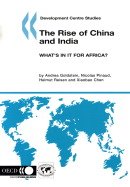
China and India: What's in it for Africa?

A summary of the OECD publication "The Rise of China and India - What's in it for Africa" makes a number of points:

In order to avoid being trapped into the unpromising corner of vulnerable, capital-intensive and high-risk raw material dependence, resource-rich Africa will have to balance the need to match the promotion of job-rich sectors with the desire to capitalise on a windfall gain generated by higher commodity prices. Monetary authorities will have to lean against the real currency appreciation in order to avoid burdening industries competing with imports, and exporters outside the resource sector. Central banks need to be supported by fiscal authorities, which are required to limit public spending on services and construction to keep non-tradables prices in check.Investment abroad of export proceeds will further insulate the local economies from ‘DutchDisease’ effects.
Furthermore, in low-tech activities like clothing or footwear, growing FDI into China and India is likely to crowd out investment in Africa, although geography and preferential tariff treatment may still provide some African countries with a competitive edge. Head-on competition, however, is unlikely to be the main channel through which the Asian drivers impact on FDI flows into (and out of) Africa.

  • Digg
  • Del.icio.us
  • StumbleUpon
  • Reddit
  • RSS

Teachers Pay Teachers

This isn't really a technology-in-the-classroom post; this is more of a teacher-resource post. But I have to talk about it because I think it is amazingly awesome! Teachers Pay Teachers (TpT for short) is, hands down, the best educational resource I've ever found. A mentor teacher introduced this website to me in 2009 and I have been using it steadily ever since. Seriously, I cannot say enough good things about Teachers Pay Teachers!

TpT

Teachers Pay Teachers is an online forum for teachers to sell and purchase classroom materials. These may be "real" materials (shipped to you), but most appear as digital documents that are usable as soon as they're downloaded. A ton of the downloadable material is free, but there are some documents you need to pay for. You can be choosy with what you spend money on (I certainly am!) and still get quality materials. There are exams and worksheets, of course, but there are also more creative documents, as well. I found several "character facebook page" assignments, literature BINGO assignments, in-class courtroom trial assignments..you name it! So it's not just "Turn to page 20 and decipher the meaning of line 19" kind of junk.

Another feature I love: you can become a seller in mere minutes. I used to be only a buyer (that account is free). But after I started teaching 8th grade ELAR, I realized that I made ALL of my own projects and worksheets, so why not post them and try to help out other teachers while simultaneously making myself a little ca$h? So I converted my buyer account to a basic seller account (also free) and began posting products. Teachers Pay Teachers takes about a 40% cut from your earnings on a basic seller account, but even with that being deducted, I've still made as much as $80 in a quarter! (Teachers Pay Teachers pays you 4 times per year unless you make an astronomical amount...then you get a check once your earnings hit x amount of dollars.) You can upgrade your seller account ($60 a year isn't bad!) in seconds and then take home around 90% of the earnings, so it's customizable in a way that I enjoy. Why don't you check out my personal TpT page to get acclimated with the site?


One more feature that is pretty nice: Lesson Plans On Demand (LPOD). Teachers post lesson plans (or unit plans) that they need quickly but aren't willing to create or track down themselves. If the lesson/subject suites you, you could create a LPOD for someone and make a pretty penny! If you find yourself in the middle of a planning pickle during the year, you can benefit from LPOD, too!  

If you make your own classroom materials, definitely post your stuff on Teachers Pay Teachers and make a little money off of it! (I mean, if you're going to make your stuff anyway, why not make some moo-lah, too?!)

If you're a person who is constantly looking for more materials (PowerPoints are available here, too!), sign up for a buyer account.

If you decide to sign up, I encourage you to use my referral link! http://tiny.cc/z02yp It helps me out a little. :)

You will not regret using this website!!

  • Digg
  • Del.icio.us
  • StumbleUpon
  • Reddit
  • RSS

Commodity Resource - African Footballers

We have highlighted the commodity resource characteristics of football players within the continent.I would like to ask, why cant we build up an African football space comparable to South America's professional leagues with all its consequent non-material and financial benefits? John Wilson expands on the African state of affairs in the Guardian:
Image courtesy of orble
...there's something distasteful about an economic system that means the best players from Africa, if they're to be properly remunerated, have to move to a different part of the world to perform for western Europe's benefit. That's true of other parts of the globe, of course, but the economic imbalance isn't as stark and, elsewhere, doesn't have the same awkward echoes of colonial exploitation.

Talk of a new slave trade is unhelpfully emotive, but there is an unpleasant traffic in vulnerable and often naive young players, and it seems hard to deny that the demands of the European market have shaped the tactical development of African football. Tom Vernon, who runs an academy near Accra in Ghana and scouts for Manchester United, speaks of the "Pape Bouba Diop" template: having seen the success of big, muscular west African players, clubs go to west Africa looking for more big, muscular players and so that sort of player is prioritised, something that in part explains the dearth of west African creative players in the decade between Abedi Pelé, Jay-Jay Okocha and Kanu and the emerging generation of Kwadwo Asamoah, Dede Ayew and Gervinho.

It even suits the football administrations of individual countries within Africa to pretend that all is well, that things are developing. Not to do so, after all, would be to admit failure, and to do that would be to risk the sinecures that bring wealth, prestige and influence. The myth of Progress is sustained by a conspiracy of the complacent and the self-interested.
More here

  • Digg
  • Del.icio.us
  • StumbleUpon
  • Reddit
  • RSS

South Africa's Resource Curse

Moeletsi Mbeki writes in the New Statesman:

At least a quarter of the South African population receives social grants that would not be possible if South Africa were not mineral-rich. Without mineral wealth to redistribute, the government would have to work harder and be more creative to find solutions to unemployment and poverty.Resource wealth makes it possible for the government not to have to put an effort into redeveloping the economy to create more jobs, and instead it sustains the unemployed and their dependants with social grants.

via African Path

  • Digg
  • Del.icio.us
  • StumbleUpon
  • Reddit
  • RSS

"Extracting Intelligence from its People"

Thomas Friedman writing in the NYTimes, contrasts the oil based economy of Iran and the knowledge based society of Israel. African natural resource obsessed countries should take note,In Israel:

The economy is exploding from the bottom up. Israel’s currency, the shekel, has appreciated nearly 30 percent against the dollar since the start of 2007.
The reason? Israel is a country that is hard-wired to compete in a flat world. It has a population drawn from 100 different countries, speaking 100 different languages, with a business culture that strongly encourages individual imagination and adaptation and where being a nonconformist is the norm. While you were sleeping, Israel has gone from oranges to software, or as they say around here, from Jaffa to Java.

Meanwhile:
Iran has invented nothing of importance since the Islamic Revolution, which is a shame. Historically, Iranians have been a dynamic and inventive people — one only need look at the richness of Persian civilization to see that. But the Islamic regime there today does not trust its people and will not empower them as individuals. ...Iran’s economic and military clout today is largely dependent on extracting oil from the ground. Israel’s economic and military power today is entirely dependent on extracting intelligence from its people. Israel’s economic power is endlessly renewable. Iran’s is a dwindling resource based on fossil fuels made from dead dinosaurs.

  • Digg
  • Del.icio.us
  • StumbleUpon
  • Reddit
  • RSS

As Africa Sleeps

John Mbaria writing in the The Nation asks a question that strikes at the heart of one the themes that resonated at the recently concluded TED Global.Which include: Where are our capital accumulation engines? How do we build our equivalent Tata's, Infosys's and BHP Billiton's? How can we not realize the critical importance of this and channel our energies accordingly? Instead we have vacuous summits discussing irrelevancies like a United States of Africa.

The million-dollar question is how different African countries will position their economies to benefit from not just oil royalties and taxes, but also in terms of attracting global capital to invest in industries and ventures that will create significant multiplier effects and lift millions from poverty and depravity...Africa is asleep in as far as creating modern business ventures from its resources is concerned. For instance, long before subsidiaries of multinationals came in to bottle and offer “designer” water in the market, springs and streams were regarded as a communal resource to be used by all. And until very recently, locals would merely go to the nearest forest to collect as much fuel wood as their backs could carry.
And although some communities used wildlife for protein while others had long traded in ivory, many in Kenya had not learnt to commercialize its “aesthetic” value. But as Africa sleeps, American, European and Asian companies have based “roaring” businesses on its resources. With a history of innovation, better resource exploitation technology and the ability to strike very lucrative deals with the local elite, such capital is moving fast and furious, and might eventually root out what remains of Africa’s social system of yester years.

  • Digg
  • Del.icio.us
  • StumbleUpon
  • Reddit
  • RSS

Overcoming the Burden of Resource Wealth

Suman Bery writing in the Economist:

With the two exceptions of Malaysia and Indonesia these countries did not enjoy rents from significant mineral resources. As such they were not subjected to the so-called “resource curse” of a struggle for control of these rents, the problems of an appreciated real exchange rate, and lack of competitiveness of the tradables sector. Also, at the time of their fast growth episodes, most of the Asian countries were well into their demographic transition, with the dependency ratio declining as the labour force expanded. This led to a rise in their saving rates, complemented in many cases by significant foreign aid.
As Angus Maddison pointed out a decade ago (in his "The World Economy: A Millennial Perspective") Africa’s underlying circumstances are much less favourable. (His discussion includes Mediterranean Africa, while I will restrict myself to sub-Saharan Africa.) Several of its major economies enjoy enormous mineral riches, which the world over pose tremendous problems for economic management. The prices for these minerals fluctuate violently in global markets causing volatility in revenues; the easy availability of mineral revenues inhibits the growth of a domestic taxation culture essential for the development of accountability to the citizenry; the struggle for illegal control of the mineral resources has been a source of fierce conflict and corruption; while the easy foreign exchange revenues the mineral exports make available boost the real exchange rate. This inhibits the growth of labour-intensive manufacture, which was the source of Asia’s growth.
More here
Enhanced by Zemanta

  • Digg
  • Del.icio.us
  • StumbleUpon
  • Reddit
  • RSS

The Resource Curse

The [African] blog wars writes about the 'Resource Curse':

It is widely suspected that the ‘curse’ is largely caused by the effects of over-dependence on resources. Governments, perhaps believing resources will never run dry (in their time), fail to wean economies off these commodities. One of the consequences of this is that in times of high prices, the real exchange rate rises making local industries less competitive, while encouraging borrowing as it becomes relatively cheaper to do so.
The danger though is when prices fall, exchange rates fall and debt repayments soar, and this is after industries have contracted, which dramatically decreases tax revenues. Sure, taxes could be pushed up to compensate, but this wouldn't do much for competitiveness.
Over-dependence is the big issue though. Botswana still gets 70 percent of its export revenues from diamonds, while Burundi, Rwanda and Uganda all earn more than 50 of their export earnings from coffee. Looking west to cotton producing nations, the picture isn’t really any better. And, then, of course, there’s oil, which earns Nigeria 95 percent of its export income. Perhaps part of Chad’s defection to China was because the Asian giant is more likely to be able to buy all of Chad’s oil than Taiwan is.

The [African] blog wars

  • Digg
  • Del.icio.us
  • StumbleUpon
  • Reddit
  • RSS

Climate Change contd.

James Shikwati writes:

For resource rich Africa, the Copenhagen meeting if not well debated, might provide yet another excuse for wealthy nations to seek to micro manage mineral exploitation on the continent. It is therefore crucial that the continent's experts and leadership focus on judicious parameters for exploitation, and use of technology to ensure clean usage of the same. Climate change eschatology through the fear of "melting earth" or "end of the world" should not be used to render a resource rich continent poor at the stroke of the pen simply because world powers are at each others throats over resources.
More here

  • Digg
  • Del.icio.us
  • StumbleUpon
  • Reddit
  • RSS

The 'Africa effect'

A research team led by Robert H. Bates of the Africa Research Program found that:

African governments were instrumental in inhibiting the growth of their own economies in the late 20th century, according to a decade-long project conducted by African scholars and economists. Robert Bates, professor of government in Harvard’s Faculty of Arts and Sciences, has been immersed in this economic survey, helping the economists to understand that governmental role....whatever the material situations of various African states — whether resource-scare or resource-rich, land-locked or coastal — each economy grew more slowly in Africa than it did in counterpart economies elsewhere in the world. In fact, without the “Africa effect,” they found that no natural obstacle would have prevented coastal African countries from growing at the same rate as Asian countries such as Mauritius or Thailand

  • Digg
  • Del.icio.us
  • StumbleUpon
  • Reddit
  • RSS

Daily Education and Technology News for Schools 11/23/2011

Posted from Diigo. The rest of my favorite links are here.

  • Digg
  • Del.icio.us
  • StumbleUpon
  • Reddit
  • RSS

Daily Education and Technology News for Schools 11/11/2011

Posted from Diigo. The rest of my favorite links are here.

  • Digg
  • Del.icio.us
  • StumbleUpon
  • Reddit
  • RSS

Daily Education & Technology News for Schools 01/15/2011

  • My friend and amazing educator Arjana Blazic from Croatia has a wonderful resolution this year. Rather than an "I" centered approach - her goal is to leave more comments on the blogs of those in her PLN. Watch Arjana's blog Traveloteacher grow! This is so important and something I want to do more of as well! Way to go Arjana, you rock!

    tags: education blogging

  • Nice summary of the current "social bookmarking" controversy.

    tags: education socialbookmarking

  • Excellent reflection from learning and taking slow steady steps towards improvement from mprovost on the "provost English & Technology blog. I love this quote:

    "For one, as I focus on my goals, I want to include my students and their parents in the process."

    tags: education pln intentionalr&d

  • Funny take on an old Christmas carol. Yes, Christmas is past, but this is funny anyway and one we can pull out next year.

    tags: education learning

  • Great posting here by Tinashe Blanchet, on blanchet blog -- love this quote in particular

    "I realized that the sky is the limit if you are willing to commit to doing great work on a consistent basis. I am re-dedicating myself to a New Year free of missed opportunities! I would like to start by attending the International Society for Technology in Education Conference (ISTE) in Philadelphia to meet even more tech-savvy educators who are using 21st century tools to invigorate their lessons. Maybe I’ll meet you!"

    This is a good reflective post and the kind we should all be writing after attending conferences.

    tags: education professionaldevelopment professional_development

  • Miguel Guhlin writes about the evolution of education.

    "And, it all comes back to the point that Tim Holt suggests in his comment.
    The "education model" has changed...the rest are the equivalent of "walking dead."
    The question is, what will it take to re-animate the corpses, to move from zombie-like stupor to phoenix rising?"

    tags: education elearning

  • This is the article to share with students. Sometimes seeing adults do this helps students disconnect and see a lack of civility for what it is: childish.

    tags: education digital_citizenship cyberbullying netiquette digital_responsibilities

  • When adults act like children.

    "“Two Florida lawyers who called each other a ‘retard’ and ’scum sucking loser’ in escalating email insults [over six months] have been sanctioned by the state supreme court,”"

    tags: education digital_citienship digital_responsibilities cyberbullying netiquette

  • My friend Cheryl Oakes now also has the amazing Roku box - a great addition to anyone's home theater. I love mine (now I can watch Twit.tv to my heart's content.) I link to netflix and hulu plus which we watch more than our cable tv box!

    tags: education entertainment

  • Thirty day challenge for teachers who blog!

    tags: education blogging

  • Kevin Honecutt's new book published on Lulu. This is a curriculum for bullying on the grade school level. Kevin is a gem and a gift to those of us in education. He has a heart for kids and I admire and appreciate him very much. Yes, he is a friend and yes, I'm very biased as I'm a fan of his.

    tags: education learning bullying

  • Although what he did is certainly not a game, but rather the most serious of work that began to right a great wrong against the African -American people, Microsoft has some great "games" to play and learn about this important historical figure. This information from Microsoft.

    "Students and schools from around the nation will be taking part in MLK Day by playing InterroBANG, a unique socially-networked educational game, and completing real-world “missions” focused on MLK Day themes of making a difference in their community. With today's students it is often difficult to re-create the spirit and urgency Dr. Martin Luther King conveyed and moreover find ways to make his mission real in the eyes of our 21st century students.


    InterroBANG, aimed at middle and high-school students, is a service-learning game, that helps get students excited about learning by encouraging them to take their skills from the classroom into the real world to make a difference through “missions” that challenge them to engage in their communities in some way – such as exploring the local environment, helping the community, creating and sharing art, volunteering at senior centers, and more. The more their solutions positively impact the real world, the more points they get. Students win points and prizes by improving problem-solving skills and connecting with others to make a difference in their community"

    tags: education learning game

  • Laura Fleming's article at Getideas.org on Inanimate Alice and why it is such a compelling method of storytelling called transmedia. "Transmedia is storytelling across multiple platforms, usually digital media..." if you want to understand transmedia and digital literacy, this is a wonderful read.

    tags: education media

  • Craig's list of resources and information on using the ipad in education.

    tags: education learning mobilelearning ipad

  • Craig Nansen is one of the leaders of using the iPad in education, in my opinion. He's been doing it since day 1 and really has a great grasp. So, when he shared his list of iPad apps from Diigo, I wanted to share them with you.

    tags: education ipad apps mobilelearning

  • Dan Klumper's blog. They travel the world! This is one way for a teacher to blog - sharing resources with students. Would be interested to understand more about the online textbook feature.

    tags: education learning

  • "To help make today’s young scientists the rock stars of tomorrow, in partnership with CERN, The LEGO Group, National Geographic and Scientific American, we’re introducing the first global online science competition: the Google Science Fair. It’s open to students around the world who are between the ages of 13-18. All you need is access to a computer, the Internet and a web browser."

    tags: education learning

  • Happy 60th to my friend Heather now in Beijing. Interesting that many international teachers have to 'retire" when hitting 60 because of some arbitrary rule that says they cannot have visas at that age. Do we think "older" (ha ha) don't have value. This really bothers me.

    Heather is a gem and doing amazing collaborative work. I'll see her at the conference in Beijing next month!

    tags: education learning

  • Lots of useful films on this website. I like that there are "learning questions" below each film. This is from the person representing the firm that contacted me today.

    "I wanted to write a quick email to let you know about the free online resource for documentary film - SnagFilms.com. There are now over 2000 films in our library and we have recently launched another platform, SnagLearning, as a free online library of educational non-fiction films available 24/7. In honor of the approaching Martin Luther King Jr., day, we are featuring our full length film on him throughout this weekend. It includes incredible footage, never seen until the release of the film. This is a free streaming opportunity that I believe your audience would really enjoy. Please let me know if I can answer any questions you may have about our sites - this is not a request for funding or advertising...just letting you know about our completely free resource. Here is the link to the film on SnagLearning as well as the link to our original site."

    tags: education learning video

Posted from Diigo. The rest of my favorite links are here.

  • Digg
  • Del.icio.us
  • StumbleUpon
  • Reddit
  • RSS