RSS
Menampilkan postingan yang diurutkan menurut relevansi untuk kueri Eglash. Urutkan menurut tanggal Tampilkan semua postingan

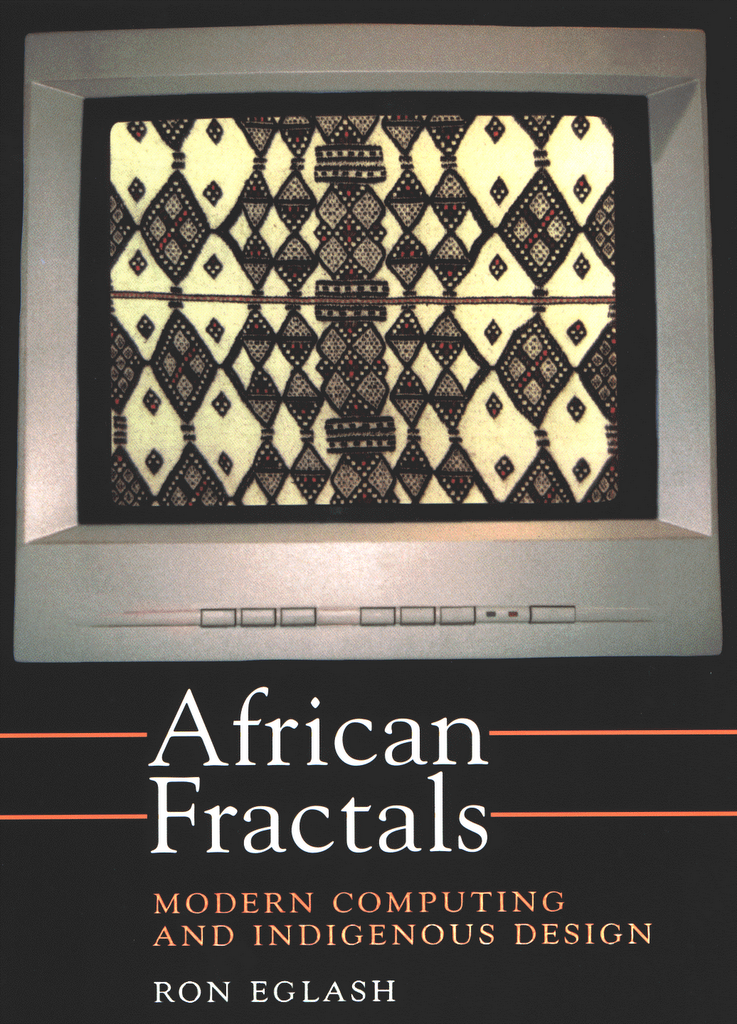
African Fractals

Abdul Karim Bangura reviews 'African Fractals: Modern Computing and Indigenous Design' by Ron Eglash:

Eglash's research began in the 1980s while investigating settlement architecture in Central and West Africa. Aerial photographs of various settlement compounds revealed that many were composed of circular structures enclosed in other circles, or rectangles within rectangles, and that the compounds were likely to have street patterns in which broad avenues branched into very small footpaths. As Eglash notes, at first he thought it was just from unconscious social dynamics. But during his fieldwork, he found that fractal designs also appear in a wide variety of intentional designs--carving, hairstyling, metalwork, painting, textiles--and the recursive process of fractal algorithms are even employed in African quantitative systems. Eglash adds that in the design rationales and cultural semantics of many African geometric figures, as well as in indigenous quantitative systems (additive progression, doubling sequences, binary recursion) and symbolic systems (iconic symbols for feedback loops, equiangular spirals, infinity), there are abstract ideas and formal structures that closely parallel some of the fundamental aspects of fractal geometry. These results, Eglash concludes, are congruent with recent developments in complex systems theory, which suggest that pre-modern, non-state societies were neither utterly anarchic, nor frozen in static order, but rather utilized an adaptive flexibility that capitalized on the nonlinear aspects of ecological dynamics.

Also mentioned at BazungaBucks

  • Digg
  • Del.icio.us
  • StumbleUpon
  • Reddit
  • RSS

Influencing Cybernetics

Appfrica highlights a paper by Ron Eglash in which he writes:
The use of African material culture as a form of analog representation is particularly vivid in cases of recursive information flow. In African architecture, recursive scaling – that is fractal geometry – can be seen in a variety of forms. In North Africa it is associated with the feedback of he “arabesque” artistic form, particularly in the branches of branches forming city streets. In Central Africa it can be seen in additive rectangular wall formations, and in West Africa we we circular swirls of circular houses and granaries. This is not limited to a visual argument; the fractal structure of African settlement patterns has been confirmed by computational analysis of digitized photos in Eglash and Broadwell (1989).
Recursive scaling in Egyptian temples can be viewed as a formalized version of the fractal architecture found elsewhere in Africa, and is most significant in it’s use of the Fibonacci sequence. The sequence is named for Leonardo Fibonacci (ca. 1175-1250), who is also associated with an unusual example of recursive architecture in Europe. The Fibonacci sequence was one of the first mathematical models for biological growth patterns, and inspired Alan Turing and other important figures in the history of computational morphogenesis. Since Fibonacci was sent to North Africa as a boy and devoted his years there to mathematics education (Gies and Gies 1969), it is possible that seminal example of recursive scaling is of African origin...[continue reading]

  • Digg
  • Del.icio.us
  • StumbleUpon
  • Reddit
  • RSS

Adinkra Patterns as Educational Tools

In the NYTimes Ron Eglash of African Fractals fame outlines his interest in using Adinkra patterns as tools of instruction:
From left to right: rotation, scaling and reflection transformations.courtesy of Ron Eglash
At first every image I showed them was interpreted as if it was an adinkra symbol – like when I showed them an example of reflection symmetry in Mangbetu design, they related it to the pattern “Wo nsa da mu a,” a symbol of democracy. It took me a long time to get them to understand that I was interested in the abstract concept of reflection symmetry (and my own fascination with their symbol interpretations didn’t help). But by the end of the day I had their explanation for the difference between linear and nonlinear spirals, as well as their translations in Twi for three geometric transformations (reflection, rotation and scaling), plus a really beautiful cloth made for me on the spot, to illustrate the transformations.
More here

  • Digg
  • Del.icio.us
  • StumbleUpon
  • Reddit
  • RSS

Influencing Cybernetics

Appfrica highlights a paper by Ron Eglash in which he writes:
The use of African material culture as a form of analog representation is particularly vivid in cases of recursive information flow. In African architecture, recursive scaling – that is fractal geometry – can be seen in a variety of forms. In North Africa it is associated with the feedback of he “arabesque” artistic form, particularly in the branches of branches forming city streets. In Central Africa it can be seen in additive rectangular wall formations, and in West Africa we we circular swirls of circular houses and granaries. This is not limited to a visual argument; the fractal structure of African settlement patterns has been confirmed by computational analysis of digitized photos in Eglash and Broadwell (1989).
Recursive scaling in Egyptian temples can be viewed as a formalized version of the fractal architecture found elsewhere in Africa, and is most significant in it’s use of the Fibonacci sequence. The sequence is named for Leonardo Fibonacci (ca. 1175-1250), who is also associated with an unusual example of recursive architecture in Europe. The Fibonacci sequence was one of the first mathematical models for biological growth patterns, and inspired Alan Turing and other important figures in the history of computational morphogenesis. Since Fibonacci was sent to North Africa as a boy and devoted his years there to mathematics education (Gies and Gies 1969), it is possible that seminal example of recursive scaling is of African origin...[continue reading]

  • Digg
  • Del.icio.us
  • StumbleUpon
  • Reddit
  • RSS

African Fractals at TED

Ron Eglash covered earlier, discusses African Fractals at TED Global:

  • Digg
  • Del.icio.us
  • StumbleUpon
  • Reddit
  • RSS

Indigenous Science for Education and Development : A Boot-strapping Approach

Ron Eglash, Egondu Onyejekwe,Christian Sina Diatta and Nfally Badiane (ENDA) are working on an initiative that:

Fractal design for Kitwe community clinic
...suggests that pre- modern, non-state societies were neither utterly anarchic, nor frozen in static order, but rather utilized an adaptive flexibility that took advantage of the nonlinear aspects of ecological dynamics. How might this potent formulation of indigenous knowledge be applied to problems in education and development? One method is to encourage its dissemination in development agencies. But decades of research have shown that a top-down approach to development, even that making use of indigenous knowledge, is often less effective than a bottom-up, "grass roots" approach. This project will create a framework in which to test the possibility that indigenous knowledge can be used in a boot-strapping approach to development. The term boot-strapping is typically applied to computer systems ("boot up the disk"), where a small program is able to self-install a larger system (from the phrase "pulling yourself up by your own bootstraps"). Similarly , we view a boot-strapping approach to development as one which begins with indigenous knowledge under local control, and self-installs modern technological abilities.

  • Digg
  • Del.icio.us
  • StumbleUpon
  • Reddit
  • RSS