
The UN's OSAA office reports that "...Remittances from Africans working abroad in the period 2000-2003 averaged about US$17 billion per annum virtually overtaking Foreign Direct Investment flows which averaged about $15 billion per annum during the same period...workers remittances boost disposable incomes, produce multiplier effects, and make education more affordable Private transfers are large and stable sources of foreign exchange for poor countries and are more likely to reach poor households than other capital flows. The average per capita remittance by migrants in developed countries is around US$ 200 per month. In the light of this it is becoming imperative that the cost of transmitting remittances needs to be reduced to allow African countries receive larger private capital flows..."
Via NextBillion
Remittances outpace Foreign Direct Investment in Africa


African agency vs the Aid industry
 Chukwu-Emeka Chikezie writes "...The western aid industry is a trap that locks Africans in the chains of dependency. Africans’ initiative, symbolised by diaspora remittance flows, is the key to liberation...The increasing aid flows to Africa that this industry advocates will, at least, “make northern-NGO poverty history”. Who else, after all, will implement all the new projects that will come? This conflict of interest, in which those arguing most loudly for increased aid flows are the aid’s biggest beneficiaries is inherently corrupt and corrupting. We disallow it in other areas of public life; so we should when it comes to the aid industry. The aid industry is helplessly dependent upon seeing an Africa that is incapable, lacking in agency, in permanent need of external direction. If all the flies photographed around those emaciated babies had demanded royalties for their appearances in northern media, Africa would have the richest flies in the world...",Opendemocracy.
Remittances & Moral Hazard
Yasser Abdih, Ralph Chami,Jihad Dagher, and Peter Montiel in an IMF working paper(PDF):
Conclude that despite their nature as household-to-household private income transfers,remittance inflows may have adverse effects on domestic institutional quality – specifically,on the quality of domestic governance – that are similar to those of large resource flows. In our analytical model, this effect arises because when households receive remittances, the government finds it less costly to free ride on the households and their emigrant relatives and divert resources for its own purposes. In other words, because access to remittance income makes government corruption less costly for domestic households to bear, the government engages in more corruption. Remittances, by acting as a buffer between the government and its citizens, give rise to a moral hazard problem; these flows allow households to purchase the public good rather than rely solely on the government to provide that good, which reduces the household’s incentive to hold the government accountable.
via Foreign Policy

Private Investment Increasing
Stephen Thomsen has just published a paper(PDF) on the increasing level of private investment in Africa:
"...Private capital flows to Africa in the form of foreign direct investment (FDI) are growing. While in the past much of this investment was limited to the raw materials sector, the current wave involves firms from more countries and sectors than ever before.
• Foreign investors, including from within Africa itself, invested almost $50 billion in Africa during 2000–03. While this represents only a small share of global flows, the more relevant comparison is with the size of the African economy. By this measure sub-Saharan Africa attracts almost as much FDI as Southeast Asia.
• Although Europe remains the principal source of investment, a rising share is coming both from Asia and from within Africa itself.
• Investors have been influenced by improvements in governance, most notably with respect to the business climate, where the desire to attract foreign investors can provide a strong incentive for African governments to reform their policies and practices. Although much remains to be done, some countries have nevertheless made great progress in areas such as political and economic stabilization, privatization and simplification of cumbersome regulations.
• This foreign investment also has implications for patterns of trade and integration. Many African exports are channelled through multinational enterprises, helping to integrate African countries both with one another and with the global economy.
Via Owen.org
New Actors in the Global Economy
Richard Gnodde writes in the FT:
For the past five years we have seen a strong period of global growth and wealth creation driven by the opening of new markets, financial innovation, favourable credit conditions and disciplined corporate management. Perhaps more striking has been the breadth of this growth – across geographies, asset classes and industries. We have one global economy, but it is increasingly powered by multiple engines, with multiple sources of demand and liquidity.
The new flows go beyond the increased investment in emerging markets to include investments from those markets into mature economies, and cross-border investments between emerging economies. Since 1990, cross-border capital flows have grown more than 10 per cent annually. Over that period, capital inflows to emerging markets have grown twice as fast as inflows to developed countries. Investment flowing to developing countries now accounts for nearly half of world total FDI inflows, compared with only 20 per cent in 1990. Even excluding China, the share doubled to 32 per cent.
Leveraging Remittances
A Bombastic Element points us to Dilip Ratha's ponderings on the subject of remittances:
A standard remittance is a simple financial transaction that -- if lightly regulated and processed using modern technology -- can cost as little as one percent. If funds were transferred through banks and other financial intermediaries, migrants and their beneficiaries would be encouraged to save and invest. Intermediary banks could also use remittance inflows as collateral to borrow larger sums in international credit markets for local investments.More here
To best leverage these flows for development, it is time to create an international body -- an "International Remittances Institute" -- that would monitor the flows of labor and remittances and oversee policies to make them easier, cheaper, safer, and more productive. The proposed African Remittances Institute, supported by the African Union and the European Union, is a small but important step in this direction.
Remittance Flows
Sharda Naidoo reports on remittances:
Remittance flows into Africa have grown exponentially over the past two years, more than $11-billion in 2005 via formal and informal channels.World Bank researchers further believe that remittances have helped reduce poverty and that they offer a lifeline to struggling economies. They have also helped to stabilise irregular incomes and build human and social capital. In Uganda, remittances have cut the share of poor people by 11% and in Ghana by 5%. In Lesotho, remittances now account for more than one-third of gross domestic product (GDP), and more than 50% in Ghana.
Opportunities within West African Financial Flows
A recent study(PDF) on Financial Flows within West Africa made the following findings:
(1) presently, the aggregate value of these transactions may amount to US$2 billion annually in remittances from migrant laborers and perhaps as much as US$8 billion in trade settlements in the four countries.
(2) Overly restrictive government policies, the inconvertibility of the currencies in the region, corruption and traditional patterns have the effect of driving potentially legitimate business into the informal economy.
(3) Small and medium sized enterprises, in particular, have
difficulty gaining access to formal mechanisms and institutions that could normally provide business loans and financial settlement services. Concurrently, the region is vastly underbanked.
(4) Microfinance institutions and credit unions service a part of this informal market but they operate under financial regulations that make it difficult to service the full needs of their clients. The settlement of international transactions is particularly difficult.
(5) The use of technology may help provide options that will encourage greater use of formal systems
via West AfricanTrade Hub
Obama On Inner and Outer Circles of Leadership
In The Man Who Was Thursday: A Nightmare (Penguin Classics)
This is a vast philosophic movement, consisting of an outer and inner ring. The outer ring- the main mass of their supporters- are merely anarchists; that is, men who believe that rules and formulas have destroyed human happiness. They believe that all the evil results of human crime are the results of the system that has called it a punishment. They do not believe that the crime creates the punishment. They believe that the punishment has created the crime. These people talk about 'a happy time coming,' 'the paradise of the future,' 'mankind freed from the bondage of vice and the bondage of virtue,' and so on.In my post Book Review: The Man Who Was Thursday I noted that:
And so also the men of the inner circle speak. But in their mouths these happy phrases have a horrible meaning. They are under no illusions; they are too intellectual to think that man upon this earth can ever be quite free of original sin and the struggle. And they mean death. When they say that mankind shall be free at last, they mean that mankind shall commit suicide. When they talk of a paradise without right or wrong, they mean the grave. They have but two objects, to destroy first humanity and then themselves.
Chesterton might have called them anarchists or philosophers, and later they might go by other names like fascist or communist, but to me, their ideas about economic suicide for no reason, their dislike of labeling things right and wrong, and their views on life and mark them as the modern Democratic Party. And at the center of the inner circle there is a man who speaks to applauding crowds and says pleasing phrases, but he is under no illusions, and his actions have terrible consequences for our great nation.
The idea of an inner circle of committed revolutionaries surrounded by an outer circle of people who are more moderate in their views is an idea that I have never read or heard about before. Reading it in Chesterton's book was the first time I had ever even thought about viewing the world in this way.
President Obama, on the other hand, jumps quickly to viewing the world this way, and in a classic case of the pot calling the kettle black he has ascribed his personal world view to his enemies, the American people who go to Tea Parties.
Via The Politico story Obama dissects demonstrations:
Obama describes tea party movement this way: "There's some folks who just weren't sure whether I was born in the United States, whether I was a socialist. So there's that segment of it, which I think is just dug in ideologically." "Then," he continued, "I think that there's a broader circle around that core group of people, who are legitimately concerned about the deficit, who are legitimately concerned that the federal government may be taking on too much."
Obama sees in the Tea Party movement structure and order that he is familiar with- an inner circle preaching bad things, and an outer circle who are being fooled into following the movement, but both circles are bad and wrong and do not have legitimate views.
Now, I've been to Tea Parties (see my posts Best State of the Union Address Ever, My Report from the Birmingham Healthcare Rally, or Report from Peters Townhall Sept 09) and to be honest, I don't have the slightest freaking clue what Obama is talking about. I saw the core of Tea Parties as people with legitimate views about spending and government power, and a couple hanger's on who even Tea Party people didn't like who talked about Obama's birth certificate and who waved posters of Obama as Hitler. But, there was no inner and outer core of organization to the Tea Parties- they are just masses of concerned patriots who are trying to make the world a better place.
On the other hand, let's take a look at the Democratic Party... it increasingly is attempting to centralize all decisions with Pelosi, Reid, and Obama, Democratic members of Congress increasingly have 95% party line voting records (like my Congressman Peters, who is as far from moderate and independent as possible), and money that flows into the Democratic Party increasingly flows to the inner circle and then out again. That party, as it is increasingly becoming, is an inner circle of men preaching destruction (pro-abortion, pro-economic destruction, anti-allies, pro-war) surrounded by an outer circle of people duped and who chant hope and change and say the most naive and stupid ideas about the role of government in making people better.
The Democrats fit Obama's narrative better than the Tea Party movement- an inner core of devoted liberals surrounded by a mass of weak willed 'Blue Dogs' who follow orders when push comes to shove.
Get the book today!
Filtration Fever Hits China (and US)
You can't visit China without seeing the western influence there. Our tour guide had a Justin Bieber haircut that he had proudly made himself. Chinese who cannot speak English can sing in perfect Bieberese "Baby, Baby, Baby..." Ah, Bieber Fever is Everywhere.
Government Snow
But, the government is everywhere too. In the sky, on the ground, everywhere.
The government made it snow on Saturday of the Flat Classroom conference. Snow?
 |
| Flat Classroom Conference 2011 - February Beijing, China |
As I met Julie Lindsay the lead organizer for the conference, I commented how odd it was that it snowed that day. She laughed in her lilting sort of way
"Ah, the government made it snow last night, it is no big deal."Others from Beijing verified this.
"I can see the snow cannons, they fire them near my house and seed the clouds," said Julie.
Others said that this is a frequent occurence in Colorado and Utah where they need snow. I'm not sure but something in me gets upset at governments controlling the weather.
But it shouldn't be surprising as filters have a whole lot of influence on the weather inside the computer screens. They can cast government snow upon the seeds of discontent and revolution. The can just cast snow upon any and all collaboration by chilling the pipes upon which such collaboration flows.
Yes, China is blocking Google services
I can confirm beyond a shadow of a doubt that China is aggressively blocking Google services. When I arrived in China in February, it was during the time when Middle Eastern unrest was spreading and I could not check my gmail for the first two days even behind my well-selected VPN. Google Docs was unstable as well.
She Who Shall Not Be Named
In fact, we had one young lady named Jasmine and because the government was so heavily filtering the word "Jasmine" (the Jasmine revolution) we renamed her on our wiki and in our projects to keep from losing our wiki. Our behind the scenes joke was that Jasmine was "she who shall not be named" as we did not want to speak the word.
The Company Who Shall not Be Named
Now, my friends in China are quietly moving to yahoo accounts just in case they cannot get back into their gmail. Even with VPN's, Western expatriates are cut off from most Google services: docs, calendars, especially gmail. Unstable and unusable.
Keeping it Flat Anyway
Yes, this has put a hitch in things for Flat Classroom - an organization of global collaboration for students that we have kept decidedly apolitical. We are about teaching. Teaching technology, asychronous collaboration, online leadership skills. We believe that you can't have excellence in education without global collaboration. Period. And yet, when things happen like this it can set us back.
This is nothing new. We will press forward.
The Great Firewall of China
From what I understand, China has 7 firewall centers as part of their "Great Firewall of China" and these firewalls have been locked down tighter and tighter over the past few months.
Filtration Fever
in China
Despite the influence of entertainment, right now, not only can my Chinese friends not read this blog but now, they cannot read my email.
 |
| David Truss, Pair a Dimes Blog |
"The Students Live website provides a number of different ways to connect and interact with the Olympic reporter student bloggers. However, we live in China which filters a lot of social software websites and so these were the options that my Grade 9 teacher was confronted with:
Facebook: BLOCKED
Twitter: BLOCKED
YouTube: BLOCKED
Blogspot Blogs: BLOCKED
Flickr: (recently) BLOCKED (again)
I had to use my VPN to bypass the Chinese filter in order to cut and paste the blog post, mentioned above, into an email so that my teacher could read it in his class. A potential global ‘conversation’ reduced to a reading, confined to a classroom. Frustrating!
Now here is the thing… I chose to move to a country where a lot of sites get blocked. I can’t imagine what it’s like for teachers in the ‘free world’ that have their own school districts do this to them!"
in the US
We in the US cannot look down our trusty 1Gbps Internet connections at our Chinese friends.
I can tell you from experience, the two toughest places to collaborate IN THE WORLD are: any school in China and US public schools.
Thank God for the progressive US schools, public and private, who collaborate anyway and that we have many of them in our projects. These schools are usually characterized by extraordinary leadership who understand that:
YOU CANNOT HAVE EXCELLENCE IN EDUCATION WITHOUT GLOBAL COLLABORATION.
What do schools block?
Like China, most US public schools won't allow unblocking of even one Ning - even educational ones like Digiteen, Flat Classroom, or NetGen. They put our emails from us to the teachers into their blacklist filters and teachers can't even get started. Joining a Google Group or Google calendar at school is out of the question.
They won't allow kids to wiki because "people write porn on wikis." (Yes, I had a school that said that.) Sad.
Some teachers have to create non-school emails and accounts and do work from home to make global collaboration happen in the classroom. Their filters are that locked down and no method exists for unblocking anything.
I think that we have to look at our practices and our filtering here in the US very closely.
Filter fever is a symptom of fear. We all see clearly what China is afraid of.
But what on earth are US public schools afraid of?
- Are we afraid that our kids might learn to work with someone from another country? That is a business requirement.
- Are we afraid that we might have to shuffle our work day to work with someone from another time zone? We are surrounded by oceans that soak up the time zones and need to work through this.
- Are we afraid of a future where we can no longer keep prosperity on our shores by the boundary of our country? We already live in a world where money flows through the Internet and can shift the GDP of whole countries in a day due to websites hosted in country.
Every Student Collaborates
Filter out the smut but please, we should be able to allow meaningful global collaboration with students all over the world for EVERY US public school system. It can be done inexpensively or for free - the only cost is to move outside our comfort zone.
We work so hard measuring if each individual child is learning that we forget to see if they can work together at all.
In this day of budget cuts, this is something we can do to invest in our future that won't cost a lot of money and will pay huge dividends in future generations. Most students are woefully unprepared for this. Don't say "they are already connected now on Facebook." It simply isn't applicable to the professional environment where they are headed.
Collaborate or be unemployed.
We Love Our Walled Window boxes?
I love my country (the US) and it disheartens me to know that our very future lies in collaborating with countries like India and China and all of the world and we continue to "wall our gardens."
The problem is that I'd hardly call the technology ecosystems at most schools a garden - they are probably more like a windowbox if anything. Some would even say windowdressing as their internal networks languish unused with kids forgetting passwords and not logging in for months.
Let me repeat the motto of our Flat Classroom Conference: there is no excellence in education without global collaboration.
The question is NOT: "What are we keeping out?" The question should be "What are we letting in?"
Remember your noble calling teachers, administrators, ed tech leaders. Few such callings are as noble as this: to promote students working together in the K12 level so when they grow up we have a world that can work together. Promoting collaboration and collaboration from the bottom up.

Cracking Down on the Looters

Paul Collier writes:
The loot-seeking elites that control parts of Africa illicitly send capital out of the region to the tune of $20 to $28bn per year. Illicit money flows are hard to quantify, but this is the new estimate by Raymond Baker of the NGO Global Financial Integrity, the most careful and ingenious study to date. Capital flight of this magnitude is roughly equivalent to the entire aid inflow to the region, so closing it would generate a similar resource transfer to doubling aid. One side-effect of the financial crisis is that aid commitments will be at the front of the queue for spending cuts. For example, in the vice-presidential debate it was the only Democratic spending pledge that Joe Biden suggested might be rethought...[continue reading]
Diasporas & Remittances
Writing about remittances De Montclos, M.A.P. states (PDF)
Contemporary migrants are very much in touch with their homeland, to which they often remit money on a regular basis. They have an economic and political role to play in the countries of departure as well as arrival. In the homeland, they can contribute to development and democracy, especially in enclaves, island micro-states and war-torn countries which record disproportionate emigration flows. Yet the governments of developing countries are not fully aware of the opportunities that these migrant communities offer.
Accountability, Africa & her Diaspora
Chukwu-Emeka Chikezie writes "...Today the authority and legitimacy of public officials in Africa must be negotiated with a rich texture of regional, communal and social associations; rapid progress in communications technology is providing Africans with new opportunities for networking and enterprise; and, perhaps above all, increasing numbers of Africans in the diaspora are reconnecting to their home countries in imaginative new ways involving creative “peer-to-peer” development strategies.All these transformations are fuelling changes in the ways Africans nurture the relationships of accountability – embodying practices of obligation, respect, responsibility and mutuality – that underpin their connection to each other...With the rise and rise of remittance flows over the last few years, Africans in the diaspora are Africa’s biggest aid donors and investors. They are, in effect, Africa’s biggest taxpayers, hit by a double whammy. First, they contribute to the overseas aid budget through their tax contributions to their new home government. Second, they make direct contributions via their individual and collective remittances(PDF). The latter far outstrip the former in terms of absolute volumes...African governments are far more accountable and responsive to their bilateral and multilateral aid donors than they are to African taxpayers at home or abroad...Africans have developed fairly sophisticated strategies for avoiding a state that seems hell-bent on obstructing their lives. Income from informal economic activity and remittances; healthcare and education provided by modern-day missionaries (as well as many new Pentecostal churches and their charismatic pastors); law provided by sharia courts and imams; protection provided by vigilante groups and their magic potions. All this and more happens with little state involvement. Africans weave together the fabric of their lives far from the state’s purview..."
Via OpenDemocracy
Gulf invests in Sub-Sahara
The Ft reports:
Gulf-based private and public equity fund managers have this year shifted some of their vast wealth from Asia and the Middle East/North Africa region to the world’s poorest region: sub-Saharan Africa. These portfolio flows to a half-dozen countries have been accompanied by direct investment in property and other sectors...The Gulf push into the sub-Sahara reinforces pioneer efforts, notably by Saudi Arabia’s Prince Alwaleed bin Talal whose Kingdom Holdings created a $125m joint venture in 2004 with New York-based Zephyr Investment for African private equity. Its best-known success was a $20m stake in the pan-regional mobile provider Celtel, which was later acquired at a hefty premium by Kuwait owners. The prince has joined HSBC in a separate dedicated vehicle.
As petrodollars head towards these locations, western wealth advisers who have shunned them may re-examine their assumptions and consider participation a viable emerging market option.
The Colonialism-Imperialism Paradigm Is Kaput (1 of 2)
The Colonialism-Imperialism Paradigm Is Kaput
George B. N. Ayittey, Ph.D.
June 26, 2005.
Africas paradox is galling: immense mineral wealth yet inexorably mired in steaming squalor, misery, deprivation, and chaos. A few countries have sprinted ahead but Africas overall economic performance remains abysmal, lagging behind those of other regions in the Third World. The United Nations Development Program (UNDP) has warned that at the prevailing rates black Africa would take another 150 years to reach some of the development targets agreed by UN members for 2015. (Financial Times, July 9, 2003; p.1). Who ruined Africa?
The causes of Africas lack of development have always evoked heated emotional debates. On one hand are those who portray Africa as a victim of powerful external forces and conspiracies a group that may be described as externalists.On the other are those who believe that the causes of Africa's crisis lie mostly within African in the nature of government (governance) or how Africa runs its own affairs. This group may be described as the internalists.
The Externalists
The externalists believe that Africa's woes are due to external factors such as the lingering effects of Western colonialism and imperialism, the pernicious effects of the slave trade, racist conspiracy plots, exploitation by avaricious multinational corporations, an unjust international economic system, inadequate flows of foreign aid, the neo-liberal policies of the World Bank, IMF, and deteriorating terms of trade. Disciples of the externalist creed include most African leaders, scholars, and intellectual radicals. For decades, the externalist position held sway, attributing the causes of almost every African problem to such external factors.
In his book, The Africans, African scholar and historian Professor Ali Mazrui, examining Africas crises, attributed most of Africas woes to Western colonialism and imperialism. "The West harmed Africa's indigenous technological development in a number of ways" (164). Africa's collapsing infrastructure (roads, railways, and utilities) is due to the "shallowness of Western institutions," "the lopsided nature of colonial acculturation" and "the moral contradictions of Western political tutelage" (202). In fact, "the political decay is partly a consequence of colonial institutions without cultural roots in Africa" (199). Therefore, self congratulatory western assertions of contributing to Africa's modernization are shallow: "The West has contributed far
less to Africa than Africa has contributed to the industrial civilization of the West" (164). Decay in law enforcement and mismanagement of funds can be traced to Western colonialism too. "The
pervasive atmosphere in much of the land is one of rust and dust, stagnation and decay, especially within those institutions which were originally bequeathed by the West signal the slow death of an alien civilization" (204) and Africa's rebellion "against westernization
masquerading as modernity" (211). Western institutions are doomed "to grind to a standstill in Africa" or decay. "Where Islam is already established, the decay of western civilization is good for Islam since it helps to neutralize a major threat" (19).
Many African leaders also subscribed to and espoused similar views ascribing the causes of Africa's crises to external factors. In fact, since independence in the sixties, almost every African malaise was alleged to have been caused by the operation or conspiracy of extrinsic agents. This externalist doctrine totally absolved the leadership of any responsibility for the mess in Africa. The leadership was above reproach and could never be faulted. President Mobutu even blamed
corruption on European colonialism. Asked who introduced corruption into Zaire, he retorted: "European businessmen were the ones who said, 'I sell you this thing for $1,000, but $200 will be for your (Swiss bank) account'" (New African, July, 1988, 25).
In his address to the third Congress of the Democratic Union of Malian People recently, President Moussa Traore observed that, The world economy is passing through a period characterized by monetary disorder and slow trade exchanges. The worsening crisis is affecting all countries, particularly developing countries. Due to the difficult situation, which is compounded by the serious drought, socio economic life has been affected by serious imbalances
that have jeopardized our country's development growth. Debt servicing, characterized mainly by state to state debts are a heavy burden on the state budget. The drop in the price of cotton which accounts for much of the country's foreign earnings, has led to a great reduction in export
earnings" (West Africa, 16 May 1988, 876).
President Danial arap Moi accused the IMF and other development partners of denying Kenya development funds, thus triggering mass poverty (The Washington Times, June 3, 1999; p.A12). According to the Chairman of Ghanas ruling NDC, Issifu Ali, whatever economic crisis the nation was going through had been caused by external factors. He said the NDC has since 1982 adopted pragmatic policies for the progress of Ghana, adding that the macro-economic environment of 1999 has been undermined by global economic developments" (The Independent, Nov 18, 1999; p.3). Said the Zimbabwe Independent (April 27, 1999), Mugabe
rejects the criticism of those who blame the government for the economic crisis. It is, he says, the fault of greedy Western powers, the IMF, the Asian financial crisis and the drought (p. 25).
Naturally, African leaders would deny any responsibility and blame everybody else except themselves for the mess in Africa. The New Economic Partnership for African Development (NEPAD) echoes this orthodoxy when it claims that Africas impoverishment has been accentuated by the legacy of colonialism and other historical legacies, such as the Cold War and the unjust international economic system. Colonialism subverted the "traditional structures, institutions and values," creating an economy "subservient to the economic and political
needs of the imperial powers" (para 21). Colonialism, according to NEPAD, retarded the development of an entrepreneurial and middle class with managerial capability. At independence, Africa inherited a "weak capitalist class," which explains the "weak accumulation process, weak states and dysfunctional economies." (para 22). More recent reasons for Africa's dire condition include "its continued marginalization from globalization process." (para 2). NEPAD seeks $64 billion in investments from the West.
Frankly, this colonialism-imperialism card has been so overplayed that it has lost its relevance and credence. Even Africas children dont buy it. Chernoh Bah, president of the Children's Forum asserted that Africa's socio economic problems are a direct repercussion of incompetent and corrupt political leaders who usurped political office via the gun. "Some blame colonialism for Africa' plight while others blame the continent's harsh climatic conditions. I think the reason is the kind of political systems we have had over the past decades, he said. (Standard Times [Freetown], April 2, 2003; web posted). At the United Nations Children's Summit held in May 2002 in New York, youngsters from Africa ripped into their leaders for failing to improve
their education and health. "You get loans that will be paid in 20 to 30 years and we have nothing to pay them with, because when you get the money, you embezzle it, you eat it, said 12-year-old Joseph Tamale from Uganda (BBC News, May 10, 2002).
The Internalists
Internalists are the new and angry generation of Africans, who are fed up with African leaders who refuse to take responsibility for their own failures and, instead use colonialism and other external factors as convenient alibis to conceal their own incompetence and mismanagement.
Internalists believe that, while external factors have played a role, internal factors have been far more significant in causing Africas crisis. This school of thought maintains that while it is true Western colonialism and imperialism did harm Africa and continues to do so, Africa's condition has been made immeasurably worse by such internal factors as misguided leadership, misgovernance, systemic corruption, capital flight, economic mismanagement, declining investment, collapsed infrastructure, decayed institutions, senseless civil wars, political
tyranny, flagrant violations of human rights, and military vandalism. In fact, one can identify a whole lot of them but these will suffice. U.N. Secretary-General, Kofi Annan, himself an African, lashed out at African leaders at the Organization of African Unity (OAU) Summit in Lome in July 2000. He pointedly told them that they are to blame for most of the continent's problems. Instead of being exploited for the benefit of the people, Africas mineral resources have been so
mismanaged and plundered that they are now the source of our misery (Daily Graphic, July 12, 2000; p.5). Earlier in the year at a press conference in London in April, 2000, Kofi Annan, lambasted African leaders who he says have subverted democracy and lined their pockets
with public funds, although he stopped short of naming names (The African-American Observer, April 25 May 1, 2000; p.10). During a brief stop-over in Accra, he disclosed in a Joy FM radio station interview that "Africa is the region giving him the biggest headache as the
Security Council spends 60 to 70% of its time on Africa. He admitted sadly that the conflicts on the continent embarrasses and pains him as an African" (The Guide, July 18-24, 2000; p.8).
Ordinary people are speaking out too. Said Akobeng Eric, a Ghanaian, in a letter to the Free Press (29 March - 11 April 1996): "A big obstacle to economic growth in Africa is the tendency to put all blame, failures and shortcomings on outside forces. Progress might have been achieved if we had always tried first to remove the mote in our own eyes" (2). Angry
at deteriorating economic conditions in Ghana, thousands of Ghanaians marched through the streets of the capital city, Accra, the economic crisis is due to external forces and therefore, beyond his control, then he should step aside and allow a competent person who can
manage the crisis to take over," Atta Frimpong demanded (The Ghanaian Chronicle, Nov 29, 1999; p.1). Appiah Dankwah, another protestor blamed the NDC government for mismanaging the resources of the nation.
By the 1990s, African governments had completely lost touch with their people; in fact, they were at war with their people. Citing "the credibility gap between the people and the leadership built up through years of mismanagement," Mr. Mohammed Boudiaf, the head of Algeria's
High Executive Council (HEC), lamented: "A large segment of the population has, I am afraid, lost confidence in the capacity of the leadership to provide jobs, housing, health care and its ability to combat corruption" (Financial Times, June 17, 1992; p. 4). Indeed, said Simon Agbo, a farmer in Ogbadibo, south of Makurdi, Benue state capital in Nigeria: "I heard we have a new government. It makes no difference to me. Here we have no light ( electricity), we have no water. There is no road. We have no school. The government does nothing for us (The
Washington Times, Oct 21, 1999; p.A19).
Rafael Marques, a journalist, jailed and convicted of defamation for a 1999 article in which he characterized President Jose Eduardo dos Santos of Angola as a dictator, wrote: "The government has created a stateless state here in Angola. Each citizen is responsible for his own health and welfare while the government is accountable to no one. The MPLA and
UNITA are like two gangs and the people of Angola are innocent bystanders caught in the middle of a drive-by shooting" (The Washington Post, Sept 18, 2000; p.A1).
As a result of the failure to provide the basic necessities of life, the state and those in power have increasingly alienated themselves from those they rule and from whom they claim to derive their legitimacy. The growing gap between the leaders and the people has made the leaders increasingly insecure, sensitive, repressive and less responsive to the wishes of society. The mass of the people in turn regard the state and its organs with fear, suspicion and cynicism because as far as they are concerned, they are no longer legitimate or relevant in their lives. The government does nothing for them. Insecure African despots spend inordinate amounts on the military and security forces, subverting other state institutions squelch dissent, prop them up in power, and serve their parochial interests. The masses on the other hand, sensing their
inability to meaningfully influence the policies of the state and the behaviors of those in positions of power, develop apathy and withdraw from participation in the political process for safety reasons.
Government, as an institution that cares about its people and attends to their needs, has ceased to exist in many African countries. What exists is a vampire state, where the government has been hijacked by a phalanx of unrepentant bandits and crooks, who use the machinery of the
state to enrich themselves, their cronies and tribesmen, while excluding everyone else (the politics of exclusion). The richest persons in Africa are heads of state and ministers. Quite often, the chief bandit is the head of state himself.
At an African civic groups meeting in Addis Ababa, Ethiopia, Nigeria's President, Olusegun Obasanjo, claimed that corrupt African leaders have stolen at least $140 billion (95 billion) from their people in the decades since independence (The London Independent, June 14, 2002. Web
posted at www.independent.co.uk). In August 2004, an African Union report claimed that Africa loses an estimated $148 billion annually to corrupt practices, a figure which represents 25 percent of the continent's Gross Domestic Product (GDP). But these are gross underestimates. According to one UN estimate, $200 billion or 90 percent of the sub-Saharan part of the continent's gross domestic product was shipped to foreign banks in 1991 alone (The New York Times, Feb 4, 1996; p.4). Nigeria's past rulers stole or misused 220 billion ($396 billion) -- that is as much as all the western aid given to Africa in almost four decades. The looting of Africa's most populous country amounted to a sum equivalent to 300 years of British aid for the
continent (The London Telegraph, June 25, 2005; web posted). If this sum had been divided equally among Nigerias 120 million people, its income per capita would be at least $3,000, instead of the miserable $265, which is about the same as it was when it gained its independence in 1960. Between 1970 and 2004, more than $400 billion in oil money
flowed into Nigerian governments coffers. What happened to the oil money?
Eventually the vampire state metastasizes into what Africans call a coconut republic and implodes when politically-excluded groups rise up in rebellion: Somalia (1993), Rwanda (1994), Burundi (1995), Zaire (1996), Sierra Leone (1998), Liberia (1999), Ivory Coast (2000), and
Togo (2005). Only reform intellectual, economic, political and institutional will save Africa but the leadership is not interested. Period.
Ask these leaders to develop their countries and they will develop their pockets. Ask them to seek foreign investment and they will seek a foreign country to invest their booty. Ask them to cut bloated state bureaucracies or government spending and they will set up a Ministry of
Less Government Spending. Ask them to establish better systems of governance and they will set up a Ministry of Good Governance (Tanzania). Ask them to curb corruption and they will set up an Anti-Corruption Commission with no teeth and then sack the Commissioner if he gets too close to the fat cats (Kenya). Ask them to establish democracy and they will empanel a coterie of fawning sycophants to write the electoral rules, hold fraudulent elections with opposition leaders either disqualified or in jail, and return themselves to power (Ivory Coast, Rwanda). Ask them to reduce state hegemony in the economy and place more reliance on the private sector and they will create a Ministry of Private Enterprise (Ghana). Ask them to privatize inefficient state-owned enterprises and they will sell them off at fire-sale prices to their cronies. In 1992, in accordance with World Bank loan conditionalities, the Government of Uganda began a
privatization effort to sell-off 142 of its state-owned enterprises. However, in 1998, the process was halted twice by Ugandas own parliament because, according to the chair of a parliamentary select committee, Tom Omongole, it had been derailed by corruption, implicating three senior ministers who had "political responsibility" (The East African, June 14, 1999). The sale of these 142 enterprises was initially projected to generate 900 billion Ugandan shillings or $500
million. However, by the autumn of 1999 the revenue balance was only 3.7 billion Ushs.
Now, their recalcitrance has transmogrified into extortion. Ask them to move a foot and they will demand foreign aid in order to do so. In 2003, some 30,000 ghost names were discovered on the payroll of the Ministry of Education, costing the government $1.2 million a month in salaries heisted by living workers. When Ghana demanded foreign aid to purge these ghost names, Japan ponied up $5 million.
The reform process has stalled through vexatious chicanery, strong-arm tactics, deception, and vaunted acrobatics. Only 16 out of the 54 African countries are democratic and fewer than 8 African countries can be described as economic success stories. Intellectual freedom remains
in the Stalinist era: only 8 African countries have a free and independent media. But without genuine reform, more African countries will implode -- Chad, Cameroon, Central African Republic, Equatorial Guinea, Guinea, Togo and Zimbabwe are already teetering on the brink
The slave trade, Western colonialism, imperialism and external factors have nothing to do with the naked plunder and wrong choices made by bad African leaders. The World Bank has nothing to do with monumental leadership failure in Africa. The IMF, which most African leaders relish
vilifying, has nothing to do with petrol (gasoline) shortages in Nigeria. Nor do Western agricultural subsidies have anything to do with why African governments cant supply reliable electricity and safe drinking water to their people. The slave trade has nothing to do with
Nigeria turning itself into the scam capital of the world.
The Flaws in the Externalist Position
The issue of Western culpability or complicity in causing Africas woes evokes such intense emotionalism that it often clouds rational analysis of our problems in Africa. Let us strip the issue of its emotionalism and examine it rationally.
Historical Wrongs Committed by the West
The Slave Trade/Colonialism
Everyone agrees that the slave trade was at once a brutally inhumane treatment that can ever be meted out to a people. The horrors of capture, the trans-shipment, the loss of millions of able-bodied men, the atrocities that were committed by European slave traders, etc. are all documented. We all agree to the humiliating experience of colonial subjugation. The discrimination against African natives, the exploitation of Africa's mineral wealth and artifacts, etc. -- we also agree on that.
Remedies
We may seek compensation (reparations) for the harm that slavery did to us. We may seek the return of the stolen booty. Ethiopia has just received its ancient obelisk, stolen by the Italian colonialists. But even here, African leaders have debauched the issue.
Back in August 1999, representatives of African governments met in Accra and issued a declaration: "Africa is demanding $777 trillion from Western Europe and the Americas in reparation for enslaving Africans while colonizing the continent" (Pan African News Agency, August 18, 1999). It added that the money would be demanded from ''all those nations of Western Europe and the Americas and institutions, who participated and benefited from the slave trade and colonialism''. Dr. Hamet Maulana and Debra Kofie, co-chairpersons of the commission, urged that worldwide monitoring and networking systems be instituted to ensure
that reparation and repatriation will be achieved by 2004. Problem is, U.S. GNP is only $12 trillion and amount asked- $777 trillion- exceeds the combined sum of the GNPs of the entire Western world! According to the British governments Office of National Statistics, The United
Kingdom -- that is England, Wales, Scotland and Northern Ireland -- is officially valued at $8.8 trillion, a sum that includes all of its property and buildings, machinery, roads, bridges, planes, trains and automobiles. It also includes all the money deposited in its banks and other financial institutions. Plus everything on the shelves at Harrods (The New York Times, Jan 1, 2004; p.A4). So how do African leaders hope to collect $777 trillion?
We may argue all we want about the size of reparations but these historical wrongs cannot repeat, cannot -- be used to justify the cruel atrocities and grotesque misdeeds African leaders commit against their own people. Winning independence for their respective countries gives no African leader -- none of them -- the license to do what they want with their people and countries.
European slave traders or colonialists did not tell President Mugabe to raze down shanty-towns, destroying the propertied of hundreds of thousands of Zimbabweans and rendering more than 1.5 million HOMELESS. American imperialists did not tell President Meles Zenawi of Ethiopia
to order his security forces to open fire on student demonstrators, killing more than 40 of them on June 15, 2005. British racists did not tell President Isaiah Afwerki of Eritrea to shut down all the private newspapers in Eritrea and jail all their editors and journalists.
These leaders must be held ACCOUNTABLE for their actions. Historical wrongs by the West do not factor in here because they are a separate issue and CANNOT be used to excuse wrongful actions taken by African leaders TODAY.
Colonial Legacies
It is also agreed that the colonial legacies bequeathed to Africa were pitiful. What the Portuguese left behind in Guinea-Bissau, after 200 years of colonial rule, was a small brewery for their local servicemen. There was no social development; industry was not encouraged. African colonies were to serve as sources of raw material and cheap labor for the industrial machines of Metropolitan Europe. The colonial economies were based on export mono-culture: the export of one or two cash crops.
Colonial education was geared toward training male clerks for the colonial administration. The Belgians and Portuguese never encouraged university education as that would teach African natives of their political rights. When Tanzania gained its independence in 1964, it had only 4 university graduates.
Infrastructure was Spartan. Few roads and railways were built. Even where built in West Africa, they exhibited a dendritic pattern: Straight from the coast to the hinterland to evacuate some mineral or cash crop.
All this is true but heres the problem: After independence, we, African elites, did not maintain, let alone keep the little infrastructure we inherited from the colonialists. In fact, we destroyed them! Infrastructure crumbled in the post colonial period. The few universities we got in Ghana and Nigeria decayed. In Uganda, Makerere University used to be called the Harvard of Africa in the 1950s. By 1980, it was a shambles. In Zaire, the Belgian colonialists put down only 2,000 miles of paved road appalling for that huge country the size of Texas. By 1990, only 200 miles were usable. So who do you blame: the Belgian colonialists for not laying down enough roads OR Mobutu for failing to maintain the little that Zaire got? Later, we learned that Mobutu allowed the roads and infrastructure to crumble in Zaire because it made it difficult for the opposition to organize against him!
(contd)
Bracing for the Downturn
 Ernest Harsch writes in African Renewal:
As economic growth slows worldwide and some major industrial economies have gone into recession, it has become clearer that the repercussions of the global financial crisis will be felt throughout Africa’s “real economy” — beyond the narrow realm of stock trading. Dwindling financial remittances from Africans working abroad, lower world prices for Africa’s exports, scarcer and more costly commercial credit and less generous flows of foreign aid will inevitably dampen productive activity across the continent...[continue reading]
via African Loft
China and India: What's in it for Africa?
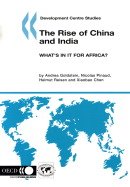 A summary of the OECD publication "The Rise of China and India - What's in it for Africa" makes a number of points:
In order to avoid being trapped into the unpromising corner of vulnerable, capital-intensive and high-risk raw material dependence, resource-rich Africa will have to balance the need to match the promotion of job-rich sectors with the desire to capitalise on a windfall gain generated by higher commodity prices. Monetary authorities will have to lean against the real currency appreciation in order to avoid burdening industries competing with imports, and exporters outside the resource sector. Central banks need to be supported by fiscal authorities, which are required to limit public spending on services and construction to keep non-tradables prices in check.Investment abroad of export proceeds will further insulate the local economies from ‘DutchDisease’ effects.
Furthermore, in low-tech activities like clothing or footwear, growing FDI into China and India is likely to crowd out investment in Africa, although geography and preferential tariff treatment may still provide some African countries with a competitive edge. Head-on competition, however, is unlikely to be the main channel through which the Asian drivers impact on FDI flows into (and out of) Africa.
Growth of South-South Trade
Trade between developing nations is booming, which potentially marks the beginning of a new era of "rapid growth." The developed world during the 1950s and 1960s experienced a similar growth trajectory. The trade flows, termed South-South trade, has grown dramatically over the past two decades. Nearly half of all the goods and services produced in developing countries are exported to other developing countries. Stronger trade ties among developing countries may yield positive outcomes, but fears are growing that some emerging powers are exploiting these relationships merely to extract raw materials...[continue reading]
Comparing Michelle Obama's Speech to Condoleezza Rice's Speech
Frank Beckman (heard locally on 760 am) gave me this idea. He noticed the differences in the speech Michelle Obama gave on Monday with the speech Condoleezza Rice gave at the RNC convention in 2000. It's a fair comparison- both are black women, well educated, and in positions of power where they could advise potential Presidents.
I've gone through both speeches, quoting from them, comparing them, and hopefully making intelligent comparisons when it occurred to do so. I hope you enjoy, and see how these major advisers could be shaping the worldview of their presidential preferences.
Michelle Obama begins her speech by talking about herself- she jumps right how she was raised, and gives thanks to her father. She then states her main message of the speech- "And Barack and I were raised with so many of the same values: that you work hard for what you want in life; that your word is your bond and you do what you say you're going to do; that you treat people with dignity and respect, even if you don't know them, and even if you don't agree with them." To repeat- the values that she represents are hard work, honesty, and respect.
Condoleezza Rice begins her speech by thanking all those who have gone before her- great Presidents like Ford, Reagan, and HW Bush. She then states her main message of the speech- "The future belongs to liberty, fueled by markets in trade, protected by the rule of law and propelled by the fundamental rights of the individual. Information and knowledge can no longer be bottled up by the state. Prosperity flows to those who can tap the genius of their people." To repeat- the values she represents are liberty, free trade, and individual rights.
We'll stop here- both are great messages. But one sounds better on the streets of Chicago, trying to organize a community and help people, and the other sounds better in the White House, trying to lead a nation and defend America.
Obama goes on to speak about how her "piece of the American Dream is a blessing hard won by those who came before me... All of us driven by a simple belief that the world as it is just won't do -- that we have an obligation to fight for the world as it should be."
Rice goes on to speak about something similar- that "Democracy in America is a work in progress, not a finished masterpiece. But even with its flaws, this unique American experience provides a shining beacon to people..."
Obama sees the failures of America, while Rice sees the triumph. That's a major difference in looking at America.
Obama says "I believe that each of us -- no matter what our age or background or walk of life -- each of us has something to contribute to the life of this nation."
Rice says "In America, with education and hard work, it really does not matter where you came from; it matters only where you are going."
Compare those two statements- they both talk about background, but Obama's conclusion is that people most go to work for the state now, and be a slave to its desires, while Rice believes that people can do whatever they want in life, and don't owe anybody anything- including owing the state some sort of service.
Obama goes on to say that Obama will make a great President, because he will be "bringing us together and reminding us how much we share and how alike we really are."
Rice says that Bush will be a great President because he "challenges us to call upon our better selves, to be compassionate toward those who are less fortunate, to cherish and educate every child, descendants of slaves and immigrants alike, and to thereby affirm the American dream for us all."
So Obama brings us together and reminds us how alike we are, and Bush challenges us to be greater, more compassionate, and better than we are. Obama wants us all to wallow in the mud, saying- hey, we're all pigs together, while Bush wants us to rise above, be more, and be greater. Our country was built by people more like Bush, who challenged us to be more than we are, and not by people like Obama, who demands we all be alike.
Michelle Obama ends her speech by saying "So tonight... let us devote ourselves to finishing their work; let us work together to fulfill their hopes; and let us stand together to elect Barack Obama president of the United States of America."
Condoleezza Rice ends her speech by saying "We will go forth--to extend peace, prosperity and liberty beyond our blessed shores. Thank you. Let's go out and elect George W. Bush and Dick Cheney. Good night. God bless you and God bless America."
I'm not editing these comments- I'm just quoting and comparing. So what do we get out of the closing statements by these two advisers with similar messages but different conclusions. First, I notice that Rice ended by saying God Bless, and God bless America, and Michelle didn't end that way. That might mean something, or might mean nothing- you decide. I see that Obama says that by electing Obama we will finish the work of our ancestors and fulfill their dreams- in other words, Obama is the savior. Whereas Rice simply says that Bush will extend peace, prosperity, and liberty- stuff that a person can do, although maybe not as impressive as a savior. Lastly, and this might just be semantics, but Obama asks everyone to 'stand together', where Rice asks people to 'go out.' You stand together when you are weak, and your biggest threat is separating from the herd. You go out when you are strong, and your biggest threat is not getting up and getting out.
Comparing these two speeches is relevent and useful, and gives me some further insights into the type of candidates that Obama is and Bush was. Bush was moralistic and willing to fight to bring liberty to other countries, for better or worse. Obama believes you're all the same, although he is better than you, and you should serve him.
By comparing Condoleezza Rice's speech and Michelle Obama's speech, it becomes more clear that you should vote against Obama in this coming election.
Rwandan Diasporan Investment Fund-RDGN
New Times reports:
The RDGN hopes to raise a total of Frw 800m annually. The commitment by the Diasporan Community to invest in the country comes at a crucial time in Rwanda's history.The Diasporans are offering a viable alternative, that will not only contribute to the country's prosperity, but will ensure that she stands on her two feet, able to take on any political challenges with dignity.
This effort also shores up what the country is getting in remittances from Rwandans abroad. The latest reported figure is of a total of USD 110m of remittances in the form of investment flows into various development sectors of the economy...[continue reading]