
I'm going to come back to this post several times in the future, because there is a lot of gold to mine in this debate. Here are my running thoughts- I'll expand on some of these later.
First, while I was watching the pre-debate on ABC, as they went through the history/biography of both candidates, I thought to myself how surprising it is that this election is even a contest. McCain is a true American hero- a war hero who has been at the forefront of legislation for 20 years, has few scandals, and is a decent person, running against Obama, who is... what? A world traveler? A community organizer? Black? I don't understand how Obama could win- it's like everything our country has been about for the last several hundred years is all being forgotten. Our Founding Fathers would not be proud of us if Obama won. For a more comical take on this, see this earlier 'joke' I posted on this idea.
Economic Plan- Obama. Obama talked about putting forward a series of proposals to solve the economic crisis. Did he actually do those things? To whom? Was it in the form of legislation, or just talk? I don't recall this ever coming up in the news- if you brag about this sort of thing, shouldn't it be well-known? Obama then summed up the issues facing us. He emphasized that things are really bad right now and getting worse.
Economic Plan- McCain. McCain talked about the fact that he has been a leader on this issue and is trying to get a bipartisan approach passed. He talked about specific elements of proposed legislation that is working to pass. Although I got the sense that he is more about trying to be a leader than actually crafting the legislation, that's not really a bad thing for a President. He ended with a good quote about how this isn't the beginning of the end, but is the end of the beginning of the crisis- projecting hope. Going back, he did project a lot more hope than Obama throughout the whole debate- I don't get why Obama is the candidate of "HOPE".
Obama emphasized that the question to ask about this crisis is what did we do wrong several years ago. McCain stressed asking what we can do now and in the future. Again- why is Obama considered the candidate looking into the future- all he does is talk about how he would have made different decisions in the past. That's great if we have that time-travel machine invented, but we don't, so I want to hear about what you are doing now and will do in the future- both areas Obama can say very little about.
Obama said that there are problems that need solutions. McCain mentioned specific solutions that he was working on. Obama mentioned problems with the solutions. McCain offered solutions for the solutions. Obama offers visions and questions, McCain offers legislation and answers.
Obama thinks tax breaks for the rich are bad. As he said, he wants to grow the economy from the bottom-up- give money to the poor, and then the money will trickle up to the top. Has this economic theory ever worked in history? For that matter, which economics believe in this idea, or is this just another case where Obama has decided he is really smart and knows what to do. I guess this means that Obama believes in "TRICKLE-UP" economics!
Obama wants to give 95% of people a tax cut, but then clarified that it would not be a tax cut, it just wouldn't be a tax increase. Such a politician- not raising taxes is just that- not a tax cut. If this is what he means by cuts, I'd be worried- anything he wants to 'cut' will just stay the same, and anything he wants to stay the same will be going up. I guess if 95% get cuts, the top 5% will pay more now? That's a lot of money. That's anti-trickle down economics!
Obama talked about how the market doesn't solve problems and that deregulation doesn't work. See, Obama does not believe in the free-market- he does not think that you are smart enough to make the right choices about what products to buy and how much to pay for them. He wants the government to run the economy. He might fudge this, he might clarify this, but if Obama had been in the Soviet Union in the 1980's, he would have been closer to Gorbachev than Reagan!
Obama again references using the line-item veto to solve the issue of earmarks- he said he would "go line-by-line and veto stuff"- am I mistaken about this? I'm 99% sure he can't do that right now. Does he even understand what powers the Presidency has? See my earlier post on this subject- I've noticed this in the past too- this is a reoccurring claim by Obama, and really speaks to the fact that he is less knowledgeable about what the President can and can't do than a high school government teacher (me). Someone who is a constitutional scholar should educate Obama about this, or write an article on how Obama doesn't know what he is talking about.
McCain talked about looking at his record on tax cuts, fighting spending, etc. He emphasized that a tax system has to be fair for everyone, not one sided 'anti-rich'. He is a fighter of earmarks and government waste, and an independent or moderate would really like his record. As a conservative, I like it less so- he did vote against Bush's tax cuts, and has supported some large expansions of federal power. Regardless, his record is a 1000 times better on this issue than Obama's, who is the most liberal left-wing senator in Congress.
Obama talked about how oil companies shouldn't get any tax breaks, because if they do, others will have to pay more. This logic only works if tax cuts don't cause growth in government revenue- which they do- or you refuse to lower taxes overall- which as a liberal Democrat, he could never ever even imagine lowering taxes overall. Obama wants energy independence now by developing more solar and wind power. These will not work now- although in 20-30 years, maybe!
McCain cited specific attempts of his to fight wasteful spending by talking about contracts he had fought as wasteful, legislation he introduced to combat wasteful spending, etc. McCain took this chance to talk about his proposal to increase nuclear power in the US, which is a common-sense solution to our energy needs while satisfying those who believe in the global warming myth.
On what spending would be delayed, Obama said nothing specific would be, and instead just attacked lobbyists. McCain said that he would be in place a spending freeze until after the crisis was over. Obama will not freeze spending due to the financial crisis- instead, from his answer, it sounds like in a time of crisis when money was tight he would spend more. That's the change we need! McCain said that he would help the economy grow to off-set losses.
Lesson of Iraq. McCain said the lesson was on developing a good strategy and getting the tactics right. He said he pushed for these and got them, and then success happened. Obama said the lesson he learned of Iraq was that 6 years ago he opposed the war. The lesson he learned is that it is important to always say you were against decisions that are now unpopular. He really wants that time-travel machine. Odd that again he is more backward looking than McCain. Obama then said that he would never hesitate with the use of force, but he will hesitate a lot about whether to use it in the first place (ha ha ha). Read the transcript. That's what he basically said.
Obama said that McCain was wrong that we would be welcomed as liberators, thus showing his lack of judgement, and thus why he was unfit for command. I'm always curious when I hear this one- exactly who has not welcomed us as liberators? The bad guys? People who strap bombs to their children to blow up innocents shopping to show their opposition to democracy and freedom? So what if these people don't welcome us as liberators. Most of the population has. McCain hinted at this by saying that the good guys are winning now.
Obama that the role of the President is to make the first call, but let everyone else settle on the correct tactics. McCain said that making the right tactics is also important as President. Obama said this is just managing bad problems- that's actually a good point. Maybe the only job of the President is to set the big vision and not worry about the details. Although, the Democrats and Obama have spent the last 7 years ripping Bush for his weakness with details and lack of micro-managment of everything, so I think that although this might be a good point, it is not a fair one.
Afghanistan. Obama said that we should send in more troops, by pulling them out of Iraq. He denies that there are any bad guys or terrorists in Iraq. He wants to press Afghan government to give more welfare to its people and have a stronger national government. McCain said that a troop surge isn't just it- you need to change tactics too. He also said that you shouldn't tell people your moves ahead of time. Obama implied that he would allow attacks into Pakistan if cross-border attacks continue, McCain said that you have to think of Pakistan as a failed state, and treat it with caution. He only goes all-in if he can win. Both candidates bring up bracelet- did Obama steal this idea from McCain? That's sad. Says Afghanistan is the central conflict in the War on Terror. McCain says Iraq is. And says that if Obama thought that, he should have visited Afghanistan.
Iranian Threat. McCain wants to come up with a "League of Democracies" to combat Iran. Obama doesn't want to provoke Iran, and wants Russia and China to get involved in diplomacy with the US for sanctions. Obama said that isolationism has never worked, and elaborated that never in history has not sitting down with dictators worked. McCain gave example after example of when it had worked. I guess using actual events and experience is just not that important to Obama- or for Obama voters. Obama said that he has been a leader- he said that he had suggested that we need to think about looking at talks with North Korea, and this might have started progress. McCain said that North Korea isn't progress, and implied that if this is Obama's experience, then it is rather weak. Both candidates then got into an exchange about Kissinger- Obama is flat wrong on this.
Russia. Obama said that Russia is bad, but you can't piss them off. McCain said that this is naive, that Putin is bad, and that he's been there and seen it. It really doesnt' even matter if Russia or Putin is bad, Obama doesn't believe in good or evil, just how he can win more power. I wonder- has Obama the world traveler ever been to Russia, Georgia, Afghanistan, etc.? McCain called out Obama's slow response to Georgia conflict. Obama replied that he was the first to call for foreign aid for Georgia to help them build a bigger welfare system. He then said that one of the reasons that Russia is resurgent is because of oil, and so he supports increased drilling. Did I miss something? I'm pretty sure he never has done this and is way against drilling. But actually citing experience, past voting records, and real events is probably just boring.
Preventing another 9/11. McCain said we are safer now and led push for 9/11 Commission. Obama said safer in some ways but not enough. Isn't he supposed to be about hope? He was the less hopeful of the two. He then talked about world perception and how important that was. Is improving world perception more important than sponsoring legislation? McCain said we should stay in Iraq and win, Obama disagreed. Seriously? Isn't this the debate from 4 years ago? I thought Obama's position was thoroughly discredited by now.
Obama talked about catching Bin Laden, and that this is more important than winning in Iraq. Iraq is not worth it. It's about a broader strategic vision. McCain said that Obama does not have the experience and judgement to seriously say these things.
McCain said that his record speaks for himself.
Obama said that the children of the world no longer respect us, and that's why we should elect him. Has anyone seen the research on this claim?
The after coverage was also interesting to note- I was flipping around. Here is what I saw. MSNBC said that Obama missed his chances to get McCain, and that Obama looked better. CNBC was interviewing Democrats who repeated talking points I heard last week. CNN said that McCain knew his stuff and was more in command, but Obama looked good and wove themes well. Fox News said that Obama was more direct and knew more, but Obama was more nuanced and sounded better.
I judge the winner of the debate to be McCain.
Notes from the First Presidential Debate


Africa through African Eyes-And Five Books
How do you tackle Africa’s problems?More hereAyittey: To move Africa forwards requires a new paradigm. At the centre of this model must be the African people and how they view and analyse their own situation and problems. Ultimately, it is they who must save their own continent, not Westerners or Easterners. The West sees Africa’s problems differently from how Africans themselves see them. It was for this reason that I coined the expression “African solutions for African problems” in 1994, after Somalia imploded in 1991 and the international rescue mission led by the US failed. “African solutions” does not mean solutions crafted by an African. Rather, it means solutions anchored in or in consonance with Africa’s heritage.
A Deficit of Original Thought
 Bryan Mukandi writes in the Mail & Guardian:
...the continent is notable for its underdevelopment. It is the focus of the bulk of the workings of the “development industry”. No other continent has as many development NGOs giving aid, conducting research, formulating policy and so forth. Africa also has a good number of solid universities, as well as some very good ones, many of which are staffed by people who could hold their own anywhere in the world. These thinking communities are meant to dwell on society’s problems and offer solutions. A huge problem in their immediate environment is underdevelopment. Why then doesn’t more original thought on development and economics (as well as other social sciences) come from Africa?Asserting that solutions must be largely self-generated:
The sad thing about the bulk of sub-Saharan Africa is that very few of the ideas that are lying around at any given time come from within the region. Perhaps it is time that African institutions of learning stopped seeing themselves as being in the business of “training” people so they can find work in some company or another. Maybe their basic function should be to inspire thinking and alternative solutions to local and regional problems...[continue reading]
![Reblog this post [with Zemanta]](http://img.zemanta.com/reblog_e.png?x-id=d96d9ac9-5adb-4afa-80fd-e0f478a181ea)
James Lee Thinking is Just Scaled Up Liberalism?
Usually I don't like to blog about messed up individuals that do messed up things- their isn't a whole lot to read into when a crazy person acts in a crazy way. But I do want to comment on the recent incident involving environmental activist James Lee, who was sadly shot and killed after taking over the Discovery Channel headquarters. Something about this incident bugged me, and I was unwilling to simply shrug it off as the usual 'crazy people doing crazy stuff means nothing'. It took Richard Fernandez over at the Belmont Club though to articulate what I was thinking:
But one way to detect logical fallacies is to see what happens when you scale them up. Those harmless ideas when projected onto a horizon ten miles high and fifty miles wide are so awe-inspiringly crazy that either you say “what the f**k?” or “why not?” James Lee said “why not”.Scale up all my harmless ideas about freedom, liberty, protection of life, protection of property, founding principles, etc, and imagine the world that you get. It isn't really that bad, is it? But scale up the harmless ideas of the liberal left- promoting birth control in Third World countries, abolishing all advanced combat systems, ridding the world of the Judaeo-Christian heritage, fighting Climate Change, building down the US economy, handing out subsidized housing, increasing the power of the state, etc- and you get James Lee. Here is what he wrote at a site believed to be affiliated with the suspect, Save the Planet, where he set forth his creed as the “sayings of Lee”. Some of his demands were
•All programs on Discovery Health-TLC must stop encouraging the birth of any more parasitic human infant.These are simply scaled up versions of mainstream Leftwing notions. If you're going down that road, seeing what happened to James Lee should cause you to pause and reconsider.
•All programs promoting War and the technology behind those must cease.
•Civilization must be exposed for the filth it is. That, and all its disgusting religious-cultural roots and greed.
•Immigration … Find solutions FOR these countries so they stop sending their breeding populations to the US.
•Find solutions for Global Warming
•Develop shows that will correct and dismantle the dangerous US world economy.
•You’re also going to find solutions for unemployment and housing.
Why Do My Clouds Look Like Cotton Wool? Art Instruction Book

Take a look at my new book on landscape art that tackles common peeves associated with landscape painting, such as painting water, skies and mountains.
 |
| Click to buy kindle edition from Amazon |
 Inspired by this blog and my experience teaching art, this book is a compilation of difficulties artists and beginners often face when landscape painting. It has 115 photographs and illustrations, approximately 22,800 words and 190 pages. It is available on Amazon’s Kindle store, for a modest sum or $4 or £2.60, or from my Amazon estore. Click on the image link to take you to the Amazon page where the book is located.
I plan to add more to my oil painting medic series, which are: Why Can’t I Paint Ellipses? Why is My Oil Painting Cracking? Why do My Animal Portraits Look Stuffed? and How do I Paint Skin Tones? All will be out sometime in 2011 or 2012.
Art Solutions for Landscape Painting
Many suggested solutions for landscape art are suggested, including techniques for painting clouds, reflections in water and shadows. By simple strategies, the artist can avoid garish colours in flowers, washed out landscape colours and buildings that appear skewed. This book also forces the artist to look harder at the subject matter, making more sensitive observations regarding the colour of snow or skies, for example, and also the contours of shadows and trees.
Common Peeves with Landscape Art
My years of teaching have highlighted recurrent themes with creative processes, the causes of which are more often than not the dictatorial part of the brain that insists it knows better than what the eye actually sees. The secret to overcoming this dogma is to try out various painting and drawing exercises, outlined in this book. This will help avoid trees that resemble lollypops, mountains to look like cones topped with cream or of course, for clouds to look like cotton wool.
Colour of Landscapes
A section on colour theory is invaluable to the artist wishing to avoid bright green foliage, garish flowers, a washed out sky or tarnished sunsets. Dirty colour mixes can also be prevented with better understanding on how colours behave, particularly when trying to darken colours for shadows.
Art Exercises for Landscape Painting
Everything the landscape artist needs to know can be found within this book, including a section on the art materials required, descriptions of the key art techniques associated with landscape painting and art practices that will develop landscape painting technique. Special art exercises will help the artist overcome a childish rendering of a landscape painting, which could deter the artist in the future. In truth, such problems can easily be overcome with the right strategies and with a little persistence.
AU: Pushing for Conservatives of Color
One of the biggest problems facing the Republican Party is the perception that it is not welcoming to minority groups. To many Republicans, this upsets us- after all, our party freed the slaves, our party fought against slavery, our party fought the racial segregation in the south, our party passed the Civil Rights bills over Democrat's objections, and our party today pushes an agenda that minority groups should support.
The Republican Party has pushed for educational reform and accountability- not to help out the rich kids in the white schools, but to help out those stuck in failing schools in predominantly urban areas. The Republican party has pushed for welfare reform- not to hurt minority groups but to help them to gain dignity and freedom by moving off of the welfare rolls of the state to making their own living in this world. The Republican Party pushes for more crime fighting and tougher punishments on criminals, ideas that should be winning in communities that sadly have higher rates of crime. The Republican Party is the party that fights the drug culture that is so corrupting to the inner cities and minority communities. The Republican Party fought against raising the minimum wage, which studies have shown cause higher unemployment in minority groups. On issue after issue, it is Republicans who are pushing policies and ideas that would benefit minority groups, and yet the perception remains that Republicans and their ideas are wrong.
This is partly the own fault of the Republican Party, and efforts need to be made to change this perception. Akindele Unleashed discussed this in a recent column-read the full column by linking here- here are some highlights:
However, it seems like the biggest challenge is how Republicans can approach urban areas. The answer is simple. Just talk about issues that are relevant. I think I brought this up several times in our discussion. Instead of template talking points and foreign platforms I stressed the need for discussions on mental health, family building, global education, and even participating in race relation discussions. The key here is relationship building.Akindele hit on a couple important ideas that Republicans should be well aware of- relationship, making the effort to reach out, and focusing on solutions. Every Republican can should heed this advice- they can not afford to not to if they want to help out minority groups in our nation.
We know the GOP has ties with various Chamber of Commerces across the State of Michigan but are we partnering with other community based groups who have direct access to people in our community? When was the last time the GOP connected with Focus Hope? The North Oakland Republican Club volunteered to work in a soup kitchen in Pontiac not too long ago. Most GOP clubs will not even conduct meetings in urban communities. That alone shows the disconnect.
Civic education forums are needed to inform constituents on the issues as well as creating solutions. I said nothing about bashing elected officials. I said solutions. If the GOP becomes more solution-oriented we will see a positive outcome in urban communities.
The West's 'Green' Protectionism
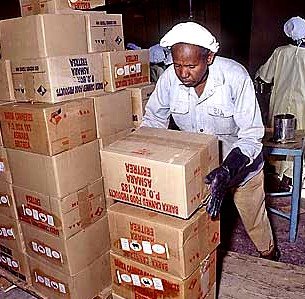 Rainer Chr. Hennig writes about the emerging 'green' protectionist policies of developed world:
Populist solutions that are to satisfy customers, politicians and the European industry alike are therefore surfacing all over Africa's neighbour continent and the main market of its products. And the solutions seem neat and nice - easy to understand and with the potential of creating more work locally. Even the industry starts propagating these solutions.
The victim mainly is Africa, because the message is that, as longer as a product or person is transported, the more energy is wasted unnecessarily. Worst of all is airborne transport, having the highest emissions of climate gases such as CO2. Unluckily, Africa is far away from European markets and poor transcontinental infrastructure puts most products and travellers on an airplane.
All over Europe, therefore, home-grown campaigns are being promoted, attacking Africa's newest and most successful export products. Anti-globalisation activists, "green" politicians, local industry and even occasional experts and scientists head these "buy local" campaign
See related coverage of this subject by Ethan Zuckerman and Alex Steffen
Photo courtesy of Afrol News
Why do My Ellipses look like Doughnuts? Plus 25 Solutions to Other Still Life Painting Peeves

Book on Painting Still Life
 |
| Click to buy kindle edition from Amazon |
 There is lots of advice inside to help with any issue with painting (and drawing) a still life, including overcoming childish style of painting, the Golden Section, drawing ellipses, drawing foreshortenings, composing a still life, lighting a still life, how to paint textures, how to draw perspectives, how to paint light from life, and how to make a rendering of objects appear as though they could be plucked from the canvas. The size of the print version of the book is: 24,000 words, over 100 colour illustrations and 20 diagrams. The hard copy of this book has 152 pages.
Advice for Still Life Painting
In total, there are twenty six chapters in this book including a demonstration on painting strawberries in the back and a glossary. Various art techniques are explored within, such as alla prima, oil painting glazing, scumbling, working impasto and working in detail. Common issues are tackled in depth, such as drawing foreshortenings, or objects with extensions head-on, which might be teapot spouts or handles.
Other common problems, are ellipses, which are often rendered with corners or assymetrically. A section on painting objects with angles, such as boxes or biscuit tins tackles common problems with vanishing points and angles that do not converge correctly. Painting rust or aged material can often result in material that looks too new. Painting reflections on glass is also a common issue. Suggested art techniques for painting other textures such as fruit, china and fur are also explored in depth.
The Secret of Great Still Life Art
Light and shadow are the secret to convincing still life, which can be achieved by good light. Effective use of a lamp, natural daylight or even painting out of doors will bring out textures and colour in objects, not always apparent in poor light or strip lighting. A section on painting out of doors, such as in the garden is also provided. Indeed, painting from life presents its own set of challenges, not least in capturing the changing light into paint. Painting from life is possible with certain strategies, given in this book.
Reflected light will suggest form and texture. Reflected light is light bouncing back onto the dark side of an object from a bright surface and is often overlooked in preference to simply light and shadow, but reflected light can make the difference between an average still life to a great one.
Problems with Childish Looking Still Life Art
The beginner might be deterred by a still life painting that looks childish or naïve. Common problems are a still life that leans to one side, not placed centrally on the page or has objects that appears out of proportion to one another. In regards to colour, the tones might appear too washed out, garish or flat. Down to earth and direct advice for the beginner is given to help overcome all these problems, via suggested painting and drawing exercises.
Recommended Book for Painting
Everything the still life artist needs to know can be found within this book, from the art materials needed to the best techniques for various effects. Overcomming common problems with still life painting is the key to moving forward and discovering a new passion for painting.
The Internalists
Inequality in K-12 Public Education
This one's for Chris L. @ A.U.
I think that The Frustrated Teacher said it best on the subject of inequality in education: "There is no quick fix because the problem, whatever the problem is, is not the fault of public education; it's the fault of society to adequately take care of those in need. I think its pretty clear that the "haves" have been having at the expense of the "have-nots" for so long that we are where we are now; a rich/poor society; very little in the middle.The "poor" don't need better schools and teachers, they need better lives !"
On a similar note Public Education Defender made a number of key points about Obama's recent speech on education policy. Public Ed. Defender argues that Obama's plan like that of other well intended politicians will do little to significantly improve education in America. Here's what this teacher blogger said: "... President Obama gave a major speech on education policy. So far, I like him a lot. Who knows whether or not he will have a successful presidency, but he seems to have the potential for greatness. His plan to improve education in America, however, does not inspire me. It's not that I'm disappointed by the things Obama is proposing; it's exactly what I would expect from a good politician who does not really understand what happens in a classroom. It's not that I think the things he is proposing are necessarily bad things. "
"President Obama is endorsing merit pay, that's not a bad thing, but I think it is greatly overrated by its proponents. It might help a little, and I am all for doing whatever it takes to make sure we keep our best teachers, regardless of seniority, and get rid of our worst ones. "
"...America's teachers are often portrayed by our media and elites as being incompetent. This is unfair. There are some lousy teachers out there--no one can deny that--and we should get rid of them. But much of the so-called "bad teaching" is being done by teachers who have been put into impossible classroom situations. Once in a blue moon you might find an incredible teacher who can go into one of those classrooms and turn things around. Those teachers, however, are very rare. If anyone thinks that enough of them can be found to turn around those impossible classroom situations in large cities throughout the nation, they are dreaming. Something has to be done about those classroom situations, and Obama's policies don't. "
I can't help but agree with both of these education bloggers. Somehow I feel that many out there, although well-intended I am sure try to offer simplistic solutions to a very complex problem without considering the research. It seems to me that almost everyone is an 'expert' when it comes to education reform. Many argue that if we just get rid of teacher tenure, fire all of the incompetent teachers, offer merit pay, and get all parents to make their challenging students behave then all of our problems will be solved. All of these solutions seem to be rooted in a "schools only" approach to fixing the problem which is part of the problem.
A look at a Bolder Approach to Education website is quite insightful and is a deliberate effort by leaders from various fields in education, social welfare, housing, and civil rights. Their position statement reveals that ".. research has documented a powerful association between social and economic disadvantage and low student achievement." They argue that our national education policy has been crafted around the expectation that schools alone can offset the full impact of socio-economic status on learning. As an example they cite the No Child Left Behind Law. They support that schools can ameliorate some of the impact of social and economic disadvantage on achievement but not all.
Many including our DC schools chancellor denies that socio-economic status has a significant impact despite what the research states. According to bolder approach : "evidence demonstrates that achievement gaps based on socioeconomic status are present before children even begin formal schooling. What is crucial for all of us is to not get caught into the trap that many of our politicians have which as bolder approach states is a "failure to act on the evidence — in tandem with a schools-only approach — which is a major reason why the association between disadvantage and low student achievement remains so strong. " Check out a bolder approach to education for solutions.
On Tuesday evening, I had the pleasure of a dinner meeting with 17 American University students and their professor from the DC Education Project on the subject of systemic inequities in K-12 education in the District and the nation. Chris L. , sophomore student leader of this group contacted me through my blog to arrange this very delightful evening. Our meeting took place in a Adams- Morgan hostel where several college students prepared all of us an informal dinner of burritos while we dialogued on this very interesting subject. This took me back to my ole' college days which for me offer many fond memories.
What I learned is that these 17 students are part of an alternative spring break project which included visiting DC schools (Janney ES and Hart middle school), meeting with non-profits, a community activist parent - Maria Jones, and Chancellor Rhee and WTU President George Parker, etc. As a public education advocate, I did my best to answer their many well- thought out questions from my vantage point on the subject of systemic inequities. I think that a good starting point for our discussion was their recent visit to a school west of the park and another school east of the river. What a dichotomy ! As I shared with Chris, I look forward to seeing the final outcome of their project. At a time when college students could be enjoying all of the simple pleasures of their spring break- they decided to become a part of an interesting alternative educational experience. I applaud their efforts. I am sure it will provide many life-long academic and personal memories . I believe that we ALL can learn a lot from their project- even President Obama. (Posted by The Washington Teacher).
Infrastructure Financing: Private-Public solutions
 Eric Osiakwan's AfricaCan lauds the alternative financing mechanism proposed for Kenya's National Fiber Network,commenting on a Balancing Act report that states:
The Kenya Government will have a 40 per cent holding in the project, Etisalat 20% and the remaining 40% will go to investors in the East African region. The Government has said it will organise an IPO on the Kenyan Stock Exchange. Several Kenyan companies have expressed interest and one said that the Government had told them it would “guarantee their loan”.
He says:
Thank God the Kenyans are experimenting with this approach where government owns part, private sector owns part, educational institutions should also own part, CSO owns part through IPO on the stock market.
The Kenyan government can actually raise the 40% from government bonds . I am not an expert on the stock market discipline of shares or bonds but this is where the financial experts need to come out with innovative solutions that can help raise much of this money locally - it is possible.
Why paying teachers for test scores doesn't work
Dan Pink's 2008 Ted Talk should be watched by everyone who thinks that teachers and principals being paid for good test scores is something that would actually work. Incentives only work when you have "simple rules and a clear destination."
When you have tasks that require creative solutions, right brain creative thinking, incentives lead to worse performance. In fact, the higher the "bonus" or incentive, the worse the performance.
How do you improve creative performance?
You harness intrinsic motivation by giving:
- Autonomy - flexibility, independence
- Mastery
- Purpose
We want to be held accountable and be good at what we do. Teachers want to be great teachers. We want to do a good job. And we all want purpose, or else we wouldn't be teaching. We are modern day nobility - when we act like it.
Lucky to make no money and have no benefits?
I'm blessed to be at a school that only tests 3 days a school year and gives us teachers a lot of autonomy in what we do (we are involved in textbook purchases and curriculum decisions), we all have a desire to be great at what we do, and we have a purpose. I think it is a common ingredient in successful schools and teachers. There are many teachers here who have left public schools because they have more freedom here and they have fallen in love with teaching again. They make less money and have no benefits but the autonomy, purpose, and mastery is here. They would never go back, they say, because they can be real teachers. That is a sad statement.
 |
| Photo: BigStock |
You get what you pay for.
But as for now, American public schools are getting what they pay for: worse test scores. If you believe the research Pink quotes, it means that if you pay someone more money for a job that requires creative solutions, the more you pay them an incentive pay (for the scores themselves), the worse that they will do, according to the science backing this up. (This is talking about INCENTIVE pay - Not base pay. Teachers should be well paid for a very important job. But paying for test scores is the wrong thing.)
Applying the Creativity Time to the Classroom
I have a Freshman project that takes 15-20% of the student's time and am giving them autonomy, mastery, and purpose. It is going to be a big positive of this year.
Think Noble Thoughts, it may help you more than you think
Watch this 18 minute video and think about it. Remember your noble calling -- perhaps that thought may do more to help you improve test scores in your room than anything else because that gives you PURPOSE it is up to your administration and school board to give you Autonomy and let you Master your profession.

Diffusion of Precommercial Inventions
An IDRC Study examined the success of indigenous pre-commercial inventions in Nigeria and posits solutions to improve the structural inefficiencies within this important plank of industrial realization. They include that
"...The government should not fund R&D activities until it identifies specific social, economic, technical, and other kinds of problems that need R&D solutions. The next step should be to develop research programs with specific objectives and, after dialogue with R&D institutes, to evolve means for achieving the desired results. Funds should then be tied to specific research programs. R&D institutes should be made to sink or swim on the basis of the number of feasible need-oriented research programs they can attract and what they can do with the programs. This means putting an end to blanket funding for institutes..."also"...The R&D institutes should be allowed to sell their services to the private sector and thus become more relevant to the needs of the country. The institutes should be allowed to compete for research projects initiated in the private sector. For this to be effective, the government needs to provide the private sector with an incentive to use R&D services. A climate of liberal imports does not provide this incentive. The incentive should take the form of special tax rebates or outright matching of funds for private-sector users of indigenous R&D institutes..."
National Council for a New America
Whenever you get a lot of Republicans together in one room, the topic inevitably turns to the future of the Republican Party and attempts to rebrand it. One such attempt is the National Council for a New America (NCNA), which is the brainchild of top Republicans like Eric Cantor and John Boehner. This new group has gotten heavyweights like Palin, Jindhal, McCain, Romney, and Jeb Bush to sign on to it, and will attempt to duplicate the success of The Contract with America.
This forum will focus on engaging Americans around the country in a series of policy debates in an attempt to develop ideas and proposals that the Republican Party can run with in the next election, or to get people around the nation behind policy proposals that they have already developed (not sure which). The NCNA will bring together citizens from across the country to begin a dialogue with the American people through a series of forums, town halls, and an online effort that will engage people in discussion- a Republican attempt to 'start the conversation'.
Here are some of the topics that this group with focus on: "Economy: Real Solutions for Economic Recovery," "Healthcare: Building a 21st Century, Patient-Centered System," "Education: Preparing Our Children to Succeed," "Energy: Solutions for Energy Independence," and "National Security: Defending American Liberty and Freedom."
Efforts like these are important, and I think can be a good part of helping Republicans win more elections. Together with the Tea Parties, which get citizens out and active, the NCNA will get Republicans together to talk about policy and government, and that is always a good thing. I've contacted Cantor's office already and offered to help set up a policy discussion here in my area- you should go ahead and do that too.
If you're interested in this group, read about it here, here, and here.
Return to Cloward-Piven Strategy: Beckman Interviews McCotter
Last week on Frank Beckman's show on WJR 760AM, Frank asked Michigan Congressman Thaddeus McCotter (R-11) if he thought that Obama was engaging in Cloward-Piven Strategy. This question surprised and intrigued me. I wrote about the Cloward-Piven Strategy before (see post Cloward-Piven Strategy), but for those of you who are sadly not frequent readers of my blog, I'll explain it to you now.
The strategy is called the Cloward-Piven Strategy after a pair of radical socialist professors from the 60's who came up with it. The idea is to purposefully create a series of crisis, each one of which will then be blamed on capitalism, de-regulation, low taxes, free markets, etc. After the crisis is at its peak and conservative ideals have been successfully blamed, you then advance a solution for the crisis- a solution to put in place a more socialist, state-run, liberal society. This solution will not make society better, but will instead create more crisis, which you then in turn blame on conservative ideas, and advance more solutions that are liberal. Eventually, the state will take over every aspect of our lives and run our society as a radical socialist utopia.
When I first suggested that the national Democrats were engaging in this policy back in 2008, I was drawing on my long experience watching Democrats in Michigan, particularly Detroit. In our state, Democrats put in place their liberal ideas, they backfire, and we get more liberal ideas, which backfire, leading to more liberal ideas, and eventually, you get Detroit (dominated by liberal Democrats for over 40 years) and to a lesser degree Michigan (dominated by liberal Democrats for almost 8 years). I figured that the series of crisis which followed the Democrats regaining control of Congress in 2006 were not due to bad ideas, incompetence, or just plain stupidity, but due to an organized and concentrated plot to create crisis so that that you could then advance liberal solutions.
For example, this current healthcare bill is not just an idiotic attempt to destroy our nation out of a foolish and misguided attempt to make things better, but a grand conspiracy to actually create a crisis in the healthcare system by putting in place laws and regulations that will lead to higher costs and lower coverage and benefits, and the response then will be an even bigger and stronger healthcare bill (which will then create an even worse situation, like we see in Canada, which will then lead to calls for more government, etc, until government controls everything).
In other words, the Democrats are purposefully overloading the system in an attempt to collapse it- adding more regulations and laws and taxes to our capitalist free-market system so that people will then think that the capitalist free-market system is failing, where in reality it is the very liberal policies that are creating the crisis.
In his interview, Frank Beckman suggested that the Democrats were engaging in this policy. Congressman McCotter disagreed.
McCotter thinks that it isn't an intelligent conspiracy of not letting any crisis go to waste to put in place more government, but rather just plain out liberal elitism and incompetence. He thinks that it is instead simply a selfish desire to create permanent dependent constituencies that will then vote Democrat, who will then distribute benefits to them. It isn't 1984, but rather more like the People's Republic of Haven (from the Honorverse). He makes a good argument, as most liberals that I have come across are really not evil manipulative people, but rather idiots and fools who lack an understanding of people, history, economics, and policy.
It does bear watching though if the pattern laid out in the Cloward-Piven Strategy holds true- if we get another crisis followed by more government control which leads to another crisis and more government control, etc. Keep your eyes on it- we have one more year of Democrats running the show in Congress, and they are sure to create more crisis in our society, either through an orchestrated strategy or incompetence, and keep your eyes out for the resulting 'the market failed' rhetoric and the 'more government is the solution' rhetoric that will follow.
Creating problem-solving systems
Bill Easterly contends that to solve development challenges "problem-solving systems" must be be in existence. This assertion has been on this blog and Timbuktu Chronicles under a number of guises. Be it evolving the culture; informal industrial clusters;startup; ecosystems; etc. Societies that do not evolve autocatalytic,sustainable methods of overcoming their challenges will remain moribund,regardless the level of external intervention:
Development happens thanks to problem-solving systems. To vastly oversimplify for illustrative purposes, the market is a decentralized (private) problem solving system with rich feedback and accountability. Democracy, civil liberties, free speech, protection of rights of dissidents and activists is a decentralized (public) problem solving system with (imperfect) feedback and accountability. Individual liberty in general fosters systems that allow many different individuals to use their particular local knowledge and expertise to attempt many different independent trials at solutions. When you have a large number of independent trials, the probability of solutions goes way up.More here
The Three R's to the DC Teacher Shortage Problem : Retain, Respect and Resources
From: The Mail - September 21, 2008
The research supports that teacher attrition rates are higher in teaching than other professions. The National Center on Education estimates that one third of all teachers in the US leave education during their first three years of teaching and almost half leave after five years. In poorer communities, it is even worse. For those who choose teaching through alternative certification programs, it isn’t uncommon for as many as 60 percent to exit education. Little wonder that DC Public Schools is facing a teacher shortage citywide. Of course other factors contribute to teacher shortages. For instance when Chancellor Rhee offered the Teacher Transition Award program last school year it encouraged certified teachers from closing and restructuring schools to leave in exchange for monetary awards. Not to mention the 78 probationary DC teachers who were fired in June without regard to their work performance while another 269 teachers were terminated, even though some of them were certified and some had agreed upon action plans. Then there are teachers like Denise Hamilton, the blind teacher (certified) featured on channel 9 news that was fired by DCPS due to a glitch created by the DC Central office. Go figure. Let’s not forget about the teachers who just got up and left for greener pastures.
The media recently reported that there is a teacher shortage at Thurgood Marshall, Ferebee Hope, and Garfield schools in the district. Many other schools complain of teacher shortages, including Ballou, Davis, Hamilton-Moten Academy, and the Shadd Center amongst a host of unreported others. A listserve parent weighs in on the impact of the DC teacher shortage at Thurgood Marshall: “Both Rhee and Fenty would never subject their kids to be placed in a class of forty students. You would think school principals should be the first voices we hear when school conditions are unacceptable. But instead they hide out in their offices, hoping parents will not complain. They are so afraid of drawing attention to their school to even ask for help or assistance from DCPS, for fear of loosing their positions, that they are placing our children in overcrowded classrooms.”
I wish I had a crystal ball, because if I did I would love to predict how our mayor and Chancellor will deliver the hard and quick solutions to our teacher shortage problem. After all, they are revolutionizing education, aren’t they ? Could teacher retention be one of the solutions? Randi Weingarten, now President of American Federation of Teachers, offers her perspective: “If we can’t keep the teachers who are hired, building a cadre of experienced, well-prepared teachers becomes like trying to fill a bucket that has a hole in its bottom. It’s costly and counterproductive to hire thousands of well-qualified people every year, invest millions of dollars in incentives, orientation, and professional development — only to see one of every four leave within a year and more than one of every three by the end of the third year. Worse, it’s bad for kids. Experienced teachers are more confident and more competent than brand-new teachers.” The key to retaining certified teachers depends on the three R’s which, by the way, have been discussed in many UFT publications: “You need to respect your professional staff, you need to retain (not fire) qualified teachers, and you need to provide adequate and appropriate resources.” Written by Candi Peterson.
In Order for the National Government to Save Education, It Has to Let it Go
If the national government wants to save education in America, I have become increasingly convinced that it needs to let it go, and for that matter, if the states want to save education in America, they have to let it go to. The education of children needs to be shoved as hard as it can be shoved to the lowest local level of our governmental system so that parents, local community leaders, and stakeholders in the educational system can regain the power and control over the education of their children's lives. What made our nation great was decentralization, local control, and personal responsibility, and by moving more and more control to the state and national levels we have lessened the very things that made us great.
America is not China, nor is it Finland, nor is it Germany, nor is it Singapore- those nations, although perhaps doing well lately, didn't conquer a continent, win two major world wars, and in recent years become the world's sole superpower. So we should not look to them for solutions on how to build and design and run an educational system for our nation- we should instead take those things that made America great and helped it to become what it is and modernize them and improve them and build on them, and that means not adopting statist models built on communistic principles designed to suck massive amounts of wealth from the system and funnel it through large bureaucracies to favored politically connected groups within societies. That's not our model to follow- our model is to return power over education back to the local level, which will then experiment with public policy solutions and funding models in order to achieve a democratic solution to providing high quality education at minimum cost to society with little loss of efficiency.
Rules regarding what is taught in each district need to be returned back to the district. Funding for each district needs to be returned to the district. Rules regarding discipline need to be returned back to the district. Control over hiring and regulations over hiring and rules regarding hiring need to be returned to the district. School districts at the local level must once again be where the education of children is designed, set up, and practiced, and this power and money and decisions should no longer to sent off to far-away places where faceless bureaucrats who don't know your kids make decisions that are very important to your children and their futures.
Democrats and Republicans alike make the mistake of trying to fix education by moving more and more power to the national or state levels, killing any innovation that local districts may experiment with to build better educational systems in favor of trying to adopt one-size-fits-all models that not everyone wants and so no one adopts. Creativity, growth, and great ideas come from people who actually work in education and manage education professionals and whose children go through the education system, and yet in our nation, more and more of decisions, funding, and power is flowing rapidly away from those people to unelected bureaucrats, childless professors, and scheming politicians. Republicans and Democrats alike need to reject this siren song of government power fixing everything, and take a deep breath and a leap of trust and once more empower the people of our great nation to do what needs to be done to fix and improve education by returning powers and funds that once were at the local level- once when America was great- back to the local level.
Daily Education & Technology News for Schools 04/12/2011
-
YouTube - Teachers Who Inspire Student Entrepreneurs
Winners for imagine cup:
Thanks so much!
This afternoon in Redmond, WA, the nation's best and brightest tech students gathered for the ninth annual Imagine Cup 2011 U.S. Finals. Starting with a field of more than 74,000 students, the final 12 teams presented their life-changing projects to a panel of elite judges, tackling diverse issues from eliminating malaria to promoting alternative energy. After an intense weekend of presentations and eliminations, the winners were named:
* 1st Place, Software Design: Team Note-Taker, Arizona State University. Project: "Note-Taker" - A portable, assistive technology to help vision-impaired students take notes in class.
* 1st Place, Game Design - Windows/Xbox: Team Bloom, Tribeca Flashpoint Media Arts Academy. Project: "Spero" - A game focused on alternative energy solutions and educating people on how to live healthier lives.
* 1st Place, Game Design - Mobile: Team Big Impact Bear, University of Houston. Project: "Forest Gun" - A game that aims to prevent and reverse deforestation in the world.
* 1st Place, People's Choice Award - Software Design: Team BearPaw, Brigham Young University. Project: A mobile and cloud solution for ultrasound images that is cost-effective, widely available and easy to implement.
* 1st Place, People's Choice Award - Game Design: Team Bloom, Tribeca Flashpoint Media Arts Academy. Project: "Spero" - A game focused on alternative energy solutions and educating people on how to live healthier lives. -
Home to Homeroom | Stop Medicine Abuse
A website about helping teens with medicine abuse. A good specific website from the national association of school nurses.
"Multiple national surveys point to the disturbing abuse of prescription (Rx) and over-the-counter (OTC) medicines, like OTC cough medicine, among today's teens. Five percent of high school teens admit to having abused cough medicine containing dextromethorphan, or DXM, to get high in the past year." -
From this organization:
"We’re launching a new “60 Second Lecture” campaign in conjunction with the Ford Focus Global Test Drive, and many interesting individuals from the PresidentAmy Gutmann of the University of Pennsylvania to Dean Thomas Robertson of the Wharton School have already agreed to share their insights." -
MacdonaldTechForTeachers - iPad Apps for Education
Ann McDonald is building a very nice wiki with so many resources! She is an excellent Flat Classroom teacher.
-
Excellent article about a struggle to ban cell phones in schools and why it is not working.
-
Social Media Policy Best Practices: Trust Is Cheaper Than Control | Beth’s Blog
Nice Social Media Policy Best Practices discussion for nonprofits. The social media policy is related to your strategy. Most schools only have a strategy to prevent litigation and certainly, that is a factor as we look at schools and yet - we're not there yet on this discussion. I have to think at some point we're either going to have platforms that do a better job of protecting the privacy of minors or we're going to have to grow up in how we deal with these tools.
-
Flat Classroom : The Tornado Tribune
Helen Harvey's Flat Classroom participation received a write up in her local paper. An important part of each of our projects is to issue press releases to gain media attention for the schools that break down the walls.
-
Seth's Blog: Moving beyond teachers and bosses
So we, as teachers, are characterized like this from Seth Godin:
"We train kids to deal with teachers in a certain way: Find out what they want, and do that, just barely, because there are other things to work on. Figure out how to say back exactly what they want to hear, with the least amount of effort, and you are a 'good student.'"
Are we the kind of teachers who have to move past or someone that kids are moved with.
Do we have a limiting mindset? -
Knight Foundation Webinars - Knight Foundation
April 20th from 2-3 pm EDT - a connected citizens webinar about their new report "Connected Citizens: The Power, Peril and Potential of Networks"
sign up for this event here. -
Connected Citizens Report: The Power, Peril, and Potential of Networks | Beth’s Blog
If you have no idea what network-centric grantmaking is and you write grants or work with fundraising - this blog post is an important read for you. (Buy Beth's book - the networked nonprofit - it is great.)
Themes as per Beth:
These themes include:
1. Listening to and consulting the crowds: Actively listening to online conversations and openly asking for advice.
2. Designing for serendipity: Creating environments, in person and online, where helpful connections can form.
3. Bridging differences: Deliberately connecting people with different perspectives.
4. Catalyzing mutual support: Helping people directly help each other.
5. Providing handrails for collective action: Giving enough direction for individuals to take effective and coordinated action. -
join the crowdsourced keynote at the BC educational technology users group. Here are instructions:
We Want Your Videos
April 7, 2011 By grantpotter Leave a Comment
Share
PrintFriendly
In June 2011 the BC educational technology users’ group (etug) will be hosting a Spring Workshop in Nelson, BC. The theme? OPEN 4 LEARNING.
In the spirit of openness we would like to invite YOU to participate in a crowd-sourced keynote. Our vision is to create a keynote video that highlights the collective voice on the value of openness.
Here’s what we would LOVE for you to do:
Create a short video/interview/montage answering one or two of the following questions:
1. What is the value of openness?
2. What examples of openness stand out to you as being valuable/worthwhile?
3. WHY do you believe in the value of open education?
If you are interested in participating we would love to have you be a part of this exciting opportunity, to collectively gather voices across the globe in answering the question “what is the value of openness”. Have fun with your video – the more creative the better.
.
Upload your video to:
http://www.dropitto.me/etug
password: open
.
Deadline: May 9, 2011 -
Online Learning in Australia - Connections, Partnerships and Successes ~ Stephen's Web
A report on the state of elearning in Australia. Every collection must comprise 40% free content.
Again, this article proves that if you're in education and not reading Stephen Downes' feature-rich blog, you're missing out. -
Colleges Spend Far Less on Educating Students Than They Claim, Report Says ~ Stephen's Web
Colleges actually spend LESS educating students than students are paying. From Stephen Downes as cited from the Chronicle of Higher Education April 8, 2011.
-
STUDYBLUE | Make online flashcards & notes. Study anywhere, anytime.
Study Blue website to let you make flashcards to study and put on your ipod, ipad, cell phone, etc. Over 12,000 have recommended via facebook. Facebook is linking with learning as are mobiles.
-
20 Terrific TED Talks for Language Lovers | Bachelor's Degree Online
Ted Talks for Language Lovers.
-
The Truth is Out There | November Learning
Interesting discussion about "blue blood" and the quest for truth in an age where even Googling something may not change minds. By Bob Sprankle
-
TLC = Tech + Library + Classroom: iPad Apps To Love
Tara from the TLC (Tech + Library + Classroom) Blog posts her iPad apps she loves.
I think the I write words app is very interesting for handwriting. I wonder if the fact that they are using their finger is a drawback but think that it will help the kids take the strokes the same way. -
Speak Up National Findings 2010
Important study surveying students about empowered education with emerging technologies.
-
One Year Later: Assessing the Impact of iPads on Education - iPads in Education
Assessing the impact of iPads on education one year later by Sam Gliksman on the Ipad educators ning (hat tip to Julie Lindsay for this information.)
-
Final Teams in US Imagine Cup:
Software Design
TTHV - Harvard University, University of Pennsylvania, Central Connecticut State University
Uca Ursus - University of Central Arkansas
Lifelens - Anderson School of Management, Harvard School of Business, University of California San Diego, University of California Davis, University of Central Florida
Note-Taker - Arizona State University
Game Design –Windows/XBOX (XNA):
Bloom - Tribeca Flashpoint Academy
Plump Pixel - California State University Chico
Righteous Noodle - University of Houston
XozGaming - Lick-Wilmerding High School
Game Design Mobile (Zune/Phone)
Big Impact Bear - University of Houston
EDO - Arizona State University
Team AAMP - University of Houston
Team Mintrus - Columbia College in Chicago, University of Louisville
Read Alfred's blog for more. -
Alfred Thompson's ongoing coverage of the Imagine Cup. I love this interview with the kids who invented a program about fighting a global pandemic.
-
Sneak Peak of New Facebook Nonprofit Use Research from Idealware | Beth’s Blog
Yes, nonprofits are seeing success on Facebook. Beth Kanter, nonprofit social media guru, has a guest post from Kyle Andrei of Idealware on their findings about Facebook and nonprofits. Fundraisers, schools, and facebook fans read up.
-
Gesture-Based ‘Gmail Motion’ April Fools’ Day Prank Gets Real - Techland - TIME.com
I love this! Gmail motion was Google's april fools day prank and many people fell for it. Heck, if I'd had time, I might have played with it but after thinking I realized what day it was! Tee hee.
But a lot of people WANTED this -even though the gestures were designed to be silly (who is going to do a jumping jack for making a star on an email.) so ICT used a kinect camera and actually made Gmail actions work! Watch the video and enjoy.
People actually WANT this just not with the exaggerated motions and definitely not a shot that requires the camera to see your feet.