RSS
Menampilkan postingan yang diurutkan menurut relevansi untuk kueri Scholars. Urutkan menurut tanggal Tampilkan semua postingan

Live It

Beijing, China - 5:21 am, 2/24/2011
4:21 pm EST - USA 2/23/2011


Why China? Why was the first one held in Qatar? Why India last year?

Some has to do with sponsorship - finding innovative schools. But a lot has to do with living it.

You don't have to teach ABOUT China if you can live China. Some of you will participate virtually in the conference and see the sites go up and down, the teachable moments, you'll understand it better because you were either face to face and lived it or because you were virtual and lived it.

I have been living China for almost a week. Just now I'm able to get back on this blog even through my VPN. There are things I have to be wary of discussing even as I type that could cause sites to be blocked or for me to be viewed unfavorably. I am living it.

My students are living it (as you can see in the photo album.) The students who went last year with me to India are comparing and contrasting India and China in many powerful ways. They live it.

I'm living it to. The struggle of getting money into China. The struggle of the time zone differences with the US. The struggle of the ability to communicate with you back in the US. The tears.

Yes, we have a vision, but making visions happen comes at a price. It has been at a price and continues to be.

James Paul Gee has an excellent MacArthur report paper where he talks about that New Digital Media and Learning as an Emerging Area and "Worked Examples" as One Way Forward. The summary of this work says:


"He argues that DMAL will not evolve until a real coherence develops through collaboration and the accumulation of shared knowledge. Gee offers a concrete proposal of one way scholars in DMAL could move the area forward to a more cohesive, integrated, and collaborative enterprise: the production of what he terms "worked examples."

In Gee's sense of a worked example, scholars attempting to build the new area of DMAL would publicly display their methods of valuing and thinking about a specific problem, proposing them as examples of "good work" in order to engender debate about what such work in DMAL might come to look like and what shape the area itself might take. The goal would not be for the proposed approach to become the accepted one but for it to become fodder for new work and collaboration."

This conference will produce 41 worked examples of how global collaborative projects (using Digital Media and Learning) can be used to improve education. (See http://conference2011.flatclassroomproject.org) - these projects designed by students and teachers and administrators with participation from virtual participants and people from diverse backgrounds can give us some great thoughts and discussion points for how we can truly integrate global collaboration into our courses in ways that add meaning and improve learning.


This is a worthy cause. We've worked very hard to get the best in the business who understand this model of action-based conferencing undergirded by meaningful actions and outcomes for the participants to come here and honestly, most of them are barely breaking even on the trip, if that. Julie and I do not pay ourselves anything. This method of conferencing is in its infancy but we believe it is an important method of professional development and hope that the conference itself becomes a working model of effective action-based professional development and learning for both students and educators.


WE're excited and the conference is going to be great, but I will tell you that it has been a huge strain pulling this together... especially on Julie but also on me as well. Any support you wish to give our nonprofit is appreciated as right now we are faced with US and Chinese banks that have not handled our money transfers properly.


So, please join us virtually if you wish by joining our Ning and Wiki and viewing the conference on our Taking IT Global  portal.


Oh, one great thing - I can now get on Twitter and Hootsuite again after beeing Tweetless for most of this week! It has been a struggle to communicate this week. (Wonder why? ;-) and yes I know why - just can't say it.) Will tell you more later -- right now I'm living it!


Join us and live it to. You can be part of something that people are willing to sacrifice for to improve education. You can be part of a wonderful vision that has teachers connecting directly. Yes, we have a nonprofit, but for the most part we're just moving forward with a ton of amazing volunteers who believe it is time to stop lecturing about "action based learning" and "global collaboration" and "digital storytelling" and to do it for a change.


The hypocrisy of a lecture about project based learning doesn't happen here - we're to busy working and teaching. Let the fun begin! Live the change!


  • Digg
  • Del.icio.us
  • StumbleUpon
  • Reddit
  • RSS

Letting Africa Down - It's Intellectuals

An Open letter to Africa's Academics, Scholars and Intellectuals from George Ayittey:
Upon reviewing the current upheavals in North Africa and elsewhere on the continent, I felt it is necessary for us – African academics, scholars and intellectuals – to take stock and a fresh look at ourselves: What role have we played in advancing the cause of liberty and improving governance in post colonial Africa. Our record is not very good. Sometimes, self-criticism is necessary in order for us to make progress. You do not have to agree with what I am going to say – diversity of opinion is healthy. There have been outstanding individuals among us who risked death to champion the cause of freedom in Africa. However, as a group we have let Africa down badly by not providing intellectual leadership to the democratic struggle.

“He who doesn’t know where he came from doesn’t know where is going,” says an African proverb. We of the intellectual community are lost; we don’t know where we are going. The recent upheavals in Africa caught us completely off guard. We did not see it coming because we were pre-occupied elsewhere. It seems we are way behind the curve, late to the struggle for democracy in Africa and are now only playing “catch-up.”...[continue reading]

  • Digg
  • Del.icio.us
  • StumbleUpon
  • Reddit
  • RSS

The Saudi-isation of Pakistan and warning's for Africa

Pervez Hoodbhoy writes:

For three decades, deep tectonic forces have been silently tearing Pakistan away from the Indian subcontinent and driving it towards the Arabian peninsula. This continental drift is not physical but cultural, driven by a belief that Pakistan must exchange its South Asian identity for an Arab-Muslim one. Grain by grain, the desert sands of Saudi Arabia are replacing the rich soil that had nurtured a magnificent Muslim culture in India for a thousand years. This culture produced Mughul architecture, the Taj Mahal, the poetry of Asadullah Khan Ghalib, and much more. Now a stern, unyielding version of Islam (Wahhabism) is replacing the kinder, gentler Islam of the Sufis and saints who had walked on this land for hundreds of years.
via 3quarksDaily
Perve's piece is almost a corollary to Philip Smucker's 2004 article which reported on efforts being taken via dissemination of historical texts to reaffirm a liberal African version of Islam.A cause all the more pertinent as the region confronts a most intolerant version of the faith:
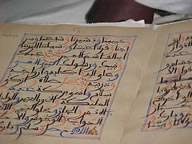
Particularly relevant, black African and Arab scholars say, are accounts of how the African interpretation of Islam helped regulate the affairs of men, resolve disputes and provide a model of tolerance. Buried in the crumbling manuscripts of Timbuktu and neighboring cities, scholars are finding evidence of wars averted, sieges ended and lawlessness put to rest.
The information is all the more valuable for moderate Muslim leaders because of the rise of less tolerant forms of Islam, like Saudi Arabia's Wahhabism or the Salafist movement in Algeria, that are expanding their foothold.
Photo courtesy of Getty Images

  • Digg
  • Del.icio.us
  • StumbleUpon
  • Reddit
  • RSS

Scientific Historians and Timbuktu


John H. Lienhard on the city of Timbuktu:
Timbuktu Mosque (www.aluka.org)Image by Aluka Digital Library via Flickr
Today, this remote and impoverished city is rich in some 14,000 old books that've literally come out of its woodwork. Scientific historians who converge upon Timbuktu have only dented the task of translating the old science texts from Arabic and other less know languages. They find that Timbuktu's medieval and renaissance scholars followed a path separated from Europe.
Their astronomers didn't follow the European leap to a sun-centered solar system, but they sprang far ahead in the mathematics of calendar writing -- far ahead in trigonometry. The writings detail astronomic events six hundred years ago. Scholars, racing to translate this huge trove of literature, now wonder what these ancients knew of medicine, botany, chemistry and climatology. How did the knowledge of other regions flow through this glittering outpost? How much new science did it create?
More here
Enhanced by Zemanta

  • Digg
  • Del.icio.us
  • StumbleUpon
  • Reddit
  • RSS

Daily Education and Technology News for Schools 12/05/2011

Posted from Diigo. The rest of my favorite links are here.

  • Digg
  • Del.icio.us
  • StumbleUpon
  • Reddit
  • RSS

The "Colonialism-Imperialism" Paradigm Is Kaput (2 of 2)

PART II (see part I)

Modern Grievances against the West

External Props of African Despots

Historically, every foreign entity that goes to Africa does so to pursue their own interest, not those of Africans. Witness the scramble for Africa in the 1880s. The Chinese do not go to Africa because they love black people soo much. They go there to pursue their interests. Exactly the same can be said of the Cubans. This competition for influence in Africa became pronounced during the Cold War, when super-power rivalry led to the establishment of client states across Africa. The West supported the likes of Mobutu Sese Seko, Samuel Doe, Hastings Banda, Felix Houphouet-Boigny, etc. etc. The East supported the likes of Mengistu, dos Santos, Mattieu
Kerekou, Sassou Nguesso, Samora Machel, etc. etc. Arab countries also backed their clients in Africa: Sudan, Mauratania, Chad, etc.

Cold War Intrigues and Machinations

Each side in the Cold War provided billions in aid to their clients to protect their security interests in Africa. Angola, Ethiopia, and Mozambique all received substantial amounts of Soviet military hardware. For example, Mengistu Haile-Mariam of Ethiopia received more than $11 billion in military weapons between 1975 and 1990. Angola received at least $2 billion annually
in military assistance from the Soviet Union in the 1980s (The Independent, London, Feb 19, 1992). In 1991, $4 billion of Angola's $8.7 billion foreign debt was owed to the former Soviet Union. On July 1, 1991, President Eduardo dos Santos said: "military debts were not usually honored," implying that Angola would not pay it (The New York Times, July 8, 1991). Soviet aid was stingy.
The economic aid the Council for Mutual Economic Assistance (Comecon) provided to sub-Saharan Africa in 1985 was $300 million. Of this, Ethiopia received by far the most (57.9 percent). Next were Mozambique (13.8 percent), Egypt (6.6 percent), Madagascar (4.2 percent), Angola (2.8 percent), and Tunisia (2.1 percent) (West Africa, Dec 12-28, 1988; p. 2320). Angola and Mozambique benefited more from arms supplies. The $300 million aid was only 5 percent of total Comecon bilateral disbursements and only 3 percent of the total aid flow to sub-Saharan Africa.

Furthermore, the little Soviet economic aid that did flow to Africa had strings rigidly attached. Loans and trade credits supplied could only be spent in the Soviet Union and Comecon countries (100 percent tied aid). In addition, the Soviets supplied the technical personnel and the equipment for project construction. Repayments of loans were often by barter, but to the
decisive advantage of the Soviet Union. For example, in Guinea, Soviet help in building a bauxite plant at Kindia was to be repaid with deliveries of two million tons of bauxite ore a year for 30 years.

Barter arrangements also hurt Soviet clients in Africa in a different way. For example, repayments of loans Nkrumah of Ghana took from the Soviet Union were to be made in kind with exports such as cocoa. But the Soviet Union had little use for Ghana's cocoa. Re-export of cocoa by the Soviet Union helped depress the world market price of cocoa in the mid-1960s.

China, an active player in Africa, sought to win adherents to the Chinese brand of socialism. Zhao Ziyang, China's foreign minister in the early 1960s, reminded African leaders of the presence of Chinese coolies in Africa. China's perception was that Moscow, not Washington, was its principal enemy. Its strategy was therefore to weaken "social imperialism at the expense of monopolistic capitalism" (Snow, 1988). West Africa observed that "in Africa, China increased assistance to old friends such as Tanzania and Zambia. The 2000km Tan-Zam railroad was meant to overshadow the Soviet-built Aswan High Dam in Egypt. China also made friends with old enemies such as Mobutu, helping him during the Shaba uprising in 1978-79; in 1980 they helped him build a naval base at Kinkuzu in southern Zaire to threaten Angola" (Aug 15, 1988; p. 1473).

China's fortunes in Africa quickly turned into mirages, however. At first, China's anticolonial stance was welcomed by African liberation movements. But as independence was gained, China's emphasis on subversion and its intense enmity toward the Soviet Union became less and less appealing or relevant to Africans. In fact, as early as 1963 Julius Nyerere of Tanzania
complained of a new scramble for Africa between the Soviet Union and China. Because their actions were anti-Soviet rather than pro-African, the Chinese themselves did not achieve much by way of influence.

Furthermore, China was no less immune to blunders than the Soviets. Less wisely than the Soviets, China meddled in Burundi ethnic feuds. In 1963 China backed the Tutsi expedition by training a number of Tutsi in guerrilla warfare in China. The subsequent massacres in Burundi earned China much opprobium. China also supported the Biafran secessionists in Nigeria's civil
war (1967 to 1970) simply because Moscow backed the Federal Government of Nigeria. Similarly, in Angola, China supported the FNLA (National Front for the Liberation of Angola) because Moscow was backing the ruling MPLA.

In Mali and Congo-Brazzaville, China made some headway. But a spate of military coups brought to power new rulers distrustful of China. Only in Tanzania did China achieve some diplomatic and ideological success. China agreed to fund and build the 1,200-mile Tan-Zam railway line at a cost of 166 million pounds sterling, free of interest. The railway was both an
engineering and a political achievement. It was completed two years ahead of schedule and was much touted as a model of what foreign aid could do for Africa. But it was one thing to build the railway and quite another to run it efficiently. Maintenance was poor, services degenerated, and the Dar es Salaam terminal became chronically clogged to the point of immobility. Although the Chinese had nothing to do with these shortcomings, their reputation suffered.

Zimbabwe received technical and military aid from North Korea and China. For its part, the West also poured billions into Zaire, Liberia, Kenya, Nigeria, and other African countries.

Each side also sought to undermine African regimes that were hostile to it. Lumumba was assassinated by the CIA operatives and the 1966 coup against Nkrumah was orchestrated by the CIA. In this sphere, the French were the worst, intervening directly to remove African leaders they did not like in Francophone Africa. For the French, independence did not mean a retreat from Africa. France left hundreds of officials in Africa as advisers. Behind the doors of many key ministries in the Ivory Coast and Senegal or Gabon, discreet but powerful French officials kept a close eye on policy. The French also sent teachers to Africa and brought African students and civil servants to France for training. France secured the right to maintain a
heavy military presence in Africa. In 1989, for example, France had a significant number of military advisers in 16 African countries and permanent Forces d'Intervention in seven. Total strength of French troops in Africa exceeded 12,000 in 1990. In France itself, the Forces d'Action Rapide, numbering 47,000, could be mobilized in less than 48 hours for action anywhere in Francophone Africa. These forces played an economic policing role and backed up French diplomacy and paternalism. They supported "approved" Francophile governments such as those of Leopold Senghor of Senegal and Felix Houphouet-Boigny of Cote d'Ivoire.

After 1960 the French intervened on many occasions to prop up unpopular African regimes against internal dissatisfaction and disorders. The most notorious such occasion was in Gabon in 1964, when French troops were used to reinstate President Mba after a coup. Noting that the French did not intervene to save President Youlou in Brazzaville in 1963, critics charged that intervention was predicated on mineral wealth. (Gabon is rich in oil.)

Now, each foreign entity operating in Africa pursues its own interests. It was ONLY the West which propped up hideous dictators in Africa. A foreign prop is a foreign prop is a foreign prop, regardless of its origin. An African leader is supposed to pursue the interests of his PEOPLE. If he doesn t, remove him from power but did we? Instead, we argued ad nauseam that, since the West put Mobutu, for example, in power, it was the responsibility of the West to remove him. This was ridiculous because if Mobutu was serving Western interests, why would the West remove him? And even if the West removed him, who do you think the West would have installed as a replacement? Another Mobutu !

It is clear that we have drawn no historical lessons from our dealing with the West and other foreign blocs. Here s a popular adage: If someone cheats you once, he is the fool but if he cheats you again, you are the fool. If you agree, then why are we talking about the Second Scramble for Africa ? And have we not learned that if you give an African problem to the Americans, Brits, French or the Chinese to solve it, each would solve it to their advantage? Does the mantra, African solutions for African problems, make sense to you?

Again, prop or no prop,

You cannot claim that it was the West which told Mobutu to loot the Zairean treasury. Nor claim that it was the North Koreans who told Mugabe to butcher over 20,000 Ndebele in 1980 (Matabeleland massacre). Neither can you claim that it was the Arabs who ordered Idi Amin to
butcher over 200,000 Ugandans. Nor can you claim that tell me it was the French who ordered Gnassingbe Eyadema to cling to power for 34 years and amass a personal fortune worth $3
billion.

True, the French and indeed the World Bank knew these African despots were stealing money and looked the other way. But who is an African leader accountable to? To the French, the World Bank or his PEOPLE? Prop or no prop, these leaders must be held accountable for their actions.

In fact, these days the charge of foreign meddling in African affairs and the specter of sinister and greedy multinational corporations lurking in the dark, waiting for a chance to pounce and exploit Africa confute reality. Foreign investors have fled Africa as the continent remains unattractive. Is it not African governments who have been drawing up elaborate and fancy
investment codes to ATTRACT them back? And is it not African governments themselves who take their budgets to foreign capitals for approval in order to get foreign aid? So who ALLOWS the meddling in African affairs?

Even then, the West has shown little interest in meddling in African affairs in the past few decades. If anything, the West has been in retreat from Africa! Recall the statement by presidential candidate, George Bush, that Africa was not of strategic importance to the U.S. And was it not the same African leaders who were complaining after the Cold War that Africa was
being marginalized ? So which is which: Is the West meddling in African affairs or the West marginalizing Africa?

In case you did not know, the West is thoroughly fed up with Africa, which it regards as a cry-baby, hopelessly incapable of solving any of its problems and is constantly crying out for help. What do you think the expression donor fatigue means? That is the diplomatic way of saying that the international community is fed up with incessant African appeals and begging. Today, there is famine in Ethiopia, tomorrow, there is a refugee crisis created by war in Liberia, or Somalia. Then there is genocide in Rwanda, starvation among refugees in eastern Congo, Ivory Coast, and on and on. Haba. Africa is now synonymous with war, destruction, famine, refugees, starvation, instability and chaos. Year after year since 1985, one African country after another has imploded, scattering refugees in all directions: Ethiopia (1985), Angola (1986), Mozambique (1987), Sudan (1991), Liberia (1992), Somalia (1993), Rwanda (1994), Zaire (1996), Sierra Leone (1997), Congo DRC (1998), Ethiopia/Eritrea (1998), Angola (1999), Ivory Coast (2000), Togo (2005).

The implosion of these countries had nothing absolutely nothing to do with the slave trade, nothing to do with Western colonialism or imperialism, nothing to do with artificial colonial borders, nothing to do with an unjust international economic system; in short, nothing to do with so-called external factors. They all had to do with one thing: POWER the adamant refusal to relinquish or share political power. If GENERAL Siad Barre of Somalia, GENERAL Juvenal Habryimana of Rwana, GENERAL Pierre Buyoya of Burundi, GENERAL Mobutu Sese Seko of Zaire, GENERAL Samuel Doe of Liberia, GENERAL Joseph Momoh of Sierra Leone, GENERAL Robert Guie of Ivory Coast, GENERAL Gnassingbe Eyadema, etc. etc. had been willing to step down or put in place power-sharing arrangements, each of their countries would have been
saved. Note the frequency of the title, GENERAL.

The rule is this and you can call it Ayittey Law: "The adamant refusal of an African head of state to step down or share political power will ultimately lead to the destruction of his country." If Mubarak of Egypt, Museveni of Uganda, Mugabe of Zimbabwe, Ghaddafi of Libya refuse to leave the political scene or share power, their countries will be destroyed. This is not rocket
science and it has nothing to do with the West. It is a personal or political failure that cannot be blamed on Americans, Chinese or Martians.

Back in 1986, President Museveni of Ugana said that no African leader should be in power for more than 10 years. What happened to him? He has been in power for more than 16 years and still counting. Finally in the late 1990s, African leaders wrote Constitutions in which they inserted the two-term limits. What happened? They are the very same ones who are now using their parliamentary majority and various devious maneuvers to override or repeal the two-term limits in Chad, Guinea, Namibia (Nujoma before he retired), Uganda, and even Nigeria.

Benin, Cape Verde Islands, Sao Tome & Principe, South Africa and Zambia all saved themselves from implosion because their leaders agreed to power-sharing arrangements crafted out of sovereign national conferences. South Africa would have blown up if the whites had not sat down with the blacks in a Convention for a Democratic South Africa (CODESA) to craft a new
political dispensation for the country. Rwanda blew up because the Hutu-dominated government of GENERAL Juvenal Habryimana refused to share power with the Tutsi minority and, instead, decided to exterminate them. "No Tutsis, nobody to share power with" was the macabre and brutal logic. More than 800,000 Tutsis were slaughtered in a orgy of violence and brutal massacre. That, in itself, was an excellent example of "intellectual astigmatism".

We could see with eagle-eyed clarity all the repugnant and inhumane brutalities of the white apartheid system in South Africa but we were hopeless blind to the equally heinous tribal apartheid regime in Rwanda. If the racist apartheid regime in South Africa had butchered just 2,000 blacks, even Idi Amin, who himself slaughtered more than 200,000 Ugandans, would
have arisen from his grave to attack South Africa with 3 dilapidated helicopters! But we said nothing when 800,000 Tutsis were slaughtered. Instead, we blamed the WEST for NOT intervening to stop the genocide. In fact, at its July 2000 Summit in Lome, Togo, the defunct OAU demanded a Marshall plan style compensation package for Rwanda. The demand for
compensation was part of the OAU inquiry into the 1994 Rwandan genocide, which blamed Western powers for failing to intervene to stop the mass slaughter. Naturally.

The OAU inquiry singled out France and the United States for particular blame for failing to prevent the genocide in addition to the United Nations Security Council as a whole. France was culpable because, having high level contact within Rwanda s Hutu-led government, the OAU report argued, could have exerted pressure to prevent the death of 800,000 people. The OAU
enquiry also blamed the US for failing to use its influence in the Security Council to authorize a military intervention to prevent the killing. The report argued that the West failed Africa despite the availability of copious evidence that the mass killing had been about to begin. In
conclusion, the report noted, a simple apology as already made by the United Nations was not enough and called for compensation, alluding to the $13 billion Marshall Aid plan the U.S. launched for the reconstruction of Europe after World War II. And what did these self-righteous leaders do to prevent the killings going on right under their very noses? And how can these
leaders complain about foreign meddling in African affairs and at the same time blame the West for NOT INTERVENING in an African problem to stop a massacre?

These days appeals by African leaders fall on deaf ears. OECD aid to Africa fell by 22 percent between 1990 and 1996, decreasing by 18 percent to sub-Saharan countries between 1994 and 1996 alone. (DeYoung, 2000a; p.A1). Even humanitarian aid to Africa has been shrinking. Contributors to United Nations aid and development programs have provided slightly more than half of the $800 million requested in 1999 for African countries suffering from "complex emergencies" -- the term is applied when war and failed institutions, often combined with a natural disaster, leave vast numbers of people homeless and starving. Specific programs for some particularly problematic areas, such as the Great Lakes region of Central Africa
including the two Congos, Rwanda and Burundi, have fared even less well (DeYoung, 2000b; p.A1).

In Sept 1999, the U.N.'s World Food Program announced it would curtail its feeding program for nearly 2 million refugees in Sierra Leone, Liberia and Guinea after receiving less than 20 percent of requested funding. An emergency appeal during the summer to feed and shelter at least 600,000 Angolans who had been displaced in that country's long-standing civil war
brought minimal initial response and predictions of mass starvation. In Africa's Great Lakes region of Congo, Burundi and Rwanda, where wars have produced nearly 4 million refugees, the United Nations estimated it would need $278 million to take care of them. By Oct 1999, only 45 percent of that amount had been donated. Nearly 80 percent of the United Nations humanitarian appeals in 2004 were to address African problems, but the response was disappointing as to be non-existent. "I remember sitting in this very room last summer (2004) asking for five helicopters to save thousands of lives in Darfur (Sudan). In the end we had to hire helicopters commercially as no Member States were willing to provide them," Under-Secretary-General Jan Egeland, head of the UN Office for the Coordination of Humanitarian Affairs (OCHA), the chief of the UN humanitarian office told the Security Council meeting on humanitarian challenges in Africa in January 2005 (http://www.un.org/apps/news/story.asp?). Even Irish rock star, Bob Geldof, who organized Band Aid and Live Aid to provide famine relief to starving victims in Ethiopia in 1985 is now fed up with Africa. He said this on Jan 31, 2005, of his work in Africa: "I'd dearly love not to have to go there the day after tomorrow. More often than not, it bores me profoundly - the pace of change is far too slow, and Africans excuse their own complicity in exactly the same way as our politicians (http://news.bbc.co.uk/1/hi/entertainment/music/4222373.stm).

Private organizations are also having difficulty raising funds for African relief operations. According to Mario Ochoa, executive vice president of the Maryland-based Adventist Development and Relief Agency (ADRA), which operates relief projects out of its own donations and under contract with donor governments, If I were to go now and make an emergency appeal for, say, Rwanda, for $500,000 for food, I'd probably get about seventy or eighty
thousand" in contributions (The Washington Post, Nov 26, 1999; p.A1).

True, every now and then, a major effort is launched in the West to help Africa. Africa s plight follows a ten-year attention deficit cycle: 1985 (Live Aid to save famine victims in Ethiopia), 1996 (a Special U.N. Session to boost aid to Africa to $25 billion), and now (2005). It is so humiliating to have the salvation of Africa tied to the success of rock concerts. And 20
years later, Ethiopia still can t feed itself and is appealing for food aid. Who do you blame: The white kids who did not give enough charity at the rock concerts or the stupid policies of Ethiopia s leaders?

Unjust International Economic System

Back in the 1950s and 1960s, this argument had much validity: The international economic system, dominated by western multi-national corporations, was rigged in favor of the rich countries. Prices of cash crops were fixed at artificially low levels; markets were cornered by giant western corporations, paying low wages and raking huge profits. While prices Africa received for its exports remained low, the prices Africa paid for imported manufactures soared astronomically (declining terms of trade). But today, with the onset of globalization, this argument carries little validity.

First, there is much competition on the international market. Asian corporations are now some of the big players. Second, African governments have done next to nothing to add value to their exports. Ghana still exports much of its cocoa in raw beans form. Third, every market has its ups and downs. We complain when the markets are down but conspicuously silent when
the market booms. Did we complain about an unjust international economic system when copper prices reached record levels in the late 1970s? When gold prices soared in the 1980s, cocoa prices in the 1990s? May I mention oil prices? By the way, what did we do with the windfall we reaped from the high prices? We squandered it!

Fourth, Africa s share of world trade fell from more than 3 percent in the 1950s to less than 2 percent in the mid1990s and to only 1.2 percent, excluding South Africa (The World Bank, Can Africa Claim the 21st Century;p.20). This erosion of Africa s world trade share in current prices between 1970 and 1993 represents a staggering annual income loss of $68 billion. This loss is not due to an unjust international economic system. Fact is, Africa has not been producing and you can t trade on the international market if you have nothing to sell. The physical volume of exports has been declining and therefore it is not a question of Africa not being able to earn enough because of low prices. Burundi s coffee exports, Ivory Coast's cocoa exports, and Sierra Leone s diamond exports have been devastated not because of low world market prices but by senseless civil wars. Even with food, we don t produce enough to feed ourselves and spend $19 billion a year on food imports. Nigeria spends $3 billion a year on food imports and has now brought white Zimbabwean farmers to teach it how to become self-sufficient in food production. What a disgrace!

Much of the decline in agricultural production in Africa is due to price controls, naked exploitation of Africa s peasant farmers, and senseless civil wars that have devastated the countryside and uprooted millions of people. Refugee camps are full of women and children, who produce the bulk of Africa s foodstuffs. State marketing boards fixed at ridiculously low
prices to milk the peasant farmers and they REBELLED. In Senegal, peanut (groundnut) farmers were receiving less than 20 percent of the world market price for their produce; in Ghana, cocoa farmers were receiving less than 30 percent for their produce in the 1980s. Those who complain about the Western conspiracy to fix prices for African exports at artificially low levels obviously do not see the ridiculously low levels their own State Marketing
Boards fix prices for peasant farmers.

Unfair Trade Practices, Trade Barriers and Subsidies

To be sure, unfair trade practices -- trade barriers and agricultural subsidies -- are legitimate issues of concern for the Third World. It is hypocritical for the West to preach free trade to the developing countries and yet put barriers in its place. But there is hypocrisy on both sides.
According to Columbia University economist, Jagdish Bhagwati, there is greater tariff protection on manufacturers in the poor countries . . . and autarkic trade barriers make domestic markets more lucrative than exports, leading therefore to an incentive bias against exports. So even when the rich country markets are opened further, one s own trade barriers can prevent the penetration of these markets (The Wall Street Journal, Jan 18, 2005; p.A16).

More importantly, the rich countries protect themselves against unfair trade practices, so why shouldn t African countries? A case in point is U.S. s anti-dumping law. Known as the Byrd Amendment for its chief author, Senator Robert Byrd (D-W. Virginia), the law passed by Congress in 2001 provides that when foreign manufacturers are found to be dumping goods in the U.S. market that is, selling at unfairly low prices any anti-dumping duties that are imposed can be handed over to the U.S. companies that brought the dumping case, rather than to the Treasury. It has benefited U.S. firms in industries including steel and pasta, with one of the largest beneficiaries being Timken Co., an Ohio maker of bearings, which collected about $40
million in 2004 (The Washington Post, April 1, 2005; p.A4). So, what have African governments done to protect their countries against dumping? NOTHING!

Even then, trade barriers are peripheral to the core issue of Africa's under development. Africa s exports consist mainly of cash crops (cocoa, cotton, coffee, bananas, sisal, etc.) and minerals (gold, diamonds, oil, titanium, cobalt, copper, etc.). Trade barriers and agricultural subsidies in the West affect only a few African exports, such as cotton (Burkina Faso, Mali, Sudan), peanuts or groundnuts (Gambia, Senegal, Sudan), sugar (Mauritius, Mozambique, South Africa), tobacco (Malawi, Zimbabwe), and beef (from Botswana, Namibia). Only a few African countries such as Ivory Coast, Mauritius, and South Africa export manufactured goods, which can encounter
trade barriers in the West.

It is not Western agricultural subsidies, however, that have hurt African food agriculture. Food production per capita has been declining and Africa's food import amounts to some $19 billion annually. The recent civil war in Ivory Coast, for example, cut the country's cocoa exports by half and disrupted agricultural exports of neighboring countries that pass through Ivory Coast. In Burundi, coffee production has dropped by more than 50 percent because of civil war/strife that has engulfed that small country of 8 million people since 1993. In Malawi, crime has risen so sharply that some farmers have refused to grow crops. And while the U.S. maintains import
quotas against Zimbabwe's tobacco exports, the industry has virtually been destroyed by President Robert Mugabe's violent seizures of white commercial
farmland to remedy "colonial injustices .

Wailing over agricultural subsidies in rich countries amounts to shedding crocodile tears since it gives the false impression that African governments care much about agriculture. The erosion of Africa s share of world trade was caused not so much by trade barriers but rather a host of internal factors. Among them are the neglect of agriculture occasioned by the over-emphasis on industrialization, raging civil wars, crumbling infrastructure, and misguided socialist policies that exploited Africa's farmers through a system of marketing boards and price controls. For example, trade barriers do not block exports of oil, diamonds, gold, col-tan, and other minerals from Africa. Yet, paradoxically, countries that produce them -- Angola, Congo, Equatorial Guinea, Gabon, Nigeria, Sudan, among others -- have been wracked by war, poverty and social destitution. In fact, Africa's diamonds have fueled such barbarous civil wars in Angola, Congo, and Sierra Leone that human rights activists in the West have called for a boycott of Africa's "conflict diamonds.

A key note speech by the new African Union (AU) secretary-general, Amara Essy, to mark the New Year on Jan 3, 2002 in Addis Ababa, Ethiopia, did not provide Africans with hope or assurance. He "accused the international community of failing the continent; their refusal to alleviate Africa's huge
debt burden continues to compromise its development" (IRIN, Jan 03, 2002). Same old drivel. Rather, it is African leaders who have failed the continent. The externalist paradigm by which African leaders blame everyone else but themselves for Africa s woes, is now KAPUT. The African people no longer buy it. Why then does this paradigm still have avid adherents? Four
reasons.

First, it is naturally the credo of most African leaders since it exculpates them from any blame for the current mess. Some evil external force did it! But the people don t buy it. Witness the huge credibility gap between the rulers and the ruled. Second, advocacy or veneration of the externalist paradigm constitutes a passport to career advancement. Those African scholars and intellectuals who rail against the World Bank, IMF and other external enemies are often rewarded with ministerial posts and government appointments. Rail against British colonialists and President Robert Mugabe will reward you with a government post. Such was the case of Jonathan Moyo.

Outside Africa are the third and fourth groups. Black Americans, drawing upon their own horrific experience, unfortunately have a radically different perception and understanding of Africa s woes. Most black Americans do not distinguish between African leaders and the African people and see Africa as a victim of Western neo-colonialism and imperialism just as they see
themselves as victims of racism, white supremacy and the lingering effects of slavery. Given their history and experience, black Americans tend to see only white devils because their oppressors and exploiters in the past were all white. Black Americans have never lived under brutal tyrants such as Idi Amin, Samuel Doe or Sani Abacha and therefore cannot relate to black
tyranny. This partly explains why black American leaders led the campaign against the heinous apartheid system in South Africa but were conspicuously absent in the campaign against the equally heinous de facto apartheid regimes in Rwanda, Burundi, Uganda and elsewhere in Africa. It also explains the tendency of black American leaders to embrace those African leaders that spit venomous anti-West vitriol: Minister Louis Farrakhan and Moammar Ghaddafi of Libya. Thus, black American perspective on Africa often clashes with that of the people. In fact, when President Clinton appointed Rev. Jesse Jackson as special envoy to Nigeria in 1994 activists threatened to stone him if he ever stepped foot in Nigeria. Five years later, Sierra Leonians were outraged when Rev. Jackson compared Foday Sankoh to Nelson Mandela. Sankoh was the late leader of RUF (Revolutionary United Front), the murderous gang of savage rebels whose signature trademark was to chop off the limbs of those even children and breasts of women who stood in their way.

The final group of strict adherents to the externalist doctrine consists of some African scholars and intellectuals in the diaspora. They are mostly in academia and have made heavy emotional, personal and professional investment in the externalist paradigm. Their bible continues to be How Europe Under-developed Africa. Their careers have been advanced, promotions secured and books written, propagating the externalist doctrine. It would exceedingly difficult for them to admit that their books and scholarly works are no longer relevant to the immediate needs of Africa. Political correctness pervasive in academia and black American influence also make
it difficult and embarrassing for these African scholars to admit that African leaders have failed their people. They erroneously think such an admission would amount to washing Africa s dirty linen in public and provide ammunition to racists. But who is fooling who?

The African people know that the leadership and/or government are the primary obstacles that stand in the way of poverty reduction in Africa. Said a tribal chief in a rural farming community in Lesotho: "We have two problems: rats and the government" (International Health and Development, March/April 1989; p. 30). Amina Ramadou, a peasant housewife, came up with a
creative way of solving Zaire s economic crisis: "We send three sacks of angry bees to the governor and the president. And some ants which bite. Maybe they eat the government and solve our problems" (The Wall Street Journal, Sept 26, 1991; p. A14). When the presidents of Algeria, Nigeria, Senegal and South Africa traveled to Kananaski, Alberta (Canada) on June 26,
2002, to present NEPAD to the G-8 Summit for funding by the rich nations, Mercy Muigai, an unemployed Kenyan was irate: All these people [African leaders and elites] do is talk, talk, talk. Then if they do get any money from the wazungu [white men], they just steal it for themselves. And what about us? We have no food. We have no schools. We have no future. We are just left to die (The Washington Times, June 28, 2002; p.A17).

In July, African leaders will be heading to another G-8 Summit in Gleneagles, Scotland, to beg, beg, and beg for more foreign aid. I will be going there myself to represent Mercy Muigai. Let the other African scholars continue to read How Europe Under-developed Africa by Walter Rodney.

  • Digg
  • Del.icio.us
  • StumbleUpon
  • Reddit
  • RSS

Timbuktu Educational Foundation

The Timbuktu Educational Foundation was "...founded for the sole purpose of preserving, restoring, and disseminating the important intellectual contributions of the early African scholars from the famous Timbuktu Universities of Mali, West Africa...its goals include to restore preserve translate and publish the manuscripts of Timbuktu.Restore the historical buildings which house the University of Timbuktu and to reopen the University with its classical methods of teaching..."

  • Digg
  • Del.icio.us
  • StumbleUpon
  • Reddit
  • RSS

Africa: From Victimhood to Agency

John Lonsdale critiques the thinking of Africa as an enduring victim, he suggests the rebuilding of African higher education as a necessary first step.
"...How far are the professed “friends of Africa” – scholars, students, activists – to blame for the mix of everyday indifference and latent fear, tempered now and again by pity? What can we do to repair our failures in representation? Perhaps it would be to do what best serves our own professional interest: regard African colleagues as allies in a common cause, and repair the failures in African higher education that so diminish the African ability to speak to the rest of the world as intellectual equals, expert witnesses in their own cause, full citizens of our one world...Why do we need celebrities to enlist our attention? What Bob Geldof and Bono have done is marvellous (the Nobel laureate economist Amartya Sen tells me that Geldof proved to be a sharp student of development economics in the telephone tutorials Sen gave at the popstar’s request in 2004). But there are also two dangers in the “celebritisation” of Africa’s needs:

  • the sense of guilt that Geldof and Bono arouse in their audiences may prove fleeting and ineffective – when it is important that the G8 and the European Union need to be subjected to intellectually sustained and politically creative scrutiny
  • the image of the secular saint flatters the self-regarding, even racist, European image as the heroic dragon-slayer riding to the rescue of a voiceless and helpless African continent, trapped by poverty, ignorance and disease
...Africans need our advocacy as well as our learning; without passionate commitment there can be no dispassionate research. The best way to combine such passion with its opposite, professional disinterest, is for European Africanists to concentrate our public energies on demanding that our governments support the properly funded, properly protected, rebirth of African universities – a matter to which the Commission for Africa paid some, but too little, attention..."

Via OpenDemocracy

  • Digg
  • Del.icio.us
  • StumbleUpon
  • Reddit
  • RSS

The Chinua Achebe Center

From their Site


The Achebe Center will build a world class institution that serves a new generation of African writers; encourages literary/cultural entrepreneurship; positions our literature in its appropriate place in world literature; and always serves the highest of ideals and ideas. Our current projects include facilitating events featuring visiting writers, artists and scholars; publishing books and chapbook; facilitating writer/artist residencies, projects and collaborations; the creation of a new low-residency creative writing program; and more.

  • Digg
  • Del.icio.us
  • StumbleUpon
  • Reddit
  • RSS

The Colonialism-Imperialism Paradigm Is Kaput (1 of 2)

The Colonialism-Imperialism Paradigm Is Kaput
George B. N. Ayittey, Ph.D.
June 26, 2005.

Africas paradox is galling: immense mineral wealth yet inexorably mired in steaming squalor, misery, deprivation, and chaos. A few countries have sprinted ahead but Africas overall economic performance remains abysmal, lagging behind those of other regions in the Third World. The United Nations Development Program (UNDP) has warned that at the prevailing rates black Africa would take another 150 years to reach some of the development targets agreed by UN members for 2015. (Financial Times, July 9, 2003; p.1). Who ruined Africa?

The causes of Africas lack of development have always evoked heated emotional debates. On one hand are those who portray Africa as a victim of powerful external forces and conspiracies a group that may be described as externalists.On the other are those who believe that the causes of Africa's crisis lie mostly within African in the nature of government (governance) or how Africa runs its own affairs. This group may be described as the internalists.

The Externalists

The externalists believe that Africa's woes are due to external factors such as the lingering effects of Western colonialism and imperialism, the pernicious effects of the slave trade, racist conspiracy plots, exploitation by avaricious multinational corporations, an unjust international economic system, inadequate flows of foreign aid, the neo-liberal policies of the World Bank, IMF, and deteriorating terms of trade. Disciples of the externalist creed include most African leaders, scholars, and intellectual radicals. For decades, the externalist position held sway, attributing the causes of almost every African problem to such external factors.

In his book, The Africans, African scholar and historian Professor Ali Mazrui, examining Africas crises, attributed most of Africas woes to Western colonialism and imperialism. "The West harmed Africa's indigenous technological development in a number of ways" (164). Africa's collapsing infrastructure (roads, railways, and utilities) is due to the "shallowness of Western institutions," "the lopsided nature of colonial acculturation" and "the moral contradictions of Western political tutelage" (202). In fact, "the political decay is partly a consequence of colonial institutions without cultural roots in Africa" (199). Therefore, self congratulatory western assertions of contributing to Africa's modernization are shallow: "The West has contributed far
less to Africa than Africa has contributed to the industrial civilization of the West" (164). Decay in law enforcement and mismanagement of funds can be traced to Western colonialism too. "The
pervasive atmosphere in much of the land is one of rust and dust, stagnation and decay, especially within those institutions which were originally bequeathed by the West signal the slow death of an alien civilization" (204) and Africa's rebellion "against westernization
masquerading as modernity" (211). Western institutions are doomed "to grind to a standstill in Africa" or decay. "Where Islam is already established, the decay of western civilization is good for Islam since it helps to neutralize a major threat" (19).

Many African leaders also subscribed to and espoused similar views ascribing the causes of Africa's crises to external factors. In fact, since independence in the sixties, almost every African malaise was alleged to have been caused by the operation or conspiracy of extrinsic agents. This externalist doctrine totally absolved the leadership of any responsibility for the mess in Africa. The leadership was above reproach and could never be faulted. President Mobutu even blamed
corruption on European colonialism. Asked who introduced corruption into Zaire, he retorted: "European businessmen were the ones who said, 'I sell you this thing for $1,000, but $200 will be for your (Swiss bank) account'" (New African, July, 1988, 25).

In his address to the third Congress of the Democratic Union of Malian People recently, President Moussa Traore observed that, The world economy is passing through a period characterized by monetary disorder and slow trade exchanges. The worsening crisis is affecting all countries, particularly developing countries. Due to the difficult situation, which is compounded by the serious drought, socio economic life has been affected by serious imbalances
that have jeopardized our country's development growth. Debt servicing, characterized mainly by state to state debts are a heavy burden on the state budget. The drop in the price of cotton which accounts for much of the country's foreign earnings, has led to a great reduction in export
earnings" (West Africa, 16 May 1988, 876).

President Danial arap Moi accused the IMF and other development partners of denying Kenya development funds, thus triggering mass poverty (The Washington Times, June 3, 1999; p.A12). According to the Chairman of Ghanas ruling NDC, Issifu Ali, whatever economic crisis the nation was going through had been caused by external factors. He said the NDC has since 1982 adopted pragmatic policies for the progress of Ghana, adding that the macro-economic environment of 1999 has been undermined by global economic developments" (The Independent, Nov 18, 1999; p.3). Said the Zimbabwe Independent (April 27, 1999), Mugabe
rejects the criticism of those who blame the government for the economic crisis. It is, he says, the fault of greedy Western powers, the IMF, the Asian financial crisis and the drought (p. 25).

Naturally, African leaders would deny any responsibility and blame everybody else except themselves for the mess in Africa. The New Economic Partnership for African Development (NEPAD) echoes this orthodoxy when it claims that Africas impoverishment has been accentuated by the legacy of colonialism and other historical legacies, such as the Cold War and the unjust international economic system. Colonialism subverted the "traditional structures, institutions and values," creating an economy "subservient to the economic and political
needs of the imperial powers" (para 21). Colonialism, according to NEPAD, retarded the development of an entrepreneurial and middle class with managerial capability. At independence, Africa inherited a "weak capitalist class," which explains the "weak accumulation process, weak states and dysfunctional economies." (para 22). More recent reasons for Africa's dire condition include "its continued marginalization from globalization process." (para 2). NEPAD seeks $64 billion in investments from the West.

Frankly, this colonialism-imperialism card has been so overplayed that it has lost its relevance and credence. Even Africas children dont buy it. Chernoh Bah, president of the Children's Forum asserted that Africa's socio economic problems are a direct repercussion of incompetent and corrupt political leaders who usurped political office via the gun. "Some blame colonialism for Africa' plight while others blame the continent's harsh climatic conditions. I think the reason is the kind of political systems we have had over the past decades, he said. (Standard Times [Freetown], April 2, 2003; web posted). At the United Nations Children's Summit held in May 2002 in New York, youngsters from Africa ripped into their leaders for failing to improve
their education and health. "You get loans that will be paid in 20 to 30 years and we have nothing to pay them with, because when you get the money, you embezzle it, you eat it, said 12-year-old Joseph Tamale from Uganda (BBC News, May 10, 2002).

The Internalists

Internalists are the new and angry generation of Africans, who are fed up with African leaders who refuse to take responsibility for their own failures and, instead use colonialism and other external factors as convenient alibis to conceal their own incompetence and mismanagement.
Internalists believe that, while external factors have played a role, internal factors have been far more significant in causing Africas crisis. This school of thought maintains that while it is true Western colonialism and imperialism did harm Africa and continues to do so, Africa's condition has been made immeasurably worse by such internal factors as misguided leadership, misgovernance, systemic corruption, capital flight, economic mismanagement, declining investment, collapsed infrastructure, decayed institutions, senseless civil wars, political
tyranny, flagrant violations of human rights, and military vandalism. In fact, one can identify a whole lot of them but these will suffice. U.N. Secretary-General, Kofi Annan, himself an African, lashed out at African leaders at the Organization of African Unity (OAU) Summit in Lome in July 2000. He pointedly told them that they are to blame for most of the continent's problems. Instead of being exploited for the benefit of the people, Africas mineral resources have been so
mismanaged and plundered that they are now the source of our misery (Daily Graphic, July 12, 2000; p.5). Earlier in the year at a press conference in London in April, 2000, Kofi Annan, lambasted African leaders who he says have subverted democracy and lined their pockets
with public funds, although he stopped short of naming names (The African-American Observer, April 25 May 1, 2000; p.10). During a brief stop-over in Accra, he disclosed in a Joy FM radio station interview that "Africa is the region giving him the biggest headache as the
Security Council spends 60 to 70% of its time on Africa. He admitted sadly that the conflicts on the continent embarrasses and pains him as an African" (The Guide, July 18-24, 2000; p.8).

Ordinary people are speaking out too. Said Akobeng Eric, a Ghanaian, in a letter to the Free Press (29 March - 11 April 1996): "A big obstacle to economic growth in Africa is the tendency to put all blame, failures and shortcomings on outside forces. Progress might have been achieved if we had always tried first to remove the mote in our own eyes" (2). Angry
at deteriorating economic conditions in Ghana, thousands of Ghanaians marched through the streets of the capital city, Accra, the economic crisis is due to external forces and therefore, beyond his control, then he should step aside and allow a competent person who can
manage the crisis to take over," Atta Frimpong demanded (The Ghanaian Chronicle, Nov 29, 1999; p.1). Appiah Dankwah, another protestor blamed the NDC government for mismanaging the resources of the nation.

By the 1990s, African governments had completely lost touch with their people; in fact, they were at war with their people. Citing "the credibility gap between the people and the leadership built up through years of mismanagement," Mr. Mohammed Boudiaf, the head of Algeria's
High Executive Council (HEC), lamented: "A large segment of the population has, I am afraid, lost confidence in the capacity of the leadership to provide jobs, housing, health care and its ability to combat corruption" (Financial Times, June 17, 1992; p. 4). Indeed, said Simon Agbo, a farmer in Ogbadibo, south of Makurdi, Benue state capital in Nigeria: "I heard we have a new government. It makes no difference to me. Here we have no light ( electricity), we have no water. There is no road. We have no school. The government does nothing for us (The
Washington Times, Oct 21, 1999; p.A19).

Rafael Marques, a journalist, jailed and convicted of defamation for a 1999 article in which he characterized President Jose Eduardo dos Santos of Angola as a dictator, wrote: "The government has created a stateless state here in Angola. Each citizen is responsible for his own health and welfare while the government is accountable to no one. The MPLA and
UNITA are like two gangs and the people of Angola are innocent bystanders caught in the middle of a drive-by shooting" (The Washington Post, Sept 18, 2000; p.A1).

As a result of the failure to provide the basic necessities of life, the state and those in power have increasingly alienated themselves from those they rule and from whom they claim to derive their legitimacy. The growing gap between the leaders and the people has made the leaders increasingly insecure, sensitive, repressive and less responsive to the wishes of society. The mass of the people in turn regard the state and its organs with fear, suspicion and cynicism because as far as they are concerned, they are no longer legitimate or relevant in their lives. The government does nothing for them. Insecure African despots spend inordinate amounts on the military and security forces, subverting other state institutions squelch dissent, prop them up in power, and serve their parochial interests. The masses on the other hand, sensing their
inability to meaningfully influence the policies of the state and the behaviors of those in positions of power, develop apathy and withdraw from participation in the political process for safety reasons.

Government, as an institution that cares about its people and attends to their needs, has ceased to exist in many African countries. What exists is a vampire state, where the government has been hijacked by a phalanx of unrepentant bandits and crooks, who use the machinery of the
state to enrich themselves, their cronies and tribesmen, while excluding everyone else (the politics of exclusion). The richest persons in Africa are heads of state and ministers. Quite often, the chief bandit is the head of state himself.

At an African civic groups meeting in Addis Ababa, Ethiopia, Nigeria's President, Olusegun Obasanjo, claimed that corrupt African leaders have stolen at least $140 billion (95 billion) from their people in the decades since independence (The London Independent, June 14, 2002. Web
posted at www.independent.co.uk). In August 2004, an African Union report claimed that Africa loses an estimated $148 billion annually to corrupt practices, a figure which represents 25 percent of the continent's Gross Domestic Product (GDP). But these are gross underestimates. According to one UN estimate, $200 billion or 90 percent of the sub-Saharan part of the continent's gross domestic product was shipped to foreign banks in 1991 alone (The New York Times, Feb 4, 1996; p.4). Nigeria's past rulers stole or misused 220 billion ($396 billion) -- that is as much as all the western aid given to Africa in almost four decades. The looting of Africa's most populous country amounted to a sum equivalent to 300 years of British aid for the
continent (The London Telegraph, June 25, 2005; web posted). If this sum had been divided equally among Nigerias 120 million people, its income per capita would be at least $3,000, instead of the miserable $265, which is about the same as it was when it gained its independence in 1960. Between 1970 and 2004, more than $400 billion in oil money
flowed into Nigerian governments coffers. What happened to the oil money?

Eventually the vampire state metastasizes into what Africans call a coconut republic and implodes when politically-excluded groups rise up in rebellion: Somalia (1993), Rwanda (1994), Burundi (1995), Zaire (1996), Sierra Leone (1998), Liberia (1999), Ivory Coast (2000), and
Togo (2005). Only reform intellectual, economic, political and institutional will save Africa but the leadership is not interested. Period.

Ask these leaders to develop their countries and they will develop their pockets. Ask them to seek foreign investment and they will seek a foreign country to invest their booty. Ask them to cut bloated state bureaucracies or government spending and they will set up a Ministry of
Less Government Spending. Ask them to establish better systems of governance and they will set up a Ministry of Good Governance (Tanzania). Ask them to curb corruption and they will set up an Anti-Corruption Commission with no teeth and then sack the Commissioner if he gets too close to the fat cats (Kenya). Ask them to establish democracy and they will empanel a coterie of fawning sycophants to write the electoral rules, hold fraudulent elections with opposition leaders either disqualified or in jail, and return themselves to power (Ivory Coast, Rwanda). Ask them to reduce state hegemony in the economy and place more reliance on the private sector and they will create a Ministry of Private Enterprise (Ghana). Ask them to privatize inefficient state-owned enterprises and they will sell them off at fire-sale prices to their cronies. In 1992, in accordance with World Bank loan conditionalities, the Government of Uganda began a
privatization effort to sell-off 142 of its state-owned enterprises. However, in 1998, the process was halted twice by Ugandas own parliament because, according to the chair of a parliamentary select committee, Tom Omongole, it had been derailed by corruption, implicating three senior ministers who had "political responsibility" (The East African, June 14, 1999). The sale of these 142 enterprises was initially projected to generate 900 billion Ugandan shillings or $500
million. However, by the autumn of 1999 the revenue balance was only 3.7 billion Ushs.

Now, their recalcitrance has transmogrified into extortion. Ask them to move a foot and they will demand foreign aid in order to do so. In 2003, some 30,000 ghost names were discovered on the payroll of the Ministry of Education, costing the government $1.2 million a month in salaries heisted by living workers. When Ghana demanded foreign aid to purge these ghost names, Japan ponied up $5 million.

The reform process has stalled through vexatious chicanery, strong-arm tactics, deception, and vaunted acrobatics. Only 16 out of the 54 African countries are democratic and fewer than 8 African countries can be described as economic success stories. Intellectual freedom remains
in the Stalinist era: only 8 African countries have a free and independent media. But without genuine reform, more African countries will implode -- Chad, Cameroon, Central African Republic, Equatorial Guinea, Guinea, Togo and Zimbabwe are already teetering on the brink

The slave trade, Western colonialism, imperialism and external factors have nothing to do with the naked plunder and wrong choices made by bad African leaders. The World Bank has nothing to do with monumental leadership failure in Africa. The IMF, which most African leaders relish
vilifying, has nothing to do with petrol (gasoline) shortages in Nigeria. Nor do Western agricultural subsidies have anything to do with why African governments cant supply reliable electricity and safe drinking water to their people. The slave trade has nothing to do with
Nigeria turning itself into the scam capital of the world.

The Flaws in the Externalist Position

The issue of Western culpability or complicity in causing Africas woes evokes such intense emotionalism that it often clouds rational analysis of our problems in Africa. Let us strip the issue of its emotionalism and examine it rationally.

Historical Wrongs Committed by the West

The Slave Trade/Colonialism

Everyone agrees that the slave trade was at once a brutally inhumane treatment that can ever be meted out to a people. The horrors of capture, the trans-shipment, the loss of millions of able-bodied men, the atrocities that were committed by European slave traders, etc. are all documented. We all agree to the humiliating experience of colonial subjugation. The discrimination against African natives, the exploitation of Africa's mineral wealth and artifacts, etc. -- we also agree on that.

Remedies

We may seek compensation (reparations) for the harm that slavery did to us. We may seek the return of the stolen booty. Ethiopia has just received its ancient obelisk, stolen by the Italian colonialists. But even here, African leaders have debauched the issue.

Back in August 1999, representatives of African governments met in Accra and issued a declaration: "Africa is demanding $777 trillion from Western Europe and the Americas in reparation for enslaving Africans while colonizing the continent" (Pan African News Agency, August 18, 1999). It added that the money would be demanded from ''all those nations of Western Europe and the Americas and institutions, who participated and benefited from the slave trade and colonialism''. Dr. Hamet Maulana and Debra Kofie, co-chairpersons of the commission, urged that worldwide monitoring and networking systems be instituted to ensure
that reparation and repatriation will be achieved by 2004. Problem is, U.S. GNP is only $12 trillion and amount asked- $777 trillion- exceeds the combined sum of the GNPs of the entire Western world! According to the British governments Office of National Statistics, The United
Kingdom -- that is England, Wales, Scotland and Northern Ireland -- is officially valued at $8.8 trillion, a sum that includes all of its property and buildings, machinery, roads, bridges, planes, trains and automobiles. It also includes all the money deposited in its banks and other financial institutions. Plus everything on the shelves at Harrods (The New York Times, Jan 1, 2004; p.A4). So how do African leaders hope to collect $777 trillion?

We may argue all we want about the size of reparations but these historical wrongs cannot repeat, cannot -- be used to justify the cruel atrocities and grotesque misdeeds African leaders commit against their own people. Winning independence for their respective countries gives no African leader -- none of them -- the license to do what they want with their people and countries.

European slave traders or colonialists did not tell President Mugabe to raze down shanty-towns, destroying the propertied of hundreds of thousands of Zimbabweans and rendering more than 1.5 million HOMELESS. American imperialists did not tell President Meles Zenawi of Ethiopia
to order his security forces to open fire on student demonstrators, killing more than 40 of them on June 15, 2005. British racists did not tell President Isaiah Afwerki of Eritrea to shut down all the private newspapers in Eritrea and jail all their editors and journalists.

These leaders must be held ACCOUNTABLE for their actions. Historical wrongs by the West do not factor in here because they are a separate issue and CANNOT be used to excuse wrongful actions taken by African leaders TODAY.

Colonial Legacies

It is also agreed that the colonial legacies bequeathed to Africa were pitiful. What the Portuguese left behind in Guinea-Bissau, after 200 years of colonial rule, was a small brewery for their local servicemen. There was no social development; industry was not encouraged. African colonies were to serve as sources of raw material and cheap labor for the industrial machines of Metropolitan Europe. The colonial economies were based on export mono-culture: the export of one or two cash crops.

Colonial education was geared toward training male clerks for the colonial administration. The Belgians and Portuguese never encouraged university education as that would teach African natives of their political rights. When Tanzania gained its independence in 1964, it had only 4 university graduates.

Infrastructure was Spartan. Few roads and railways were built. Even where built in West Africa, they exhibited a dendritic pattern: Straight from the coast to the hinterland to evacuate some mineral or cash crop.

All this is true but heres the problem: After independence, we, African elites, did not maintain, let alone keep the little infrastructure we inherited from the colonialists. In fact, we destroyed them! Infrastructure crumbled in the post colonial period. The few universities we got in Ghana and Nigeria decayed. In Uganda, Makerere University used to be called the Harvard of Africa in the 1950s. By 1980, it was a shambles. In Zaire, the Belgian colonialists put down only 2,000 miles of paved road appalling for that huge country the size of Texas. By 1990, only 200 miles were usable. So who do you blame: the Belgian colonialists for not laying down enough roads OR Mobutu for failing to maintain the little that Zaire got? Later, we learned that Mobutu allowed the roads and infrastructure to crumble in Zaire because it made it difficult for the opposition to organize against him!
(contd)

  • Digg
  • Del.icio.us
  • StumbleUpon
  • Reddit
  • RSS

“Aid is a bigger curse than oil”

Amity Shlaes comments at Bloomberg:

In a recent paper(pdf), scholars Simeon Djankov, Jose G. Montalvo and Marta Reynal-Querol surveyed data from more than 100 countries over four decades. They also found that aid tends to supplant growth and makes countries quantifiably less democratic. They compared aid with petroleum wealth. Based on their research, they determined, ``aid is a bigger curse than oil.
via African Loft

  • Digg
  • Del.icio.us
  • StumbleUpon
  • Reddit
  • RSS

What is the purpose of African Universities?

Keguro Macharia writes:

We are curious and, as the jua kali sector proves, we generate new innovative unheralded forms of knowledge all the time.As scholars such as Joyce Nyairo have shown, our most interesting forms of knowledge production and dissemination may not be happening within the universities.Kenya’s knowledge economy thrives and flourishes on matatu graffiti, on street corners, in community-based theatre productions.
But to say this is also to ask, then, about the role of our universities.If most of our knowledge is produced and disseminated elsewhere, what role do our universities have in the knowledge economy?
...We cannot continue to rely on that old, tired “I’m an African” bit so beloved of African participants in international conferences, who use that opening statement to disengage from the tough conceptual demands being placed on them.Locating ourselves is an ethical and political act. Disengaging from tough conceptual demands because of location is anti-intellectual...[continue reading]

  • Digg
  • Del.icio.us
  • StumbleUpon
  • Reddit
  • RSS