
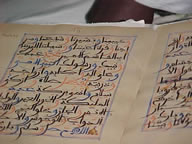
 The Timbuktu Educational Foundation was "...founded for the sole purpose of preserving, restoring, and disseminating the important intellectual contributions of the early African scholars from the famous Timbuktu Universities of Mali, West Africa...its goals include to restore preserve translate and publish the manuscripts of Timbuktu.Restore the historical buildings which house the University of Timbuktu and to reopen the University with its classical methods of teaching..."
Menampilkan postingan yang diurutkan menurut relevansi untuk kueri timbuktu. Urutkan menurut tanggal Tampilkan semua postingan
Menampilkan postingan yang diurutkan menurut relevansi untuk kueri timbuktu. Urutkan menurut tanggal Tampilkan semua postingan
Timbuktu Educational Foundation


Read User's Comments(0)

Scientific Historians and Timbuktu
John H. Lienhard on the city of Timbuktu:
More hereToday, this remote and impoverished city is rich in some 14,000 old books that've literally come out of its woodwork. Scientific historians who converge upon Timbuktu have only dented the task of translating the old science texts from Arabic and other less know languages. They find that Timbuktu's medieval and renaissance scholars followed a path separated from Europe.Image by Aluka Digital Library via Flickr
Their astronomers didn't follow the European leap to a sun-centered solar system, but they sprang far ahead in the mathematics of calendar writing -- far ahead in trigonometry. The writings detail astronomic events six hundred years ago. Scholars, racing to translate this huge trove of literature, now wonder what these ancients knew of medicine, botany, chemistry and climatology. How did the knowledge of other regions flow through this glittering outpost? How much new science did it create?

Sightlines and African Urbanism
Dwell speaks with Erika Gee about the upcoming "Sightlines" lecture series. One of the questions was:
More here"The talks range in location from South Africa to quite literally Timbuktu. Tell me about that Timbuktu lecture and what it hopes to say about architectural cross-pollination across the continent.
courtesy of Dwell
That lecture looks at West African architecture and how often times academics are quick to treat it as something apart from the rest of Africa and particularly North Africa. But curator Labelle Prussin looks at the Jewish influence in Timbuktu and tries to make connections between West Africa and North Africa. She sees an influence in architecture, art, and commerce, and makes the point that West Africa is really an area with a number of different styles.


Timbuktu's Ancient Texts
 The NYTimes reports on the renewed interest in the manuscripts of Timbuktu covered earlier:
A surge of interest in ancient books, hidden for centuries in houses along Timbuktu’s dusty streets and in leather trunks in nomad camps, is raising hopes that Timbuktu — a city whose name has become a staccato synonym for nowhere — may once again claim a place at the intellectual heart of Africa.
...This ancient city, a prisoner of the relentless sands of the Sahara and a changing world that prized access to the sea over the grooves worn by camel hooves across the dunes, is on the verge of a renaissance.
photo courtesy of Afrol News
Timbuktu's Libraries
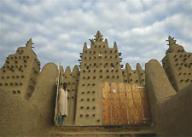 Reuters reports on efforts to preserve the manuscripts of Timbuktu covered earlier:
Researchers in Timbuktu are fighting to preserve tens of thousands of ancient texts which they say prove Africa had a written history at least as old as the European Renaissance...Written in ornate calligraphy, some were used to teach astrology or mathematics, while others tell tales of social and business life in Timbuktu during its "Golden Age", when it was a seat of learning in the 16th century.
"These manuscripts are about all the fields of human knowledge: law, the sciences, medicine," said Galla Dicko, director of the Ahmed Baba Institute, a library housing 25,000 of the texts.
photo courtesy of reuters
The Meanings of Timbuktu
 David Robinson at Sociolingo reviews the The Meanings of Timbuktu:
Jonathon Bloom begins the examination of the scholarly production of Timbuktu by looking at the unusual but crucial subject of paper. Never produced in sub-Saharan Africa, it was imported from North Africa at great cost and rather late to permit scholars to copy important works and write their own...[continue reading]
Time for Africans to Explore Africa
Kate Nkansa writing in Feint & Margin:
More hereI often listen to Africans speaking and boasting about how many European countries they have been to, they however fail to mention one African country they have visited. Have you ever heard of anyone mentioning that they have been saving for a trip to visit Timbuktu in Mali, which was a centre of Islamic learning from the 13th to the 17th century...We travel to France to get a taste of French bread and wine; Italy to experience their pasta and pizza; and Switzerland for their cheese and chocolate. What cuisine are African countries celebrated for having?

via Kabissa

Where are Africa's intellectuals today?
In 1998 the then Deputy South African President,Thabo Mbeki articulated his hopes for an African Renaissance. "...The time has come that we call a halt to the seemingly socially approved deification of the acquisition of material wealth and the abuse of state power to impoverish the people and deny our Continent the possibility to achieve sustainable economic development.Africa cannot renew herself where its upper echelons are a mere parasite on the rest of society, enjoying a self-endowed mandate to use their political power and define the uses of such power such that its exercise ensures that our Continent reproduces itself as the periphery of the world economy, poor, underdeveloped and incapable of development.The African Renaissance demands that we purge ourselves of the parasites and maintain a permanent vigilance against the danger of the entrenchment in African society of this rapacious stratum with its social morality according to which everything in society must be organised materially to benefit the few As we recall with pride the African scholar and author of the Middle Ages, Sadi of Timbuktu, who had mastered such subjects as law, logic, dialectics, grammar and rhetoric, and other African intellectuals who taught at the University of Timbuktu, we must ask the question - where are Africa's intellectuals today?..."A question as pertinent now as it was then.
Digitizing Timbuktu

John Noble Wilford at Hastac reports :
From Timbuktu to here, to reverse the expression, the written words of the legendary African oasis are being delivered by electronic caravan. A lode of books and manuscripts, some only recently rescued from decay, is being digitized for the Internet and distributed to scholars worldwide...[continue reading]
photo courtesy of Harlan Wallach/NUAMPS
Stories of Timbuktu-'Abdallahi'
In Bombastic Elements:

Skip through preview pages of part 1 and 2 of Abdallahi, Jean-Denis Pendanx and Christophe Dabitch 2006-7 graphic novels (Futuropolis). They pull from the diaries of René Caillé, claimed to be the first European to enter "mythical city" of Timbuktu (which was off limits to whites) and to come out alive. He then made the 4500 miles journey on foot from Senegal to Tangier...[continue reading]
The Rise of the Naija Auteur
From OludaScribe:
For context read an early Timbuktu Chronicles post on Nollywood and its promise of helping spawn Auteurs
WAITING LINES by Lagos Based Daniel Oriahi Follow @Filmic25
Shorts have been the means by which upcoming film makers show the world and more specifically the industry what they are capable of doing. Many of the legends of today made short films which enabled them to be recognized and get the opportunity to make feature films. Directors like Speilberg, Scorcese, Chris Nolan ,George Lucas and other went through this path at some point.More here
As a cinephile and director, i get excited when i discover other film makers that know their craft , so I want to dedicate this post to the young film makers from Nigeria.
I won’t write much but i’ll let their work speak for them. Some of them are based in Nigeria others are outside the country, But they are all Naija Bred .
They vary in genre and tone. Some are socially relevant, some are art house and indie, and others are just entertainment,your opinions on their execution may vary. but they all show something different about their craft and the capabilties and potential of their directors. So ladies and gentlemen, say hello to The Future
For context read an early Timbuktu Chronicles post on Nollywood and its promise of helping spawn Auteurs
The New TED Fellows Program
Crossposted at Timbuktu Chronicles
From the TED website:
The TED Fellows program helps world-changing innovators from around the globe become part of the TED community and, with its help, amplify the impact of their remarkable projects and activities. Fellows are drawn from many disciplines that reflect the diversity of TED's members: technology, entertainment, design, the sciences, the humanities, the arts, NGOs, business and more...[continue reading]
The Saudi-isation of Pakistan and warning's for Africa
Pervez Hoodbhoy writes:
via 3quarksDailyFor three decades, deep tectonic forces have been silently tearing Pakistan away from the Indian subcontinent and driving it towards the Arabian peninsula. This continental drift is not physical but cultural, driven by a belief that Pakistan must exchange its South Asian identity for an Arab-Muslim one. Grain by grain, the desert sands of Saudi Arabia are replacing the rich soil that had nurtured a magnificent Muslim culture in India for a thousand years. This culture produced Mughul architecture, the Taj Mahal, the poetry of Asadullah Khan Ghalib, and much more. Now a stern, unyielding version of Islam (Wahhabism) is replacing the kinder, gentler Islam of the Sufis and saints who had walked on this land for hundreds of years.

Perve's piece is almost a corollary to Philip Smucker's 2004 article which reported on efforts being taken via dissemination of historical texts to reaffirm a liberal African version of Islam.A cause all the more pertinent as the region confronts a most intolerant version of the faith:
Particularly relevant, black African and Arab scholars say, are accounts of how the African interpretation of Islam helped regulate the affairs of men, resolve disputes and provide a model of tolerance. Buried in the crumbling manuscripts of Timbuktu and neighboring cities, scholars are finding evidence of wars averted, sieges ended and lawlessness put to rest.Photo courtesy of Getty Images
The information is all the more valuable for moderate Muslim leaders because of the rise of less tolerant forms of Islam, like Saudi Arabia's Wahhabism or the Salafist movement in Algeria, that are expanding their foothold.
Mobilising Capital for State Building
Ashraf Ghani on TEDTalks presents a case for Mobilising Capital to enable State Building:
Full disclosure, Emeka Okafor publisher of Timbuktu Chronicles and Africa Unchained is the co-producer for the TED Global Arusha event.
Creating problem-solving systems
Bill Easterly contends that to solve development challenges "problem-solving systems" must be be in existence. This assertion has been on this blog and Timbuktu Chronicles under a number of guises. Be it evolving the culture; informal industrial clusters;startup; ecosystems; etc. Societies that do not evolve autocatalytic,sustainable methods of overcoming their challenges will remain moribund,regardless the level of external intervention:
Development happens thanks to problem-solving systems. To vastly oversimplify for illustrative purposes, the market is a decentralized (private) problem solving system with rich feedback and accountability. Democracy, civil liberties, free speech, protection of rights of dissidents and activists is a decentralized (public) problem solving system with (imperfect) feedback and accountability. Individual liberty in general fosters systems that allow many different individuals to use their particular local knowledge and expertise to attempt many different independent trials at solutions. When you have a large number of independent trials, the probability of solutions goes way up.More here
Seeking A Few Good Men & Women
Dele Olojede's Timbuktu Media seeks a few Good Men & Women:
We are looking for a few good men and women to join us in a national project. We seek to create a space where honest conversation can take place about the direction of our country(Nigeria). We are building a new kind of media company; one that values ethics, integrity and service.
We seek the kind of people who are ambitious enough and confident enough to help contribute to this transformative project.
The Sustainable Village- Songhai Center
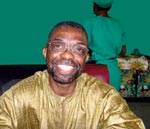 John Matshikiza wrote about the Songhai Center covered earlier on Timbuktu Chronicles:
Godfrey Nzamujo’s guiding principle was: “The only way to fight poverty is to transform the poor person into an active producer.” His way of doing this was to create a living and teaching environment where ordinary Africans could learn the skills of self-advancement. There, thoroughly applying all he had learned over the years about mechanical and electronic engineering, farming, economics, business, and husbandry in general (spiritual and temporal) he set about turning his vast, abstract knowledge into something practical.
Langganan:
Postingan (Atom)