RSS
Menampilkan postingan yang diurutkan menurut relevansi untuk kueri manuscripts. Urutkan menurut tanggal Tampilkan semua postingan

Timbuktu's Libraries

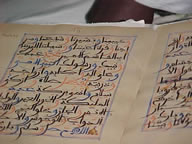
Reuters reports on efforts to preserve the manuscripts of Timbuktu covered earlier:

Researchers in Timbuktu are fighting to preserve tens of thousands of ancient texts which they say prove Africa had a written history at least as old as the European Renaissance...Written in ornate calligraphy, some were used to teach astrology or mathematics, while others tell tales of social and business life in Timbuktu during its "Golden Age", when it was a seat of learning in the 16th century.
"These manuscripts are about all the fields of human knowledge: law, the sciences, medicine," said Galla Dicko, director of the Ahmed Baba Institute, a library housing 25,000 of the texts.

photo courtesy of reuters

  • Digg
  • Del.icio.us
  • StumbleUpon
  • Reddit
  • RSS

Timbuktu Educational Foundation

The Timbuktu Educational Foundation was "...founded for the sole purpose of preserving, restoring, and disseminating the important intellectual contributions of the early African scholars from the famous Timbuktu Universities of Mali, West Africa...its goals include to restore preserve translate and publish the manuscripts of Timbuktu.Restore the historical buildings which house the University of Timbuktu and to reopen the University with its classical methods of teaching..."

  • Digg
  • Del.icio.us
  • StumbleUpon
  • Reddit
  • RSS

Timbuktu's Ancient Texts

The NYTimes reports on the renewed interest in the manuscripts of Timbuktu covered earlier:

A surge of interest in ancient books, hidden for centuries in houses along Timbuktu’s dusty streets and in leather trunks in nomad camps, is raising hopes that Timbuktu — a city whose name has become a staccato synonym for nowhere — may once again claim a place at the intellectual heart of Africa.
...This ancient city, a prisoner of the relentless sands of the Sahara and a changing world that prized access to the sea over the grooves worn by camel hooves across the dunes, is on the verge of a renaissance.

photo courtesy of Afrol News

  • Digg
  • Del.icio.us
  • StumbleUpon
  • Reddit
  • RSS

The Saudi-isation of Pakistan and warning's for Africa

Pervez Hoodbhoy writes:

For three decades, deep tectonic forces have been silently tearing Pakistan away from the Indian subcontinent and driving it towards the Arabian peninsula. This continental drift is not physical but cultural, driven by a belief that Pakistan must exchange its South Asian identity for an Arab-Muslim one. Grain by grain, the desert sands of Saudi Arabia are replacing the rich soil that had nurtured a magnificent Muslim culture in India for a thousand years. This culture produced Mughul architecture, the Taj Mahal, the poetry of Asadullah Khan Ghalib, and much more. Now a stern, unyielding version of Islam (Wahhabism) is replacing the kinder, gentler Islam of the Sufis and saints who had walked on this land for hundreds of years.
via 3quarksDaily
Perve's piece is almost a corollary to Philip Smucker's 2004 article which reported on efforts being taken via dissemination of historical texts to reaffirm a liberal African version of Islam.A cause all the more pertinent as the region confronts a most intolerant version of the faith:
Particularly relevant, black African and Arab scholars say, are accounts of how the African interpretation of Islam helped regulate the affairs of men, resolve disputes and provide a model of tolerance. Buried in the crumbling manuscripts of Timbuktu and neighboring cities, scholars are finding evidence of wars averted, sieges ended and lawlessness put to rest.
The information is all the more valuable for moderate Muslim leaders because of the rise of less tolerant forms of Islam, like Saudi Arabia's Wahhabism or the Salafist movement in Algeria, that are expanding their foothold.
Photo courtesy of Getty Images

  • Digg
  • Del.icio.us
  • StumbleUpon
  • Reddit
  • RSS

Digitizing Timbuktu


John Noble Wilford at Hastac reports :

From Timbuktu to here, to reverse the expression, the written words of the legendary African oasis are being delivered by electronic caravan. A lode of books and manuscripts, some only recently rescued from decay, is being digitized for the Internet and distributed to scholars worldwide...[continue reading]

photo courtesy of Harlan Wallach/NUAMPS

  • Digg
  • Del.icio.us
  • StumbleUpon
  • Reddit
  • RSS

Bizarro World Escapee Obama Says Opposite of Reality on Rutherford Hayes?

On the right sidebar of my blog (under a 'Donate' button) I have a description of Bizarro World, also known as Htrae, which is a fictional planet in the DC comics universe. Htrae is home to Bizarro and his companions, who are ruled by the Bizarro Code, which states that you should do the opposite of everything.

For example, if a past US President was actually a forward-thinking President who embraced new technology, a resident of Bizarro world would give a speech suggesting that this President was the opposite of that. Like President Obama just did:

President Obama got a laugh out of a Maryland audience on Thursday when he mocked the Republican Party in a speech, comparing their skepticism of alternative energy to the “Flat Earth Society” in Christopher Columbus’ day and President Rutherford B. Hayes’ apparent dismissal of the telephone. But while Obama thinks the GOP is in need of a science lesson, he may need to bone up on history himself.

In mocking the GOP, Obama cited an anecdote about Hayes in which, upon using the telephone for the first time, he said, “It’s a great invention, but who would ever want to use one?”

But Nan Card, curator of manuscripts at the Rutherford B. Hayes Presidential Center in Ohio, told TPM that the nation’s 19th president was being unfairly tagged as a Luddite.

“He really was the opposite,” she said. “He had the first telephone in the White House. He also had the first typewriter in the White House. Thomas Edison came to the White House as well and displayed the phonograph. Photographing people who came to the White House and visited at dinners and receptions was also very important to him.”...

....“He was pretty technology-oriented for the time,” Card said. “Between the telephone, the telegraph, the phonograph and photography, I think he was pretty much on the cutting edge.”...
President Obama was suggesting that Republicans are anti-technology for opposing windmills and not supporting railroads and and for denying that the globe is rapidly rising in temperature because of actions of mankind, and attempting to make his point by comparing the Republicans of today to past backwardness. But as usual, the reality is the exact opposite of everything that he said.

The reality is that President Obama is pushing for energy sources that are older than modern oil and nuclear which he opposes, that President Obama's attempt to force us to railroads and away from cars it the kind of anti-progress sentiment that one could expect from a Luddite, and that his theories about global warming have long-since been discredited by now, and that his examples of backwardness are in fact either made-up or forward looking in reality.

One has to wonder sometimes if my crazy joke that Bizarro world is real and that residents of this world have been flooding into the United States through some sort of interworld rift is really a joke or just may be true. I struggle to explain how so much of what Obama says is just so sheer the opposite of reality- on so many issues, so many policies, and so many 'statements of fact,' on further research not only is he wrong but he has been proven to be direct opposite of correct.

I call on all good Americans to resist these Bizarro's and their Bizarro agenda, and vote Republican in 2012.

  • Digg
  • Del.icio.us
  • StumbleUpon
  • Reddit
  • RSS

Daily Education & Technology News for Schools 06/16/2011

  • Here is the time to grow Keynote that Julie and I did not so long a go. Was listening to it and I think the message is still relevant. It is about change and a willingness to grow.

    tags: education learning inspiration

  • "A new way of learning
    Augmented Reality in School Environments
    - A European Research Project -

    Technological advances in the field of information and communication technologies enable innovative ways to mediate knowledge. Among them, Augmented Reality (AR) becomes increasingly a field of interest.

    Integrated in e-learning systems, AR will provide innovative ways to transfer knowledge in education. This is the purpose of the project Augmented Reality in School Environments (ARiSE). The aim is to create an innovative teaching aid, enabling teachers to develop, with a moderate effort, new teaching practices for teaching scientific and cultural content to school classes in an easy to comprehend way. "

    tags: augmentedreality education

  • T.S. Eliot's masterpiece is now an app. An expensive app, topping at $13.99 but it has literary experts abuzz. It includes the poem, perspectives, sychronized performances from Eliot (at two points in his life) and other readers, the original manuscripts showing the process of editing the document, and lots of resources and readings. Created by Faber digital it is part of "Faber's mission to re-imagine poetry for the digital age."

    If you teach literature or are an edtech professor, it is time to get this on your ipad and put in some serious academic reviews as to the quality of content here. Academicians now have a new place: writing reviews on the iTunes store. We may have an app-full textbook-free future.

    tags: education ipad literature literature_teacher

  • A wordle I made of the upcoming Flat Classroom book - chapter 7 of student choice. If you want to know when the book comes out (we'll only use your email to let you know the publish date) you can go to www.flatclassroombook.com - if you're into social media or doing book reviews, you can apply to be put on our reviewers list. (Sorry not everyone can be selected, but please apply if this fits you.)

    tags: education flatclassroom

  • The DeforestAction project has sstudents create local, national and international entrepreneurial initiatives that protect and regrow endangered forests and create local projects to promote awareness and action.

    tags: education science_teacher globalcollaboration flatclassroom collaboration

  • A ning promoting connections with schools in Asia.

    tags: education globalcollaboration flatclassroom

  • Lovely slideshow by Valerie Diigs on her school's transformation from library to learning commons. She's been featured in several books and in school library journal.

    I think every librarian should be familiar with the learning commons concept to see if there are elements that will work to make your environment more relevant to learners. It isn't whether you like the concept yourself - for libraries to stay funded they must stay relevant. I think learning commons is just one way to do that. Valerie knows far more than me on this topic, so look at what she's done.

    tags: library education learningcommons librarian

  • Why is your hard drive full? Why does it keep filling up? I use this to help me find those pesky video files that keep FILLING UP MY HARD DRIVE.

    tags: education utility

Posted from Diigo. The rest of my favorite links are here.

  • Digg
  • Del.icio.us
  • StumbleUpon
  • Reddit
  • RSS

The Art of Abyssinia

Maddy Fry of Think Africa on the art of Ethiopia,in the words of SOAS scholar Jacopo Gnisci:
Triptych with Virgin and ChildFlanked by archangels Nancy and Robert Nooter Collection. Tadias
“14th to 17th century Ethiopian art is unique in that it incorporated a variety of influences in its language. Works came from as far as the Indian Ocean and the Mediterranean Basin, yet many artists remained faithful to their African roots.”
Examples include Coptic crosses made in the northern town of Lalibela bearing Greek inscriptions and 14th century manuscripts edged with Byzantine gold, despite gold plating not being a widely used technique in Ethiopian industries. Likewise, images from the 14th and 15th centuries of Adam and Eve, the Madonna and Child and the Crucifixion of Christ show prominent Venetian and Jewish influences.
However, Ethiopian artists had notably little interest in aesthetics. Art was created with a specific purpose, designed to bring the observer into greater contact with the metaphysical. Given the centrality of Christianity to life in Ethiopia, appreciating Ethiopian art appears essential in understanding the very soul of the country itself, providing an insight into the history, culture and beliefs of many of its peoples.
More here

  • Digg
  • Del.icio.us
  • StumbleUpon
  • Reddit
  • RSS