
Over and over liberals and progressives argue that the recovery of the US economy is being held back by the lack of investment by those in society with money- and they are right. There is a lot of money being sat on in our nation right now- record amounts which are just being held rather than invested, and this is a large reason why the US economy has not recovered.
Liberals and progressives believe that the reason why businesses and individuals are sitting on massive amounts of money range from racism to a desire for Obama to fail to greed to selfishness to a desire to just swim in their loot and not use it. When they talk about these rich people and profitable businesses sitting on their money they are angry, because they want to use the power and force of the government to make them invest the money. They don't understand what motivates these people and businesses, and it frustrates them, so they attribute their behaviors to irrational or evil motives.
But the truth of the matter is that the reason why individuals and businesses are sitting on cash rather than investing it is because of the policies, positions, rhetoric, beliefs, and desires of liberals and progressives. Progressives and liberals have created an environment of fear and uncertainty, and few are willing to invest in an environment such as that.
Under Obama and the modern-day Democratic Party, regulations and rules and barriers to profitability are being forced on businesses, costs of engaging in business is increasing with new mandates such as Obamacare, taxes are continually talked about increasing (even if they haven't really yet in reality) and every speech by every major politician in the Democratic Party promises to go after the very people who have money, profits are attacked and those who make profits are increasingly viewed as people to exploit and whose wealth the government should take, free trade is hurt by lack of free trade agreements and union kickbacks and increased tariffs and an overall hostile environment to free trade, and individuals are reluctant to engage in investing when the government is picking and choosing the leaders and has demonstrated contempt for well-established bankruptcy laws designed to protect investors (GM bailout).
It will not be until President Obama and the liberals and progressives who have achieved influence and positions of power in his administration are gone that the US economy will recover and businesses will begin to invest again. Even if the moderates and liberals who once were in control of the Democratic Party were in office, perhaps under a President Clinton, then our nation would be growing again and people would have jobs- but there is no moderate or Clinton on the ballot for the Democrats, only a progressive Obama at the top of the ticket who intends to double-down on his policies, especially when he will be a lame duck if he wins re-election and no longer have to worry about putting in place policies that get America back to work.
Do not forget either that Democrats in Congress supported President Obama's policies and put them into legislation and passed them, usually with no bipartisan support and a great many of which were strongly opposed by large numbers of Americans. They had an option to oppose the President, to moderate his policies, and to attempt to reach out for bipartisan consensus to create an environment more friendly to businesses and more encouraging to investors. But they didn't- in many cases, radicals like Pelosi and Reid led the charge to create more fear and uncertainty in doing business and investing in America, and for that they need to go.
Republicans should be the ones to benefit from the suicidal march of the Democratic Party in recent years, not because they necessarily are putting for brilliant ideas and are the best party in the world, but because under a Perry or Romney with a GOP House and Senate at least businesses will not be afraid any more, will feel like they can once again invest and make profits and provide jobs, and not be considered evil or wrong because of this success.
For more information, check out the post on Carpe Diem called We've Got a Sub-Par Recovery Because of Weak Investment Spending, Consumption Has Recovered.
Lack of Investment Laid at the Doorstep of Democratic Policies?


Central Africa Free Trade Zone?
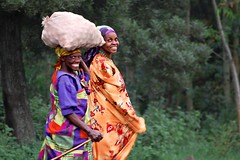 Image by YoungRobV via FlickrHerman j. Cohen writes about the potential for a Central Africa Economic free trade area:
Acts of war and military occupation aside, there is a natural economic synergy between eastern Congo and the nations of East Africa, including Rwanda, Burundi, Tanzania and Uganda. The normal flow of trade from eastern Congo is to Indian Ocean ports rather than the Atlantic Ocean, which is more than a thousand miles away.
After his inauguration, Barack Obama should appoint a special negotiator who would propose a framework for an economic common market encompassing Congo, Rwanda, Burundi, Kenya, Tanzania and Uganda. This agreement would allow the free movement of people and trade. It would give Rwandan businesses continued access to Congolese minerals and forests. The products made from those raw materials would continue to be exported through Rwanda. The big change would be the payment of royalties and taxes to the Congolese government. For most Rwandan businesses, those payments would be offset by increased revenues...[continue reading]
![Reblog this post [with Zemanta]](http://img.zemanta.com/reblog_e.png?x-id=02a9415a-69c6-4149-a40c-440f60f7fb6f)
High Economic Freedom = Where We Want to Be
For years, the United States has been a leader in the world in economic freedom. Economic freedom is defined as having property rights protected by impartial rule of law, free trade, a sound currency, and a small limited government relative to the size of the economy. My blog supports economic freedom, and the political party that I support also pushes for policies that make economic freedom a reality- no bailouts, no government take-overs, bond holder rights that are respected, low and fair taxes, consistent regulations and rules, a restrained bureaucracy, free trade agreements with Columbia or other nations, no inflating the currency through QE or other Fed schemes, a return to the gold standard, and a limited and small government that does take valuable resources away from the private sector.
Many people oppose these policies- they seek to make the United States less free. The problem with this is that those countries that are less free also are less prosperous. By pushing for stimulus bills, czars, subsidies for green energy, deficit spending, higher taxes, inflating of the currency, or other liberal Democrat policies, our nation becomes less economically free, and the result is higher unemployment, lower income, less happiness, lower life expectancy, less clean environment, and more corruption.
I know, I know- you care about the poor people, you see Bush as a bogeyman, you hate the war in Iraq, you are passionate about the environment- it does not matter why you vote Democrat and why you are a liberal, the result is that you support policies that make our nation less economically free, and thus a lesser nation in so many ways.
This video will help illustrate it for you and you'll see what nations are economically free and which ones aren't- and hopefully this will help you to understand what sort of policies to support in our society and which political party to vote for and which ones not to.
H/T to Orlin for passing this video on to me. Thanks!
Why Factory Asia beats Factory South Africa
“Among the non-western economic blocs, East Asia has the highest intraregional trade, comprising largely intermediate goods, underpinning the region’s global trade and competitiveness agenda, and attracting ample FDI. In other words, Factory Asia has worked well. Factory Southern Africa has not. Southern Africa remains the least integrated region in the world despite the presence of a customs union and a free trade area.”Report co-author Sandeep Mahajan says a successful Factory Southern Africa requires dynamic trade based on nimble networks of multi-national firms. Formal and informal trade barriers have to be removed. “South Africa,” he says, “needs to open up, as well as integrate its own rural and advanced regions.” Current policy, he says, “tends towards mercantilism, at the cost of much larger gains from trade based on the principles of comparative advantage."More here
via Trade Africa
Africa's War on Poverty Begins at Home
Marian Tupy writes "...It is true that rich countries' protectionism harms some producers in the developing world but trade liberalization in rich countries as a cure for African poverty is often over-emphasized. The main causes of African impoverishment are internal. Africa lacks political stability and economic freedom. Its tariffs are high and private property rights weak. It is hypocritical for African leaders to call for greater access to global markets while avoiding policy reforms, including trade openness, at home...Clearly, free trade is a necessary, but not a sufficient, condition for economic growth in Africa. But trade can play a role in promoting prosperity by increasing domestic competition and changing the dynamic of the political economy that keeps privileged groups protected. Many reforms are needed but a good place to start is with freeing trade at home. African countries should do so regardless of what the rich countries do. India, China, Hong Kong, Singapore, South Korea, Taiwan, Chile, Estonia and many other developing countries undertook unilateral trade liberalization in the past and reaped the benefits..."
Can Africa trade with Africa?
Obiageli Ezekwesili writes:
Today, there is strong consensus among African leaders that regional integration is indispensable to unlock economies of scale and sharpen competitiveness. And promoting intra-African trade has emerged as a top priority, in recognition that the African market of one billion consumers can be a powerful engine for growth and employment.More here
Yet despite the introduction of free trade areas, customs unions, and common markets within the Region, the level of intra-African trade remains among the lowest in the world -- only about 10% of African trade is within the continent, compared to about 40% in North America and about 60% in Western Europe.

Quick Reactions on Third Debate
This debate was one of the best debates in terms of each candidate expressing their opinions on domestic issues clearly, without filter. Because of this, I call this debate, as I did the last ones, as a narrow victory for McCain- that gives McCain 3 narrow victories over Obama.
Somehow though, whether McCain ties or wins a narrow victory, it doesn't matter- Obama only needs to tie or slightly lose. What does that say about Obama, that the best he needs to do is be present to win? He is a master at this present stuff- he never needs to take a stand, win anything, or show any leadership at all- just be there, and he wins. Must be nice to be able to advance to the highest position in the world by just being present.
Obama's answers all were about enlarging the size of government, redistribution of wealth, and spending more money. He couched his responses in a lot of qualifiers and a lot of words, but that is the essence of them, and as proof I point to his voting record in the US Senate and Illinois Senate. Although I disagreed with most of his positions, the only one that truly caused me to yell at the TV was when Obama said the main job of a Supreme Court Judge was to provide fairness and justice to those who don't have it- I shouted at my TV at this point that the main job of a Supreme Court judge is to judge on the law, above all to judge on the US Constitution. Obama never mentioned the US Constitution in his discussion on judges.
I guess when I think about it I did yell at the TV at another point in the debate. When the two candidates were talking about free trade, Obama talked about how he nixed the Columbia free trade agreement because labor leaders were getting killed in Columbia, and showing international solidarity with the labor movement is more important to him than helping America with jobs, drugs, or fight terrorism. That pisses me off.
McCain missed a lot of openings this debate- on abortion, Ayers, spending, etc. McCain's problem is that he knows that the winning formula is conservative ideas- he knows that conservative arguments are the best, the most moral, the most logical, and resonate with Americans more. But McCain isn't a true conservative, so many times he says the argument, but doesn't hammer it home. That could be McCain is just too nice of a guy, or that he is underestimating Obama's skill, or overestimating Americans intelligence- regardless, he missed many chances to expose Obama for the liberal socialist fraud that he is.
One thing that I liked that McCain did, probably by accident, was call Obama "Senator Government." McCain corrected himself, but he shouldn't have- Obama is Senator Government- he believes in big government, and he wants to run it like an all power legislative branch, not as an executive. Obama is Senator Government.
More thoughts later.
10 Commandments for African Intellectuals
George Ayittey of the Free Africa Foundation writes:
1) Never Forget Your Roots
Africa's traditions, institutions, and customs are integral part of your heritage. This heritage includes participatory democracy based on consensus, free village markets, free enterprise and free trade. You cannot reject this heritage and remain African.
2) Seek Ye First the Economic Kingdom in the Private Sector
There is nothing wrong in wanting to be rich, but nobody became rich working for a wage/salary, unless he was prepared to steal or embezzle, like the African kleptocrats. But that does not pay in the long run. Earn your wealth in the private sector by actually producing something, even charcoal. If capital is a problem, do as the illiterates do by pooling savings as in the revolving credit schemes.
3) Privatize the Universities
Africa's universities should be privatized. They may be given a fixed annual government subvention and then allowed to raise their own revenue and manage their own affairs. This way, they can uphold academic freedom, which is currently not possible with the head of state, often a military imbecile, as the chancellor.
4) Demand and Defend Freedom of statement/Media
Recall that the first critical step in problem resolution is the exposure of the problem. Without freedom of statement this is nearly impossible... "African governments are responsible for the underdevelopment of African literature. Among the four main problems inhibiting the development of African literature is the expulsion of prominent African writers . . . the absence of African writers in international debates, absence of integrative policies and lack of publishing infrastructure" . All African intellectuals must demand the right to free speech and defend the rights of others for the freedom to speak, publish and write...
5) Practice Intellectual Solidarity
Respect and assist members of your own profession, regardless of differences of opinion. If one is under siege, all wherever they may be --- in or out of government, in or out of the country -- must go his or her aid. You may need group assistance yourself in the future. And extend this solidarity to other groups fighting the same cause as well...
6) Demand National Conferences
When a national crisis erupts, demand that a national dialogue or conference be set up to resolve it, as is done in African villages. The national conference must be sovereign and its decisions binding on all parties, including the government...
7) Disband the Military or Cut It in Half
No African intellectual with an iota of intelligence and a modicum of Pan-Africanist spirit would support, much less serve, a barbarous military regime. Ever! All those African countries that imploded were ruined by the military.
8) Pan-Africanism
Pan-Africanism, originating from the belief that African countries share common problems, common solutions, and common destinies will remain a dream unless you learn more about African countries other than your own.
9) Set Up a Rival AU
The time has come for the useless OAU(nowAU) to be disbanded or for a rival body, the Organization of Free African States to be set up. It should be made up of strictly democratic countries. OFAS can be set up under the aegis of President Nelson Mandela of South Africa.
10) Selectively Repudiate Foreign Debt
Insist that foreign aid be given only to democratic African countries. Time and again, foreign loans are taken by corrupt, illegitimate and repressive African regimes without the approval of the people.
Lessons from Asian capitalism
Thoughts to ponder for those in Africa who believe in mimicry rather than adaptation and self-generation, Kishore Mahbubani wrote in the FT:
...the strengths of Asian capitalism are greater than the weaknesses. Within a decade Asians will have some of the largest free trade areas, including those between China and the Association of South East Asian Nations, the Japan-Asean FTA, and the Indian-Asean FTA that is likely to be set up. Recent history has taught Asians a valuable lesson: more trade leads to greater prosperity. In the Asian way – two steps forward, one step back – trade barriers will gradually come down. By the middle of the 21st century, intra-Asian trade will far surpass that of any other region.More here
Despite this, there will be no ideological trumpeting of the virtues of Asian capitalism. After their experiences of the past 100 years, Asians are wary of ideology. They prefer the simple, commonsense approach of learning from experience and they will heed the advice of Adam Smith, who said that prudence is “of all virtues that which is most useful to the individual”. It may also be helpful to nations.

Simplifying the Healthcare Debate
This current healthcare debate is not at all difficult to understand- it is a standard debate between freedom and tyranny. In one corner, there are conservatives and Republicans who are advocating a capitalist health care system where market forces are unleashed and people can freely choose what insurance they get and what treatments they want to receive. In other other corner, there are communists and Democrats who are advocating a state-run health care system where the state makes more decisions and puts in place bureaucrats who will make decisions about what sort of insurance or treatments that people get.
The details of this debate are not that important. If this seems as if it is simplifying the situation, then it is- the situation is simple. The only way to cut costs and make health insurance more affordable is to make it more capitalist and more free. If the system is made more communist and less free, than costs will go up and insurance will be less affordable. The current failures in the system stem from the state, and thus the state is the problem, not the solution.
At the center of this health care debate are several deeper ideas. One idea that is debated is the nature of the system. Is it the best in the world, covering almost everyone who wants to be covered, and providing unmatched service and quality? Or is it a broken system, in a crisis, needing a radical change? What is the reality of the situation?
Another idea at the center of this debate is whether people will turn down medical treatments and willingly not seek out more and more expensive cures and drugs in an 'enlightened' attempt to keep costs down for all society. Listening to liberals and Democrats talk about health care, they reject the nature of man and pretend that man can transcend to heaven and will willingly give up freedom, liberty, wants, and desires in order to keep the costs on the system down. Many liberals feel that society's needs come before individual's needs, just like Hitler did (that's a quote from Hitler). But this is not reality- the absolute truth is that man operates on the principle of enlightened self-interest, and will not willingly surrender freedom, property, and choices, and so the power of the state will be used to make him do these things unwillingly.
Think about what the Democrats in Congress want to do with the healthcare system. Do they want to free it, remove barriers to commerce, limit lawsuits from lawyers on businessman, let trade operate freely across borders, and lessen regulations and rules on doctors and insurance companies? Or do they wish to shackle commerce, control it, limit it, and regulate it? James Madison said that commercial shackles are unjust, oppressive, and impolitic, and I agree with him- the Democrats agenda is not the agenda for America, and the details to their bills only reinforce this central fact.
After the Democrats pass Obama's healthcare plan and Pelosi's cap and trade scheme, ask yourself whether you can still freely make your own decisions any more. Do you control your won destiny anymore? Do you command yourself- do you decide what you want to do and what you don't want to do? Or does someone else command you now- does someone else make decisions for you? Democrats, Obama, Pelosi, Reid, and all the others are working to make you less free- Pythagoras wrote that no man is free who cannot command himself.
This healthcare argument may seem complicated and overwhelming, but don't let it be. Trust yourself. Trust your morals, knowledge, and logic. You know in your heart and mind that Obama is wrong, that the Democrats plan for our country is wrong, and that liberalism doesn't work. Don't get confused by details or sucked into claims of racism, nazism, or personal attacks. Just stick to the truth, and you'll come through this okay.
This post drew for inspiration on a powerpoint presentation put together by the Constructive Curmudgeon called The Moral Basis of Capitalism. Thank you.
The "Colonialism-Imperialism" Paradigm Is Kaput (2 of 2)
Modern Grievances against the West
External Props of African Despots
Historically, every foreign entity that goes to Africa does so to pursue their own interest, not those of Africans. Witness the scramble for Africa in the 1880s. The Chinese do not go to Africa because they love black people soo much. They go there to pursue their interests. Exactly the same can be said of the Cubans. This competition for influence in Africa became pronounced during the Cold War, when super-power rivalry led to the establishment of client states across Africa. The West supported the likes of Mobutu Sese Seko, Samuel Doe, Hastings Banda, Felix Houphouet-Boigny, etc. etc. The East supported the likes of Mengistu, dos Santos, Mattieu
Kerekou, Sassou Nguesso, Samora Machel, etc. etc. Arab countries also backed their clients in Africa: Sudan, Mauratania, Chad, etc.
Cold War Intrigues and Machinations
Each side in the Cold War provided billions in aid to their clients to protect their security interests in Africa. Angola, Ethiopia, and Mozambique all received substantial amounts of Soviet military hardware. For example, Mengistu Haile-Mariam of Ethiopia received more than $11 billion in military weapons between 1975 and 1990. Angola received at least $2 billion annually
in military assistance from the Soviet Union in the 1980s (The Independent, London, Feb 19, 1992). In 1991, $4 billion of Angola's $8.7 billion foreign debt was owed to the former Soviet Union. On July 1, 1991, President Eduardo dos Santos said: "military debts were not usually honored," implying that Angola would not pay it (The New York Times, July 8, 1991). Soviet aid was stingy.
The economic aid the Council for Mutual Economic Assistance (Comecon) provided to sub-Saharan Africa in 1985 was $300 million. Of this, Ethiopia received by far the most (57.9 percent). Next were Mozambique (13.8 percent), Egypt (6.6 percent), Madagascar (4.2 percent), Angola (2.8 percent), and Tunisia (2.1 percent) (West Africa, Dec 12-28, 1988; p. 2320). Angola and Mozambique benefited more from arms supplies. The $300 million aid was only 5 percent of total Comecon bilateral disbursements and only 3 percent of the total aid flow to sub-Saharan Africa.
Furthermore, the little Soviet economic aid that did flow to Africa had strings rigidly attached. Loans and trade credits supplied could only be spent in the Soviet Union and Comecon countries (100 percent tied aid). In addition, the Soviets supplied the technical personnel and the equipment for project construction. Repayments of loans were often by barter, but to the
decisive advantage of the Soviet Union. For example, in Guinea, Soviet help in building a bauxite plant at Kindia was to be repaid with deliveries of two million tons of bauxite ore a year for 30 years.
Barter arrangements also hurt Soviet clients in Africa in a different way. For example, repayments of loans Nkrumah of Ghana took from the Soviet Union were to be made in kind with exports such as cocoa. But the Soviet Union had little use for Ghana's cocoa. Re-export of cocoa by the Soviet Union helped depress the world market price of cocoa in the mid-1960s.
China, an active player in Africa, sought to win adherents to the Chinese brand of socialism. Zhao Ziyang, China's foreign minister in the early 1960s, reminded African leaders of the presence of Chinese coolies in Africa. China's perception was that Moscow, not Washington, was its principal enemy. Its strategy was therefore to weaken "social imperialism at the expense of monopolistic capitalism" (Snow, 1988). West Africa observed that "in Africa, China increased assistance to old friends such as Tanzania and Zambia. The 2000km Tan-Zam railroad was meant to overshadow the Soviet-built Aswan High Dam in Egypt. China also made friends with old enemies such as Mobutu, helping him during the Shaba uprising in 1978-79; in 1980 they helped him build a naval base at Kinkuzu in southern Zaire to threaten Angola" (Aug 15, 1988; p. 1473).
China's fortunes in Africa quickly turned into mirages, however. At first, China's anticolonial stance was welcomed by African liberation movements. But as independence was gained, China's emphasis on subversion and its intense enmity toward the Soviet Union became less and less appealing or relevant to Africans. In fact, as early as 1963 Julius Nyerere of Tanzania
complained of a new scramble for Africa between the Soviet Union and China. Because their actions were anti-Soviet rather than pro-African, the Chinese themselves did not achieve much by way of influence.
Furthermore, China was no less immune to blunders than the Soviets. Less wisely than the Soviets, China meddled in Burundi ethnic feuds. In 1963 China backed the Tutsi expedition by training a number of Tutsi in guerrilla warfare in China. The subsequent massacres in Burundi earned China much opprobium. China also supported the Biafran secessionists in Nigeria's civil
war (1967 to 1970) simply because Moscow backed the Federal Government of Nigeria. Similarly, in Angola, China supported the FNLA (National Front for the Liberation of Angola) because Moscow was backing the ruling MPLA.
In Mali and Congo-Brazzaville, China made some headway. But a spate of military coups brought to power new rulers distrustful of China. Only in Tanzania did China achieve some diplomatic and ideological success. China agreed to fund and build the 1,200-mile Tan-Zam railway line at a cost of 166 million pounds sterling, free of interest. The railway was both an
engineering and a political achievement. It was completed two years ahead of schedule and was much touted as a model of what foreign aid could do for Africa. But it was one thing to build the railway and quite another to run it efficiently. Maintenance was poor, services degenerated, and the Dar es Salaam terminal became chronically clogged to the point of immobility. Although the Chinese had nothing to do with these shortcomings, their reputation suffered.
Zimbabwe received technical and military aid from North Korea and China. For its part, the West also poured billions into Zaire, Liberia, Kenya, Nigeria, and other African countries.
Each side also sought to undermine African regimes that were hostile to it. Lumumba was assassinated by the CIA operatives and the 1966 coup against Nkrumah was orchestrated by the CIA. In this sphere, the French were the worst, intervening directly to remove African leaders they did not like in Francophone Africa. For the French, independence did not mean a retreat from Africa. France left hundreds of officials in Africa as advisers. Behind the doors of many key ministries in the Ivory Coast and Senegal or Gabon, discreet but powerful French officials kept a close eye on policy. The French also sent teachers to Africa and brought African students and civil servants to France for training. France secured the right to maintain a
heavy military presence in Africa. In 1989, for example, France had a significant number of military advisers in 16 African countries and permanent Forces d'Intervention in seven. Total strength of French troops in Africa exceeded 12,000 in 1990. In France itself, the Forces d'Action Rapide, numbering 47,000, could be mobilized in less than 48 hours for action anywhere in Francophone Africa. These forces played an economic policing role and backed up French diplomacy and paternalism. They supported "approved" Francophile governments such as those of Leopold Senghor of Senegal and Felix Houphouet-Boigny of Cote d'Ivoire.
After 1960 the French intervened on many occasions to prop up unpopular African regimes against internal dissatisfaction and disorders. The most notorious such occasion was in Gabon in 1964, when French troops were used to reinstate President Mba after a coup. Noting that the French did not intervene to save President Youlou in Brazzaville in 1963, critics charged that intervention was predicated on mineral wealth. (Gabon is rich in oil.)
Now, each foreign entity operating in Africa pursues its own interests. It was ONLY the West which propped up hideous dictators in Africa. A foreign prop is a foreign prop is a foreign prop, regardless of its origin. An African leader is supposed to pursue the interests of his PEOPLE. If he doesn t, remove him from power but did we? Instead, we argued ad nauseam that, since the West put Mobutu, for example, in power, it was the responsibility of the West to remove him. This was ridiculous because if Mobutu was serving Western interests, why would the West remove him? And even if the West removed him, who do you think the West would have installed as a replacement? Another Mobutu !
It is clear that we have drawn no historical lessons from our dealing with the West and other foreign blocs. Here s a popular adage: If someone cheats you once, he is the fool but if he cheats you again, you are the fool. If you agree, then why are we talking about the Second Scramble for Africa ? And have we not learned that if you give an African problem to the Americans, Brits, French or the Chinese to solve it, each would solve it to their advantage? Does the mantra, African solutions for African problems, make sense to you?
Again, prop or no prop,
You cannot claim that it was the West which told Mobutu to loot the Zairean treasury. Nor claim that it was the North Koreans who told Mugabe to butcher over 20,000 Ndebele in 1980 (Matabeleland massacre). Neither can you claim that it was the Arabs who ordered Idi Amin to
butcher over 200,000 Ugandans. Nor can you claim that tell me it was the French who ordered Gnassingbe Eyadema to cling to power for 34 years and amass a personal fortune worth $3
billion.
True, the French and indeed the World Bank knew these African despots were stealing money and looked the other way. But who is an African leader accountable to? To the French, the World Bank or his PEOPLE? Prop or no prop, these leaders must be held accountable for their actions.
In fact, these days the charge of foreign meddling in African affairs and the specter of sinister and greedy multinational corporations lurking in the dark, waiting for a chance to pounce and exploit Africa confute reality. Foreign investors have fled Africa as the continent remains unattractive. Is it not African governments who have been drawing up elaborate and fancy
investment codes to ATTRACT them back? And is it not African governments themselves who take their budgets to foreign capitals for approval in order to get foreign aid? So who ALLOWS the meddling in African affairs?
Even then, the West has shown little interest in meddling in African affairs in the past few decades. If anything, the West has been in retreat from Africa! Recall the statement by presidential candidate, George Bush, that Africa was not of strategic importance to the U.S. And was it not the same African leaders who were complaining after the Cold War that Africa was
being marginalized ? So which is which: Is the West meddling in African affairs or the West marginalizing Africa?
In case you did not know, the West is thoroughly fed up with Africa, which it regards as a cry-baby, hopelessly incapable of solving any of its problems and is constantly crying out for help. What do you think the expression donor fatigue means? That is the diplomatic way of saying that the international community is fed up with incessant African appeals and begging. Today, there is famine in Ethiopia, tomorrow, there is a refugee crisis created by war in Liberia, or Somalia. Then there is genocide in Rwanda, starvation among refugees in eastern Congo, Ivory Coast, and on and on. Haba. Africa is now synonymous with war, destruction, famine, refugees, starvation, instability and chaos. Year after year since 1985, one African country after another has imploded, scattering refugees in all directions: Ethiopia (1985), Angola (1986), Mozambique (1987), Sudan (1991), Liberia (1992), Somalia (1993), Rwanda (1994), Zaire (1996), Sierra Leone (1997), Congo DRC (1998), Ethiopia/Eritrea (1998), Angola (1999), Ivory Coast (2000), Togo (2005).
The implosion of these countries had nothing absolutely nothing to do with the slave trade, nothing to do with Western colonialism or imperialism, nothing to do with artificial colonial borders, nothing to do with an unjust international economic system; in short, nothing to do with so-called external factors. They all had to do with one thing: POWER the adamant refusal to relinquish or share political power. If GENERAL Siad Barre of Somalia, GENERAL Juvenal Habryimana of Rwana, GENERAL Pierre Buyoya of Burundi, GENERAL Mobutu Sese Seko of Zaire, GENERAL Samuel Doe of Liberia, GENERAL Joseph Momoh of Sierra Leone, GENERAL Robert Guie of Ivory Coast, GENERAL Gnassingbe Eyadema, etc. etc. had been willing to step down or put in place power-sharing arrangements, each of their countries would have been
saved. Note the frequency of the title, GENERAL.
The rule is this and you can call it Ayittey Law: "The adamant refusal of an African head of state to step down or share political power will ultimately lead to the destruction of his country." If Mubarak of Egypt, Museveni of Uganda, Mugabe of Zimbabwe, Ghaddafi of Libya refuse to leave the political scene or share power, their countries will be destroyed. This is not rocket
science and it has nothing to do with the West. It is a personal or political failure that cannot be blamed on Americans, Chinese or Martians.
Back in 1986, President Museveni of Ugana said that no African leader should be in power for more than 10 years. What happened to him? He has been in power for more than 16 years and still counting. Finally in the late 1990s, African leaders wrote Constitutions in which they inserted the two-term limits. What happened? They are the very same ones who are now using their parliamentary majority and various devious maneuvers to override or repeal the two-term limits in Chad, Guinea, Namibia (Nujoma before he retired), Uganda, and even Nigeria.
Benin, Cape Verde Islands, Sao Tome & Principe, South Africa and Zambia all saved themselves from implosion because their leaders agreed to power-sharing arrangements crafted out of sovereign national conferences. South Africa would have blown up if the whites had not sat down with the blacks in a Convention for a Democratic South Africa (CODESA) to craft a new
political dispensation for the country. Rwanda blew up because the Hutu-dominated government of GENERAL Juvenal Habryimana refused to share power with the Tutsi minority and, instead, decided to exterminate them. "No Tutsis, nobody to share power with" was the macabre and brutal logic. More than 800,000 Tutsis were slaughtered in a orgy of violence and brutal massacre. That, in itself, was an excellent example of "intellectual astigmatism".
We could see with eagle-eyed clarity all the repugnant and inhumane brutalities of the white apartheid system in South Africa but we were hopeless blind to the equally heinous tribal apartheid regime in Rwanda. If the racist apartheid regime in South Africa had butchered just 2,000 blacks, even Idi Amin, who himself slaughtered more than 200,000 Ugandans, would
have arisen from his grave to attack South Africa with 3 dilapidated helicopters! But we said nothing when 800,000 Tutsis were slaughtered. Instead, we blamed the WEST for NOT intervening to stop the genocide. In fact, at its July 2000 Summit in Lome, Togo, the defunct OAU demanded a Marshall plan style compensation package for Rwanda. The demand for
compensation was part of the OAU inquiry into the 1994 Rwandan genocide, which blamed Western powers for failing to intervene to stop the mass slaughter. Naturally.
The OAU inquiry singled out France and the United States for particular blame for failing to prevent the genocide in addition to the United Nations Security Council as a whole. France was culpable because, having high level contact within Rwanda s Hutu-led government, the OAU report argued, could have exerted pressure to prevent the death of 800,000 people. The OAU
enquiry also blamed the US for failing to use its influence in the Security Council to authorize a military intervention to prevent the killing. The report argued that the West failed Africa despite the availability of copious evidence that the mass killing had been about to begin. In
conclusion, the report noted, a simple apology as already made by the United Nations was not enough and called for compensation, alluding to the $13 billion Marshall Aid plan the U.S. launched for the reconstruction of Europe after World War II. And what did these self-righteous leaders do to prevent the killings going on right under their very noses? And how can these
leaders complain about foreign meddling in African affairs and at the same time blame the West for NOT INTERVENING in an African problem to stop a massacre?
These days appeals by African leaders fall on deaf ears. OECD aid to Africa fell by 22 percent between 1990 and 1996, decreasing by 18 percent to sub-Saharan countries between 1994 and 1996 alone. (DeYoung, 2000a; p.A1). Even humanitarian aid to Africa has been shrinking. Contributors to United Nations aid and development programs have provided slightly more than half of the $800 million requested in 1999 for African countries suffering from "complex emergencies" -- the term is applied when war and failed institutions, often combined with a natural disaster, leave vast numbers of people homeless and starving. Specific programs for some particularly problematic areas, such as the Great Lakes region of Central Africa
including the two Congos, Rwanda and Burundi, have fared even less well (DeYoung, 2000b; p.A1).
In Sept 1999, the U.N.'s World Food Program announced it would curtail its feeding program for nearly 2 million refugees in Sierra Leone, Liberia and Guinea after receiving less than 20 percent of requested funding. An emergency appeal during the summer to feed and shelter at least 600,000 Angolans who had been displaced in that country's long-standing civil war
brought minimal initial response and predictions of mass starvation. In Africa's Great Lakes region of Congo, Burundi and Rwanda, where wars have produced nearly 4 million refugees, the United Nations estimated it would need $278 million to take care of them. By Oct 1999, only 45 percent of that amount had been donated. Nearly 80 percent of the United Nations humanitarian appeals in 2004 were to address African problems, but the response was disappointing as to be non-existent. "I remember sitting in this very room last summer (2004) asking for five helicopters to save thousands of lives in Darfur (Sudan). In the end we had to hire helicopters commercially as no Member States were willing to provide them," Under-Secretary-General Jan Egeland, head of the UN Office for the Coordination of Humanitarian Affairs (OCHA), the chief of the UN humanitarian office told the Security Council meeting on humanitarian challenges in Africa in January 2005 (http://www.un.org/apps/news/story.asp?). Even Irish rock star, Bob Geldof, who organized Band Aid and Live Aid to provide famine relief to starving victims in Ethiopia in 1985 is now fed up with Africa. He said this on Jan 31, 2005, of his work in Africa: "I'd dearly love not to have to go there the day after tomorrow. More often than not, it bores me profoundly - the pace of change is far too slow, and Africans excuse their own complicity in exactly the same way as our politicians (http://news.bbc.co.uk/1/hi/entertainment/music/4222373.stm).
Private organizations are also having difficulty raising funds for African relief operations. According to Mario Ochoa, executive vice president of the Maryland-based Adventist Development and Relief Agency (ADRA), which operates relief projects out of its own donations and under contract with donor governments, If I were to go now and make an emergency appeal for, say, Rwanda, for $500,000 for food, I'd probably get about seventy or eighty
thousand" in contributions (The Washington Post, Nov 26, 1999; p.A1).
True, every now and then, a major effort is launched in the West to help Africa. Africa s plight follows a ten-year attention deficit cycle: 1985 (Live Aid to save famine victims in Ethiopia), 1996 (a Special U.N. Session to boost aid to Africa to $25 billion), and now (2005). It is so humiliating to have the salvation of Africa tied to the success of rock concerts. And 20
years later, Ethiopia still can t feed itself and is appealing for food aid. Who do you blame: The white kids who did not give enough charity at the rock concerts or the stupid policies of Ethiopia s leaders?
Unjust International Economic System
Back in the 1950s and 1960s, this argument had much validity: The international economic system, dominated by western multi-national corporations, was rigged in favor of the rich countries. Prices of cash crops were fixed at artificially low levels; markets were cornered by giant western corporations, paying low wages and raking huge profits. While prices Africa received for its exports remained low, the prices Africa paid for imported manufactures soared astronomically (declining terms of trade). But today, with the onset of globalization, this argument carries little validity.
First, there is much competition on the international market. Asian corporations are now some of the big players. Second, African governments have done next to nothing to add value to their exports. Ghana still exports much of its cocoa in raw beans form. Third, every market has its ups and downs. We complain when the markets are down but conspicuously silent when
the market booms. Did we complain about an unjust international economic system when copper prices reached record levels in the late 1970s? When gold prices soared in the 1980s, cocoa prices in the 1990s? May I mention oil prices? By the way, what did we do with the windfall we reaped from the high prices? We squandered it!
Fourth, Africa s share of world trade fell from more than 3 percent in the 1950s to less than 2 percent in the mid1990s and to only 1.2 percent, excluding South Africa (The World Bank, Can Africa Claim the 21st Century;p.20). This erosion of Africa s world trade share in current prices between 1970 and 1993 represents a staggering annual income loss of $68 billion. This loss is not due to an unjust international economic system. Fact is, Africa has not been producing and you can t trade on the international market if you have nothing to sell. The physical volume of exports has been declining and therefore it is not a question of Africa not being able to earn enough because of low prices. Burundi s coffee exports, Ivory Coast's cocoa exports, and Sierra Leone s diamond exports have been devastated not because of low world market prices but by senseless civil wars. Even with food, we don t produce enough to feed ourselves and spend $19 billion a year on food imports. Nigeria spends $3 billion a year on food imports and has now brought white Zimbabwean farmers to teach it how to become self-sufficient in food production. What a disgrace!
Much of the decline in agricultural production in Africa is due to price controls, naked exploitation of Africa s peasant farmers, and senseless civil wars that have devastated the countryside and uprooted millions of people. Refugee camps are full of women and children, who produce the bulk of Africa s foodstuffs. State marketing boards fixed at ridiculously low
prices to milk the peasant farmers and they REBELLED. In Senegal, peanut (groundnut) farmers were receiving less than 20 percent of the world market price for their produce; in Ghana, cocoa farmers were receiving less than 30 percent for their produce in the 1980s. Those who complain about the Western conspiracy to fix prices for African exports at artificially low levels obviously do not see the ridiculously low levels their own State Marketing
Boards fix prices for peasant farmers.
Unfair Trade Practices, Trade Barriers and Subsidies
To be sure, unfair trade practices -- trade barriers and agricultural subsidies -- are legitimate issues of concern for the Third World. It is hypocritical for the West to preach free trade to the developing countries and yet put barriers in its place. But there is hypocrisy on both sides.
According to Columbia University economist, Jagdish Bhagwati, there is greater tariff protection on manufacturers in the poor countries . . . and autarkic trade barriers make domestic markets more lucrative than exports, leading therefore to an incentive bias against exports. So even when the rich country markets are opened further, one s own trade barriers can prevent the penetration of these markets (The Wall Street Journal, Jan 18, 2005; p.A16).
More importantly, the rich countries protect themselves against unfair trade practices, so why shouldn t African countries? A case in point is U.S. s anti-dumping law. Known as the Byrd Amendment for its chief author, Senator Robert Byrd (D-W. Virginia), the law passed by Congress in 2001 provides that when foreign manufacturers are found to be dumping goods in the U.S. market that is, selling at unfairly low prices any anti-dumping duties that are imposed can be handed over to the U.S. companies that brought the dumping case, rather than to the Treasury. It has benefited U.S. firms in industries including steel and pasta, with one of the largest beneficiaries being Timken Co., an Ohio maker of bearings, which collected about $40
million in 2004 (The Washington Post, April 1, 2005; p.A4). So, what have African governments done to protect their countries against dumping? NOTHING!
Even then, trade barriers are peripheral to the core issue of Africa's under development. Africa s exports consist mainly of cash crops (cocoa, cotton, coffee, bananas, sisal, etc.) and minerals (gold, diamonds, oil, titanium, cobalt, copper, etc.). Trade barriers and agricultural subsidies in the West affect only a few African exports, such as cotton (Burkina Faso, Mali, Sudan), peanuts or groundnuts (Gambia, Senegal, Sudan), sugar (Mauritius, Mozambique, South Africa), tobacco (Malawi, Zimbabwe), and beef (from Botswana, Namibia). Only a few African countries such as Ivory Coast, Mauritius, and South Africa export manufactured goods, which can encounter
trade barriers in the West.
It is not Western agricultural subsidies, however, that have hurt African food agriculture. Food production per capita has been declining and Africa's food import amounts to some $19 billion annually. The recent civil war in Ivory Coast, for example, cut the country's cocoa exports by half and disrupted agricultural exports of neighboring countries that pass through Ivory Coast. In Burundi, coffee production has dropped by more than 50 percent because of civil war/strife that has engulfed that small country of 8 million people since 1993. In Malawi, crime has risen so sharply that some farmers have refused to grow crops. And while the U.S. maintains import
quotas against Zimbabwe's tobacco exports, the industry has virtually been destroyed by President Robert Mugabe's violent seizures of white commercial
farmland to remedy "colonial injustices .
Wailing over agricultural subsidies in rich countries amounts to shedding crocodile tears since it gives the false impression that African governments care much about agriculture. The erosion of Africa s share of world trade was caused not so much by trade barriers but rather a host of internal factors. Among them are the neglect of agriculture occasioned by the over-emphasis on industrialization, raging civil wars, crumbling infrastructure, and misguided socialist policies that exploited Africa's farmers through a system of marketing boards and price controls. For example, trade barriers do not block exports of oil, diamonds, gold, col-tan, and other minerals from Africa. Yet, paradoxically, countries that produce them -- Angola, Congo, Equatorial Guinea, Gabon, Nigeria, Sudan, among others -- have been wracked by war, poverty and social destitution. In fact, Africa's diamonds have fueled such barbarous civil wars in Angola, Congo, and Sierra Leone that human rights activists in the West have called for a boycott of Africa's "conflict diamonds.
A key note speech by the new African Union (AU) secretary-general, Amara Essy, to mark the New Year on Jan 3, 2002 in Addis Ababa, Ethiopia, did not provide Africans with hope or assurance. He "accused the international community of failing the continent; their refusal to alleviate Africa's huge
debt burden continues to compromise its development" (IRIN, Jan 03, 2002). Same old drivel. Rather, it is African leaders who have failed the continent. The externalist paradigm by which African leaders blame everyone else but themselves for Africa s woes, is now KAPUT. The African people no longer buy it. Why then does this paradigm still have avid adherents? Four
reasons.
First, it is naturally the credo of most African leaders since it exculpates them from any blame for the current mess. Some evil external force did it! But the people don t buy it. Witness the huge credibility gap between the rulers and the ruled. Second, advocacy or veneration of the externalist paradigm constitutes a passport to career advancement. Those African scholars and intellectuals who rail against the World Bank, IMF and other external enemies are often rewarded with ministerial posts and government appointments. Rail against British colonialists and President Robert Mugabe will reward you with a government post. Such was the case of Jonathan Moyo.
Outside Africa are the third and fourth groups. Black Americans, drawing upon their own horrific experience, unfortunately have a radically different perception and understanding of Africa s woes. Most black Americans do not distinguish between African leaders and the African people and see Africa as a victim of Western neo-colonialism and imperialism just as they see
themselves as victims of racism, white supremacy and the lingering effects of slavery. Given their history and experience, black Americans tend to see only white devils because their oppressors and exploiters in the past were all white. Black Americans have never lived under brutal tyrants such as Idi Amin, Samuel Doe or Sani Abacha and therefore cannot relate to black
tyranny. This partly explains why black American leaders led the campaign against the heinous apartheid system in South Africa but were conspicuously absent in the campaign against the equally heinous de facto apartheid regimes in Rwanda, Burundi, Uganda and elsewhere in Africa. It also explains the tendency of black American leaders to embrace those African leaders that spit venomous anti-West vitriol: Minister Louis Farrakhan and Moammar Ghaddafi of Libya. Thus, black American perspective on Africa often clashes with that of the people. In fact, when President Clinton appointed Rev. Jesse Jackson as special envoy to Nigeria in 1994 activists threatened to stone him if he ever stepped foot in Nigeria. Five years later, Sierra Leonians were outraged when Rev. Jackson compared Foday Sankoh to Nelson Mandela. Sankoh was the late leader of RUF (Revolutionary United Front), the murderous gang of savage rebels whose signature trademark was to chop off the limbs of those even children and breasts of women who stood in their way.
The final group of strict adherents to the externalist doctrine consists of some African scholars and intellectuals in the diaspora. They are mostly in academia and have made heavy emotional, personal and professional investment in the externalist paradigm. Their bible continues to be How Europe Under-developed Africa. Their careers have been advanced, promotions secured and books written, propagating the externalist doctrine. It would exceedingly difficult for them to admit that their books and scholarly works are no longer relevant to the immediate needs of Africa. Political correctness pervasive in academia and black American influence also make
it difficult and embarrassing for these African scholars to admit that African leaders have failed their people. They erroneously think such an admission would amount to washing Africa s dirty linen in public and provide ammunition to racists. But who is fooling who?
The African people know that the leadership and/or government are the primary obstacles that stand in the way of poverty reduction in Africa. Said a tribal chief in a rural farming community in Lesotho: "We have two problems: rats and the government" (International Health and Development, March/April 1989; p. 30). Amina Ramadou, a peasant housewife, came up with a
creative way of solving Zaire s economic crisis: "We send three sacks of angry bees to the governor and the president. And some ants which bite. Maybe they eat the government and solve our problems" (The Wall Street Journal, Sept 26, 1991; p. A14). When the presidents of Algeria, Nigeria, Senegal and South Africa traveled to Kananaski, Alberta (Canada) on June 26,
2002, to present NEPAD to the G-8 Summit for funding by the rich nations, Mercy Muigai, an unemployed Kenyan was irate: All these people [African leaders and elites] do is talk, talk, talk. Then if they do get any money from the wazungu [white men], they just steal it for themselves. And what about us? We have no food. We have no schools. We have no future. We are just left to die (The Washington Times, June 28, 2002; p.A17).
In July, African leaders will be heading to another G-8 Summit in Gleneagles, Scotland, to beg, beg, and beg for more foreign aid. I will be going there myself to represent Mercy Muigai. Let the other African scholars continue to read How Europe Under-developed Africa by Walter Rodney.
Establishing Free-Market Societies
 George Ayittey stated that "...the solutions to Africa’s problems lie in Africa itself. It involves Africa going back to its roots and building upon its own indigenous institutions. Indigenous institutions of freedom, free markets in Africa, free enterprise and free trade. Some of us may not know these indigenous institutions, and this is why people like us have to talk about it in this book(Indigenous African Institutions)..."
Lessons from Economic Recessions- Introduction and Great Depression
History teaches lessons- it allows those of us in the present to see how results in the past worked. Economic recessions are a great teaching tool for policy makers and average citizens, because they teach us how the recession may have happened and how to emerge from the recession and therefore inform us as to the policy actions that we must take and those that we as citizens must support.
The problem is though that policymakers and citizens really only have learned about one historical economic recession, The Great Depression, and the lessons that they have been learned regarding this recession are usually the wrong lessons. There are other recessions that our nation has battled through and the lessons we can learn from them may be more instructive to policy makers and average citizens, especially in light of the current Obama recession.
The version of the Great Depression that most Americans learn is that unregulated capitalism, free trade, lax regulation, and unequal distribution of wealth led to a massive collapse of our economy in 1929, then President Hoover did nothing to intervene and help, and our nation didn't recover until FDR actively and aggressively acted with his New Deal policies of massive spending, massive debt, massive regulation, and massive changes to the American system. The problem with this version of history, and the lessons that it teaches, is that it is almost wholly false.
The Great Depression resulted from government policies- the Federal Reserve messing with rates, the regulations and taxes from the Wilson administration, etc- combined with restrictive trade policies and the collapse of a major economic power (Germany), which resulted in a recession in 1929. President Hoover then acted in a very active and ultimately destructive manner, increasing spending, regulation, and activity by the government, resulting in the recession deepening and lasting until 1932. FDR took these mistakes and expanded on them and enlarged them, and the result was that a real recovery never took place and rather the nation dropped into another recession (1937), leading us to just lump this whole time period together as the 'Great Depression.' Although the world war helped mask many of our economic problems, it wasn't until the death of FDR and the ending of his policies that our nation began to recover in any real economic normal sense, and wealth began to be created again. This is a closer version of events, with entirely different sets of lessons to learn.
But don't take my word for it- check out the following books to become more educated on the Great Depression- America's Great Depression


In my next post I'll address other economic recessions and the lessons to learn from them.
Saving Africa
Tomas Brandberg and Nima Sanandaji write:
Africa's real problem is the lack of private investment. According to the OECD, private capital flows to developing countries between 1990-97 exceeded $600 billion. However, only $10 billion of this amount went to sub-Saharan Africa of which $9 billion went to South Africa.
Africa is poor because most countries in the region lack the fundamental elements of a capitalist system: property rights, free markets, free trade and the rule of law. Africans are like everybody else, and ideas that did not work in China, North Korea and the Soviet Union will not work in Africa either. The blame for the present situation in Africa does not lie with capitalists. It lies with corrupt politicians, who have implemented bad economic policies, together with leftist intellectuals who convinced African politicians to implement anti-capitalist economic policies. The west is also responsible, by enforcing trade barriers. It is ironic that anti-globalization movements are frequently opposed to abolishing tariffs and import quotas.
via TCS
Iran Missile Tests
Okay, so Iran fired a couple missiles off, and now I hear Obama's moronic response. I'm not an expert in diplomacy or international affairs, but neither is this guy, so I can criticize him. In fact, my undergrad degree is in International Affairs, and his is in law, so I think I actually am more of an expert than he is! That's kind of sad!
Anyways, his response is 'firm talks' and 'economic incentives' while 'cutting exports.' So, talk to them and give them money- that won't do anything. 'A strong incentive program'- he thinks he can bribe bullies to leave us alone, much like he is trying to bribe the American people into picking him President.
And the whole stuff about cutting exports- if they become dependent on us, then we can control them. Exports create dependency. It's the whole idea of free trade- countries that trade together won't go to war together. China won't go to war with us- we'll quit importing/exporting to them, and their economy will collapse. Economically isolating a country really doesn't work (unless the whole world does).
Comparing Michelle Obama's Speech to Condoleezza Rice's Speech
Frank Beckman (heard locally on 760 am) gave me this idea. He noticed the differences in the speech Michelle Obama gave on Monday with the speech Condoleezza Rice gave at the RNC convention in 2000. It's a fair comparison- both are black women, well educated, and in positions of power where they could advise potential Presidents.
I've gone through both speeches, quoting from them, comparing them, and hopefully making intelligent comparisons when it occurred to do so. I hope you enjoy, and see how these major advisers could be shaping the worldview of their presidential preferences.
Michelle Obama begins her speech by talking about herself- she jumps right how she was raised, and gives thanks to her father. She then states her main message of the speech- "And Barack and I were raised with so many of the same values: that you work hard for what you want in life; that your word is your bond and you do what you say you're going to do; that you treat people with dignity and respect, even if you don't know them, and even if you don't agree with them." To repeat- the values that she represents are hard work, honesty, and respect.
Condoleezza Rice begins her speech by thanking all those who have gone before her- great Presidents like Ford, Reagan, and HW Bush. She then states her main message of the speech- "The future belongs to liberty, fueled by markets in trade, protected by the rule of law and propelled by the fundamental rights of the individual. Information and knowledge can no longer be bottled up by the state. Prosperity flows to those who can tap the genius of their people." To repeat- the values she represents are liberty, free trade, and individual rights.
We'll stop here- both are great messages. But one sounds better on the streets of Chicago, trying to organize a community and help people, and the other sounds better in the White House, trying to lead a nation and defend America.
Obama goes on to speak about how her "piece of the American Dream is a blessing hard won by those who came before me... All of us driven by a simple belief that the world as it is just won't do -- that we have an obligation to fight for the world as it should be."
Rice goes on to speak about something similar- that "Democracy in America is a work in progress, not a finished masterpiece. But even with its flaws, this unique American experience provides a shining beacon to people..."
Obama sees the failures of America, while Rice sees the triumph. That's a major difference in looking at America.
Obama says "I believe that each of us -- no matter what our age or background or walk of life -- each of us has something to contribute to the life of this nation."
Rice says "In America, with education and hard work, it really does not matter where you came from; it matters only where you are going."
Compare those two statements- they both talk about background, but Obama's conclusion is that people most go to work for the state now, and be a slave to its desires, while Rice believes that people can do whatever they want in life, and don't owe anybody anything- including owing the state some sort of service.
Obama goes on to say that Obama will make a great President, because he will be "bringing us together and reminding us how much we share and how alike we really are."
Rice says that Bush will be a great President because he "challenges us to call upon our better selves, to be compassionate toward those who are less fortunate, to cherish and educate every child, descendants of slaves and immigrants alike, and to thereby affirm the American dream for us all."
So Obama brings us together and reminds us how alike we are, and Bush challenges us to be greater, more compassionate, and better than we are. Obama wants us all to wallow in the mud, saying- hey, we're all pigs together, while Bush wants us to rise above, be more, and be greater. Our country was built by people more like Bush, who challenged us to be more than we are, and not by people like Obama, who demands we all be alike.
Michelle Obama ends her speech by saying "So tonight... let us devote ourselves to finishing their work; let us work together to fulfill their hopes; and let us stand together to elect Barack Obama president of the United States of America."
Condoleezza Rice ends her speech by saying "We will go forth--to extend peace, prosperity and liberty beyond our blessed shores. Thank you. Let's go out and elect George W. Bush and Dick Cheney. Good night. God bless you and God bless America."
I'm not editing these comments- I'm just quoting and comparing. So what do we get out of the closing statements by these two advisers with similar messages but different conclusions. First, I notice that Rice ended by saying God Bless, and God bless America, and Michelle didn't end that way. That might mean something, or might mean nothing- you decide. I see that Obama says that by electing Obama we will finish the work of our ancestors and fulfill their dreams- in other words, Obama is the savior. Whereas Rice simply says that Bush will extend peace, prosperity, and liberty- stuff that a person can do, although maybe not as impressive as a savior. Lastly, and this might just be semantics, but Obama asks everyone to 'stand together', where Rice asks people to 'go out.' You stand together when you are weak, and your biggest threat is separating from the herd. You go out when you are strong, and your biggest threat is not getting up and getting out.
Comparing these two speeches is relevent and useful, and gives me some further insights into the type of candidates that Obama is and Bush was. Bush was moralistic and willing to fight to bring liberty to other countries, for better or worse. Obama believes you're all the same, although he is better than you, and you should serve him.
By comparing Condoleezza Rice's speech and Michelle Obama's speech, it becomes more clear that you should vote against Obama in this coming election.
Capital is a Cowardly Bird
Franklin Cudjoe writes "...Globalization can hardly be blamed for the fact that only 10 percent of Africa’s trade takes place among African countries themselves. With 750 million people living on the continent, the potential for the expansion of trade must be enormous. Very little trade has been allowed in this poorest of continents where tariffs are almost as high as 50 percent and where highway robbers dressed as customs officials block free exchange...Capital is a cowardly bird. It flies to safer places where it expects to earn better returns. 40 percent of Africa’s private investment takes place outside of the continent, while only 3 percent of Asia’s investment takes place overseas...If there is to be any hope for long term prosperity in Africa, Africans must be given the predictability that comes with the rule of law, the protection of private property and free markets, and decentralized management of resources. This will harness local knowledge along with the creativity, diligence, and thrift that is natural to Africans..."
Via PsdBlog
Aid to Africa will not Lead Self-sustained Growth
 Thompson Ayodele writes "...The resources needed for development in Africa can be generated within the continent. From 1970 to 2000 Africa received about U$400 billion in aid. Africa has got enough financial help from overseas. Africa’s lack of development clearly does not stem from lack of funds. More foreign aid will not eliminate poverty and launch African countries to productivity and growth...development in the continent is possible through change which must come from within Africa. If anyone really wants to help poor Africans out of the vicious circle of poverty he must promote free commerce, protect property rights, encourage openness to trade, allow markets to flourish and reduce government intervention in the economy..."He"...berates the proponents of ‘trade justice’ such as the Make Poverty History coalition who push for more barriers to trade. This would, according to Ayodele, further harm and impoverish the poor and vulnerable. “If countries should relax barriers to trade, it would kick-start entrepreneurial activities. People would discover where goods are most needed and innovate how best to produce those goods. The competition for supply would spur improvements in local production, investment and technology transfer with consequent benefits for
everyone, particularly the poor..."
Via Institute of Public Policy Analysis
Let Food Range Free
Douglas Southgate and Caroline Boin write
When food does not cross borders, hunger does. Politicians and experts meet in Rome this week at the UN Food and Agriculture Organization to address “How to Feed the World in 2050,” building up to World Food Day on Friday. But famine looms right now in Kenya, Ethiopia and their neighbours, as many governments continue to reject the UNFAO's recipe for success: free trade in food.More here
California Continues War on Freedom: Now Proposes to Ban Circumcision
Recently I wrote in San Francisco Passes Ban on Toys and Happiness:
The San Francisco Board of Supervisors recently approved a preliminary ban on toys in McDonald's Happy Meals, although the decision still needs to pass a final vote. This echo's an earlier decision in California’s Santa Clara County, which also passed a similar Happy Meals toy ban ordinance. And don't look now, but the Center for Science in the Public Interest wants the ban on toys and happiness for children to go national- it is going to sue McDonald's to force it to end its practice of throwing in a free toy along with an order of fries and Chicken McNuggets....Well, it doesn't stop with this for liberals. Not content to control what you choose to feed your child, liberals in San Francisco could soon put a measure on the ballot banning circumcision, reports CBS San Francisco, and it will likely pass because it meets the liberals main criteria of 'control other peoples' behavior.' The ballot measure that would make it a “misdemeanor to circumcise, excise, cut or mutilate the…genitals” of a person under 18.
....Liberals in California and potential liberals in the court system believe that if you are left to freely decide on your own what to feed your child, you will make the wrong decisions because you are an idiot. You are not free to decide what to feed your children and your child is not free to enjoy happiness and a toy unless they eat their vegetables. Oh, we've all been there- threatening little Timmy or Amy to eat their vegetables or no toys, but I bet you never figured that someday you wouldn't have to say this, because if little Timmy or Amy didn't eat their vegetables the police would beat them down and steal their toys. The nanny state continues to get bigger and bigger, as people in California vote against a limited government that is restricted to protecting life, liberty, and property rights, and instead empower an all-powerful government to rule your life and control your children, all in the name of some sort of morality or fairness or something. It's creepy and predatory, and it warrants an injunction, and that injunction will be the American people standing up and saying "come and get me, and pry this McDonald's toy out of my cold dead hand if you can." ....
Now, whatever your views as parents are regarding circumcising your son (and we did extensive research before having our 5 boys circumcised), it is clear that the decision is yours and not the state's to make. People circumcise their children for many reasons- health and religion chief among them- and for the government to come in and punish parents or doctors who perform this surgery because some liberal doesn't like it speaks again to the tyranny that government increasingly engages in, where it is now the greatest threat to your life, liberty, and property.
This is not the first or last time in the last year that California has proposed or considered banning human liberty and freedom just because some do-goody fascists controlled government power and used it to coerce others into obeying their unjust commands. Whether it is outlawing Happy Meals, banning male circumcision, or outlawing bacon-wrapped hog dogs, the government of California is out of control. Instead of doing a few things right and doing them well and under budget, California's government, run by liberals and Democrats, is now a bankrupt sprawling Leviathan that threatens the citizens of that once great state increasingly.
In Government Thugs vs Bacon-Wrapped Hot Dog Vendors I wrote:
...In what is only to become more common with the passage of legislation giving more government power over controlling the health care and energy industries, the video shows how public officials paid for by citizen taxpayer dollars spend their time going around Los Angeles seizing bacon-wrapped hot dogs...If I'm wrong, how come I'm so right so often? Liberty and Tyranny: A Conservative Manifesto
...Yes, amid the hustle and bustle of downtown Los Angeles, there exists an underground world of illicit trade in bacon-wrapped hot dogs. The Department of Health has made it illegal to sell a hot dog wrapped in bacon, and if they catch any street vendors doing so, they will use their police powers to hassle these private businesses, shut them down, seize their goods, or even destroy their businesses....
...A government bureaucrat, supported by no data at all, feels personally that bacon-wrapped hot dogs are not safe, and put in a rule that makes it illegal to sell them. Apparently he feels he is the business of stopping people from doing what they want because he doesn't agree with it- sounds like more government officials in the business of tyranny....
....Be prepared for more of this- is your home or business going to be up to the new Green Codes or the new Health Codes that government officials come up with every day? With Democrats in office, you really need to ask yourself- are you really living in a free country any more?...
...Democrats, liberals, and Obama are only about one thing- controlling your life. Now they are even trying to control what you eat! Will the attacks on property, liberty, and life never end?...
