RSS
Menampilkan postingan yang diurutkan menurut relevansi untuk kueri microfinance. Urutkan menurut tanggal Tampilkan semua postingan

Africa still needs Microfinance

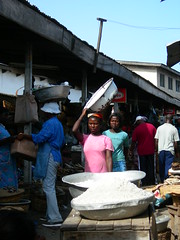
Accra's Makola Market, GhanaImage by transaid images via FlickrIn the Harvard International Review, Eric Thurman argues for a continued focus on microfinance while others see a need for more emphasis on the SME space:

It is time to maximize the abundant resources of Africa, especially the human assets. Microfinance is an excellent tool to achieve this goal. A close look at the realities of Africa reveals factors which must be taken into consideration as part of any effort in development. Economic patterns here are different from other parts of the world. First, few people have wage-paying jobs. Self-employment dominates the labor force. Also, people are more dispersed than in most other parts of the world. In a situation where the population is geographically scattered and self-employment is the norm, microfinance is a proven, practical way to boost personal income. Large public works projects or signs of industrial development are rare. Foreign direct investment and job creation in any form should be encouraged wherever possible, but no one is suggesting that these will produce large scale employment for Africans anytime soon.

via Microcapital
Zemanta Pixie

  • Digg
  • Del.icio.us
  • StumbleUpon
  • Reddit
  • RSS

Microfinance Misses Its Mark

Aneel Karnani chimes in on the debate regarding the insufficiency of Microfinance:

My analysis of the macroeconomic data suggests that although microcredit yields some noneconomic benefits, it does not significantly alleviate poverty. Indeed, in some instances microcredit makes life at the bottom of the pyramid worse. Contrary to the hype about microcredit, the best way to eradicate poverty is to create jobs and to increase worker productivity.
To understand why creating jobs, not offering microcredit, is the better solution to alleviating poverty, consider these two alternative scenarios: (1) A microfinancier lends $200 to each of 500 women so that each can buy a sewing machine and set up her own sewing microenterprise, or (2) a traditional financier lends $100,000 to one savvy entrepreneur and helps her set up a garment manufacturing business that employs 500 people. In the first case, the women must make enough money to pay off their usually high-interest loans while competing with each other in exactly the same market niche. Meanwhile the garment manufacturing business can exploit economies of scale and use modern manufacturing processes and organizational techniques to enrich not only its owners, but also its workers. As these scenarios illustrate, a surer way to ending poverty is to create jobs and to increase worker productivity, rather than investing in microfinance...[continue reading]

  • Digg
  • Del.icio.us
  • StumbleUpon
  • Reddit
  • RSS

Microfinance : Taking off the training wheels

Where does Microfinance go from here Raghuram Rajah asks "...How can microfinance be made more viable? Asking this question relegates financial services for the poor to a separate and unequal existence. Instead, we should ask how we can make financial services available to all. If we focus just on finance for the very poor, the thinking immediately shifts to subsidies and charity, which hurts the quality of service. Not only do the poor lack the collective voice to demand better services, but government money can spoil the credit culture. As one participant in a women's credit cooperative said, 'We don't default now because we would be defaulting on our sisters' money. If we took money from the government, default rates would go up because we would all feel we were defaulting only on the government...What needs to be done? For one, the government should encourage the creation of infrastructure that can allow technology to bring down transaction costs...Perhaps most important, the government should encourage competition in the financial sector. As private sector banks find their traditional businesses coming under fierce competition, they will seek out nontraditional businesses, including providing services to the very poor..."
via PSD Blog

  • Digg
  • Del.icio.us
  • StumbleUpon
  • Reddit
  • RSS

The Failure of Development Assistance

John Paul reviews Despite Good Intentions a critique of developmental assistance "...in the rush to scale up microfinance offerings, many newcomers to the field might actually be doing more harm than good. He points out a number of flaws with the current approach to microfinance, cautioning that there is little historical evidence for the developmental role of credit to the poor; that there has been little rigorous evaluation of the overall benefits of microfinance to a person’s quality of life; and that the poorest of the poor are by definition the ones who "need" credit the most, but can do the least with it..."
via NextBillion

  • Digg
  • Del.icio.us
  • StumbleUpon
  • Reddit
  • RSS

MFIs and the Remittances Business

A recent publication of the Foundation for Development Cooperation states:

Migrant workers and their families need financial products which make it easier to send, receive and manage international money transfers, and to save and invest their income. Microfinance is well-suited for remittance-linked financial services, particularly among poor and geographically isolated populations. Because they are poor, many remittance recipients fall outside typical bank client profiles, but are well within the market segment targeted by microfinance agencies. By extending remittance-linked services to the ‘unbanked’, microfinance has the potential to promote broad-based development while vastly expanding the volume of remittance flows mediated through financial institutions.
via NextBillion

  • Digg
  • Del.icio.us
  • StumbleUpon
  • Reddit
  • RSS

Microfinance or Enterprises?

Niranjan Rajadhyaksha asks at Livemint "What is the solution to poverty?":

Many have asked why Bangladesh continues to be mired in terrible poverty when it has such a large microfinance sector. The good ol’ basics matter more — property rights, open markets, human capital, innovation etc.
A new policy research paper, Who Gets Credit?, published by the World Bank shows that economies benefit more when money is lent to firms rather than households. India is one of the 45 countries the economists have covered in their study.
Quoting Milford Bateman
The East Asian countries managed to develop brilliantly through channelling much, if not most, of their savings into serious growth-oriented sustainable business projects. This is why many East Asian countries may have started at similar GDP levels as Bangladesh in the 1970s but have since massively outpaced Bangladesh in terms of growth and development. Economics 101 shows conclusively how critical savings are to development, but only if intermediated into growth and productivity enhancing projects. If it goes into rickshaws, kisoks, chicken farms, traders and so on, then the country simply will not develop and sustainably reduce poverty...[continue reading]
via World is Green

  • Digg
  • Del.icio.us
  • StumbleUpon
  • Reddit
  • RSS

Beyond the Romance of Microfinance

In the Huffington Post TED Africa Fellow Magatte Wade co-founder of Adina and Michael Strong write:

In the course of starting a business based in Africa, I was referred to a former Silicon Valley CFO who had made enough money and now devoted his life to helping the world's poor. As I began to explain my project to him, which involved setting up manufacturing plants in Senegal, he kept encouraging me to buy crafts from local artisans rather than setting up manufacturing plants. Despite the fact that he had become wealthy through a capitalist world and lived a comfortable lifestyle that depended on tens of thousands of factories around the world, his vision of helping the poor was strictly limited to microfinance and local crafts. My vision of manufacturing in Africa was frankly repulsive to him.

more here

  • Digg
  • Del.icio.us
  • StumbleUpon
  • Reddit
  • RSS

Looking towards SME Finance

The importance of SME's in building viable economies is often overlooked,Alan Patricof of Apax partners stated, "You could find tons of people who’d give you loans for $1,000 at 3 or 4 percent a month, but you can’t build businesses on that,"At a Brookings Blum roundtable it was noted that, "...With scalable models for microfinance increasingly well established, attention is shifting to the SME sector, where enterprise needs are more complex and there are fewer successful models. Although SMEs have correspondingly higher needs for capital than microfinance, the problem is not so much the amount as the type of capital needed. The class of SMEs with the greatest potential for high-yielding investment and innovation is too small and unproven to depend on commercial loans or internal cash flow, and simultaneously too large and risky to rely on modest short-term microcredit loans..."

  • Digg
  • Del.icio.us
  • StumbleUpon
  • Reddit
  • RSS

The Need for Managerial Expertise

Apoorva Shah asks?

The question is not whether there should be more innovators and entrepreneurs in Africa, but how? What concrete steps must be taken in order to develop the business sector?
He believes that part of the answer lies in building managerial expertise:
The importance of governance, financial institutions, and the overall "enabling environment" has already been proven by the widely referenced World Bank Doing Business Reports. By measuring the difficulty of starting and sustaining business, the report allows for governments to know where to direct and manage reforms. However, an assessment of business know-how and expertise is less frequently discussed, and some over-enthused optimists, especially those on the microfinance bandwagon, insinuate that skills like balancing a checkbook or managing organizational structure are inherent in all entrepreneurs, even budding ones in Africa and South Asia.
Yet studies show that many times it is not the availability of funding or even government reforms that hold back business development, but simply business expertise. Management skills are especially important when entrepreneurs look to scale their businesses and employ more workers
via more business schools
The Association of African Business Schools (AABS), organized by the International Finance Corporation's Global Business School Network, is a quiet but crucial voice in a sector where passions thrive on shirtsleeves and megaphones. The AABS member schools collaborate to improve the standards and increase accreditation of business schools in Africa. Right now, only one school, the University of Cape Town in South Africa, ranks within the Top 100 Business Schools on the 2007 Financial Times Global MBA Index.
But more entrepreneurial Africans in the middle and lower-middle classes should also have the opportunity to attend decent business schools close to home, preventing brain drain and catalyzing larger-scale local business development. As the AABS addresses the quality of business schools, private donors can look to increase the quantity of these schools

  • Digg
  • Del.icio.us
  • StumbleUpon
  • Reddit
  • RSS

Quick Hits

The rise of self-financed development.
Corruption and publicly owned telecom companies.
Africa the newest biofuel battleground.-Der Spiegel
"The energy market should be privatised"-IOl
The rise of consumerism-African Path
Mining privitisation in the Congo.-FT
Successful targeted microfinance-African Loft

  • Digg
  • Del.icio.us
  • StumbleUpon
  • Reddit
  • RSS

SMEs Are What's Next

Derek Newberry of Next Billion reports:

The Miami Herald interviewed Root Capital founder Willy Foote this week about the basics of his enterprise development organization. Root Capital identifies and supports SMEs in countries where the private sector is dominated by micro-enterprises and large corporations. This structure represents a dearth of businesses in the investment range of roughly $100,000 - $3 million - the infamous "missing middle"Willy, a key player in this space, believes that providing success stories of SME finance can help set off a rising tide of investment in this sector - very similar to the New Ventures approach. In his words: "...we can really do what microfinance did. That is, show local financial institutions that this is an asset class they can penetrate profitably."

  • Digg
  • Del.icio.us
  • StumbleUpon
  • Reddit
  • RSS

Now AfriCAN Congo

Founded by Priscillia Kounkou Hoveyda and Camille Ntoto "...Now AfriCAN is a non-profit organization whose mission is to professionally and socially empower African youth living in post-conflict zones through microfinance, education and the media..."read about their entrepreneur hero's here

  • Digg
  • Del.icio.us
  • StumbleUpon
  • Reddit
  • RSS

Modern Entrepreneurship

Amar Bhide and Carl Schramm write in the WSJ:

Mr. Yunus's ameliorative entrepreneurship however is very different from the transformative entrepreneurship that Mr. Phelps argues has been central to modern capitalism. Indeed, most of the ventures funded by microloans in Bangladesh (read Sub-Saharan Africa) are activities that were marginalized by modern entrepreneurs: They don't involve any economies of scale or scope or the use of new technologies capable of producing significant advances in overall productivity and incomes.
Economic development does wonders for peace, but what does microfinanced entrepreneurship really do for economic development?... A few small port cities or petro-states aside, there is no historical precedent for sustained improvements in living standards without broad-based modernization and widespread improvements in productivity brought about by the dynamic entrepreneurship that Mr. Phelps celebrates...In principle, microfinance does not preclude modern entrepreneurship. But in practice, we wonder if the romantic charm of the former might distract governments in impoverished countries from undertaking reforms needed to foster the latter.

via NextBillion

  • Digg
  • Del.icio.us
  • StumbleUpon
  • Reddit
  • RSS

Building Businesses with Small Producers

The Open Book "...Building Businesses with Small Producers makes an important contribution to the ongoing debate regarding market- and demand-based provision of non-financial services to existing and potential small and microentrepreneurs and businesses in the developing world, a debate which originated in the success to date in standardizing and commercializing microfinance programmes..."

  • Digg
  • Del.icio.us
  • StumbleUpon
  • Reddit
  • RSS

One Hen: Microfinance for Kids


One Hen empowers kids to become social entrepreneurs who make a difference for themselves and the world. We do this by equipping educators with educational resources to inspire kids to four values: financial responsibility, personal initiative, global awareness and giving back-website

  • Digg
  • Del.icio.us
  • StumbleUpon
  • Reddit
  • RSS

Patient Capital

Rob Katz reviews Tom Friedman's recent article about patient capital otherwise known as meso finance:

Friedman writes about mesofinance, the missing middle of investment that comprises the gap between microfinance and formal finance. He notes that there's a huge opportunity to support bottom-up development in Africa by providing patient capital: longer-term, lower-interest loans and investments (versus venture capital).

  • Digg
  • Del.icio.us
  • StumbleUpon
  • Reddit
  • RSS

Opportunities within West African Financial Flows

A recent study(PDF) on Financial Flows within West Africa made the following findings:

(1) presently, the aggregate value of these transactions may amount to US$2 billion annually in remittances from migrant laborers and perhaps as much as US$8 billion in trade settlements in the four countries.
(2) Overly restrictive government policies, the inconvertibility of the currencies in the region, corruption and traditional patterns have the effect of driving potentially legitimate business into the informal economy.
(3) Small and medium sized enterprises, in particular, have
difficulty gaining access to formal mechanisms and institutions that could normally provide business loans and financial settlement services. Concurrently, the region is vastly underbanked.
(4) Microfinance institutions and credit unions service a part of this informal market but they operate under financial regulations that make it difficult to service the full needs of their clients. The settlement of international transactions is particularly difficult.
(5) The use of technology may help provide options that will encourage greater use of formal systems

via West AfricanTrade Hub

  • Digg
  • Del.icio.us
  • StumbleUpon
  • Reddit
  • RSS

What Micro Loans Miss

James Surowiecki writes in the New Yorker:

Businesses that can generate jobs for others are the best hope of any country trying to put a serious dent in its poverty rate. Sustained economic growth requires companies that can make big investments—building a factory, say—and that can exploit the economies of scale that make workers more productive and, ultimately, richer. Microfinance evangelists sometimes make it sound as if, in an ideal world, everyone would own his own business. "All people are entrepreneurs," Muhammad Yunus has said. But in any successful economy most people aren't entrepreneurs—they make a living by working for someone else. Just fourteen per cent of Americans, for instance, are running (or trying to run) their own business. That percentage is much higher in developing countries—in Peru, it's almost forty per cent. That's not because Peruvians are more entrepreneurial. It's because they don't have other options...What poor countries need most, then, is not more microbusinesses. They need more small-to-medium-sized enterprises, the kind that are bigger than a fruit stand but smaller than a Fortune 1000 corporation.

  • Digg
  • Del.icio.us
  • StumbleUpon
  • Reddit
  • RSS