
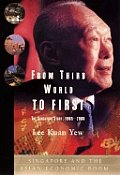
 Leadership imbued in the personality of Lee Kuan Yew was critical to the transformation of the then island backwater state of Singapore to a regional powerhouse."From Third World To First" is his account of this journey. "...Few gave tiny Singapore much chance of survival when it was granted independence in 1965. How is it, then, that today the former British colonial trading post is a thriving Asian metropolis with not only the world's number one airline, best airport, and busiest port of trade, but also the world's fourth-highest per capita real income?...",HarperCollins.
What lessons does this hold for the Liberia's, Malawi's and Senegal's of this world? Countries comparatively with much more than Singapore ever had in terms of raw material and human resources.
From Third World To First :The Singapore Story


Reform or Perish
The Guardian comments on the rising pragmatism of the Communist West Bengal goverment in India,a shift that has relevance for the 'peoples' regime of Ethiopia and other communist/socialist movements elsewhere in the continent:
"...Calcutta, the first capital of the British Raj, is a bastion of Indian communism. The left has run this Indian state for almost three decades, a period which has seen West Bengal become a byword for labour unrest. But in recent years, like its ideological cousin in China, the Communist Party of India (Marxist), or CPI(M), has been busy rebranding itself - bearhugging foreign investors and Indian businessmen...West Bengal's increasingly warm embrace of foreign capital has paid off. The state has just sold 2,000 hectares (5,000 acres) of agricultural land to an Indonesian group in a $10bn deal for a software park and industrial zone building motorbikes, across the river from Calcutta. The state says investors from Singapore are keen to fund and build a new airport. Last year West Bengal signed a $235m contract with P&O to build India's first private port..."
Quick Hits
An architect of Singapore's astounding economic growth-via Ethan Zuckerman
Investing and empowering farmers-Guardian
Nurturing an industrial renaissance in Ghana.
Africa,Business destination-TIME
Favoring poor governments over poor people-Aidwatch
Africa’s Singapore or Uganda waiting to happen?
Yet Rwanda has one huge advantage: the rule of law. No African country has done more to curb corruption. Ministers have been jailed for it. Transparency International, a watchdog, reckons Rwanda is less graft-ridden than Greece or Italy (though companies owned by the ruling party play an outsized role in the economy). “I have never paid a bribe and I don’t know anyone who has had to pay a bribe,” says Josh Ruxin, one of the owners of Heaven, a restaurant in Kigali, the capital.
The country is blessedly free of red tape, too. It ranks 45th in the World Bank’s index of the ease of doing business, above any African nation bar South Africa and Mauritius. Registering a firm takes three days and is dirt cheap. Property rights are strengthening, as well—the government is giving peasants formal title to their land.
In Order for the National Government to Save Education, It Has to Let it Go
If the national government wants to save education in America, I have become increasingly convinced that it needs to let it go, and for that matter, if the states want to save education in America, they have to let it go to. The education of children needs to be shoved as hard as it can be shoved to the lowest local level of our governmental system so that parents, local community leaders, and stakeholders in the educational system can regain the power and control over the education of their children's lives. What made our nation great was decentralization, local control, and personal responsibility, and by moving more and more control to the state and national levels we have lessened the very things that made us great.
America is not China, nor is it Finland, nor is it Germany, nor is it Singapore- those nations, although perhaps doing well lately, didn't conquer a continent, win two major world wars, and in recent years become the world's sole superpower. So we should not look to them for solutions on how to build and design and run an educational system for our nation- we should instead take those things that made America great and helped it to become what it is and modernize them and improve them and build on them, and that means not adopting statist models built on communistic principles designed to suck massive amounts of wealth from the system and funnel it through large bureaucracies to favored politically connected groups within societies. That's not our model to follow- our model is to return power over education back to the local level, which will then experiment with public policy solutions and funding models in order to achieve a democratic solution to providing high quality education at minimum cost to society with little loss of efficiency.
Rules regarding what is taught in each district need to be returned back to the district. Funding for each district needs to be returned to the district. Rules regarding discipline need to be returned back to the district. Control over hiring and regulations over hiring and rules regarding hiring need to be returned to the district. School districts at the local level must once again be where the education of children is designed, set up, and practiced, and this power and money and decisions should no longer to sent off to far-away places where faceless bureaucrats who don't know your kids make decisions that are very important to your children and their futures.
Democrats and Republicans alike make the mistake of trying to fix education by moving more and more power to the national or state levels, killing any innovation that local districts may experiment with to build better educational systems in favor of trying to adopt one-size-fits-all models that not everyone wants and so no one adopts. Creativity, growth, and great ideas come from people who actually work in education and manage education professionals and whose children go through the education system, and yet in our nation, more and more of decisions, funding, and power is flowing rapidly away from those people to unelected bureaucrats, childless professors, and scheming politicians. Republicans and Democrats alike need to reject this siren song of government power fixing everything, and take a deep breath and a leap of trust and once more empower the people of our great nation to do what needs to be done to fix and improve education by returning powers and funds that once were at the local level- once when America was great- back to the local level.
Pirate Bankers, Shadow Economies
Khadija Sharife writes in FPIF:
In Africa, political power is often used as a ‘get out of jail free’ card, immunising the venal political elite through various mechanisms. Transparency International, the global corruption watchdog renowned for its annual Corruption Perceptions Index (CPI), argues that corruption is especially rampant in Africa. TI defines corruption as the ‘abuse of entrusted power for private gain’, a notion limited to the governing bodies in developing countries.More here
But this is only half the story. A respectable financial army plays an invaluable role in a global shadow economy. A coterie of bankers, accountants, and lawyers – based in ‘transparent’ London, New York, and Singapore – serve as the ‘postcard-island’ tax havens, and they're backed by multilateral financial institutions. Corrupt government leaders get away with graft much more easily and more frequently because of these international financial enablers
Via Pambazuka
![Reblog this post [with Zemanta]](http://img.zemanta.com/reblog_e.png?x-id=e093bc73-98f1-4676-a872-4b2fedcc0e32)
Pirate Bankers, Shadow Economies
Khadija Sharife writes in FPIF:
In Africa, political power is often used as a ‘get out of jail free’ card, immunising the venal political elite through various mechanisms. Transparency International, the global corruption watchdog renowned for its annual Corruption Perceptions Index (CPI), argues that corruption is especially rampant in Africa. TI defines corruption as the ‘abuse of entrusted power for private gain’, a notion limited to the governing bodies in developing countries.More here
But this is only half the story. A respectable financial army plays an invaluable role in a global shadow economy. A coterie of bankers, accountants, and lawyers – based in ‘transparent’ London, New York, and Singapore – serve as the ‘postcard-island’ tax havens, and they're backed by multilateral financial institutions. Corrupt government leaders get away with graft much more easily and more frequently because of these international financial enablers
Via Pambazuka
Africa's War on Poverty Begins at Home
Marian Tupy writes "...It is true that rich countries' protectionism harms some producers in the developing world but trade liberalization in rich countries as a cure for African poverty is often over-emphasized. The main causes of African impoverishment are internal. Africa lacks political stability and economic freedom. Its tariffs are high and private property rights weak. It is hypocritical for African leaders to call for greater access to global markets while avoiding policy reforms, including trade openness, at home...Clearly, free trade is a necessary, but not a sufficient, condition for economic growth in Africa. But trade can play a role in promoting prosperity by increasing domestic competition and changing the dynamic of the political economy that keeps privileged groups protected. Many reforms are needed but a good place to start is with freeing trade at home. African countries should do so regardless of what the rich countries do. India, China, Hong Kong, Singapore, South Korea, Taiwan, Chile, Estonia and many other developing countries undertook unilateral trade liberalization in the past and reaped the benefits..."
Interchange Student's Book 2 with Audio CD (Interchange Third Edition)
 Interchange Third edition is a four-level series for adult and young-adult learners of English from the beginning to the high-intermediate level. The Interchange Third Edition Level 2 Student's Book builds on the foundations established in Level 1 for accurate and fluent communication, extending grammatical, lexical, and functional skills. Topics such as travel, childhood, customs, personality, and predicaments are presented in unique ways using interesting real-life information. Each Student's Book contains 16 teaching units, frequent progress checks that allow students to assess and monitor their own learning, and a listening self-study section. Included is a Student Audio CD that contains the conversation, pronunciation, and self-study sections from the Student's Book.
Product Details
Paperback: 16 pages
Publisher: Cambridge University Press; 3 edition (November 1, 2004)
Language: English
Book Description
The Interchange Third Edition Level 2 Student's Book builds on the foundations established in Level 1 for accurate and fluent communication, extending grammatical, lexical, and functional skills. Topics such as travel, childhood, customs, personality, and predicaments are presented in unique ways using interesting real-life information. Each Student's Book contains 16 teaching units, frequent progress checks that allow students to assess and monitor their own learning, and a listening self-study section. Included is a Student Audio CD that contains the conversation, pronunciation, and self-study sections from the Student's Book.
About the Author
This biography was provided by the author or their representative.
Asantehene and Africa's new development thinking
Kofi Akosah-Sarpong writes about efforts to engage African traditional rulers in the continent's development process. The Asantehene "...is fast projecting the thinking of Africa's development process, an act whereby traditional values and the colonial legacies are balanced out in Africa's development process. The the development inbalances have occured since independence from the European colonialists who, in their infinite ignorance of Africa's values, imposed their development paradigms on Africa as one of their several ways of civilising the "primitive" African.Over the years, such erroneous development thinking has created not only distortions, damages, confusion and unwarrented crises but also wrong notions, especially among the so-called African elites who are educated in Eurocentric values, that Africa's values in her development process are inferior to the European ones. Confused for long, and either unable to extricate themselves from the imposed European development values so as to let African values drive their development practices or intellectually weak in mixing their African values with the European ones, as other ex-colonies such as South Korea, Singapore, Japan or Brazil has done in their develoment process...",GhanaWeb.
Transitioning to Emerging Market Status?
 From the IMF's Regional Economic Outlook for Sub-Saharan Africa,2008(PDF):
The term “emerging market” was coined in 1980 to refer to countries that had stock markets and were in transition toward having the features of the mature stock markets in industrial countries.This box suggests that some African countries fit within the emerging market group and supports this view by benchmarking these African economies of 2007 against the ASEAN countries (Indonesia, Malaysia, Philippines, Singapore,and Thailand) of 1980, when the term “emerging market” entered the lexicon.
Selected African countries compare favorably with the ASEAN countries of 1980. The ASEAN countries were already experiencing strong economic growth. Yet, in many other respects, the ASEAN countries looked quite different from what we see today. Inflation rates were still high in some cases, the depth of their financial sectors was limited, foreign direct investment had yet to accelerate, and their financial
resources, reflected in international reserves, were adequate but not high. Many African countries have perhaps reached broader macroeconomic stability than the 1980 ASEAN benchmark. Growth is strong, inflation moderate, and international reserves relatively high. Like ASEAN, financial depth remains limited.Foreign direct investment is quite high, although this is in large part a reflection of the larger share of naturalresources such as oil in the case of African countries.2 Debt-to-GDP ratios are low.
GOP Still Believes in America, Obama and Democrats Think 5% Growth is Ridiculous
Former Minnesota governor Tim Pawlenty turned out a blockbuster economic growth plan this past week, including deep cuts in taxes, spending, and regulations. It’s really the first Reaganesque supply-side growth plan from any of the GOP presidential contenders. And he caps it all off with a defense of optimism as he charges ahead with a national economic growth goal of 5 percent.Whether Pawlenty's goal is realistic or not is not the point- rather it is the Democratic liberal establishment's response to it. Rather than hope and change and pushing back the tide and restoring America's prosperity and believing in and pushing for and working for jobs and a great economy, liberals and Democrats, whether they are in Congress or in the White House or in the media, now simply laugh at and scoff and ridicule anyone who believes such things.
That’s right: 5 percent.
Pawlenty calls this target aspirational. Okay, fine. But deeper down, he’s basically saying no to the declinists and pessimists who seem to populate the economic landscape these days. Big government doesn’t work. Let’s try something different.
Ronald Reagan always believed that America is exceptional. By removing obstacles to growth, the Gipper held that economic policies could unleash a massive outpouring of risk-taking, creativity, and entrepreneurship. He was right, and his policies launched a two-decade-long boom.
Actually, the first couple years of the Reagan recovery came in at over 7 percent. And as Pawlenty noted in his speech at the University of Chicago this week, between 1983 and 1987, the economy grew at 4.9 percent annually. I note that President John F. Kennedy also had a 5 percent growth target, a response to Ike’s three recessions.
...those on the left criticize Pawlenty...
IS THIS WHAT YOU VOTED FOR? A party that's first and biggest and lasting impression of someone saying that our economy can grow again is to laugh, scoff, deny, and offer reason after reason why you won't get a job, why you won't get a raise, why your children will owe more in debts, why America will get weaker, etc- the new normal of Obama and the Democrats will be a lesser nation, one that you better get used to and expect won't improve.
The very possibility that America could rise again after the destruction that the Democrats and Obama has driven into the very foundations of America inspired the White House to reply:
With regards to 5 percent growth, we couldn’t agree more; that would be very beneficial to the economy. We think providing expansive tax cuts to the wealthy — which we did in the last term and added tremendously to our debt and resulted in this President inheriting a massive deficit and debt in 2009 — probably not the best approach.This comment filled with snark and sarcasm and divisiveness and bitterness is what we all can now expect from Obama and an Executive Branch controlled by the Democrats. He didn't say 'That's great, how can we work together and find common ground to achieve not only 5% growth but 6% growth', but rather the reply was mocking, empty rhetoric on class warfare, and transferring blame.
Firedoglake, which Obama reads and quotes from and believes in, called Pawlenty's plan a "Unicorn and Pony Economic Plan", and suggested that it is now a 'fantasy' for America to grow again at 5% and that merely suggesting that America can be a prosperous, free, and strong nation is ridiculous.
Michael Ettlinger of the liberal Center for American Progress said, "It's patently ridiculous... it's not worth serious discussion. ... No one serious thinks that's possible."
This quote illustrates the difference between the right (conservatives, tea partiers, libertarians, moderates) and the left (liberals, communists, socialists, fascists)- the right still thinks that unleashing human liberty and freedom through private property protection, limited government, rule of law, and a love of human life will lead our nation to high GDP growth rates, and the left does not. The left believes that it is no longer even possible for America to grow, and that the ruling classes need to lock in social and economic classes through regulation, government control, and excessive taxes so that the rich can grow richer and the poor can grow poorer.
It is shocking that Obama and the Democrats believe that it isn't even possible for the United States to have a 5% GDP growth rate. According to the CIA, many nations grew faster than 5% last year- Qatar grew at 16.272%, Paraguay at 15.270, Singapore at 14.471, India at 10.365, Turkmenistan at 9.222, Argentina at 9.161, Peru at 8.795, Botswana at 8.562, Nigeria at 8.394, Sweden at 5.536, or Mexico at 5.518.
In fact, out of 184 nations listed, 68 of them grew at a rate of 5% or faster last year- and yet Obama and the Democrats think that this is impossible for the United States to do, and they believe that we've turned it around and that Americans should be happy with a growth rate of 2.834% for 2009, which makes our nation the 117th fastest growing economy in the age of Obama.
Our economy that Obama and his liberal Democrat allies thinks it is impossible and silly and just wrong for our economy to grow faster than 5%, and their policies are doing just this- high taxes, high fees, increased regulation, increased government control over society, more bureaucrats, breaking the rule of law, excessive environmental regulations, rhetorical attacks on business and investment and success and industry, policies that attack our energy industry, policies that break the law white hindering our nuclear industry, and massive stimulus and spending bills that mis-allocate resources.
Republicans offer an alternative- they still believe in America, they still believe in the dream of a growing economy, and they still think that 5% growth rate is possible. Vote for them next election.