RSS
Menampilkan postingan yang diurutkan menurut tanggal untuk kueri Pambazuka. Urutkan menurut relevansi Tampilkan semua postingan

"Nigeria is about oil and nothing but oil"

Sokari Ekine writing in Pambazuka:
...I believe the majority of the country is behind not just the strikes but the Occupy Nigeria movement which seeks to seriously challenge the status quo and once and for all end the rule by kleptocracy. However there are other small but extremely powerful interest groups working for and against the government: Boko Haram and whoever is behind them; Jonathan and possibly some of the ex-Niger Delta militants; Senators and Governors who fear loss of their power and wealth; the trade union movement particularly the oil workers - how trustworthy are they? – the independent oil marketers or cabal. And of course there is the religious factor, the cozy relationship between an all-powerful state and a powerful highly influential set of religious institutions. Nigeria is about oil and nothing but oil...
more here

  • Digg
  • Del.icio.us
  • StumbleUpon
  • Reddit
  • RSS

A Senegalese spring?

In Pambazuka Ella Scheepers writes about June 23 Movement and democracy in Senegal:
The formation of M23 – a new movement born out of the 23 June protests against President Wade’s proposed constitutional amendments – is the latest result of African democracy at work. Here different (and sometimes opposing) voices join together to create a singular organization for a common cause to protect and promote the constitution and democratic principles. Instead of adhering to rules about what traditional democracy is and what traditional relationships it permits, M23 went back to the basics in defense of the common good, hence bringing together very diverse sections of society.
courtesy of CS Monitor

Its impact has been both immediate – halting the adoption of the proposed amendments in parliament - and there seems to be potential for the development of a longer lasting impression where civil society has a strong voice in the halls of power. However, this phenomenon will be tested in the upcoming 2012 election when the question of whether the movement was the voice of particular interest groups or truly has the peoples' interests at heart will be answered.
More here

  • Digg
  • Del.icio.us
  • StumbleUpon
  • Reddit
  • RSS

The importance of Funding our own Movements

Sarah Mukasa in Pambazuka:
Image of Sarah Mukasa
Philanthropy in Africa has become an area of increasing interest in the past 10 or more years. A key focus for interrogation is the manifestation of philanthropy in the African context - its areas of strength and weakness. Another is how to build on the traditions of philanthropy in Africa to attain stronger institutional processes that scale up localized forms of giving and ground these in principles of social justice, equality, peace and sustainable development. Africans are challenging the notion that Africa is purely a ‘donor recipient’ continent and instead are pointing to the rich traditions of giving and philanthropic practice in Africa – which in many instances have been the mainstay of entire communities.
Whilst it is known that philanthropy is an age-old practice in Africa, there is little recognition of the contributions it has made in developing and sustaining communities. In Africa today, much of the giving takes place in familial and informal community networks responding often to immediate/ welfare concerns. Burial societies, individual support to the payment of school fees and, building of community facilities are examples of philanthropy that can be found in many variations on the continent. Religious organizing has also formed a critical avenue for much of the more formal and institutionalised mechanisms for philanthropy, with programmes driven by local actors providing a range of services including education, health services and feeding programmes...[continue reading]

  • Digg
  • Del.icio.us
  • StumbleUpon
  • Reddit
  • RSS

Côte d'Ivoire: Descent into hell

In Pambazukablog accounts of the crisis in Ivory Coast:
cc Wikimedia
‘The fog of war clouds everything for the moment; it's impossible to tell who is responsible for what -- and against whom. But it's important to look at all sides of the fighting, because when the dust settles, Cote d'Ivoire is going to be torn apart.’
Enhanced by Zemanta

  • Digg
  • Del.icio.us
  • StumbleUpon
  • Reddit
  • RSS

Western Sahara: The last colony in Africa

In Pambazuka:
In the following interview, Radhi S. Bachir talks about Western Sahara [mp3], which the delegation of Saharawis to the World Social Forum calls ‘the last colony of Africa.’ He says Western Sahara is the only territory on the continent that had not been truly decolonised and where people have not been able to exercise their right to self-determination.
Enhanced by Zemanta

  • Digg
  • Del.icio.us
  • StumbleUpon
  • Reddit
  • RSS

Covering Revolutions-The African Egypt versus the Arab Egypt

In Al Jazeera:
"Egypt is in Africa. We should not fool about with the attempts of the North to segregate the countries of North Africa from the rest of the continent," says Firoze Manji, the editor of Pambazuka Online, an advocacy website for social justice in Africa. "Their histories have been intertwined for millennia. Some Egyptians may not feel they are Africans, but that is neither here nor there. They are part of the heritage of the continent."
And, just like much of the rest of the world, Africans watched events unfold in Cairo with great interest. "There is little doubt that people [in Africa] are watching with enthusiasm what is going on in the Middle East, and drawing inspiration from that for their own struggles," says Manji.
He argues that globalisation and the accompanying economic liberalisation has created circumstances in which the people of the global South share very similar experiences: "Increasing pauperisation, growing unemployment, declining power to hold their governments to account, declining income from agricultural production, increasing accumulation by dispossession - something that is growing on a vast scale - and increasing willingness of governments to comply with the political and economic wishes of the North.
More here
Enhanced by Zemanta

  • Digg
  • Del.icio.us
  • StumbleUpon
  • Reddit
  • RSS

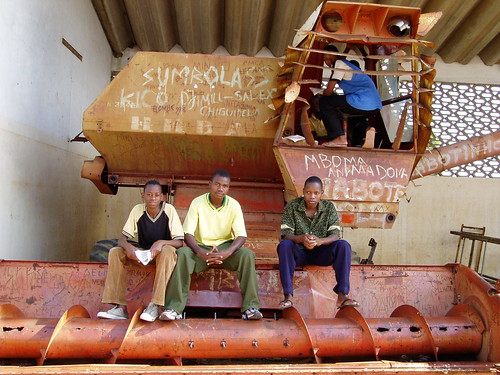
Rejuvenating the Mozambican knowledge factory

Luca Bussotti writing over at Pambazuka:

Students at Escola Agrária in Chokwé
CC Afronie
Firing up the local production of knowledge is crucial to escaping the ‘industry of development
He goes on to say:
...it appears rather obvious that few people have an interest in promoting local knowledge and knowledge in general as a key to exiting structural dependence. Rather, as Mozambican sociologist Elísio Macamo wrote, the ‘industry of development’ continues to work, and it doesn't seem to be in the interest of the leading classes to get rid of it.
More here

  • Digg
  • Del.icio.us
  • StumbleUpon
  • Reddit
  • RSS

Biotechnology-Patent Grab Alert

Hope Shand writing in Pambazuka:

Under the guise of developing ‘climate-ready’ crops, the world’s largest seed and agrochemical corporations are pressuring governments to allow what could become the broadest and most dangerous patent claims in intellectual property history. A new report by ETC Group[1] reveals a dramatic upsurge in the number of patent claims on ‘climate-ready’ genes, plants and technologies that will supposedly allow biotech crops to tolerate drought and other environmental stresses (i.e. abiotic stresses) associated with climate change. The patent grab threatens to put a monopoly choke-hold on the world’s biomass and our future food supply, warns ETC Group.
More here
Enhanced by Zemanta

  • Digg
  • Del.icio.us
  • StumbleUpon
  • Reddit
  • RSS

Unable to pay bribes...Languishing in Detention

Kersty McCourt writing in Pambazuka:

Corruption and excessive pretrial detention are mutually reinforcing: A criminal justice system that overuses pretrial detention is susceptible to corruption, and an environment marked by corruption will likely lead to over-reliance on pretrial detention. Both corruption and excessive pretrial detention flourish under the same circumstances. The two form a vicious cycle: A dysfunctional justice system leads to corruption, and that corruption further twists the justice system.
Continuing:
All over the world, poor people are arrested because they cannot pay a bribe to the corrupt police officer, then denied access to counsel or family because they cannot bribe the corrupt guard or prosecutor, then held indefinitely – or found guilty – because they cannot bribe the corrupt judge. The ability to put cash in the right hands often makes the difference between freedom and detention. Pretrial detention centres are populated almost entirely by poor people.
More here
Enhanced by Zemanta

  • Digg
  • Del.icio.us
  • StumbleUpon
  • Reddit
  • RSS

Revive traditional law systems

In Pambazuka Ronald Elly Wanda makes a case for re-instituting the indigenous institution of traditional jurisprudence:

Ronald Elly Wanda
Since flag independence in the 1960s, African governments have been in a rush to normalise authoritarian rule and human rights abuses under the auspices of maendeleo (development) and economic growth. A short stroll in any African village today confirms that the globalised Western culture of justice delivery or innovation that most African leaders seem to trust has not improved the well-being of our local communities or delivered justice for them. On the contrary, it has often blocked viable indigenous innovation of cultures and suffocated African justice. Here in East Africa, cultures of innovation have largely accrued from the jua kali (informal), and not the formal sector. Indigenous cultural innovations have also been at the centre of development in most highly indebted poor countries (HIPC), such as in Uganda or its slightly richer sister Kenya, notably because of wanainchi (citizens) exceptionally limited access to capital.
As such, when it comes to delivering justice in Africa, we ought to revise our priorities by doing away with existing preconceived ideas that might have worked within the European cultural setting. They have clearly not worked in the face of the socio-cultural heritages of African societies, and neither has the opposite, the Africanisation of Western concepts of justice delivery.
More here

Enhanced by Zemanta

  • Digg
  • Del.icio.us
  • StumbleUpon
  • Reddit
  • RSS

The Delusion of being Independent

Hama Tuma in Pambazuka

A national flag, a black oppressor in a Mercedes Benz and a Rolls Royce, palaces and corrupt and hedonistic existence for the few and Africans were expected to hail this as freedom and salvation. Those who said the emperor was actually naked and that colonialism has continued in a new garb (with the old stink in place) were quickly silenced. Belgian and CIA agents collaborated to have Patrice Lumumba murdered. Freedom fighters Um Nyobe, Felix Moumie and later on Mondlane, Machel and Cabral were gotten rid off in one way or another. Pan-Africanists with a strong anti imperialist stance were made victims of foreign-engineered coups, as in Ghana and Nkrumah. Colonialism never left but wore a new mask; Africa was doomed as the traitors had a field day, selling the whole continent without any scruples or qualms.
More Here
Photo courtesy of Ghennet Girma
Reblog this post [with Zemanta]

  • Digg
  • Del.icio.us
  • StumbleUpon
  • Reddit
  • RSS

How to reinvent Ethiopian politics

Alemayehu G. Mariam writes in Pambazuka:

The current state of affairs in Ethiopia calls for the reinvention of politics in the democratic opposition, by disconnecting from the self-destructive politics of the past and overwrought politics of the present, and connecting to a new politics of the future which transcends partisanship, ethnicity, ideology, language, region and so on. This reinvention requires several things: A paradigm shift in political thought and behaviour, a radical change in perspective, a new approach and lexicon for political communication and a redefinition of the issues within a broader national agenda. It calls for politics that is ‘compassion-centred’ and pragmatically oriented to creatively solving the entrenched problems of governance.
More here
Reblog this post [with Zemanta]

  • Digg
  • Del.icio.us
  • StumbleUpon
  • Reddit
  • RSS

Environmental Determism

Jason Hickel writes in Pambazuka:

The correlation between environment and development is indeterminate; there are many regions in the world with hostile geological and climactic characteristics that have nonetheless managed to keep from descending into inveterate poverty. Second, the theory focuses on what Africa lacks rather than what Africa has, being – among other things – vast natural resource wealth in the form of unprecedented petroleum reserves and mineral deposits. The question should not be what to do in the absence of resources, but how existing resources get used, how they are distributed, and who pockets the profits.
More here
Reblog this post [with Zemanta]

  • Digg
  • Del.icio.us
  • StumbleUpon
  • Reddit
  • RSS

The Failings of the Nation-State

In Pambazuka Amira Kheir writes:

Perhaps it is time we re-examine the dilemma of African statehood through a different prism – as a crisis of inheritance rather than a crisis of capability. And by inheritance I am not predictably alluding to colonial legacy, rather to a very specific transition that occurred in the decolonisation era. While one is not independent of the other, pursuing a deterministic approach to the current status quo – one governed by cause and consequence, and not by simplistic notions of ‘nature’ – is perhaps where our answer lies.
More precisely, what I am attempting to present is an alternative paradigm – that the reason the state of affairs is as it is could be a direct result of the subtle inheritance of a system that did not match African needs and potential. This is an inheritance that is often overlooked as a norm and that is taken for granted as the natural and certain structure of governance: The nation-state.
More here

  • Digg
  • Del.icio.us
  • StumbleUpon
  • Reddit
  • RSS

Pseudo-Intellectuals in the 'Poverty of Ideas'

In Pambazuka:


What constitutes an intellectual in the South African context?’ asks Leslie Dikeni in this week’s Pambazuka News, ‘Who is an intellectual and who isn’t?’ In an extract from a new book of essays, ‘The Poverty of Ideas’, Dikeni separates the ‘real intellectuals’ from a new breed of ‘pseudo-intellectuals’ that have emerged in recent years: The ‘celebrity intellectual’, the ‘commercial intellectual’, the ‘policy analyst’ and the ‘new gender activist’...[continue reading]

  • Digg
  • Del.icio.us
  • StumbleUpon
  • Reddit
  • RSS

Dictatorship more dangerous than climate change

Alemayehu G. Mariam writes in Pambazuka:

The inconvenient truth about Africa today is that dictatorship presents a far more perilous threat to the survival of Africans than climate change. The devastation African dictators have wreaked upon the social fabric and ecosystem of African societies is incalculable.
More here

  • Digg
  • Del.icio.us
  • StumbleUpon
  • Reddit
  • RSS

'Riches to Rags' the commodity dead-end


The cautionary tales of commodity dependence continue.In Pambazuka Khadija Sharife writes about Zambia's copper straitjacket:
Once perceived as an icon of progress in Africa thanks to wealth from its copper mines, today over 75 per cent of Zambia's population lives below the poverty line...Khadija Sharife recounts the country’s ‘riches to rags’ story – a story that is being repeated in former resource colonies across the continent, which although ‘politically liberated’ have ‘remained economically chained’.
More here
Even Russia's Medvedev rails against commodity dependence.

  • Digg
  • Del.icio.us
  • StumbleUpon
  • Reddit
  • RSS

Resource Cursed-Equatorial Guinea

Map of Equatorial Guinea
Image via Wikipedia
Tutu Alicante and Lisa Misol write in FP:
Imagine a tiny country flush with oil money, where the wealth per person is on par with that of Spain or Italy. Now picture a place quite the opposite, where nearly two-thirds of the population lives in extreme poverty and infant and child mortality rates are on par with those of the war-ravaged Democratic Republic of the Congo...impossible as it sounds, these two sentences describe the same place: Equatorial Guinea, a West African country home to roughly a half-million people. Earlier this month, the country's president, Teodoro Obiang Nguema Mbasogo, marked the 30th anniversary of the coup that brought him to power.
More here
via Pambazuka
Reblog this post [with Zemanta]

  • Digg
  • Del.icio.us
  • StumbleUpon
  • Reddit
  • RSS

Propeling Legal Reform-North African Women

Fatima Sadiqi writes in Common Ground News Service:

Women in North Africa have made tremendous progress in promoting and upholding their rights. Women in this region—commonly known as the Maghreb—are at the forefront of the Arab world in terms of individual rights and gender equality, and constitute models for other Arab women to follow. A number of lessons may be drawn from the inspiring experience of women in North Africa, especially in Morocco and Tunisia.
More here
via Pambazuka

  • Digg
  • Del.icio.us
  • StumbleUpon
  • Reddit
  • RSS

Ethiopia: A Country behind Bars?

Etyopian Simbiro writes in Pambazuka

Yesterday’s oppressed have now become today’s worst oppressors, invalidating the meaning of fighting for freedom and exacerbating the culture of vengeance, ethnic prejudice, and discrimination. They are also destroying the possibility of a dissenting and freethinking in Ethiopia step by step. They have already let the country down, a country that listened to the wind of change carefully and hoped that a better future would come, free from state-sponsored terror, torture, rape, and murder. The last 18 years have brought more misery to Ethiopia than what people expected and hoped to see; the minor changes here and there don’t really count. Just like in the past, one group still dominates the rest of the population, a one party system deceptively dressed as a multi-party system.
More here

  • Digg
  • Del.icio.us
  • StumbleUpon
  • Reddit
  • RSS