RSS
Menampilkan postingan yang diurutkan menurut tanggal untuk kueri traders. Urutkan menurut relevansi Tampilkan semua postingan

The role of women in informal trade in Africa

From UNECA's Assessing Regional Integration in Africa publication on “Informal Trade in Africa”:
Image courtesy of parallelozero
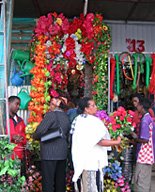
Women play a prominent role in informal trade, and in informal business activities in particular. These few figures are proof enough: four to five million women in West Africa are involved in collecting, processing and marketing shea nuts and butter, bringing in an estimated 80 per cent of their income (Plunked and Stryker, 2002). In Benin, women are 80 per cent of those involved in informal trade, and the figure rises to 95 per cent for informal marketing of unprocessed goods.
Madam Tinubu’s fame has no doubt been surpassed by the rich merchant women of contemporary Togo, known as the “Nana-Benz.” While these women have followed varying routes to success, they share several characteristics. Then, as now, these women conduct their businesses on the regional, and even international, stage, drawing on a long history of trading experience as informal actors. This results in their economic success, rather than initiating it. The volume of trade that passes through their hands enables them to regularly increase their economic and social capital (Humarau, 1999) even if their absence from or minimal institutional representation in formal political decision-making tends to minimize the crucial role that they could play in the development of intra-African trade. The factors that bring them together also separate them from most of the small-scale West African traders operating daily, who barely succeed in breaking even with their investments. All these groups constitute the major trading agents of both the formal and informal sectors.
via The Prepaid Economy Blog

  • Digg
  • Del.icio.us
  • StumbleUpon
  • Reddit
  • RSS

Art from Nairobi's 'Shadow Cities'

Craig Halliday writing in Think Africa:
Nairobi’s slums run on a functioning informal economy and have their own bars, restaurants, pharmacies, cinemas and street traders like any other neighbourhood. At the centre of these communities is a vibrant creativity and a visually evident wealth of artistic talent. This can be found in the huge mural in the Mathare slum created by graffiti artist Bankslave (Kevin Esendi), or in the performing arts programmes run by Sarakasi trust and the studio photography sessions held by Peter Olendo
Image courtesy of Think Africa
..."Ghetto" Art from KiberaWith an increase of wasani (artists) operating within Nairobi’s slums, many have come together to form collectives and establish art centres. One such group is Kibera’s "Maasai Mbili", whose name in Swahili means “the two Maasai”. The Maasai Mbili Art Centre was started in 2001 by Otieno Gomba and Otieno Kota, neither of whom are actually Maasai. The name refers to a time when the two artists would dress as Maasai to attract customers to their sign-writing business. Saving their earnings, these two artists rented a small two-storey building in Kibera and created a new art space, which became the "Maasia Mbili Art Centre". The studio attracted many other artists from Kibera who came to learn from one another. Today around ten artists use the studio as a space for their painting and sculpting.
More here

  • Digg
  • Del.icio.us
  • StumbleUpon
  • Reddit
  • RSS

Africa Rising

The Economist on increasing productive growth across the continent:
The shops are stacked six feet high with goods, the streets outside are jammed with customers and salespeople are sweating profusely under the onslaught. But this is not a high street during the Christmas-shopping season in the rich world. It is the Onitsha market in southern Nigeria, every day of the year. Many call it the world’s biggest. Up to 3m people go there daily to buy rice and soap, computers and construction equipment. It is a hub for traders from the Gulf of Guinea, a region blighted by corruption, piracy, poverty and disease but also home to millions of highly motivated entrepreneurs and increasingly prosperous consumers.
Over the past decade six of the world’s ten fastest-growing countries were African. In eight of the past ten years, Africa has grown faster than East Asia, including Japan. Even allowing for the knock-on effect of the northern hemisphere’s slowdown, the IMF expects Africa to grow by 6% this year and nearly 6% in 2012, about the same as Asia...[continue reading]

  • Digg
  • Del.icio.us
  • StumbleUpon
  • Reddit
  • RSS

Nigeria and Austrian Lace

The Style House Files on an interesting fashion and trade relationship:
Frank Osodi
The beginnings of Austrian lace exports to Nigeria can be traced all the way back to the 1960′s. Trade has been documented even prior to these dates through intermediaries, but it was during this time that the first Austrian lace pioneers sought personal contact with textile traders along Kosoko Street on Lagos Island.Withstanding political and historical ups and downs throughout the decades (such as the oil boom in the 70′s, the nationalization and various import bans on textiles in 1976 as well as 2005, the last one of which was lifted in 2010), the relationship has now grown to be much more than just trade. Nigerian traders soon started counter-visits to Austria, resulting in mutually trusting relationships, some of which have been continuing for over 40 years.
More here

  • Digg
  • Del.icio.us
  • StumbleUpon
  • Reddit
  • RSS

Quick Hits

  • Digg
  • Del.icio.us
  • StumbleUpon
  • Reddit
  • RSS

More on Clustering - From Tailors to Mini Manufacturers

A paper by John E. Akotena and Keijiro Otsuka on Kenyan Garment clusters shows:

...that the well educated and highly socially networked tailors who are capable of producing a certain product quality standard are likely to link up with traders to become mini-manufacturers over time. This suggests that transactions with traders enable mini-manufacturers to outperform tailors, thereby contributing to the transformation of the mode of industrial production in developing economies.
Photo courtesy of Donkey Crossing
Reblog this post [with Zemanta]

  • Digg
  • Del.icio.us
  • StumbleUpon
  • Reddit
  • RSS

Understanding Clusters

Steve Daniels writing in the Postconsumption:

All throughout the developing world one can find geospatial clusters of informal enterprises that have grown either through an organic capital accumulation process or a government allocation of land. In Kenya, a number of such clusters exist: Gikomba, Kamukunji, Kariobangi, Ziwani, Kibuye, and Quarry Road to name just a few. These clusters start out as grouping of either producers or traders and will likely end up as a mix of manufacturing and market activities. Clustering is what allows informal microenterprises to produce efficiently--they rely on a well-developed ecosystem of producers, suppliers, machinists, and traders to provide services, each with minimal operating costs. Linkages among enterprises can be horizontal (labor pooling, sharing machines, etc.) or vertical (relationships with suppliers and traders, associations, etc.).
More here
Reblog this post [with Zemanta]

  • Digg
  • Del.icio.us
  • StumbleUpon
  • Reddit
  • RSS

Militant Capitalists? The Mourides

In 2007 Nick Tattersall of Reuters reported on the endlessly adaptive Mourides:

Many traders are members of the Mouride brotherhood, a branch of African Sufi Islam which has become Senegal's most influential religious, political and economic force.A unique mix of militant capitalism and moderate Islam, its central doctrine of hard work as a means to paradise has led thousands to leave Senegal's sunny shores with one goal -- to earn money and send it back to the holy city of Touba.
More here
Photo courtesy of Reuters

  • Digg
  • Del.icio.us
  • StumbleUpon
  • Reddit
  • RSS

Microfinance or Enterprises?

Niranjan Rajadhyaksha asks at Livemint "What is the solution to poverty?":

Many have asked why Bangladesh continues to be mired in terrible poverty when it has such a large microfinance sector. The good ol’ basics matter more — property rights, open markets, human capital, innovation etc.
A new policy research paper, Who Gets Credit?, published by the World Bank shows that economies benefit more when money is lent to firms rather than households. India is one of the 45 countries the economists have covered in their study.
Quoting Milford Bateman
The East Asian countries managed to develop brilliantly through channelling much, if not most, of their savings into serious growth-oriented sustainable business projects. This is why many East Asian countries may have started at similar GDP levels as Bangladesh in the 1970s but have since massively outpaced Bangladesh in terms of growth and development. Economics 101 shows conclusively how critical savings are to development, but only if intermediated into growth and productivity enhancing projects. If it goes into rickshaws, kisoks, chicken farms, traders and so on, then the country simply will not develop and sustainably reduce poverty...[continue reading]
via World is Green

  • Digg
  • Del.icio.us
  • StumbleUpon
  • Reddit
  • RSS

Recognizing the "Cash Madam's"

Communcating for Change founded by Sandra Mbanefo Obiago produced Cash Madam a documentary about:

The formidable women traders who run million dollar business in the bustling street markets of Nigeria’s capital Lagos – and drive Mercedes Benz limousines – are affectionately known as Cash Madam or Mama Benz. But now they want official government recognition for the substantial contribution they make to Nigeria’s national wealth.

See related video about the "Economic Roles of African Women" here

photo courtesy of made in Africa
Reblog this post [with Zemanta]

  • Digg
  • Del.icio.us
  • StumbleUpon
  • Reddit
  • RSS

Quick Hits

Ethan discusses the piracy problem.
The BBC finally "gets it" they report on Aid addiction, its been a long time coming.
Despite its history South Africa continues to get into bed with vile regimes.
Mmegi reports on an initiative to bring small traders into the picture.

  • Digg
  • Del.icio.us
  • StumbleUpon
  • Reddit
  • RSS

Informal Jobs

Pilirani Semu-Banda writes about the critical role of informal jobs:

Economic analyst Mavuto Bamusi speaks highly of the effective role informal cross-border traders are playing in the Malawian economy. He says this type of trade offers economic opportunities to women and youth in the country who would otherwise not be employed. ‘‘The concern is that they usually face all kinds of social and economic injustices, such as harassment by public authorities, especially the tax department. They undergo unnecessary checks which are unregulated and they are forced to pay exorbitant taxes,’’

<

  • Digg
  • Del.icio.us
  • StumbleUpon
  • Reddit
  • RSS

Food Aid Distortions: Malawi

Alex Renton reports on the damaging effects of US food aid to Malawi.He quotes Charles Rethman who stated:

It's very short-sighted - it doesn't make any sense. It's going to short-circuit the effort to improve nutrition here, it undermines farmers, households. It's not sustainable and it won't bring about any long-term change to malnutrition rates,'

It has been shown that this type of assitance
can and does often do more harm than good. The very promise of free food can cause disaster-hit populations to leave their homes and move to refugee camps. They may become dependent on it, making it harder for them to take up their lives again when the disaster or danger has passed. Farmers leave their fields, prices fall and local traders lose their businesses. Clearly, while food aid saves lives in a disaster, it can hamper the return to normality.
It has done more insidious damage, as detailed by some aid agencies. Food aid can permanently damage the economies of nations it was sent to help. Vast tonnages of rice donated by the USA and Japan to Indonesia after the country's economic collapse in 1997 caused damage to farmers and distributors that has never been repaired: having been one of the world's largest producers, Indonesia is now a net importer of rice.

via African Agriculture

  • Digg
  • Del.icio.us
  • StumbleUpon
  • Reddit
  • RSS

Boosting Regional Trade and the Informal Sector

Gumisai Mutume writes:

African countries are grappling to undo a legacy dominated by trade with their former colonial rulers rather than with each other. Senegal's biggest trading partner is France, while Gambia trades extensively with the UK. Although Senegal surrounds Gambia, trade between the two neighbours is minimal...A major critique of current regional integration efforts in Africa is that their design and objectives are driven by a preference for formal rather than informal trade. Ms. Mkhonza (Former assistant secretary-general,ACP ) views the sector as an effective means of integration from below, as small-scale trade is often conducted and driven by the needs of indigenous traders rather than governments or international agencies."There is a real economic integration going on at the informal level," concurs the non-governmental InterAfrica Group (IAG). For many years it has been recognized that many countries' real economies "have been mostly informal and much larger, more dynamic and more regionally integrated than their official economies."

  • Digg
  • Del.icio.us
  • StumbleUpon
  • Reddit
  • RSS

MHO's Nigeria

A study(PDF) of Mutual Health Organizations (MHO's) in Nigeria made a number of conclusions, they include interesting features such as the fact "...that they are organised through existing community organisations of all kinds – from local trade unions, to traders and professional associations, church groups including spiritual or charismatic church groups, Muslim groups and traditional birth attendants. Membership..." in some cases is "... gained not directly as an individual but through the local association which offers advantages in terms of social control and prevention of abuse or fraud as well as the chasing up of defaulters. It also means that control is exercised at the lowest possible level...Another feature that is worth noting is the savings nature of the schemes, rather than an insurance mechanism as such. The idea of saving for health is apparently better understood (as an extension of traditional saving concepts such as esusu or ojo), whereas insurance is less well understood, and moreover, requires different and rather scarce skills to manage properly. This particular adaptation not only saves on administrative costs , but also helps avoid fraud, an ever-present danger with insurance schemes everywhere and a big problem in Nigeria.

  • Digg
  • Del.icio.us
  • StumbleUpon
  • Reddit
  • RSS

Trade Capacity Building

John Magnay of Uganda Grain Traders Limited makes prescriptions for regional trade within Eastern Africa(read all of SSA) he suggests:

Regional trade that was predicated on a regional market with a modern futures system. This would address two significant problems: the fact that different markets have different timings associated with them and the challenge of effective coordination in the use of regional storage facilities. To achieve this objective, Mr. Magnay believed that two things were necessary: (a) political will on the part of both local and donor governments, and (b) some form of artificial price mechanism. The presence of these two prerequisites will help ensure that proper market signals reach producers. In one case, buyers from a neighboring company showed up seeking 50 thousand tons of beans without prior notice, and the Grain Traders association had nothing to give them. The final element of this equation, according to Mr. Magnay is infrastructure. In his opinion, investment in this area should be driven by market signals and the private sector, not merely donor interest.

  • Digg
  • Del.icio.us
  • StumbleUpon
  • Reddit
  • RSS

Economic Challenges

Larry Elliott writes about the continents economic challenges:

"...At the level of the firm, productivity tends to be weak because of a lack of investment in both physical and human capital. In countries such as Ghana, there is evidence of micro-financing initiatives to provide seed-corn capital for individual traders, but it is still early days. At the second level, governments need to think strategically about what their priorities are. The drive for universal primary education is welcome but there has been no similar expansion of secondary, let alone tertiary, education. The regional challenge is pretty straightforward. Africa needs three or four powerhouses - one in each part of the continent - to drag the rest along. South Africa, Nigeria and Kenya are the potential hubs for regional markets in which countries can exploit economies of scale and the potential to trade. Trade barriers within Africa are as serious an impediment to development as are unfair global trade rules..."

  • Digg
  • Del.icio.us
  • StumbleUpon
  • Reddit
  • RSS

Enhancing Informal Markets

The Nigerian Marketing Network and a number of UK universities arrived at a number of conclusions on how to enhance formal and informal market institutions in the continent
They are:
* Promote associations of traders and producers where they can support poor people’s access to markets, such as trader associations.
* Identify the appropriate role of the public sector in providing better market places: for example, state and local governments should stop subsidising market stalls since this does not help poor people.
* Expand access to market information on prices and standards: for example, donors and non-governmental organisations (NGOs) should fund access to telephones for poor people and provide information about trusted suppliers.
* NGOs and schools should offer market-based education on measures and quality standards.
* State and local government should make decisions about market and transport intermediaries based on locally specific evidence. This should identify both the benefits of intermediaries and specific occasions where intermediaries exert excessive control over market places.
* When reorganising urban markets, local governments must take particular care not to disturb the employment niches occupied by the poorest people (such as petty retailers and porters)

photo courtesy of marco werman

  • Digg
  • Del.icio.us
  • StumbleUpon
  • Reddit
  • RSS

Can Southern firms break into export markets?

An Id21 paper stated that "...Southern firms can still break into export markets. Developing-country firms do export to markets with exacting standards for product quality, reliability of delivery, and consumer safety. Two crucial aspects of trade promotion for developing countries, however, are often overlooked:
* Non-manufacturing sectors, such as tourism and horticulture, generate significant employment and offer opportunities for supplying increasingly sophisticated products. Although manufacturing is considered more attractive, certain areas of tourism and horticulture can be equally appealing.
* New export opportunities are created as southern producers establish closer links with foreign customers. Producers of labour-intensive products such as garments, horticulture and footwear frequently depend on large retailers and specialist international traders for designs, information about demand and technical support..."

  • Digg
  • Del.icio.us
  • StumbleUpon
  • Reddit
  • RSS

Africa's Women: Dora Akunyili

Dora Akunyili Director of Nigeria's NAFDAC "...has defied death threats and assasination attempts while tackling corrupt practices in the manufacturing, import and export of drugs, cosmetics and food products. Since taking up her position in April 2001, Dr Akunyili has earned nationwide respect for her persistence in prosecuting illegal drug traders and in imposing strict standards on multinational companies. In particular, she has pursued manufacturers and importers of counterfeit drugs, deemed to be a leading cause of deaths by stroke and heart failure in Nigeria...",Transparency.

  • Digg
  • Del.icio.us
  • StumbleUpon
  • Reddit
  • RSS