
Koinonia founded Benjamin Ogunyo is getting Kenya’s street children back into their homes by empowering their families to become economically independent, socially responsible, and emotionally accessible for their estranged children. By alleviating the severe pressures impoverished families face, he is helping build healthier communities capable of taking responsibility for solving problems together and overcoming poverty, crime, disease and hopelessness-Ashoka
Watch interview with Benjamin:
via Mootbox
Menampilkan postingan yang diurutkan menurut relevansi untuk kueri Ashoka. Urutkan menurut tanggal Tampilkan semua postingan
Menampilkan postingan yang diurutkan menurut relevansi untuk kueri Ashoka. Urutkan menurut tanggal Tampilkan semua postingan
Koinonia


Read User's Comments(0)

Empowering Farmers
Ashoka Fellows Vincent Bagiire and Adrian Mukhebi, changing the field of agriculture:
Karagwe Agricultural Information Journal-Joseph Sekiku
 "...By educating small farmers about production chains and larger markets for their produce, Joseph Sekiku gives them new opportunities to increase their profits and improve their livelihoods. He also equips them with the tools to take advantage of these opportunities, teaching them the basic entrepreneurial skills to turn surplus into quality products. These include use of new technologies such as fruit driers and processors that lengthen the shelf life of perishable farm products, enabling farmers to sell products when the market is good. Finally, Joseph opens access to new markets by linking farmers to Tanzanian and international markets through a partnership with Adrian Mukhebi’s Kenyan Agricultural Commodities Exchange...",Ashoka.
Formalising the Informal Economy
Ashoka Fellow "...Moussa Kane has begun to organize Mali's informal economy into a formal association that compiles data on the informal sector and provides basic services to impoverished entrepreneurs. The association provides startup equipment and in-kind loans to entrepreneurs and offers business and financial training to help small ventures succeed. His organization is the first company of its kind in Mali to be owned by its due-paying members, and it is financed and run entirely by members of the informal sector. Its services will be accessible to the approximately 40 percent of Mali's population involved in the informal sector...Although it provides basic sustenance to many, the informal sector is disorganized and risky. Members of the informal economy, like the street vendors that crowd Bamako's avenues, do not have access to loans, are harassed by the government for their occupation of unregistered public space, and are vulnerable to complete collapse in the event of an illness or accident. Furthermore, most "informal entrepreneurs" do not understand the essentials of bookkeeping, business management, and resource allocation, and are therefore unable to turn a consistent profit..."
Conservation through Public Health
 Founder of Conservation through Public Health the award-winning Gladys Kalema-Zikusoka contends that:
Well-kept wildlife sanctuaries can provide an income for the community...“Most Africans think that wildlife is dangerous, harmful and detrimental to the development of the country. Some people think that wildlife should be eaten, and the national parks are just a waste [and] that pastures should be used [only] to graze cattle.”
,VOA.
photo courtesy of Ashoka
Teacher Training
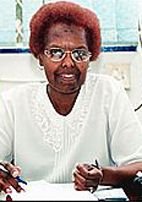 Ashoka Fellow Cynthia Mpati "...has used her expertise in correspondence teaching to develop a program which is not only able to reach large numbers of teachers in isolated areas but also make up for correspondence teaching's greatest shortcoming: the isolation of the trainee...student-teachers learn how to study by correspondence and concentrate in improving English fluency and understanding of the Western thinking/learning process, often foreign to them. They also choose a mentor teacher, a volunteer coach, on the basis of his/her outstanding teaching skills. The mentor-teacher becomes a concrete link to the system when the student-teachers return to rural areas..."
Education Pyramids

School is seen as an escape route from the village; a magic elevator that will lift your child from the patch of subsistence land and transport him or her to the city to work in an office and send money back to the family. It is a terrible illusion. Visit a typical village school and you will find rows of old-fashioned desks crammed with anxious young people chanting answers learned by heart. The curriculum that is being crammed belongs to Britain in 1960...The education system in most African countries is a steepening pyramid pointed at Oxbridge and creating failure and despair at every level. Each year millions tumble off it, without qualifications or useful knowledge. They are failures who have wasted the family's resources, but they cannot go back to digging the land, because they have "learned book." Despite the obvious need for profound curriculum reform, African civil servants and politicians have little interest, since they themselves reached the peak of the pyramid. But what about the rejects?
An answer comes in the form of Ashoka Fellow Mwalimu Musheshe founder of Uganda Rural Development and Training Programme (URDT)whose school:
teaches you how to make life better here in this area when you leave school." The next thing he tells parents is that they too must come to school and learn alongside their children. And it is not just literacy that the school teaches. There is a solar power centre and, if families can afford a car battery, they can charge it up for 60p, which will give them a light in their house for a month. In a country with 12-hour nights, that is a lot of studying time. The schoolchildren learn to grow their own food and use new farming methods. They look after the school herd of cows, using the cowshit in a biogas maker for cooking.
via Prospect Magazine
Njawara Agricultural Training Centre (NATC)
Badara Jobe,Ashoka Fellow and founder of Njawara Agricultural Training Centre
...has developed an approach that cultivates and strengthens farmers’ abilities to produce successful crop yields despite climate changes.His core insight is that fluctuations in an already short rainy season introduce a new and complicating set of variables for farmers. Even a missed day of rain or slight decreases in rainfall intensity over a few days can jeopardize certain crops in ways that were not previously understood. What is needed is not simply agricultural diversification, but hedging strategies that involve cultivation in precisely calibrated but small areas for a range of different crops tied to particular seed varieties


Wouol-A hybrid value chain
Ashoka Fellow Antoine Sombié is the founder of Wouol:
...the first regional-scale, commercial hybrid value chain that joins European businesses with small local women’s vegetable and fruit producers from across West Africa. Antoine’s program has enabled women’s associations in Burkina Faso to be active producers of organically certified products for the first time. European certification secures a stable market with higher prices, and women’s participation and training brings the economic benefits to a greater portion of society, alleviating education and health. More than three thousand people—90% female—are part of the Association’s production, health insurance schemes, social and cultural activities.

Technology is a Culture and a Mindset
Bright Simmons writing in Ashoka Tech:
Continuing he asserts that:Africa has been consigned to the passive consumption of technology rather than the latter’s utilisation for transformation in view of this “charitisation” of tech transfer. Such a pattern of appropriation is inert, and, by so being, also an added drag on a continent buffeted by retrogressive currents. Technology is disseminated in the same design that other commodities are distributed, thereby entrenching patterns of underdevelopment. In the past 50 years, matters have steadily become worse.

Technology is not merely a catalogue of tools. It is a culture and a mindset. It is an approach to getting ahead, taking over, making do, reaching out, and thinking through. A worldview animated by technology is a counterpoint to one decorated by mythology. No one argues that mythology can’t be beautiful. Mythology requires as much creative and persuasive power to get right as technology since it also requires social buy-in. But where we are interested in poverty-busting development, I bet you, dear readers, that in any prudent society technology must come up tops.More here
Bola Fajemirokun--Improving the Judiciary
 Founder of DIN Bola Fajemirokun's "...approach to improving the Nigerian judiciary system has three primary thrusts: ongoing research and monitoring of the system currently in use; introduction of an effective electronic records center; and consultation with lawyers, judges, and others to bring them up to speed on using and expanding the resource database she has created...",Ashoka.
Langganan:
Postingan (Atom)