RSS
Menampilkan postingan yang diurutkan menurut relevansi untuk kueri Botswana. Urutkan menurut tanggal Tampilkan semua postingan

The perils of relying largely on Diamonds-Botswana

Map of BotswanaImage via Wikipedia

Despite its status as the best governed SSA economy Botswana's reliance on a singular source of income-Diamonds-is proving to be an achilles heel.The FT reports:
Even for Botswana, for long the model of how a poor country can use its minerals to build a path from poverty, there is no escape from the the financial crisis.
“There is no doubt we are facing a huge challenge,” said Ian Khama, Botswana’s president in his first wide-ranging interview with a foreign newspaper since taking office in April. “The main reason is because we have been very dependent on revenues from minerals, especially diamonds, ever since they were found in the seventies.”
Diamonds bring in four of every five of Botswana’s foreign exchange dollars and generate about a third of annual gross domestic product. But the US, which accounts for up to half of diamond demand, is in recession. Debswana, the joint venture between De Beers and Botswana that normally supplies almost a quarter of the world’s rough diamonds , sold no stones in November and few in the months since...[continue reading]


In other words the importance of an industrial value-added economy cannot be under emphasized enough.Botswana wannabees take note.

Reblog this post [with Zemanta]

  • Digg
  • Del.icio.us
  • StumbleUpon
  • Reddit
  • RSS

Strengthening African Leadership

Africa has long been saddled with poor,even malevolent, leadership: predatory kleptocrats, military-installed autocrats,economic illiterates, and puffed-up posturers. By far the most egregious examples come from Nigeria, the Democratic Republic of the Congo, and Zimbabwe—countries that have been run into the ground despite their abundant natural resources. But these cases are by no means unrepresentative: by some measures, 90 percent of sub-Saharan African nations have experienced despotic rule in the last three decades. Such leaders use power as an end in itself, rather than for the public good; they are indifferent to the progress of their citizens (although anxious to receive their adulation); they are unswayed by reason and employ poisonous social or racial ideologies; and they are hypocrites, always shifting blame for their countries’ distress. Under the stewardship of these leaders,infrastructure in many African countries has fallen into disrepair, currencies have depreciated, and real prices have inflated dramatically, while job availability,health care, education standards, and life expectancy have declined. Ordinary life has become beleaguered: general security has deteriorated, crime and corruption have increased, much-needed public funds have flowed into hidden bank accounts, and offcially sanctioned ethnic discrimination—sometimes resulting in civil war—has become prevalent. This depressing picture is brought into even sharper relief by the few but striking examples of effective African leadership in recent decades. These leaders stand out because of their strength of character, their adherence to the principles of participatory democracy, and their ability to overcome deep-rooted challenges. The government of Mozambique, for example, brought about economic growth rates of more than ten percent between 1996 and 2003, following the economic catastrophe wrought by that country’s civil war (which ended in 1992). And in Kenya, President Mwai Kibaki has strengthened civil society, invested in education, and removed barriers to economic entrepreneurship instated during the repressive rule of Daniel arap Moi.The best example of good leadership in Africa is Botswana. Long before diamonds were discovered there, this former desert protectorate, which was neglected by the British under colonialism, demonstrated a knack for participatory democracy, integrity, tolerance, entrepreneurship, and the rule of law. The country has remained democratic in spirit as well as form continuously since its independence in 1966—an unmatched record in Africa. It has also defended human rights, encouraged civil liberties, and actively promoted its citizens’ social and economic development.
GOOD APPLES
What has enabled Botswana to succeed where so many other African nations have failed? Some observers point to the relative linguistic homogeneity of the country. But Somalia, which remains unstable despite a similar uniformity, shows that this factor is far from sufficient.Others point to the century-old teachings of the congregational London Missionary Society—the peaceful, pragmatic outlook that is inextricably bound up in the country’s political culture. But this explanation also fails to explain why the same positive effects have not been witnessed in other countries with a history of Christian teaching, such as in neighboring Zambia. Nor are Botswana’s plentiful diamond reserves responsible:Angola, Gabon, and Nigeria all have abundant natural resources, but none has seen comparable returns for its people.It is Botswana’s history of visionary leadership, especially in the years following independence, that best explains its success. Sir Seretse Khama, Botswana’s founding president, came from a family of Bamangwato chiefs well regarded for their benevolence and integrity.
When Khama founded the Botswana Democratic Party in 1961 and led his country to independence, he was already dedicated to the principles of deliberative democracy and market economy that would allow his young country to flourish. Modest, unostentatious as a leader, and a genuine believer in popular rule, Khama forged a participatory and law-respecting political culture that has endured under his successors, Sir Ketumile Masire and Festus Mogae. Although operating in very differerent circumstances, Mauritius’ first leader,Sir Seewoosagur Ramgoolam, held to the same leadership codes as Khama.Ramgoolam gave Mauritius a robust democratic beginning, which has been sustained by a series of wise successors from different backgrounds and parties.Both Khama and Ramgoolam could have emulated many of their contemporaries by establishing strong, single-man, kleptocratic regimes. But they refused to do so.Effective leadership has proved the decisive factor in South Africa, too: without Nelson Mandela’s inclusive and visionary leadership, his adherence to the rule of law, his insistence on broadening the delivery of essential services, and his emphasis on moving from a commandeconomy toward a market-driven one, South Africa would probably have emerged from apartheid as a far more fractured and autocratic state than it did.Too few African leaders have followed the examples of Mandela, Khama, and foreign affairs . Ramgoolam. Ghana, Lesotho, Mali, and Senegal are all showing promise. But in many other African countries,leaders have begun their presidential careers as democrats only to end up, a term or two later, as corrupt autocrats: Bakili Muluzi of Malawi, Moi of Kenya,and, most dramatically of all, Robert Mugabe of Zimbabwe. Other leaders, such as Sam Nujoma of Namibia and Yoweri Museveni of Uganda, may be heading in the same direction.
A BOLD INITIATIVE
To build on the positive leadership examples, a select group of prominent past and present African leaders who met over the last year decided to confront the continent’s pathology of poor leadership with deeds as well as words. At the conclusion of a series of private meetings(the final one of which was held in Mombasa, Kenya), they established the African Leadership Council, promulgated a Code of African Leadership with 23 commandments, issued a Mombasa Declaration promoting better leadership,and proposed a series of courses to train their political successors in the art of good government.Members of the council believe that absolute standards of leadership are both appropriate and attainable. Good leaders deliver security of the state and of the person, the rule of law, good education and health services, and a framework conducive to economic growth. They ensure effective arteries of commerce and enshrine personal and human freedoms. They empower civil society and protect the environmental commons. Crucially, good leaders also provide their citizens with a sense of belonging to a national enterprise. Conscious that Africa’s poor are getting poorer and that good governance is essential for successful economic development, the council sees itself at
the vanguard of fundamental reform in the continent. Its approach certainly goes far beyond the New Partnership for Africa’s Development (nepad) and proposals for the African Union. The Code of African Leadership, for example, says in its first commandment that leaders should “offer a coherent vision of individual growth and national advancement with justice and dignity for all,” implying that most leaders today do not. Other commandments demand that African leaders encourage “broad participation,” adhere to the letter and spirit of their national constitutions (especially term limits), encourage dissent and disagreement, respect human rights and civil liberties, strengthen the rule of law, promote policies that eradicate poverty and improve the wellbeing of their citizens, ensure a strong code of ethics, refuse to use their offices
for personal gain, oppose corruption, and bolster essential personal freedoms. This uncommonly bold agenda seeks to avoid renewed patrimonial leadership debacles, such as those presided over by Mobutu Sese Seko in Zaire, Moi in Kenya, Idi Amin in Uganda, and Jean-Bedel Bokassa in the Central African Republic. The council is highly conscious,too, of the hijacking of Zimbabwe’s government by Mugabe, which has resulted in starvation and drastically reduced living standards.The council is chaired by former President Sir Ketumile Masire of Botswana and includes former Nigerian head of state General Yakubu Gowon,Vice President Moody Awori of Kenya, former Prime Minister Hage Geingob of Namibia, and a dozen other present and former prime ministers and cabinet ministers from Sierra Leone to Kenya, Malawi, and Uganda. All are regarded throughout Africa as men of unusual personal probity and esteem and as accomplished proponents of good governance. The council intends to recruit additional members from the ranks of Africa’s outstanding democratic leaders, Francophone and Anglophone, female and male. Together they will serve the continent by advising international organizations, individual countries, and donor agencies on how to improve leadership. The group stands ready to assist civil societies in countries undergoing serious leadership crises. It will also urge greedy national leaders to attack corrupt practices and adhere to term limits (the current presidents of Gabon, Malawi, Namibia,Uganda, and Zambia, for example, have all had pangs of desire for illegal third terms). Next year(2005), it expects to begin holding special seminars for cabinet ministers and others. The council’s curriculum emphasizes constitutionalism, the rule of law, ethics, accountability,diversity, good fiscal management, coalition building, and the fundamentals of modern micro- and macroeconomics. Training courses will soon be launched.Whether the efforts of the African Leadership Council will reduce bloodshed,diminish corruption, and encourage more prosperity for citizens across Africa is by no means certain. But as a unique African response to the continent’s immense needs, this innovative endeavor is a promising, dramatic step forward.

By
Robert I. Rotberg

Reprinted with permission
Copyrighted 2004 Council on Foreign relations Inc. All Rights Reserved

  • Digg
  • Del.icio.us
  • StumbleUpon
  • Reddit
  • RSS

The New Colonialists

Bill Moyers of Wide Angle interviewed George Ayittey for his reaction to 'Border Jumpers' A documentary that asks the question? "...How does prosperous Botswana secure its borders and accommodate the influx of tens of thousands fleeing hunger, unemployment, and political repression in neighboring Zimbabwe..." On Zimbabwe his response was "... it is a repeat of the same African script where we moved out the white colonialists. And then we have black new colonialists. And country after country, they run their countries down an economic slump. Ghana, Tanzania, Zimbabwe, Zambia. All these countries are following the same script. And that is what is very disappointing about Zimbabwe..." Pointing to the success of Botswana he says "...The reason why Botswana has done very well is because it's the only black African country which went back to its roots and built upon its own indigenous institutions...Back to its roots in the sense that if you go to an African village and there's a chief and there is, let's say, a political crisis for example, the chief will call a village meeting. Put the issue before the people. It's called a kgotla. Now put the issue before the people. The people will debate until they come to a consensus. In Botswana, cabinet ministers are required to attend weekly kgotla meetings..."

  • Digg
  • Del.icio.us
  • StumbleUpon
  • Reddit
  • RSS

Dangers of Commodity Dependency-Trouble in Botswana

Why didnt they diversify? Or did they? The Economist reports:
Botswana is facing change. Its diamond bonanza, which accounts for nearly half the government’s revenue and over a third of its GDP, will not last much longer. Production has peaked and deposits may be exhausted by 2030. Growth has been slowing from an average annual rate of 13% in the first five years after independence to 5% in 2000-05 and 3% since then, including a 5% contraction in 2009-10. Last year it bounced back to 7% and is expected to remain at about that level for the next two years. But the government may not be able to keep spending at its present level of 40% of GDP.
For the first time since independence, the budget is in deficit. The World Bank has urged the government to slash its bloated public workforce by a quarter. But Mr Khama is resisting. With an official jobless rate of 17% (and a real one probably closer to 30%), he says he is loth to turf more people out of jobs. But neither, he insists, can Botswana go on living beyond its means.
More here

  • Digg
  • Del.icio.us
  • StumbleUpon
  • Reddit
  • RSS

'Wrust'-Rockers from Botswana

Africa's music scene continues to evolve. Watch Botswana's, Wrust.

Read related Vice piece on Botswana's Metalheads
courtesy of Vice

  • Digg
  • Del.icio.us
  • StumbleUpon
  • Reddit
  • RSS

"Getting the Politics Right"

2006 World Map of the Rule of Law Index, which...Image via WikipediaDuncan Green writes in the New Statesman:

The secret of Botswana's success lies in politics. The country's elite come from a single dominant ethnic group (the Batswana) whose governance systems, emphasising broad consultation and consensus-building, emerged largely unscathed from colonialism. Botswana's leading human rights activist calls it "gentle authoritarianism". The government broke every rule in the so-called Washington consensus, setting up state-owned companies, nationalising mineral rights and steering the economy via six-year national development plans. "We are a free-market economy that does everything by planning," one local academic told me, laughing.

In the second half of the 20th century, dozens of developing countries emulated Botswana's success and achieved similar growth rates. "Getting the politics right" was key for them all. These countries have built effective states that guarantee the rule of law, ensure a healthy and educated population, control their national territories and create a positive environment for investment, growth and trade. For many, the growth spurt began with the redistribution of land and other assets...[continue reading]
Zemanta Pixie

  • Digg
  • Del.icio.us
  • StumbleUpon
  • Reddit
  • RSS

Hottest Investment Destination

Finance Asia reports:

The overall African economy is expected to grow at 6.2% in 2007, compared with 5.5% in 2006. Countries such as Ghana, Botswana, Uganda, Zambia, Mozambique, Namibia and Nigeria are showing gross domestic product growth rates that are three- to four-times faster than those of the developed economies in the Euro zone. The Ghana Stock Exchange is one of the world’s best performing stock markets, while Botswana boasts one of the highest per capita government savings rates in the world

  • Digg
  • Del.icio.us
  • StumbleUpon
  • Reddit
  • RSS

Adding Value - Botswanan Diamonds

The Economist reports:

Until recently Botswana, a country of 1.8m people that produces 27% of the world's diamonds by value, exported only rough stones. The government, which is struggling to diversify its economy and create jobs, wants to get more out of its main commodity. Cutting adds about 40% to the value of rough stones. But the idea, explains Akolang Tombale, the permanent secretary of the ministry of minerals and energy, is to create an international diamond centre that not only cuts and polishes, but also trades diamonds and provides security, technology and financial services. The government hopes this will spill over into other sectors and help diversify the economy. For now, the diamond industry should create over 3,000 jobs by the end of next year.
Update: Botswana launches Diamond Trading Company

photo courtesy of Economist

  • Digg
  • Del.icio.us
  • StumbleUpon
  • Reddit
  • RSS

Frontier Markets contd.

The Economist writes about emerging markets being the flavor to the moment,are they?:

Back in 2002, emerging-market bonds offered a yield a full ten percentage points higher than American Treasury bonds. This year, although spreads have widened from the historic lows seen in May, they have settled at a modest two percentage points or so.
The performance of the equity markets has also been impressive. The MSCI emerging markets index has risen by nearly 40% so far this year, a remarkable achievement given the credit crunch and geopolitical worries. Although China's stockmarket has more than doubled, this is not all about the People's Republic; the Polish, Indian, Brazilian and Pakistani markets are all up by more than 40%.
Indeed, investor focus is now shifting towards what Michael Hartnett of Merrill Lynch dubs “the emerging emerging markets”, such as Botswana and Kazakhstan. MSCI is in the process of launching a benchmark for such exotica called the “frontier market” index.

  • Digg
  • Del.icio.us
  • StumbleUpon
  • Reddit
  • RSS

Aid 'is not solution' for Africa

Richard Dowden a Director of the Royal African Society writes "...As the momentum for Live 8 gathers pace and the pressure on international leaders to deal with Africa's problems mounts, Richard Dowden argues that aid is not the answer.Many argue that aid creates a situation of dependency When a tsunami hits or war creates refugees, the victims can do with some help to get back on their feet wherever they are.Humanitarian relief aid will always be needed when disaster strikes.But the evidence that aid can transform whole societies and lift millions out of poverty is unconvincing.It can only speed up a process that is already happening.When we see scenes of destitution from Africa we assume that we can change things by sending money.But if aid could make Africa prosperous, it would have done so by now.Despite nearly a trillion dollars of aid since independence in the 1960s, much of Africa is worse off now than it was then.Much of that aid was spent by outsiders without consultation with Africans and with little understanding of Africa's ways or needs.Today the continent is full of abandoned projects: wells in the wrong place, factories without a fuel supply, roads that were not maintained.Impoverished by politics But UK Prime Minister Tony Blair and Chancellor of the Exchequer Gordon Brown are proposing to double aid to Africa, promising a Marshall Aid plan, like the help America gave Europe at the end of the Second World War.The comparison is false.In 1945 there was peace in Europe and armies of disciplined and skilled workers stood ready to rebuild. All that was needed was the cash.Africa has rich resources but has been impoverished by bad politics - including our own policies.Africa's nation states that crammed old societies into artificially created countries have not produced effective governments.
It is impossible to deliver education and better health to Africans without working through those governments.The African countries that are well run, South Africa and Botswana for example, do not need aid.At the other end of the spectrum are countries like Somalia and Democratic Republic of Congo which have collapsed as nation states and do not have any effective administration. It is impossible to use development aid there.Those in the middle that are not doing too badly, like Mozambique, Tanzania and Uganda, are already receiving around 50% of their budgets from aid.That makes them more dependent on Western aid donors than they were in colonial times.Aid creates and sustains unequal relationships. Talk of partnerships is false.As one western diplomat in Africa put it to me recently: "We like it when they take ownership of the programme but we mean our programme. We don't like it if they start having their own ideas."No shortcut the aid business is an industry with its own dynamic.Much of it is spent in the donor countries in the form of consultancies and goods.For the recipient it creates dependency, undermines self-reliance and ultimately breeds resentment.There is no short cut to development. Only Africans themselves can bring change to Africa.States have to raise taxes and spend them productively in order for their countries to develop.Aid creates and sustains unequal relationships When state institutions are functioning in support of the people and the economy, there may be a case for helping with specific short term assistance but unless and until the local systems are in place and there is real commitment, aid will be wasted.At present lack of capacity and corruption prevent even basic services being delivered in most of Africa.Outsiders can run one-off projects like immunisation programmes but development has to be done by the people themselves.
Better alternatives Giving aid feels good but there are better ways to help Africa.We must pursue policies that create a fairer system of trade. Current policies and practices in Europe and America damage Africa's chance of earning its living in the world.We must end agricultural subsidies that distort prices allowing cheap food to be dumped in Africa and ruining farmers there. We must lower tariffs and trade barriers to allow Africa to trade more processed goods.We must stop encouraging Africa's brain drain, luring the best educated and talented out of the continent to fill jobs in the West.The British government could also do something about arms flowing into Africa.Weapons that kill in Africa's wars may not be made in Britain but arms dealers base their operations in London and are largely unregulated.
And London has become the laundry of choice for money laundering because Britain applies one of the weakest banking scrutiny systems in the world.We need to start treating money stolen by corruption in the same way as drug money or terrorism funds..."

  • Digg
  • Del.icio.us
  • StumbleUpon
  • Reddit
  • RSS

Indigenous African Institutions-George Ayittey

Brill's overview of George Ayittey's Indigenous African Institutions-2nd edition:

Since the publication of the first edition of Indigenous African Institutions in 1992, Africa has undergone a substantial change. Still, much mythology and misconception enshroud Africa and its people. An enduring myth claims that pre-colonial Africa had no viable institutions. This book is an attempt to provide a better, modern understanding of Africa and its people – not for cultural rehabilitation or romanticism but for practical reasons.
Traditional or indigenous Africa has not vanished; it is still the home of the real people of Africa – the peasant majority, who produce Africa’s real wealth using ancient institutions and practices. Kings, chiefs, and village markets still exist in Africa.
The object of development is to improve the lot of the peasants – not the pockets of Africa’s ruling elites – and it starts from the “bottom up” – not from the “top-down.” What is there at the bottom are the peasants, their institutions, practices, and economic ways of life. Africa cannot be developed by ignoring its traditional sector, nor can this sector be developed without understanding how it works. Africa’s salvation, then, lies in returning to its roots and building upon its own indigenous institutions. This ethos is captured by such phrases as “sankofa” by the Asante, “majimbo” in Swahili, and the mantra, “African Renaissance,” touted by President Thabo Mbeki of South Africa.
Botswana is the only African country that built upon its own indigenous institutions and prospered. Moreover, it was the same indigenous institutions African peasants utilized to engineer what historians call, “The Golden Age of Peasant Prosperity, 1880-1950.” In recent times, pro-democracy activists revived and modernized an indigenous African institution (the village meeting) into a “sovereign national conference” and used it as a vehicle to craft a new political dispensation for Benin, Cape Verde Islands, South Africa and Zambia – in the same way as the United Nations used a loya jirga, an ancient tribal democratic institution, to chart a new political order for Afghanistan in 2002. Similarly, the same indigenous African institutions can also be used to craft uniquely “African solutions to African problems.” Thus, the blueprint for Africa’s economic rejuvenation can be found in its on backyard; that is, its own indigenous institutions. Tragically, African leaders, elites and their Western development partners have seldom looked there.

  • Digg
  • Del.icio.us
  • StumbleUpon
  • Reddit
  • RSS

African bull markets

PSD Blog reports on the WSJ's coverage of Africa's Bull markets:

The continent's so-called frontier markets, such as Nigeria, Kenya, Ghana, Mauritius and Botswana, are up an average of 26% so far this year in dollar terms, according to Liquid Africa. By comparison, the MSCI Emerging Market Index, which includes just three African countries -- South Africa, Egypt and Morocco -- has risen 9.5% during the same period.

If you haven't heard this story, it's because the numbers are still small. The London Stock Exchange is five times as big as all African stock markets combined. And South Africa's exchange is 2/3 of the African total.

  • Digg
  • Del.icio.us
  • StumbleUpon
  • Reddit
  • RSS

Quick Hits

  • Digg
  • Del.icio.us
  • StumbleUpon
  • Reddit
  • RSS

Why Ethiopia is not the voice of Africa

M G Zimeta writes in Prospect that Ethiopia:

...gets a disproportionately large slice of Africa's aid, but the Ethiopian regime does not act in the best interests of its citizens or its neighbours. So why has the G20 made the country a spokesman for the entire continent?
He contends that the G20's
...refusal to think long term, or to recognise the diversity of Africa, they are doing the continent great disservice. Instead of indulging in tokenism, they could be drawing more on success stories like Ghana, Botswana, Senegal, Namibia and Tanzania—and we could all be learning more from what actually works.
As for Ethiopia’s citizens, whose iconic suffering seems to be what has earned their prime minister the right to be the “voice of Africa”—their suffering continues.
More here
Enhanced by Zemanta

  • Digg
  • Del.icio.us
  • StumbleUpon
  • Reddit
  • RSS

Manufacturing and Diversification

Gumisai Mutume writes about the need to renew emphasis on manufacturing:
"...Building -- or rebuilding -- African industry is a major challenge. Across the developing world, countries that have successfully shifted from producing raw materials into manufacturing have done so in stages. They started by moving into the processing of primary commodities, a process known as vertical diversification. Some African countries, for instance, are now exporting leather instead of just hides, textiles in place of cotton, or paper, plywood or furniture instead of logs. Côte d'Ivoire, now a major fish- and wood- processing country, has managed to do this. So has Senegal, which also shifted from simply selling raw fish into processing and packaging its produce."Our entrepreneurs," says Botswana's President Festus Mogae, "should look for technology from partners to enable them to process their products and sell value-added goods abroad."..."

  • Digg
  • Del.icio.us
  • StumbleUpon
  • Reddit
  • RSS

Badilisha Poetry Radio

"...Badilisha Poetry Radio uniquely focuses on podcasts by poets from the African continent and its Diaspora. This online platform creates a dynamic space in which to appreciate, celebrate and discover contemporary Pan-African poetry. The weekly podcasts feature a vast spectrum of voices across poetic genres..."-site Watch overview video after the jump
via Global Voices & Thoughts from Botswana

  • Digg
  • Del.icio.us
  • StumbleUpon
  • Reddit
  • RSS

Aid doesnt Work

Fredrik Erixon writes "...Countries are not poor because they lack roads, schools or health clinics. They lack these things because they are poor – and they are poor because they lack the institutions of the free society, which create the underlying conditions for economic development. Aid has it upside down... Botswana chose to empower its people with inclusive economic institutions instead of pursuing socialism like many of its African counterparts. As a result, it has experienced the world’s highest rates of economic growth in the past 30 years, and its people are far better off – with per capita incomes of around $8000 per year, compared with less than $1000 in many African countries..."
Via Global Growth

  • Digg
  • Del.icio.us
  • StumbleUpon
  • Reddit
  • RSS

Grassroots Governance?

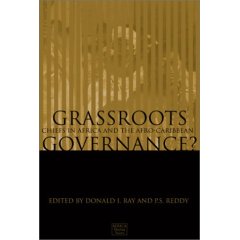
Abraham Arthur reviews Grassroots Governance? Chiefs in Africa and the Afro-Caribbean "...the popularity of the institution among chiefly subjects is axiomatic, and this makes it a legitimate force to be used in promoting local development.However, the case studies show that this reality has yet to be fully appreciated since no proper, legal accommodations have been worked out. In at least three countries (Ghana, Botswana, and South Africa), Houses of Chiefs exist which can advise governments on any issue, but they do not constitute part of the legislature. For the most part, the chiefs continue to fill in for the government at the grassroots where it is thin on the ground....Traditional authorities are culturally so deeply rooted that they still remain influential with their peoples. Consequently, they are a legitimate agency for development at the local level. It is therefore imperative to design policies that integrate them into democratic government at this level. These roles are not necessarily incompatible and need not be seen as contradictory...Grassroots Governance? makes a bold and laudable attempt to push the agenda for chiefly agency in modern local governance and development, a position fully justified by the logic of the situation..."

  • Digg
  • Del.icio.us
  • StumbleUpon
  • Reddit
  • RSS

Dragging the SADC down-Zimbabwe

Rejoice Ngwenya writes in African Liberty:

By the time you finish reading this piece, one hundred illegal immigrants will have crossed the border into South Africa and Botswana, two of their colleagues will have been murdered in xenophobic Alexandra, ten men will have been infected with HIV, one Movement for Democratic Change [MDC] activist will have been beaten up, maimed or killed in Uzumba Marambapfungwe, one child will have died of malnutrition in Matebeleland, ten people will have lost their jobs in Harare and ultimately, the Reserve Bank of Zimbabwe [RBZ] will have pumped one billion worth of valueless bearer cheques into the system.

  • Digg
  • Del.icio.us
  • StumbleUpon
  • Reddit
  • RSS

Dissecting the Zambian Opposition Win

Ethan Zuckerman writes:
Africa is becoming a hotbed for democracy. Freedom House (whose methods I sometimes disagree with, but who offer a global view of political freedoms over a long period of time) identifies three “free” states in West Africa (Ghana, Benin and Mali), and three in southern Africa (South Africa, Botswana and Namibia) as well as three of the small island states. And more than twenty states meet Freedom House’s “partly free” criteria, including powerhouses like Kenya, Nigeria and Senegal. Zambia is listed as partly free, but this year’s successful election might lead to an upgrade. Nigeria, often dismissed as a basket case, had a pretty good election this year as well.
concluding:
There’s a danger that we miss a major story here: democracy is taking root in Africa and spreading rapidly. Nations like Zambia, which survived autocratic rule and then dominance by one party are now seeing democratic change. It’s important to cover African crises and tragedies, but not at the expense of the hopeful news of democratic success and change.
More here

Meanwhile Jimmy Kainja discusses how the Zambia result spotlights "a rare moment" in the history of African politics:
No one can say what future holds for Zambia under Michael Sata but Zambians can be assured that they have a man in power that majority of them voted for. Banda has shown that he is a true statesman. His loss is not only a victory for Sata, it is also a triumph and a rare moment for African politics and democracy. Let us hope this is not an isolated incident but a sign of maturing democracy...[continue reading]

  • Digg
  • Del.icio.us
  • StumbleUpon
  • Reddit
  • RSS