RSS
Menampilkan postingan yang diurutkan menurut relevansi untuk kueri Western Sahara. Urutkan menurut tanggal Tampilkan semua postingan

Western Sahara: The last colony in Africa

In Pambazuka:
In the following interview, Radhi S. Bachir talks about Western Sahara [mp3], which the delegation of Saharawis to the World Social Forum calls ‘the last colony of Africa.’ He says Western Sahara is the only territory on the continent that had not been truly decolonised and where people have not been able to exercise their right to self-determination.
Enhanced by Zemanta

  • Digg
  • Del.icio.us
  • StumbleUpon
  • Reddit
  • RSS

A United States of Africa - AU chasing a mirage

Franklin Cudjoe wrote in Critical Opinion:

Positions at the AU are divided between the so-called “gradualists,” who believe that individual countries should first build working economies and integrate them through regional blocs, and the “radicals,” who believe a supra-national authority would somehow allow Africa to compete internationally. Neither side, however, is talking about the real issue: economics. Right now, Africans cannot compete locally or regionally, let alone internationally: we need economic freedom for Africans to raise themselves out of poverty, unshackled from State serfdom. The life-changing power of trade has been demonstrated historically and not just in the West. At the height of their glory, many pre-colonial African states and empires found trade to be a better way to prosperity than through conquests. Gold was shipped from Wangara in the Upper Niger across the Sahara desert to Taghaza, in Western Sahara, in exchange for salt, and to Egypt for ceramics, silks and other Asian and European goods. The old Ghana empire controlled much of the trans-Sahara trade in copper and ivory. At Great Zimbabwe gold was traded for Chinese pottery and glass. From Nigeria, leather and iron goods were traded throughout West Africa.
Today, Africa has lost that trade and many conspiracy theories abound for its backwardness. But the blame game ignores the devil within: the internal and regional barriers that hobble trade, making tariffs within Africa far higher than any tariff barriers by outside blocs . There are even politicians, bureaucrats and many aid activists who argue that these tariffs make essential contributions to government revenue--meaning government offices are more valuable than citizens or the economy.

  • Digg
  • Del.icio.us
  • StumbleUpon
  • Reddit
  • RSS

Aziza Brahim-Activist and Singer

A Freedom to Create profile:
Image courtesy of Freedom to Create
Aziza Brahim was in exile even before she was born. In 1976, her heavily pregnant mother fled to a refugee camp in Tindouf when Morocco annexed the land where she lived. Azizas family comes from El Aaiun, the capital of the former Spanish colony of Western Sahara. Aziza never met her father, who stayed behind in the occupied city.At the age of 11, she received a scholarship to study in Cuba but left school when she turned 18 to pursue a musical career. Aziza has never forgotten her roots and she returned to the camps, not as a 19-year-old musical ingnue, but as a voice for the Saharawis, a people fighting for independence.
Aziza embodies the new voice of the Saharawis. Her songs evoke exile, the right to freedom and human rights. She dedicates all her songs to her peoples struggle. Her song titles are evocative: Peace, Son of the Clouds, The Battle of Guelta, Memory of the Tank, and Return, a tribute to the Saharawis pursuit of self-determination and independence. She has been nominated for an album of her songs, Mi Canto.

  • Digg
  • Del.icio.us
  • StumbleUpon
  • Reddit
  • RSS

Gulf invests in Sub-Sahara

The Ft reports:

Gulf-based private and public equity fund managers have this year shifted some of their vast wealth from Asia and the Middle East/North Africa region to the world’s poorest region: sub-Saharan Africa. These portfolio flows to a half-dozen countries have been accompanied by direct investment in property and other sectors...The Gulf push into the sub-Sahara reinforces pioneer efforts, notably by Saudi Arabia’s Prince Alwaleed bin Talal whose Kingdom Holdings created a $125m joint venture in 2004 with New York-based Zephyr Investment for African private equity. Its best-known success was a $20m stake in the pan-regional mobile provider Celtel, which was later acquired at a hefty premium by Kuwait owners. The prince has joined HSBC in a separate dedicated vehicle.
As petrodollars head towards these locations, western wealth advisers who have shunned them may re-examine their assumptions and consider participation a viable emerging market option.

  • Digg
  • Del.icio.us
  • StumbleUpon
  • Reddit
  • RSS

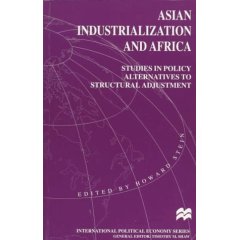
Asian Industrialization and Africa

Reviewed by Saha Santosh, Asian Industrialization and Africa is a collection of essays that offer a "directional" approach to achieving industrial growth within the continent. E. Wayne Nafziger's case study states the following:
"...Japan learned a lesson in the 1870's that many contemporary African countries have still not learned or only learned recently:that importing replicas of Western institutions and capital intensive technology may exacerbate unemployment and balance of payments problems if the local country lacks the capital and skills needed...Meiji Japan imitated,borrowed from, and modified techniques and approaches from advanced Western economies. Aquestion today is: Can Sub-Saharan Africa be as successful emulating,borrowing, and adapting innovations and procedures from the West and Japan?If anything, the contemporary Sub-Sahara has to be even more cautious than Meiji Japan in importing foreign capital and technology. Since present-day Sub-Saharan countries are even more technologically backward relative to the most technologically advanced economies than Japan was relative to the West in the late nineteenth century,it is probably more difficult to adapt technology to local conditions and indigenous production.For example some foreign productivity-raising textile technologies available to early developing Japan were labor-using while most technologies for today's latecoming Sub-Saharan African countries are labor-saving..."

  • Digg
  • Del.icio.us
  • StumbleUpon
  • Reddit
  • RSS

Investigative Journalism: Elendu Reports


Jonathan Elendu's Elendu Reports and Sowore Omoleye's Sahara Reporters are a pointer to the promise of bottom-up methods. More familiar but maverick instruments like Al-Jazeera have been positively disruptive to the social-political fabric of the Middle East and beyond,however their establishment and operational costs have been prohibitive and a barrier to scrappy potential new entrants. Elendu Reports demonstrates the potential of diligent no holds barred investigative reporting for the continent of Africa enabled by the tools of web 1.0 and 2.0 . Recent reports of corrupt goverment officials with the accompanying images of their ill-gotten luxury properties in Western cities is threshold breaking,the denials and obfuscations of the past by the officials is now indefensible the brigandage seemingly more brazen . The effect of this is undeniable, it brings the third dimension of texture to accusations of corruption, in the flesh so to speak, the world can now see what happens to the revenue and resources of some of the most impoverished countries in the world, while the leaders don the caps of debt-relief and aid. This medium yet to include podcasting (sound) and vodcasting (video),are the developing worlds alternatives to '60 Minutes' etc. The erosion of the digital divide and its interactive enabling nature could have an accelerated cleansing effect on the hitherto incorrigibles that rule the roost, accountability and transparency sought so long in Africa's leadership might now be within its grasp.

  • Digg
  • Del.icio.us
  • StumbleUpon
  • Reddit
  • RSS

International Thief Thief-British banks

Nothing surprising here,Western banks and the usual shady deposits:

British high street banks have accepted millions of pounds in deposits from corrupt Nigerian politicians, raising serious questions about their commitment to tackling financial crime, warned Global Witness. By taking money from corrupt Nigerian governors between 1999 and 2005, Barclays, NatWest, RBS, HSBC and UBS helped to fuel corruption and entrench poverty in Nigeria.
More here
via Sahara Reporters
Enhanced by Zemanta

  • Digg
  • Del.icio.us
  • StumbleUpon
  • Reddit
  • RSS

Development of an Iron-and Steel-based Metallurgical industry

Writing about The development of an Iron-and Steel-based metallurgical industry over 30 years ago Percy R. Luney stated:

The high-grade, low-cost mineral deposits presently necessary for the production of iron and steel are being exploited and sold to the industrialized countries of the world. The statement that mineral resource supplies are inexhaustible must be questioned in terms of ultimate benefit to be derived from the production of high-cost, low-grade mineral deposits. While the underdeveloped countries of the world are exporting more and receiving less in terms of quantities of mineral materials, stockpiles of recyclable mineral materials are being accumulated in the industrialized world at a rate which exceeds the loss of mineral materials through product export. The total picture must be critically re-evaluated in light of population stabilization in the industrialized nations and population growth in the industrializing African nations. The exportation of mineral resources should become secondary in importance to supplying the mineral raw material needs of an iron- and steel-based metallurgical industry in sub-Sahara Africa.
Its hard to believe that not much has changed in the intervening decades apart from the actors being largely Asian now rather than Western, time has literally stood still.

  • Digg
  • Del.icio.us
  • StumbleUpon
  • Reddit
  • RSS