RSS
Menampilkan postingan yang diurutkan menurut relevansi untuk kueri critique. Urutkan menurut tanggal Tampilkan semua postingan

Codevilla Gets to the Heart of Understanding Obama?

This is my second post on Codevilla, and I am going to have to make it a point to read more of what he writes because it is becoming clear that The Mackinac Center recently said, Angelo M. Codevilla might be our era's Thomas Paine. Like Paine, Codevilla's works make a lot of things that people intuitively know and feel now clear and boldly stated in plain English. His articles are body-blows to the lies of the world- they give voice and focus to the reality of the situation. He names the unnamed.

His earlier article was about America's Ruling Class, a powerful theme that went a long way towards explaining what is happening in our nation. My post on it was Recommended Read: Codevilla's 'America's Ruling Class', and in it I could do no more than point readers toward his brilliant essay America's Ruling Class -- And the Perils of Revolution that was recently in the American Spectator. If you haven't read it yet, please do so at some point.

Today, via Belmont Club, I came across another of Codevilla's essay's, and it also blew my socks off. Angelo de Codevilla recently reviewed the six accounts of Barack Obama’s life for the Claremont Review of Books, and he ends up with the conclusion that Obama was always something other than what he portrayed himself to be. What that is, in Codevilla’s summary, is this:

In sum, Barack Obama grew intertwined with the narrow, self-referential left side of the American Left. They helped one another believe they had come up the hard way, as underprivileged but brilliant, square-jawed tribunes of the common man. Their common problem, however, is that their agendas are antagonistic to people unlike themselves, and that they cannot keep from showing their contempt for the common folk in whose name they would ride to power.

Since the days of Karl Marx’s First International a century and a half ago, this very human opposition between socialist theory (egalitarianism) and socialist reality (oligarchic oppression) has bedeviled the Left. Marx laid the problem bare in his “Critique of the Gotha Program” (1875). Lenin dealt with it honestly and brutally in What Is to Be Done? (1902)—the foundational document of Communism. By acknowledging that the Communist Party is not the common people’s representative, but rather its “vanguard,” Leninists were comfortable with a party responsible only to itself and to history, a party that openly demanded deference from the humans whose habits it forcibly reshaped. Communism’s undeniable horrors forced the New Left to disassociate itself from What Is to Be Done? and once again to pretend that its socialism was neither oligarchic nor coercive, that somehow it was on the side of ordinary folks. This is a much tougher sell in the 21st century than it was in the 19th. Contemporary socialists try to explain away the common man’s suspicion of them as harbingers of oligarchy, corruption, and coercion by resorting to jargon (e.g., “false consciousness” and “socio-economic anxiety”). But that is ever less convincing. This is why the movement argues so strenuously with itself about whether and how much it should dissimulate its agenda.

Which is one reason why it plays the “race card” and seizes on recruits like Barack Obama: because many black Americans’ ancestors were slaves, must not any black American be, ipso facto, unquestionably, a member and true representative of the downtrodden? And if a skeptic should argue that this or that black man is really a representative of old, white, nasty socialism, of the Corporate State, of upscale parasites who prey on working people, it is easy enough to re-focus the argument on the skeptic’s “racism.” If blacks inclined to play this role did not exist, the Socialist movement would have every incentive to invent them. And in a sense it tries to invent them, through the “black studies” programs that now divert so many young Americans from useful lives into partisan service.

Obama is as close as one could imagine to a made-to-order front man for contemporary, upscale, shy-about-itself, nouveau socialism. From his earliest age, he shaped his dreams about himself to act out a character wholly fictitious, namely a black American from a humble background who rose up out of brilliance and merit, and who yearns to draw all of America’s low-born (plus the rest of mankind) up through the same paths. But he is none of that. Equally imaginary is his vaunted understanding of and sympathy for foreign cultures. A typical multiculturalist, Obama speaks no language other than a peculiar version of English. His native language, loves, and hates are common to some of the most leftist elements of the current American ruling class.

That class knows about America only that it must be changed, and looks at the vast majority of Americans the way carpenters look at warped pieces of lumber. Barack Obama is neither more nor less than its product and agent.
Angelo Codevilla is the author of The Ruling Class: How They Corrupted America and What We Can Do About It and The Character of Nations: How Politics Makes and Breaks Prosperity, Family, and Civility.

  • Digg
  • Del.icio.us
  • StumbleUpon
  • Reddit
  • RSS

Will Africa miss all MDGs? Does it really matter?

The PSD Blog reports on a Bill Easterly paper (pdf) that questions those who set the MDG goals in the first place,he concludes that.

It seems undesirable to exaggerate the “Africa as failure” image, which in turn exaggerates the role of “the West as Savior” for Africa (as the MDG campaign has often played out in practice). It is demoralizing to have goals for Africa that only be attained with progress that is nearly without historical precedent from other regions or in Africa itself. Africa has enough problems without international organizations and campaigners downplaying African progress when it happens.
This echo's an earlier critique by Bunker Roy.The question becomes, Do they really matter?

  • Digg
  • Del.icio.us
  • StumbleUpon
  • Reddit
  • RSS

Buala “Giving Voice”

Global Voices speaks with the founders of Buala which is described as:
“An interdisciplinary web portal for reflection, critique and documenting contemporary Portuguese-speaking African cultures” is how Buala is introduced. In an interview with Global Voices, Buala’s creators Marta Lança and Francisca Bagulho discuss the grounds and justification for a space that grapples with culture, history, politics, the arts in general and the city – the space par excellence of “constant change,” the living stage for playing out contemporary culture..."
They perceive it as platform and:
a “place for long, in-depth articles that focus on serious, complex works that do not dispense with irony and with the urban cultures of African youth in the Diaspora that has much to say, with people who study Africa without historic blind folly and fantasy, who wish to contribute to reflections on (and with) the continent.”
More here

  • Digg
  • Del.icio.us
  • StumbleUpon
  • Reddit
  • RSS

Daily Education and Technology News for Schools 01/11/2012

  • At the Askwith Forum on December 1, Professor Howard Gardner discussed the challenges faced by traditional education in light of two forces: the post-modern critique from the humanities and the disruptive potentials of the new digital media. As addressed in his most recent book, Truth, Beauty, and Goodness Reframed: Educating for the Virtues of the Twenty-First Century, Gardner described how the core ideas of truth, beauty, and goodness can survive and even be strengthened in education across the life span.

    tags: news education insight

  • There are so many great podcasts out there. I like to hear directly from the companies I work with. Julie's and my first book is from Pearson and this podcast is of interest to me.

    "Susan Sclafani, vice president of programs for the Pearson Foundation shares insight into the new digital curriculum being developed to adopt the common core standards."

    tags: education podcast news

  • American School has named their top education books of 2011. Not sure how it set up this list but there are a few I want to read.

    tags: education news books ebook

  • A report was released on January 10, 2012 about democratic engagement on US college campuses. You can read this and their recommendations on the Association of American Colleges and Universities website. Of course, social media tools, when used well, can facilitate many of these goals.

    "The Task Force calls on educators and public leaders to advance a 21st century vision of college learning for all students—a vision with civic learning and democratic engagement an expected part of every student’s college education. The report documents the nation’s anemic civic health and includes recommendations for action that address campus culture, general education, and civic inquiry as part of major and career fields as well as hands-on civic problem solving across differences."

    tags: education news

  • This website for parents gives you app reviews and also reports on what your child is learning in one integrated interface. The concept here is beautiful. No matter what app your child is using, if they use the Smartots platform, you can see what they're learning. I will be testing this, but the concept is an important one. We need accountability for our apps not just our teachers, otherwise, they are a black box with "educational" slapped on them. We have to play them and how many of us are going to spend hours doing that? 

    tags: education news

  • Today is "free day" on sparkfun. If you join, you can possibly get free electronics, circuit boards, etc. on January 11.

    tags: news education free

  • This young lady is "in to modeling" has her yearbook photos rejected. She's pursuing "self expression" but is she rally seeking the publicity. Her parent says it is "artistic" and "stunning." This is an interesting discussion about what is appropriate. She's going to put it in as an ad in the back. This is interesting as the "censors" are fellow students who say it is not appropriate. We deal with this sort of thing on senior comments but haven't had problems with photos yet. This is an interesting conversation piece.

    tags: education news

Posted from Diigo. The rest of my favorite links are here.

  • Digg
  • Del.icio.us
  • StumbleUpon
  • Reddit
  • RSS

Marginalization of our Heroes

Respect begins at home. It bothers me how often that we allow the attitude of our society that worships youth to effect our opinions of the heroes among us.

Sprinters are great. They run really quickly for a very short amount of time. But there is something about the Iron Man. And when you have a person like my friend Scott Rigsby (the first double amputee to run the iron man and a fellow alumnus of Westwood Schools) then, you've got a hero.


Who are Teacher Heroes?
I am writing this to teachers. We have these heroes among us.

I think heroes are all teachers who behave nobly, but especially those who have been teaching for more than 20 years.

Heroes who work hard to bring new techniques into the classroom, who manage their classes with an iron hand and warm heart. They are here. People like Maria Knee, kindergarten teacher.

The Faces in the Faculty Lounge
It is so great to welcome new faces to teach among us. We need them.We need their ingenuity, their energy, their creativity.

But let's not forget the faces that have always been there. The heroes.

  • Why do people have to die for all of their students to get together and reminisce about their greatness?
  • Why do they have to have some major medical incident for us to think twice about their service?
  • Why do we wait to say thank you?

Teachers, I am calling upon you to teach with your life.

Yes, the recent Los Angeles incident where librarians were interrogated in the basement makes me angry. (Librarians are teachers too, if you don't think so, you don't know good librarians.)

Recently, when I offered a critique of Kevin Mitnick's new book, someone tweeted to Kevin,

"That's alright, everyone has heard of Kevin Mitnick. No one has heard of Vicki A. Davis."

Yes, they are right. Because for everyone to hear about Vicki A. Davis, I'd have to cheat on a test, sleep with a student, or shoot somebody. Face it, the teachers who become famous are usually (not always) those who do horrible things. It is a lot easier to do one awful thing than to do 100 great things every day for 80 years.

Respect for Teachers Starts with Teachers
This is our profession, friends. It is time we take it back by giving each other the respect we deserve. Let's start with the heroes among us.

When I was in Evansville, Indiana and asked how many of the teachers had been teaching for more than 20 years, I was astounded. At least 1/4 of the room raised their hands.

Do you know why these people are such heroes? They are living through some of the most dramatic pedagogical changes in the classroom in the history of classrooms. They are also living through times that require us to reexamine our spending. Stress is an understatement. While all their friends are retiring, they are still teaching.
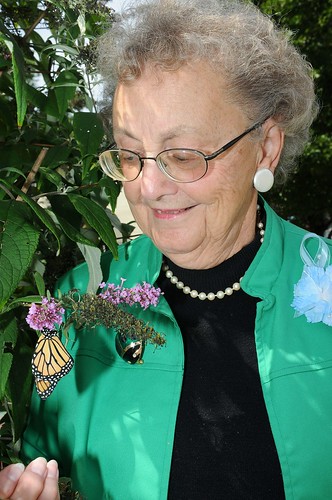
Elizabeth Walling Former  Keyport Teacher
Mrs Walling Now Retired After 40 years as a Teacher. Releases A Monarch Butterfly At The 100th Anniversary Of The East Keyport School , Now The Site Of The Keyport Senior Center. Photo from harmonica pete


6 Ways to Recognize Our Heroes
Here are 5 ways I am asking you to recognize the heroes among us. Add yours in the comments:
  1. Recognize the senior AND the new. When principals recognize the new teachers, they should also recognize those who have been teaching for more than 20 years. Recognize longevity not just newness.

  2. Create a wall of honor. - What about having the photos of teachers on your wall who have served your school for a certain amount of time. Have an assembly to recognize them. From now on, when they hit that amount of time, have a special time to recognize what they are doing. Do it again at 30 years, 35, etc. Take time to remind everyone of the importance of dedication. You could also do this wall on your website.

  3. Say thank you. Thank teachers who have been there a long time. Tell them how you feel about them as a fellow teacher.

  4. Help them. Good teachers aren't perfect teachers but they do learn new things. If you know that a senior teacher wants to try something new, take the time to help them. Encourage them by teaching them.

  5. Listen. I've learned some great things from my fellow teachers. I'm hitting my 10th year of teaching this year and still I feel like I have a lot to learn from the literature teacher who is in the room next to me (and also taught me how to write.)
  6. Thank your teachers who made a difference. Take time to thank those who helped you in your career and inspired you to be a teacher. Do they know? If they are no longer here, put flowers on their grave. Tell the world with your actions that teachers are noble and worthy of respect because we are!
Of course there are people who are "biding their time" or others think "should retire." Perhaps they are disheartened because they feel unneeded.

The greatest tragedy for aging teachers is the feeling that you no longer matter and that the sacrifices you've made were wasted. You may see a stalwart of the profession, but if you take time to talk to them, often they wonder if it was worth it. If they really did make a difference or if they imagined it.

Respect starts with us. We must all behave in noble ways. We must also treat each other with respect and this should start with the heroes among us.

I will never discount someone because of their age, in fact, anyone who can thrive and survive as a teacher for more than 20 years deserves a medal, a crown, and a million dollars. But that isn't happening, so let's give them what we can give them-- it is free -- let's generously give them our respect and gratitude.

Remember your noble calling, teachers.

Noble teachers never marginalize the heroes of the profession, we elevate them.
Enhanced by Zemanta

  • Digg
  • Del.icio.us
  • StumbleUpon
  • Reddit
  • RSS

Afropolitans

Taiye Tuakli-Wosornu writes about 'Afropolitans':

What distinguishes this lot and its like (in the West and at home) is a willingness to complicate Africa – namely, to engage with, critique, and celebrate the parts of Africa that mean most to them. Perhaps what most typifies the Afropolitan consciousness is the refusal to oversimplify; the effort to understand what is ailing in Africa alongside the desire to honor what is wonderful, unique. Rather than essentialising the geographical entity, we seek to comprehend the cultural complexity; to honor the intellectual and spiritual legacy; and to sustain our parents’ cultures...Ultimately, the Afropolitan must form an identity along at least three dimensions: national, racial, cultural – with subtle tensions in between. While our parents can claim one country as home, we must define our relationship to the places we live; how British or American we are (or act) is in part a matter of affect. Often unconsciously, and over time, we choose which bits of a national identity (from passport to pronunciation) we internalize as central to our personalities. So, too, the way we see our race – whether black or biracial or none of the above – is a question of politics, rather than pigment; not all of us claim to be black. Often this relates to the way we were raised, whether proximate to other brown people (e.g. black Americans) or removed. Finally, how we conceive of race will accord with where we locate ourselves in the history that produced ‘blackness’ and the political processes that continue to shape it.
also covered at The Afrobeat
Thanks Amini

  • Digg
  • Del.icio.us
  • StumbleUpon
  • Reddit
  • RSS

The Failure of Development Assistance

John Paul reviews Despite Good Intentions a critique of developmental assistance "...in the rush to scale up microfinance offerings, many newcomers to the field might actually be doing more harm than good. He points out a number of flaws with the current approach to microfinance, cautioning that there is little historical evidence for the developmental role of credit to the poor; that there has been little rigorous evaluation of the overall benefits of microfinance to a person’s quality of life; and that the poorest of the poor are by definition the ones who "need" credit the most, but can do the least with it..."
via NextBillion

  • Digg
  • Del.icio.us
  • StumbleUpon
  • Reddit
  • RSS

With Obama in office, Liberals learn to love war

Liberals often talk about being anti-war, about promoting peace and love and togetherness, but when it comes down to it, liberals love war and conflict and get us into more than even neo-conservatives do. I know what you're thinking- "Iraq!" (if you are a liberal, you brain is probably shouting that word in some sort of knowledgeable self-righteousness, as if you know anything about anything). In reply I yell back- "Vietnam! WWII! WWI!" Oh, but that's old news, right- remember under Clinton, everyone just held hands and sang love songs? Oh yeah- Serbia, Bosnia, Somalia, Iraq, Afghanistan- Clinton had us involved in more conflicts than even that 'war-monger' Bush did. So, when I read the following story about how liberals are no longer protesting wars now that Obama is in office, I was not surprised- the only reason (THE ONLY REASON) liberals were against the War in Iraq is because they play petty political games with America to increase their personal power.

The story appeared in The American Conservative (link to it here), and goes like this:

The antiwar rally at the University of Iowa was sparsely attended. The below 30 degree weather might have had something to do with it...The big truth is that the antiwar movement has largely collapsed in the face of Barack Obama’s victory: the massive antiwar marches that were a feature of the Bush years are a thing of the past. Those ostensibly antiwar organizations that did so much to agitate against the Iraq War have now fallen into line behind their commander in chief and are simply awaiting orders.

Take, for example, Moveon.org, the online activist group that ran antiwar ads during the election—but only against Republicans—in coalition with a group of labor unions and Americans Against Escalation in Iraq. These donors are no doubt wondering what Obama is doing escalating the war in Afghanistan and venturing into Pakistan.

As Greg Sargent noted over at WhoRunsGov.com, a Washington Post-sponsored site, “Don’t look now, but President Obama’s announcement today of an escalation in the American presence in Afghanistan is being met with mostly silence—and even some support—from the most influential liberal groups who opposed the Iraq War.”

In response to inquiries, Moveon.org refused to make any public statement about Obama’s rollout of the Af-Pak escalation, although someone described as “an official close to the group” is cited by WhoRunsGov as confirming that “MoveOn wouldn’t be saying anything in the near term.” A vague promise to poll their members was mentioned—“though it’s unclear when.” Don’t hold your breath.

The Center for American Progress, a liberal-Left think tank that sheltered many foreign-policy analysts who opposed the Iraq War and was beginning to develop a comprehensive critique of global interventionism, has recently issued a report on Afghanistan that includes a number of short-term, medium-term, and long-term (ten-year) goals, including among the latter: Assist in creating an Afghan state that is able to defend itself internally and externally, and that can provide for the basic needs of its own people. Prepare for the full military withdrawal from Afghanistan alongside continued diplomatic and economic measures to promote the sustainable security of Afghanistan.

Simply substitute Iraq for Afghanistan, and what we get is the war policy of the Bush era. That the center is run by John Podesta, who served as Obama’s transition chief, is perhaps explanation enough for the complete turnaround. One wonders, however, if the center’s more anti-interventionist scholars, such as Matthew Yglesias, whose popular blog has attracted a substantial audience, will be forced to toe the new line—or be forced out.

One also wonders when this administration will decide to let the American people in on the news that the Af-Pak war is slated to last at least a decade, if not more. During the campaign, and well before that, Joe Biden was self-righteously denouncing the Bush administration and its journalistic amen corner for not “leveling with the American people” and admitting the magnitude of our commitment in Iraq. Yet the administration of which he is now part is just as evasive on the question of an exit strategy and timeframe in Afghanistan and now Pakistan.

Biden’s counsel of restraint apparently lost out in the internal debate, and the Hillary-Gates escalators triumphed. It is inconceivable that the vice president would go public with his criticisms—he’s no Cheney. And opposition among the Democrats in Congress is low-key, minimal, and effectively marginalized.

A recent headline in The Hill tells the whole sad story: “Anti-war Democrats remain silent about Obama’s policies.”

President Obama is often compared to FDR or John F. Kennedy, but I agree with Katrina vanden Heuvel, editor of The Nation, who worries that he’s more likely to turn out to be another Lyndon Baines Johnson—a president who triumphed against a perceived warmonger at the polls and embodied liberal hopes on the domestic scene but was then driven from office by a war-weary electorate and an insurgency within his own party. Add a rapidly expiring economy at home to an increasingly unpopular war—or series of wars—abroad, and you have a recipe for disaster: Obama’s Vietnam and the Democratic Party’s Waterloo.

  • Digg
  • Del.icio.us
  • StumbleUpon
  • Reddit
  • RSS

Boosting Regional Trade and the Informal Sector

Gumisai Mutume writes:

African countries are grappling to undo a legacy dominated by trade with their former colonial rulers rather than with each other. Senegal's biggest trading partner is France, while Gambia trades extensively with the UK. Although Senegal surrounds Gambia, trade between the two neighbours is minimal...A major critique of current regional integration efforts in Africa is that their design and objectives are driven by a preference for formal rather than informal trade. Ms. Mkhonza (Former assistant secretary-general,ACP ) views the sector as an effective means of integration from below, as small-scale trade is often conducted and driven by the needs of indigenous traders rather than governments or international agencies."There is a real economic integration going on at the informal level," concurs the non-governmental InterAfrica Group (IAG). For many years it has been recognized that many countries' real economies "have been mostly informal and much larger, more dynamic and more regionally integrated than their official economies."

  • Digg
  • Del.icio.us
  • StumbleUpon
  • Reddit
  • RSS

Charitable ignorance: The reality of aid

Samantha Spooner writes in the Daily Nation:

The critics of the aid industry have focused heavily on aid accountability on both the part of the donors and the beneficiaries, and on concerns over whether aid breeds poverty and is therefore not conducive to long-term sustainable growth.
While these analyses are both valid and widely recognised there is another insight into the potential inefficiency of the aid business which sheds light on an anthropological, more localised critique: Sometimes aid attempts to solve problems which are either created or misunderstood...[continue reading]
Enhanced by Zemanta

  • Digg
  • Del.icio.us
  • StumbleUpon
  • Reddit
  • RSS

Podcasting in the Classroom

I thought I'd already talked about this, but apparently I was wrong. So...here we go! Let's learn about one of my favorite things to do in the classroom: podcasting.

Source


What are podcasts?

Podcasts are downloadable audio broadcasts. If you have iTunes on your computer, you've probably seen the "podcast" tab. Those podcasts can come with video, too, but my podcasts are audio-only.

Benefits to podcasting in the classroom
  1. Kids who are absent (for whatever reason) can still listen to your presentation in the comfort and convenience of their own home. 
  2. Kids who are slower readers or thinkers can not only listen to your lecture/whatever multiple times, but they can pause your speaking so they can comprehend. 
  3. Kids who left their book or notes at school can still get SOME information by listening to your podcasts, so they're not completely in the dark about an assignment or text. 
My history with podcasting in the classroom
I used podcasting quite regularly at my old school. A fellow teacher (she taught history) was using them, and I followed suite. She set me up with an account at mypodcast.com, gave me a set of headphones (like these) with a microphone attached, and I was rockin' and rollin' before she could say "go."

Unfortunately, I dropped the ball when I moved to my southwest OK school. First, mypodcast.com pretty much shut down. I mean, I think you can still access it, but it's no longer accepting new members, and it won't let its existing users post anything! So it's pretty much useless. In fact, I let my account expire because it was so useless to me. I was pretty discouraged by this, so I gave up on podcasting for awhile. I tried to get back into it around November, when we started reading our first classic novel of the year, Of Mice and Men. I was using a program on my Mac laptop called GarageBand to record podcasts (it specifically has an option labeled "podcasts"). I was able to record and post seamlessly using mypodcast.com the year before, so I figured I could do the same thing with a similar podcast-hosting website this year. ...No such luck. Turns out, GarageBand records in a funky format (.band, I think?), and very few podcast hosting websites can interpret that format. So no hosting site I was seeing (that was free) was working. I got so frustrated that I just burned my podcasts onto CDs and was done with it.

(By the way, burning your podcasts onto CDs is a good way to not only preserve your podcasts in case something happens to your files, but it's also a good way to allow students with no internet access to listen, as well. But I digress.)

The CD-thing wasn't nearly as helpful as the actual podcasting, though, so I kept looking for a way. I finally figured out how to convert the .band files to mp3s on my laptop...but it takes awhile. I started creating a different classroom website, using Wix, and that hosting site actually supports audio files! So I uploaded a few of my podcast-mp3 files to Wix's audio player and was super-excited! (To see the podcasting page of my Wix English website, click here.) My principal approached me about doing a presentation to my coworkers over technology in the classroom, and suddenly, I was fired up again about podcasting. There had to be another, easier way. I didn't want to go to the trouble of explaining all those steps to people who probably wanted the simplistic version. So I did some Googling. 

I know how to record on Macs, but I don't know how to record on PCs, since Mac computers come with a recording program. So I found this free program called Audacity that is compatible with both Mac and PC (rare!), AND it's free. Jackpot! My laptop memory is running low so I'm not privileged enough to be able to download anything right now...and downloads are blocked at my school computer, so I haven't tried Audacity for myself yet. However, this instruction blog over Audacity, complete with screenshots, makes it seem like a pretty easy program to use! So I'm excited for someone to download Audacity and let me know how it goes! Of course, you'll still need a microphone, but if your computer didn't come with one, you can purchase one quickly and easily at Walmart, Best Buy, Radio Shack, etc. You might even be able to ask your on-campus IT guy -- maybe there's an old one, lurking in a closet of the school somewhere! :) The external microphone I had looked like a headset with an attached microphone -- I felt like a pilot when I used it. :) You just plugged it into the computer, pressed the record button of the recording program, and began speaking. Simple as that.

Eventually, I'd like to get a battery pack that attaches to the back of my pants, and an omnidirectional microphone for my shirt, so that I could broadcast live during class. I think it would be so neat for students (or parents!) at home to be able to hear EXACTLY what is going on in my classroom...and since the microphone is omnidirectional, listeners could hear the students' questions and comments, too. That'd be great, because the Q&A section of a lecture or lesson is the most important part! I saw an advertisement for this portable recording system with multiple microphones. If it records in a .mp3 format, I'm totally buying this!

What to post on your podcast
  1. Lectures, notes, or project explanations
  2. Reading material
  3. "Radio shows"
  4. Book reviews
  5. Student projects/presentations
The "project explanations" thing is pretty self-explanatory, but for the lectures/notes, I upload the presentation to the class website. In the podcast, I instruct the student to first obtain a copy of such-and-such notes from the extra handouts folder in the classroom or the so-and-so page of the class website. Then I tell them to view the such-and-such presentation while they're listening to my podcast. If they're viewing a Prezi, I can tell the student exactly when to click the "next" arrow button, so that they're seeing on their screen EXACTLY what the other students in class were seeing, and hearing the exact same words to go with it. This is really helpful for those kids who are involved in everything and have to miss a lot of school, kids who are absent for another reason, kids who need extra help/reminders at home (because they forgot everything between class time and now), or kids who forgot their materials at home, but needed those notes to do an assignment. Oh, yeah, and it can help kids on an IEP, but we'll discuss that in the next paragraph.

The "reading material" category might sound a little ambiguous, so let me explain. As an English teacher, we read lots of short stories and novels. Some of these contain large vocabulary words and/or are very long in length. My slower readers have a hard time staying caught up with us AND understanding what's going on. Kids who are struggling readers oftentimes prefer to listen and learn that way. A friend I have is dyslexic. Even though he wasn't the best reader in school, he adapted by being an excellent listener. His memory is amazing when he gets to listen to things! Maybe you have students like this. Podcasts can help them. A friend of mine, who is a copyright guru at OSU, told me last year that I could only post about 15-20% of a text before it became plagiarism. Last year, I figured that 15-20% of the our current class novel was about 3 chapters. So I would post myself reading chapters 1-3, wait until we were completely done with those sections, take those chapters down, and then post chapters 4-6. You have to be careful, and it can be mildly time-consuming, but it's worth it to 1) make it available for your students and 2) set a good example by avoiding plagiarism! Of course, another alternative to avoiding plagiarism is to write to the publisher/author and request permission to post the entire thing for educational purposes. As long as you don't post the whole book and you're not selling the portion you've posted, you're in the clear, according to my friend. I just like to tread lightly around plagiarism issues, especially since I'm an English teacher!

As for items #3-5, those are some student-centered ways to use podcasting in the classroom. When I taught an applied communications class, my students and I talked about various mediums with which humans communicate. The radio naturally came up on our list. My students ended up creating their own radio show to communicate headlines in various topics (weather, news, etc.) while I recorded it via my laptop. But you could create a classroom radio show that "airs" on your class website once a week...or whatever works for you!

I love the idea of students doing book reviews via podcast. While I push, push, push reading in my classroom, I know that it is a dirty chore for most students. Reading is just not the "cool" thing to do, unfortunately, and many secondary students are not interested in it. So while I love the idea of using Shelfari, blogging, or some other web-writing tool in order to post book reviews, I know the majority of classmates are more likely to pay attention if they don't have to read the review. Therefore, doing book reviews as a podcast and allowing the students to listen to the recommendations might be a good idea.

As for projects and presentations, I'm sure you can think of more ideas, but what about using them in a speech class? Or for an oral report that must be given? You could record the student as he/she speaks. Then you could either post the recording online for others to hear, or you could even let the student listen to his/her speech and critique the presentation!

I've also heard of elementary classrooms allowing their students to create their own podcasts.  It's mostly the elem. student reading, and then being able to listen to him/herself and see where the mistakes are. I really wanted my communications students to make a podcast whenever we were studying media communication, and I'd assigned them the task of making their own radio show! So there are some interactive ways students can use podcasting, as well -- it doesn't just have to be the teacher's voice on the broadcast.

I think that's all the info I have about podcasting for now. When I get more, I'll update this post. Until then, happy podcasting!

::Edit:: I found an extensive list of ways to use podcasting in this 11 page PDF document. Check it out.

  • Digg
  • Del.icio.us
  • StumbleUpon
  • Reddit
  • RSS

Higher Order Thinking and Discipline: Two things Education needs NOW!

Seth Godin, author, change maker
Seth Godin is not God. I don't think he pretends to be but sometimes I think those that read his work don't realize who he is. He is a natural born gift writer / rebel who has made his own rules and had is own career. He is one of a kind. That is great. We need more Seth Godins.

In a recent post, Seth makes a great point that we are going Back to (the wrong) school and that we are educating kids for 1925.

Agreed. Totally.

I agree with this statement.

If you do a job where someone tells you exactly what to do, they will find someone cheaper than you to do it. And yet our schools are churning out kids who are stuck looking for jobs where the boss tells them exactly what to do.

But there is also some sort of insinuation I read into the post that the problem is having teachers/ educators in authority.

Let's make a line here that needs to be very clear:


We need to be promoting higher order thinking.

Memorizing is at the bottom. We aren't teaching problem solving. We're not teaching anything of lasting substance when we continue to see if kids can memorize. We just aren't.

Seth is on the money when he says that the testing environment has put us on the race to the bottom. I'm glad he's saying it.

Kids need to be problem solvers. They don't need to be told what to do at every moment. They need to know how to figure things out. This is exactly why I don't teach point and click software and handle it more holistically. We've already used more than 30 software programs to solve problems in my Computer Applications class as we customize the experience to the individual and the things we are trying to create.

We also need to have a respect for authority in place so we can have safe places to learn.

The one insinuation that I see in this discussion all over the place is the idea we should disregard authority. There is a big difference between questioning what a person in authority says and the fact that a person in authority has authority.

The lack of discipline in schools is one reason that many of my teacher friends are quitting. I know of one local school that talked to teachers about putting bullet proof glass in every classroom to protect the teachers. How about protecting the students? If teachers are afraid, how about the poor scrawny kid who won't go to the bathroom all day because he's afraid of bullying?

As a society, we don't trust people in authority. We don't trust organizations in authority. We've had a complete erosion of the belief in authority.
Never mistake a teacher in authority for a dictatorship.

Right now many of those in authority in education have led us down the wrong path as a country. So, it is understandable. But let's turn our eyes to the kids for a moment.

The danger of Selective Authority
Many parents have advocated a principle of "selective authority." Selective authority looks like this

"I'm going to learn from you because you can give me something" or
"I'm not going to learn from you because I don't like you." 

What results is punk football players who are very coachable but have no integrity and keep getting in trouble with the law. This problem is everywhere.

This type of philosophy means if a kid can convince Mom and Dad that "my Lit teacher doesn't like me" and the kid knows that suddenly anything I do to that lit teacher is excused and encouraged.

WRONG.

The "rights" of a few who don't deserve it

Rafe Esquith in his book,Teach Like Your Hair's on Fire: The Methods and Madness Inside Room 56,  talks about an incident where a group of fifth graders were interrupting their fifth grade graduation with profanity and trash talk. Rafe removed them from the proceedings and was promptly told by the principal that everyone "has a right to graduate" and that the could do nothing about it.

No! Those kids should get a diploma but they should not have the right to completely ruin the graduation for the other students.

Schools and principals who tolerate such misbehavior look impotent, incompetent, and totally backwards!

Do we encourage disrespect?
PROBLEM. The problem in many schools is that it is impossible to even teach lower order industrial age thinking because our society has so worshipped the young that we are encouraging a total disrespect for authority.


We all have bosses. We all have laws to follow. Lots of times we don't like the boss or the laws but we have to follow them anyway. We need to follow people we don't like sometimes so we can be successful in life. We can respect their authority even if we don't care for them as a person.

We can also be a renegade with cool ideas in the classroom and beyond if we have empowering teachers to bring that out of us. I can be empowering and still have my classroom management act together.


Show up and Keep your Promises
A young man at Walgreen's yesterday was talking to me. He was missing the first half of his family reunion because the manager could not get anyone to work for him. He was at work anyway. I was very impressed and told him so. He said,

'My Momma raised me right. I need to show up where they are counting on me and keep my promises."

Respect for authority does not mean subservience, slavery, or even the worst case, abuse. It means that we have guidelines. It means we treat each other with respect and have character.
Scott Filmer's Photography Journal

We need yellow lines.
We have guidelines like the yellow line in the middle of the road.

Thank goodness for the yellow line in the middle of the road. It is that guideline that keeps us all safe. We need them in school too!

No Discipline Problems
I've had a few discipline problems in my career but not many. Typically, I have to fill out a discipline form once or twice a year. That is because my principal is exceptional at handling discipline. He is consistent (writing up his own son for not having a hair cut) and treats everyone fairly.

I am free to teach. There were times, I admit, under another principal that it wasn't so pleasant. When  discipline is maintained we have freedom to learn.

Appealing versus Arguing
Authority does not mean that a person is always right. The first day of class I always say something completely, totally WRONG. Something everyone knows is wrong. The kids now know my reputation and so they get it more often than not, but I always say.

"This is my classroom and we will work together to learn, but that does not mean that I know everything. I'm wrong quite a bit. You've just let me say something you know is wrong. Why did no one stand up to me? What is the right way to disagree when a person in authority says something is wrong?" (We discuss.) Then I end with, "This is OUR classroom. We learn from each other. If you disagree with me, I respect you if you disagree respectfully in a way that helps me and the others learn and I will treat you the same way. It is ok to make mistakes and sometimes I will say things to make you think that I may or may not agree with. I want your brains and your thoughts not just your blind acceptance of what I say. But you can know that if I do say something wrong like I just did that I will always correct myself in that same class period - you can trust what I say, but I needed to prove a point to you today. Say what you think not what you think I want you to say."

Note that I don't make this a habit to do this very much because I want students to trust what I say. If I say something wrong, I always admit it pretty quickly so they know that I knew it was wrong. I don't think it is a good practice to just "lie" all the time to confuse kids. But to do it once to make a point and to say I intentionally did it is OK.

There is a difference. In this case, I've preserved my authority. My "yellow line in the middle of the road" type authority while also making my classroom a safe place for open dialog, discussion, and learning by everyone.

Our Current Students aren't ready for 1925 work in some cases
A close family member employs some of those "1925 labor workers" as he works in a factory. The problem is that many of the workers he gets aren't even fit for that. They don't know how to show up on time and only 20% of them know fractions. (They ask where the bubbles are for the answers and are told that in the real world you don't have 4 answers for every question.)

Right now, the current public education system, at least down here in South Georgia doesn't really even produce good factory workers. Yes, it is broken, yes we need to fix it.

We need people who can keep their promises. Who can be productive. Who aren't just robots who test well.  We also need students who know basic math and fractions in the real world where there are no bubbles.

We need to improve and change how we are teaching but we also need to restore the guidelines and accountability that keep us safe. According to Maslow's heirarchy of needs - if a student is hungry and feels unsafe they aren't going to learn. Yes, we need to improve our teaching but to have good teaching we also need good discipline.

The danger of the rebellion against "industrial age do what you are told" education is that some people ARE not going to realize that the scripted, step by step teaching, worksheet mentality, and memorization mantras are the problem and in fact will think it is having discipline, order, and guidelines that are the problem.

Seth Godin on Education
So, as smart as Seth Godin is, take his posts on education for what they are. Very well written big-picture critiques of the big-picture problems in education and not a prescription for how to fix education. Honestly, I'm not even sure that some of our current education "leaders" are prepared to fix those problems as they have a self-interest in preserving the current systems that have gotten us where we are.

Whatever the solution - restoring order and discipline and SAFETY is an important part of improving any school. It is called "learning environment" and it is a top indicator of a successful school.

In Conclusion
Let's promote higher order thinking but to get there we do need consistent discipline and respect for authority back in our schools.

Remember your noble calling, teacher. Remember that those who critique a system are critiquing a system.

There are many amazing teachers out there and most likely you are one of them. No one can take away your nobility but when you act beneath yourself, you alone can give away that nobility. Let's teach anyway as best we can until people realize that the Freedom to Teach is one of the best things they could give teachers.

____
Unless noted otherwise, photos are from iStock Photo.

  • Digg
  • Del.icio.us
  • StumbleUpon
  • Reddit
  • RSS