RSS
Menampilkan postingan yang diurutkan menurut relevansi untuk kueri economist. Urutkan menurut tanggal Tampilkan semua postingan

Famine in the Horn

Why is this happening again? The Economist reports:
Image courtesy of the Economist
...for years famine seemed to have departed Africa. But after the worst drought in 60 years, it has returned. Northern Kenya, south-eastern Ethiopia, southern Somalia and Djibouti have been worst hit. The UN estimates that more than 12m people in the Horn of Africa need urgent help; tens of thousands have already died and hundreds of thousands more risk starvation. Livestock have been annihilated. Hundreds of thousands of people are streaming into refugee camps in search of help. Malnutrition rates in some areas are five times more severe than the threshold aid agencies use to define a crisis. Many children are already dying of starvation.

  • Digg
  • Del.icio.us
  • StumbleUpon
  • Reddit
  • RSS

Adaptive Diasporan Communities - The Mourides

The Economist reports on a thriving resourceful expatriate Senegalese community- The Mourides:

At his home in Touba, a pious but cosmopolitan place where local businesses boast of branches in every corner of the earth, one of Bamba's (founder of the Mourides) grandsons, Cheikh Ka, explains the doctrine of self-reliance. “If you depend on others,” he says, “you are not free—it is our philosophy of life.” Before he died Bamba expressed several wishes: in particular he hoped Touba, which he founded, would be a holy city. His extended family, the Mbacke, includes many marabouts, or religious teachers. What they teach includes hard work, self-reliance and solidarity. These ideas have propelled his followers out of their country in search of work, to send money back to their families, to support their marabouts (many of whom tour the world to visit disciples) and to develop Touba.

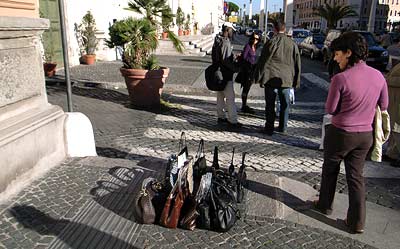
All these factors have helped make the Mourides one of the more successful African communities, at home and abroad. Wherever they are, they club together to acquire a mosque and community centre. Their networks help migrants leave Senegal, find work and procure documents. Far from being helpless victims of fate, many Mourides are shrewd operators in a complex, cross-border network. Take Alioune Ka, the owner of a wholesale shop close to Rome's Termini station: he is a brother of Cheikh Ka in Touba, who takes care of the Senegal-based members of the family. Alioune sells “ethnic” items to Senegalese (and others) who hawk them on streets or beaches. Some stock is from Senegal; a lot from Indonesia, Thailand or India.
The formalization of informal networks and institutions such as these must be pursued. Too often what really works is is ignored because it doesn't wear the cloak of 'legitimacy'.

photo courtesy of the Economist

  • Digg
  • Del.icio.us
  • StumbleUpon
  • Reddit
  • RSS

Neglected Local Science

The Economist reports:

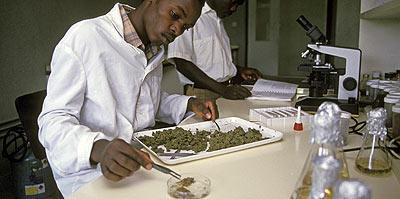
African scientists feel neglected by their politicians who, they suspect, do not understand that geeks as well as businessmen are crucial to economic development...It is, of course, possible to free-ride on the science and technology of others. But in Africa, as elsewhere, no one knows better than the locals exactly what technology needs to be created, and no one has a greater incentive to create it. Nor need such technology be of the unsophisticated kind often badged as “appropriate” by well-meaning outsiders. Appropriate technology can be very sophisticated indeed.
photo courtesy of the Economist
  • Digg
  • Del.icio.us
  • StumbleUpon
  • Reddit
  • RSS

Tata's Values

In the Economist:
Tata is also held together by a common culture that has been marinating for 140 years. Employees love to tell tales of how Tata got the better of the British overlords. They also love to point out that Tata created many of India’s greatest institutions, such as the Indian Institute of Science, the Tata Institute of Fundamental Research and the Tata Memorial Hospital. Reverence for Jamsetji Tata, the group’s founder, borders on ancestor worship: his ever-present busts are garlanded with fresh flowers daily. On March 3rd thousands marched through the streets of Jamshedpur, as they do every year, to celebrate his birthday.
More here
Enhanced by Zemanta

  • Digg
  • Del.icio.us
  • StumbleUpon
  • Reddit
  • RSS

'The Growth of Inequality'

Reuben Abraham comments on the Inequality Business:

The fact is that gross inequality is generally bad news for both the wealthy and the poor and everyone in between. The question though is whether you can a perfectly equal society. I would say that's impossible, as witnessed by the failed experiments at doing so within the Soviet spheres of influence. So, if inequality is inevitable in society, especially with increasing economic growth, the question is what are the parameters beyond which it becomes unacceptable? The Economist addresses the issue in its current issue and I could not agree more with their take on it.
the Economist states:
Inequality is not inherently wrong—as long as three conditions are met: first, society as a whole is getting richer; second, there is a safety net for the very poor; and third, everybody, regardless of class, race, creed or sex, has an opportunity to climb up through the system.

  • Digg
  • Del.icio.us
  • StumbleUpon
  • Reddit
  • RSS

Go South Young Man

In the Economist:

MUCH has been written about the rise of the BRICs (Brazil, Russia, India and China) and the shift in economic power eastward as Asia outruns the rest of the world. But the surprising success story of the past decade lies elsewhere. An analysis by The Economist finds that over the ten years to 2010, no fewer than six of the world’s ten fastest-growing economies were in sub-Saharan Africa...[continue reading]
Enhanced by Zemanta

  • Digg
  • Del.icio.us
  • StumbleUpon
  • Reddit
  • RSS

Adding Value - Botswanan Diamonds

The Economist reports:

Until recently Botswana, a country of 1.8m people that produces 27% of the world's diamonds by value, exported only rough stones. The government, which is struggling to diversify its economy and create jobs, wants to get more out of its main commodity. Cutting adds about 40% to the value of rough stones. But the idea, explains Akolang Tombale, the permanent secretary of the ministry of minerals and energy, is to create an international diamond centre that not only cuts and polishes, but also trades diamonds and provides security, technology and financial services. The government hopes this will spill over into other sectors and help diversify the economy. For now, the diamond industry should create over 3,000 jobs by the end of next year.
Update: Botswana launches Diamond Trading Company

photo courtesy of Economist

  • Digg
  • Del.icio.us
  • StumbleUpon
  • Reddit
  • RSS

Overcoming the Burden of Resource Wealth

Suman Bery writing in the Economist:

With the two exceptions of Malaysia and Indonesia these countries did not enjoy rents from significant mineral resources. As such they were not subjected to the so-called “resource curse” of a struggle for control of these rents, the problems of an appreciated real exchange rate, and lack of competitiveness of the tradables sector. Also, at the time of their fast growth episodes, most of the Asian countries were well into their demographic transition, with the dependency ratio declining as the labour force expanded. This led to a rise in their saving rates, complemented in many cases by significant foreign aid.
As Angus Maddison pointed out a decade ago (in his "The World Economy: A Millennial Perspective") Africa’s underlying circumstances are much less favourable. (His discussion includes Mediterranean Africa, while I will restrict myself to sub-Saharan Africa.) Several of its major economies enjoy enormous mineral riches, which the world over pose tremendous problems for economic management. The prices for these minerals fluctuate violently in global markets causing volatility in revenues; the easy availability of mineral revenues inhibits the growth of a domestic taxation culture essential for the development of accountability to the citizenry; the struggle for illegal control of the mineral resources has been a source of fierce conflict and corruption; while the easy foreign exchange revenues the mineral exports make available boost the real exchange rate. This inhibits the growth of labour-intensive manufacture, which was the source of Asia’s growth.
More here
Enhanced by Zemanta

  • Digg
  • Del.icio.us
  • StumbleUpon
  • Reddit
  • RSS

Biden's New Economic Advisor Writes Dear Diary for Daily Kos

Looks like the first Kossack has been named to the new administration--if you don't count Barack Obama himself!

Upon hearing that Vice President-elect Joe "Pay Attention to Me!" Biden has added the new post of Chief Economist and Economic Policy Adviser to the Vice President to the VP's Office, I grew curious. I then read that he named today Jared Bernstein, an economist at the Economic Policy Institute and a member of the CBO's advisory committee, to this post. Interested, I checked out his wikipedia page.

Now, you can do your own research or email me if you have more information on this guy, but from what I can gather, he is a regular columnist for the American Prospect online, and he has published op-eds in the New York Times and the Washington Post.[8] He has also written diaries on the Daily Kos.

If you want to read some of his garbage, here it is.

  • Digg
  • Del.icio.us
  • StumbleUpon
  • Reddit
  • RSS

African Business Flickers Even More

The Economist writes about the challenges and increasingly promising rewards of business in Africa:

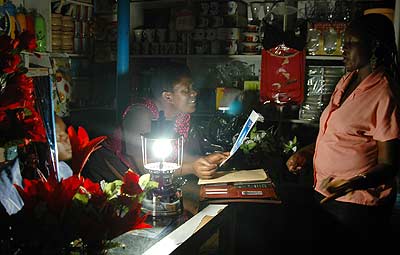
This week an annual World Bank study once again named Africa as the most difficult region in which to do business. But not everyone sees it like that. Graham Mackay, who runs SABMiller, the world's second-largest brewer, has said that “if there was any more of Africa, we'd be investing in it.”...the reward for coping with the risk and the hassle come in large returns and a lack of competition. Successful businesses can expect to enjoy comfortable margins, rewarding them for their time and investment. SABMiller's best operating margins are in Africa; MTN's are over 42%...Successful investors say that Africa can be no harder than other emerging markets, but that doing business requires good local knowledge.

photo courtesy of the Economist
  • Digg
  • Del.icio.us
  • StumbleUpon
  • Reddit
  • RSS

Adding Value to the Diamond Trade

The Economist reports on efforts by Diamond producers to climb up the value chain:

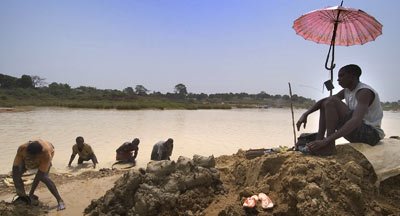
What is certain is that Africa, which produces 60% of the world's diamonds (see chart), wants to do more than just supply rough stones. “De Beers has failed to properly appraise the aspirations of African governments,” says Chaim Even-Zohar, a prominent diamond specialist. “Now it is payback time.” Gone will be the days when African diamonds were shipped to London to be sorted and aggregated in lots before being sold...African producers are also keen to cut and polish their own diamonds, which adds 50% or so to the value of rough stones, and even move into the jewellery business. Although it remains a big trading hub, Antwerp is no longer the world's cutting and polishing centre, and Israel has suffered as well. Almost all diamonds are now cut and polished in India or China, but African producers hope to get a share of the business.

via 3QuarksDaily

photo courtesy of the Economist

  • Digg
  • Del.icio.us
  • StumbleUpon
  • Reddit
  • RSS

Nigeria’s Iron Lady

The Economist profiles Nigeria's Ngozi Okonjo-Iweala:
Pan-African News Wire File Photos
“THE gele is my trademark,” says the Nigerian finance minister, Ngozi Okonjo-Iweala, describing the colourful head wrap she puts over her short, greying hair before she allows pictures to be taken. “I am very Nigerian from dress to everything.” Some of her critics disagree. During anti-reform protests in January, demonstrators focused their anger on the finance minister. They called her an unwelcome outsider because she spent long periods abroad. She was a managing director at the World Bank before coming home last year.

Sitting in her half-moon-shaped office overlooking Nigeria’s dusty capital, Abuja, Ms Okonjo-Iweala faces an unenviable task. President Goodluck Jonathan has given her just three years to overhaul sub-Saharan Africa’s second-biggest economy, one riven with corruption and inefficiencies, carved up by political bosses and vulnerable to bursts of communal violence.
More here

  • Digg
  • Del.icio.us
  • StumbleUpon
  • Reddit
  • RSS

Government Spending is UP 5% So Far This Year!

According to my liberal friends, the reason why the economy is going to double-dip is because the Republicans have been cutting so much spending that it is de-stimulating the economy. Like most things liberals say, the facts don't support it- not only haven't Republicans been cutting spending they actually are spending more money. It's understandable- they only control the House- but not acceptable- by spending more money, they are sucking up resources from the private sector and distorting our market system with their inefficient use of resources, corrupting free choices and mis-allocating valuable monies to make our nation more and more poor and less and less free. Cut spending now!

Here is the story, via IBD:

When Republicans took control of the House in January, they pledged to make deep cuts in federal spending, and in April they succeeded in passing a bill advertised as cutting $38 billion from fiscal 2011's budget. Then in August, they pushed for a deal to cut an additional $2.4 trillion over the next decade.

Some analysts have blamed these spending cuts for this year's economic slowdown.

But data released by the Treasury Department on Friday show that, so far, there haven't been any spending cuts at all.

In fact, in the first nine months of this year, federal spending was $120 billion higher than in the same period in 2010, the data show. That's an increase of almost 5%. And deficits during this time were $23.5 billion higher. These spending hikes haven't stopped many analysts from claiming that the country is in an age of budget austerity, one that's hurting economic growth.

A July article in USA Today, for example, claimed that "Already in 2011, softer government spending has sapped growth."

Jared Bernstein, former chief economic adviser to Vice President Biden, wrote over the summer that "government spending cutbacks have been a large drag on growth in recent quarters and have led to sharp losses in state and local employment."

Economist and New York Times columnist Paul Krugman argued in September that "the turn toward austerity (is) a major factor in our growth slowdown."

If government spending is related to growth, as these and others claim, then the economy presumably should be growing faster, not slower, given the current higher rates of federal outlays.

Nor does the claim that state governments sharply cut spending stand up well to closer scrutiny.

Overall state spending continued to climb right through the recession, when all money from state general funds and other funds, federal grants and state bonds is combined. Total state outlays in 2010 were almost 10% higher than in 2008, according to the National Association of State Budget Officers' annual State Expenditure Report.

And general fund spending — which makes up about 40% of total state spending — is expected to climb 5.2% in 2011 and 2.6% next year, according to the association's latest survey.

  • Digg
  • Del.icio.us
  • StumbleUpon
  • Reddit
  • RSS

Africa: From Victimhood to Agency

John Lonsdale critiques the thinking of Africa as an enduring victim, he suggests the rebuilding of African higher education as a necessary first step.
"...How far are the professed “friends of Africa” – scholars, students, activists – to blame for the mix of everyday indifference and latent fear, tempered now and again by pity? What can we do to repair our failures in representation? Perhaps it would be to do what best serves our own professional interest: regard African colleagues as allies in a common cause, and repair the failures in African higher education that so diminish the African ability to speak to the rest of the world as intellectual equals, expert witnesses in their own cause, full citizens of our one world...Why do we need celebrities to enlist our attention? What Bob Geldof and Bono have done is marvellous (the Nobel laureate economist Amartya Sen tells me that Geldof proved to be a sharp student of development economics in the telephone tutorials Sen gave at the popstar’s request in 2004). But there are also two dangers in the “celebritisation” of Africa’s needs:

  • the sense of guilt that Geldof and Bono arouse in their audiences may prove fleeting and ineffective – when it is important that the G8 and the European Union need to be subjected to intellectually sustained and politically creative scrutiny
  • the image of the secular saint flatters the self-regarding, even racist, European image as the heroic dragon-slayer riding to the rescue of a voiceless and helpless African continent, trapped by poverty, ignorance and disease
...Africans need our advocacy as well as our learning; without passionate commitment there can be no dispassionate research. The best way to combine such passion with its opposite, professional disinterest, is for European Africanists to concentrate our public energies on demanding that our governments support the properly funded, properly protected, rebirth of African universities – a matter to which the Commission for Africa paid some, but too little, attention..."

Via OpenDemocracy

  • Digg
  • Del.icio.us
  • StumbleUpon
  • Reddit
  • RSS

Obama Clearly is Spending Under $200 Million a Day for His Latest Vacation to India

Based on figures from a 1999 report by the GAO, Bill Clinton's trip to Africa cost $42.8 million dollars. He took 1,300 individuals (not including the Secret Service) and was gone 12 days. That works out to roughly $3.57 million a day. Based on this information, we can take some guesses at how much President Barack Obama's upcoming trip to India is going to cost US taxpayers.

First, Obama will only be traveling around Asia for 10 days (3 days in India, rest in Indonesia where he grew up, South Korea, and Japan), so let's lower the cost down to $35.7M. But he is taking over 3,000 people (including Secret Service), so let's guess on the lower side and just double the cost, to give us a price tag of $71.4M. Let's now adjust for inflation from 1999 to today- that will give us a price tag of about $91.07M.

It is reasonable to assume that the Taj Mahal Hotel, where Obama plans to stay, is considerably more expensive than wherever Clinton stayed in 1999, and it is also reasonable to assume that the cost of moving warships off the coast of India for protection and hiring people to knock down coconuts so they don't fall on the President's head are costs that Clinton did not incur. Plus, we know that President Obama and his wife and retinue have a taste for the finer things (see my post Barack Obama's Wagyu Steaks) that Bubba did not really flaunt. Obama will probably try to get in a round of golf while he is there or maybe take in a cricket match, so add those costs to the total too. I'm not an economist, I think it would be reasonable to put a price tag on this trip of $200 million.

So the White House is correct and the Republicans are wrong. It is not going to cost US taxpayers who are battling a recession $200 million dollars a day that we don't have to send the President on a globe-trotting trip with all his buddies to live it up in 5-star hotels. It will only cost us $200 million overall.

For fun, check out Trillion with a T: How to Spend $1,000,000,000,000.00.

  • Digg
  • Del.icio.us
  • StumbleUpon
  • Reddit
  • RSS

Daily Education & Technology News for Schools 01/03/2011

Posted from Diigo. The rest of my favorite links are here.

  • Digg
  • Del.icio.us
  • StumbleUpon
  • Reddit
  • RSS

Africans to Bono: 'For God's sake please stop!'

Jennifer Brea writes:

Many of Africa's best and brightest become bureaucrats or NGO workers when they should be scientists or entrepreneurs...We let a well-intentioned Irish rock star, a Jewish-American economist, and their Hollywood cohort become the voice and face of Africa

  • Digg
  • Del.icio.us
  • StumbleUpon
  • Reddit
  • RSS

Facets of Lagos

Victoria Island. Personal Photograph. Taken 2007.Image via Wikipedia

The attraction and intrigue about Africa's most vibrant but chaotic city continues to elicit interest. Two pieces unfold the varying layers of Lagos, firstly James Meek in the Guardian writes:
The rate at which Nigeria's population has increased, and continues to increase, is staggering. In 1950, 10 years before it gained independence from Britain, 34 million people lived here. The UN believes there are now almost 150 million Nigerians; it has become the world's eighth most populous country, bigger than Russia or Japan. Between now and the middle of the century, only India will add more people to the world's population. If you want to see what it means to live in the middle of a population explosion - the kind of generational leap in size that happened in London in the 19th century and New York in the 20th - Lagos is the ideal place. Where, I wondered, do all the extra people go?...[continue reading]
Meanwhile in the Economist's 'The City of More' travelogue piece, the writer states:
...my first impression of the verdant city was of explosive energy tempered by impressive urban development...The government fails to provide essential services, from infrastructure to education, so the market fills the gap. Lagos is a highly-functioning libertarian dystopia where you can get anything if you have the naira, and the tens of thousands streaming from the country can eke out a living alongside prospecting multinational yuppies. The Wild West model will never yield sustainable social or economic development, but in Lagos it’s the only game in town.

Reblog this post [with Zemanta]

  • Digg
  • Del.icio.us
  • StumbleUpon
  • Reddit
  • RSS

Branding Africa

Carina Ray writes:

We can't afford to turn a blind eye to the challenges facing Africans, and equally we can't continue to brand Africa, as The Economist infamously did in 2000, as "the hopeless continent." Rather, we need to begin highlighting the significant contributions Africans make everyday to shaping their own destinies for the better. Give serious airtime to the thousands of Sudanese human rights activists and aid workers in Darfur, rather than just the handful of foreigners among them. Instead of solely featuring Hollywood celebrities in the next (RED) advertising campaign, also include the heroes and heroines of Africa who work tirelessly and often at great cost to themselves to improve conditions in every corner of the continent.

  • Digg
  • Del.icio.us
  • StumbleUpon
  • Reddit
  • RSS

Covering Cote d'Voire

Map of Ivory CoastImage via WikipediaIn Sahara Reporters Gary K. Busch provides a contrarien view about the crisis in Ivory Coast:

The civil war which broke out between the North and the South in the Ivory Coast was largely about the efforts of the Gbagbo government seeking to achieve real independence; a breakaway from the colonial dominance of the French which controlled almost every aspect of national life. He had the support of the Ivorian people. However now, after all the fighting and suffering by both sides, the current policy of Gbagbo seemed to veer away from confrontation to a policy of restoring the status quo ante; French neo-colonialism. This didn’t work. It fostered is a level of bitterness and rancour among a people who were watching the yoke placed on their necks again and, despite their current apathy and discouragement after years of fighting and sacrifice, they realised that, North and South, they had nothing to lose by sweeping the board clean of their black Frenchmen and installing genuine Ivorian patriots in their place...[continue reading]
While Jordanna Matlon writing in Africa Report discusses the "high stakes" for southern loyalists:
In a country of long-term and soaring unemployment, these men found that their political activities gave them slight leverage in an atmosphere of otherwise dwindled opportunities. As one of my respondents astutely remarked, in a crisis-ridden Côte d’Ivoire, “the one business that works is politics.” Admittedly these men were far from gorging themselves off the fat of party politics. Instead, situated at the bottom of the hierarchy, they received little more than its crumbs. But crumbs – to appear as a guest speaker here, to get help to pay a medical bill or a child’s tuition there and to be relatively immune to the informalised state extraction in the form of the regular bribes – are all heavy incentives in the absence of gainful employment. Moreover, each speaker boasted of meeting warm congratulations after a speech, having his name called when walking down the street or being bought a beer from an admiring spectator he encountered when out on the town...[continue reading]
Enhanced by Zemanta

  • Digg
  • Del.icio.us
  • StumbleUpon
  • Reddit
  • RSS