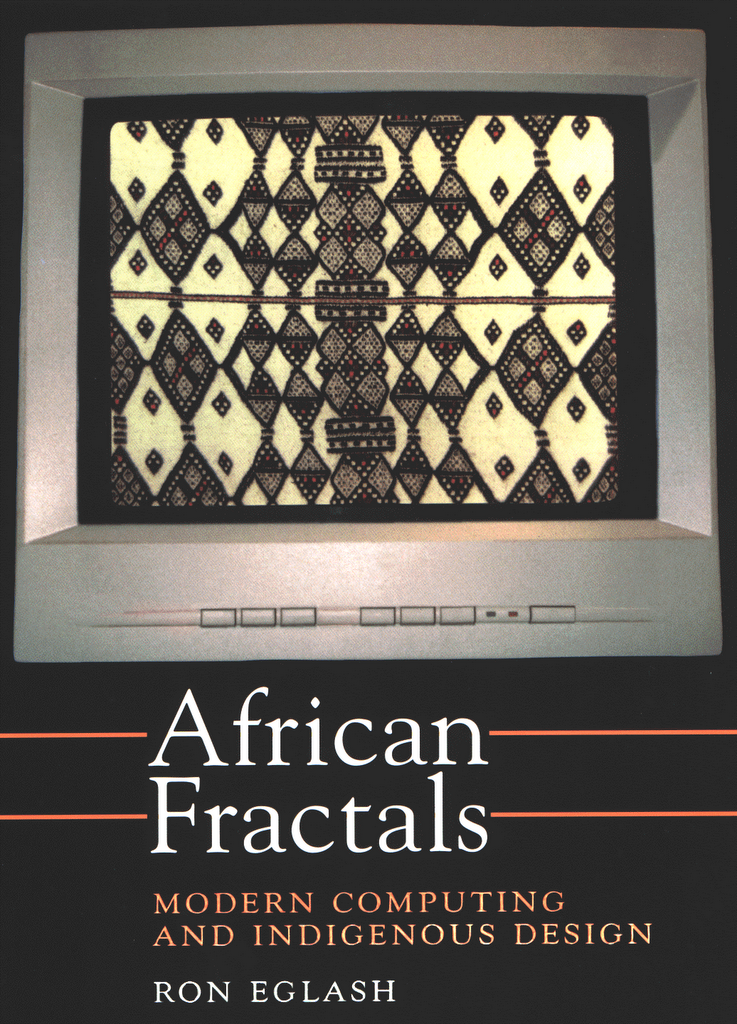
The use of African material culture as a form of analog representation is particularly vivid in cases of recursive information flow. In Africanarchitecture, recursive scaling – that is fractal geometry – can be seen in a variety of forms. In North Africa it is associated with the feedback of he “arabesque” artistic form, particularly in the branches of branches forming city streets. In Central Africa it can be seen in additive rectangular wall formations, and in West Africa we we circular swirls of circular houses and granaries. This is not limited to a visual argument; the fractal structure of African settlement patterns has been confirmed by computational analysis of digitized photos in Eglash and Broadwell (1989). Recursive scaling in Egyptian temples can be viewed as a formalized version of the fractal architecture found elsewhere in Africa, and is most significant in it’s use of the Fibonacci sequence. The sequence is named for Leonardo Fibonacci (ca. 1175-1250), who is also associated with an unusual example of recursive architecture in Europe. The Fibonacci sequence was one of the first mathematical models for biological growth patterns, and inspired Alan Turing and other important figures in the history of computational morphogenesis. Since Fibonacci was sent to North Africa as a boy and devoted his years there to mathematics education (Gies and Gies 1969), it is possible that seminal example of recursive scaling is of African origin...[continue reading]
Eglash's research began in the 1980s while investigating settlement architecture in Central and West Africa. Aerial photographs of various settlement compounds revealed that many were composed of circular structures enclosed in other circles, or rectangles within rectangles, and that the compounds were likely to have street patterns in which broad avenues branched into very small footpaths. As Eglash notes, at first he thought it was just from unconscious social dynamics. But during his fieldwork, he found that fractal designs also appear in a wide variety of intentional designs--carving, hairstyling, metalwork, painting, textiles--and the recursive process of fractal algorithms are even employed in African quantitative systems. Eglash adds that in the design rationales and cultural semantics of many African geometric figures, as well as in indigenous quantitative systems (additive progression, doubling sequences, binary recursion) and symbolic systems (iconic symbols for feedback loops, equiangular spirals, infinity), there are abstract ideas and formal structures that closely parallel some of the fundamental aspects of fractal geometry. These results, Eglash concludes, are congruent with recent developments in complex systems theory, which suggest that pre-modern, non-state societies were neither utterly anarchic, nor frozen in static order, but rather utilized an adaptive flexibility that capitalized on the nonlinear aspects of ecological dynamics.
The use of African material culture as a form of analog representation is particularly vivid in cases of recursive information flow. In Africanarchitecture, recursive scaling – that is fractal geometry – can be seen in a variety of forms. In North Africa it is associated with the feedback of he “arabesque” artistic form, particularly in the branches of branches forming city streets. In Central Africa it can be seen in additive rectangular wall formations, and in West Africa we we circular swirls of circular houses and granaries. This is not limited to a visual argument; the fractal structure of African settlement patterns has been confirmed by computational analysis of digitized photos in Eglash and Broadwell (1989). Recursive scaling in Egyptian temples can be viewed as a formalized version of the fractal architecture found elsewhere in Africa, and is most significant in it’s use of the Fibonacci sequence. The sequence is named for Leonardo Fibonacci (ca. 1175-1250), who is also associated with an unusual example of recursive architecture in Europe. The Fibonacci sequence was one of the first mathematical models for biological growth patterns, and inspired Alan Turing and other important figures in the history of computational morphogenesis. Since Fibonacci was sent to North Africa as a boy and devoted his years there to mathematics education (Gies and Gies 1969), it is possible that seminal example of recursive scaling is of African origin...[continue reading]
How do we evolve grassroots democracy with regional characteristics? Hierarchical systems within most of Sub-Saharan Africa have proven to be almost completely removed from the citizens they claim to govern, the following statements/initiatives offer varying perspectives on the subject, firstly Fred Foldvarysuggests that:
Democracy must start small. Each village and city neighborhood elects a local council. These would be the cells of the political body. Where a traditional clan leadership is in place, it would be recognized as the local authority. The cell would be small enough so that the people can hold meetings and know the candidates personally. There would be no need for large amounts of campaign money.
Decentralisation of government by devolving decision making down to the lowest constituencies is a fundamental principle of the Puntland administration. Evidence shows that smaller, more local bodies are generally more efficient, but also that taking the process of decision making down to the community level gives rise to a more responsive organization on the one hand, and greater community involvement and buy-in on the other.
The most effective and extensive way for the people to be masters of the country is that they directly exercise their democratic rights in accordance with the law to manage public affairs and public service programs at the primary level, practice self-management, self-service, self-education and self-oversight, and exercise democratic oversight over cadres. Such practices must be emphasized and promoted as the groundwork for developing socialist democracy.
In summation we can postulate the need for indigenous, adaptive, fractal governing systems that are imbued with continuous reactive input from a representative citizenry.
...suggests that pre- modern, non-state societies were neither utterly anarchic, nor frozen in static order, but rather utilized an adaptive flexibility that took advantage of the nonlinear aspects of ecological dynamics. How might this potent formulation of indigenous knowledge be applied to problems in education and development? One method is to encourage its dissemination in development agencies. But decades of research have shown that a top-down approach to development, even that making use of indigenous knowledge, is often less effective than a bottom-up, "grass roots" approach. This project will create a framework in which to test the possibility that indigenous knowledge can be used in a boot-strapping approach to development. The term boot-strapping is typically applied to computer systems ("boot up the disk"), where a small program is able to self-install a larger system (from the phrase "pulling yourself up by your own bootstraps"). Similarly , we view a boot-strapping approach to development as one which begins with indigenous knowledge under local control, and self-installs modern technological abilities.