...the architects of the Millennium Villages need to stop overstating their development impact, and heed the calls by economists like Michael Clemens at the Center for Global Development to learn more through careful evaluations. Until then, these places still appear less like the model villages of the new millennium, and more like the Potemkin villages of the last millennium: Russian towns built like theatrical sets, with large fires that glowed in the distance to portray improved economic activity.More here
U.N. Millennium Villages-Potemkin villages?
B-Schools : Engaging the Cotton Industry
Businessweek reports on an initiative to engage Senegal's cotton industry by the HEC School of Management.Bertrand Moingeon a professor at the school outlines some of their goals:
Students would be enrolled—especially those concentrating on sustainable business—in what happens at the local level in the different villages. We can see having students who go into villages and organize meetings with the local cotton producers and could contribute to knowledge-sharing forums. We think that some students, just as they did in Bangladesh, will write their research project or dissertation on these experiences in Africa...At the end of the day, what we expect is that we have an impact on the economy of this sector. If we increase the managerial skills at all levels of this industry, we will foster the competitiveness of this sector. This same knowledge can then be applied to other industries in Africa.
via Annansi Chronicles
Villages in Action - Let the Village Voices be Heard
...September 2010, international organizations, heads of state, celebrities and specialists gathered to review progress on the Millennium Development Goals (MDGs).As you may know, the MDGs were set in 2000 to achieve eight anti-poverty goals by 2015. In the midst of the coverage of these grand events, high profile attendees wined, dined and debated the relative merits of each MDGs plan, while the actual “poor,” were not invited to these elite events.
Via 2010 from Project Diaspora on Vimeo.
Project Diaspora decided to change perceptions about the poor by building the Villages in Action platform whereby the voices of the poor can be heard. On November 27, 2010, the first conference was held in a village outside Masindi, Uganda. The goal of this one-day conference was to showcase the grassroots efforts driving economic development and improving the lives of the community – all with little or no assistance from international aid organizations...[continue reading]
Why the Book is still King in Africa
From the Cassava Republic Blog:
While the West is fretting about the e-book revolution, in Africa, it’s not even a factor for the majority of people. Although changing slowly, there is still a large technological gap on the continent. Much has been made about the growing “Facebook generation,” but the truth is that only a small percentage of people have access to the internet and fewer still have access to e-readers; millions of people will live their lives without ever seeing a computer, let alone a Kindle. In countries where constant electricity is considered as a luxury, there is still an enormous need for the physical book. In tiny villages across Nigeria, families can still point to their palm-oil stained copies of classic books. And the fact that copies of our books have been sighted in the remotest of villages in Nigeria shows that the physical book is still very much important here.More here
Armenian Genocide Remembrance Day
Yesterday was Armenian Genocide Remembrance Day (April 24). The word ‘genocide’ is a recent word that means destroying, either in whole or in part, a national, ethnic, racial, or religious group. This can be done by killing them all off, deliberately inflicting on the group conditions of life that are calculated to kill them off, imposing measures on the group intended to prevent births by the group, forcibly transferring children of the group to another group, and trying to breed the group out of existence by raping the women of the group.
The 20th Century has a brutal legacy of genocide, and it all started with the Armenian Genocide from 1915-1923. Before Darfur (current day), before Bosnia (1995), before Rwanda (1994), before Cambodia (1975-1979), before the Nazi Holocaust of Jews and Poles and Gypsies (1938-1945), and before the Ukrainian Famine, there was the Armenian Genocide. Hitler once justified his Holocaust by asking “Who, after all, speaks today of the annihilation of the Armenians?”
In the Armenian Genocide, more than 1.5 million Armenians were killed out of 2 million. The main reason for this was a desire to ‘Turkify’ the Ottoman Empire and kill off all non-Muslims (Armenians were largely Christian). Armenian men were drafted into the army to fight WWI- and then were disarmed and put into labor camps, where they were soon starved or killed. Groups of government officials spread rumors of the Armenians betraying Turkey, blamed them for the losses Turkey was suffering during WWI, and demanded ‘justice.’ In April 24, 1915, all community leaders were systematically rounded up and put to death. After that, as WWI spread and became more confusing and disorganized, armed groups would come into Armenian villages and kill off the rest of the men or make them go on death marches, rape or carry off the women to use as slaves, kidnap or enslave the children, loot the village of all valuables, and then chase off remaining Armenians (who then later died of starvation, exposure, or brutality). By 1923, Armenian was simply a memory- 4000+ years of history wiped away like it never existed- churches, monasteries, schools, people, possessions were all destroyed or gone. Even the Armenian names of cities, villages, and rivers were changed.
The official line in Turkey is that the number of people that died has been grossly inflated, and the evidence of this genocide comes from dubious and prejudicial sources. Turkey claims that more Muslims than Christians died during the same period in the chaos that engulfed Turkey during and after WWI. Turkey says that Ottoman officials were tried for crimes against the Armenians and were acquitted, and that the word ‘genocide’ wasn’t even around until after WWII, and that the Holocaust isn’t anything like what happened in Turkey to the Armenians. In 2004, Turkey passed Article 301, which makes it a crime to even talk about the Armenian Genocide, and Turkey today spends millions lobbying the US to try to defeat efforts here in the US to recognize the genocide. Turkey even gives millions to prestigious universities to fund studies of the ‘Turkish view’ of the genocide and offers scholarships to people who will write books or articles denying that the genocide ever took place.
Typical for the waffling spineless President that he is, Barack Obama refused to call what happened in Armenia from 1915-1923 a genocide, instead 'artfully' finding a middle ground on the issue, much like Chamberlain did when confronted by a similar display of evil. "On this solemn day of remembrance, we pause to recall that ninety-five years ago one of the worst atrocities of the 20th century began," Obama said in a statement.... " It is in all of our interest to see the achievement a full, frank and just acknowledgment of the facts." He then refused to call what took place in Armenia a 'genocide' and mouthed vague words of nothingness to mark the occasion.
The Armenian National Committee of America (ANCA) rapped Obama for "disgraceful capitulation to Turkey's threats" and of "offering euphemisms and evasive terminology to characterize this crime against humanity," in a press release Saturday. I agree.
While it is important to maintain relations with Turkey, and while we badly need their support on a bunch of important subjects, the truth is the truth, and it is black and white. Obama should recognize the truth and quit trying to make everything so grey.
Nation Building
WorldChanging reports on Afghanistan's National solidarity program:
Ashraf Ghani has worked to establish partnerships between communities, national and international NGOs, and government, most pointedly through the establishment of the National Solidarity Program, which promotes village-level, community-run development programs, and networks Afghanistan's many villages -- through community development councils -- with one another and with agencies and organizations that can grant them access to resources.
Quick Hits
Sierra Leone's tourism promise and more-Tony Blair
Barclays Bank up to more fishy stuff?
A bid to strengthen Think Tanks.
Is corruption in Nigeria's DNA?
A tour of Nairobi.
Writing off sovereign debt and hampering growth-Thompson Ayodele in the Telegraph
Can we rein in the destabilizing effects of Natural Resources? Perhaps with the Natural Resource Charter contends Paul Collier.
Taju Tijani asks, where are the Black British Millonaires?
How Corporate America Really Views Africa.
The Guardian compares their Katine village project with MVP's. They should take a look at the Working Villages and learn from the successes of Songhai Centre.
Thirst For Power
The emphasis on large dams reinforces centralized power and invites corruption, because large dams bring big money into the hands of a few government officials and technocrats. By contrast, small dams capable of generating up to 15 MW are relatively inexpensive and require the hands-on involvement of villages and communities, thus potentially serving as a tool for local empowerment. Perhaps because small dams spread political and economic power, rather than concentrate it, African governments and the foreign donors who fund so much of Africa's infrastructure have generally ignored them.
image courtesy of IEEE spectrum
10 Commandments for African Intellectuals
George Ayittey of the Free Africa Foundation writes:
1) Never Forget Your Roots
Africa's traditions, institutions, and customs are integral part of your heritage. This heritage includes participatory democracy based on consensus, free village markets, free enterprise and free trade. You cannot reject this heritage and remain African.
2) Seek Ye First the Economic Kingdom in the Private Sector
There is nothing wrong in wanting to be rich, but nobody became rich working for a wage/salary, unless he was prepared to steal or embezzle, like the African kleptocrats. But that does not pay in the long run. Earn your wealth in the private sector by actually producing something, even charcoal. If capital is a problem, do as the illiterates do by pooling savings as in the revolving credit schemes.
3) Privatize the Universities
Africa's universities should be privatized. They may be given a fixed annual government subvention and then allowed to raise their own revenue and manage their own affairs. This way, they can uphold academic freedom, which is currently not possible with the head of state, often a military imbecile, as the chancellor.
4) Demand and Defend Freedom of statement/Media
Recall that the first critical step in problem resolution is the exposure of the problem. Without freedom of statement this is nearly impossible... "African governments are responsible for the underdevelopment of African literature. Among the four main problems inhibiting the development of African literature is the expulsion of prominent African writers . . . the absence of African writers in international debates, absence of integrative policies and lack of publishing infrastructure" . All African intellectuals must demand the right to free speech and defend the rights of others for the freedom to speak, publish and write...
5) Practice Intellectual Solidarity
Respect and assist members of your own profession, regardless of differences of opinion. If one is under siege, all wherever they may be --- in or out of government, in or out of the country -- must go his or her aid. You may need group assistance yourself in the future. And extend this solidarity to other groups fighting the same cause as well...
6) Demand National Conferences
When a national crisis erupts, demand that a national dialogue or conference be set up to resolve it, as is done in African villages. The national conference must be sovereign and its decisions binding on all parties, including the government...
7) Disband the Military or Cut It in Half
No African intellectual with an iota of intelligence and a modicum of Pan-Africanist spirit would support, much less serve, a barbarous military regime. Ever! All those African countries that imploded were ruined by the military.
8) Pan-Africanism
Pan-Africanism, originating from the belief that African countries share common problems, common solutions, and common destinies will remain a dream unless you learn more about African countries other than your own.
9) Set Up a Rival AU
The time has come for the useless OAU(nowAU) to be disbanded or for a rival body, the Organization of Free African States to be set up. It should be made up of strictly democratic countries. OFAS can be set up under the aegis of President Nelson Mandela of South Africa.
10) Selectively Repudiate Foreign Debt
Insist that foreign aid be given only to democratic African countries. Time and again, foreign loans are taken by corrupt, illegitimate and repressive African regimes without the approval of the people.
Africa's Village of Dreams
Sam Rich critiques Jeffery Sachs millennium villages:
If Sauri(A millenium village) is to become a useful model for development on a bigger scale, and not just another development expert’s white elephant, Sachs and others working on the project must acknowledge that they are still learning about Africa. Sauri is not yet a success.
Lasting changes in Sauri will come about not through distribution of commodities, but through education for children and training for adults. To put it another way, give a man a mosquito net, and when it rips, he’ll come and ask for another one. But show him how using a mosquito net benefits his health and how it will save him money on medication in the long run, and he might just go out and buy one for himself.
Mali Evolves
Robert Pringle writes about the burgeoning civil society and strengthening democracy in Mali:
Malians have redefined the term “consensus” to comport with the decentralization model. Whereas under the dictatorship “consensus” meant African-style democratic centralism, often smacking of communist practice, today it is understood to suggest reaching compromise on tough issues—more in the mode of Daniel Webster than Vladimir Lenin...Malians say that their history and culture have nourished interethnic tolerance. They cite a whole tool kit of conflict resolution and avoidance mechanisms...Mali’s new decentralization has created a three-tiered system: regions (think states), circles (think counties), and communes, which usually comprise several villages. Commune inhabitants elect local councils, which choose their own mayors and send representatives to the two higher tiers of the system. The 702 rural communes are widely regarded as the backbone of Malian democratization...The most striking thing about Malian democracy is its success in drawing intellectual and spiritual sustenance from an epic past, and actively incorporating homegrown elements, such as decentralization. If there is occasional fiddling with historical truth, the past provides plenty of room for differing viewpoints and for shaping tradition to meet modern needs. It is this aspect of the Malian experience that is least appreciated, and it deserves more attention from policymakers, both African and foreign, who have a tendency to assume that “tradition” equates with “bad.”via 3quarksdaily
photo courtesy cr.nps.gov
Incremental Infrastructure
Ethan Zuckerman builds on his Incremental Infrastructure concept:
[T]he idea is to build essential facilities -- telephone networks, power grids, roads -- in small pieces using private investment, instead of relying on large, centrally planned, government-run projects.The rise of mobile phone networks linking more than 100 million Africans across the continent and the blossoming of cybercafes from Cape Town to Dakar are evidence that incremental infrastructure is already transforming the continent. But Africa needs go beyond telephones and computers. Many nations lack roads, electric power, schools, hospitals, clean water. If the lessons learned from building telephone and Internet systems can be applied to other types of African infrastructure, African entrepreneurs could find themselves wiring villages, paving roads, and perhaps even building airports -- building the new Africa while turning a profit in the process.
Entering the debate Ory Okolloh says:
I’m wondering whether he’s too quick to extrapolate the mobile phone phenomenon to other areas. I’m especially thinking about big ticket items like roads and power generation/transmission that don’t have the same option of being subsidized by the consumer. Also the incremental and even moreso the “pico” approach does not address needs on a macro-level that most countries in Africa need to address, having power in the village is great but if factories / business can’t operate at an optimal level because of power shortages or costs there’s still a big conundrum that needs be address (and unfortunately the role of government can’t be wished away).
For added coverage see Worldchanging
Radio & Video: Tools for Agricultural Innovation
Africa News reports:
“Farmers innovations are often shaped by capital limitations and mainly rely on locally available resources, of which knowledge is a key one,” said Paul Van Mele, a scientist at the Africa Rice Center. “Video proved a powerful, low-cost medium for farmer-to-farmer extension and to expose rural communities to new ideas and practices.”...Innovation levels of 72 percent were recorded in villages where women were introduced to improved rice processing techniques by videos compared to 19 percent among farmers who had attended training workshops. When women who had attended training workshops watched the videos, the innovations recorded shot up to 92 percent.More here.
Quick Hits
Reforming health care in Nigeria-Oxford Journal
The Invisible Children campaign about war affected children.
Can India ( and or Africa) afford its villages-Atanu Dey & Reuben Abraham
From Inventors to Innovators: An investigation into individual inventors in Tanzania via ATPS
The Beautiful Tree
Liam Julian reviews James Tooley's The Beautiful Tree:
In slums around the world, from Lagos, Nigeria and Nairobi, Kenya to rural villages in Ghana and China and places in between, Tooley has discovered poor people opening small private schools that offer alternatives to dismal or inaccessible public education. The schools charge only pennies a day, and most also provide scholarships to orphans or children of the indigent. One in five students in the Hyderabad slums, for example, attends a private school on some kind of need-based scholarship. Whether in Kibera (Kenya) or Gansu (China), these schools all seem to boast committed and punctual teachers, efficient and attentive owners, and satisfied parents...[continue reading]
Building Technology Villages-AproTech Ghana
In conclusionAt first glance,there’s nothing extraordinary about the shed sitting next to Uncle Joe’s mud brick home in the coastal Ghanaian village of Atabadze.Inside there’s a certain familiarity about the clutter – tools propped up against stacks of roofing sheets and machinery – the kind of organized chaos you’d find in tool sheds and workshops anywhere in the world. But the sheer ordinariness of it of all belies the fact that this is the birthplace of a remarkable and important technology.Those roofing sheets – Uncle Joe made them,out of local river sand,using only his own ingenuity and the electric vibrating table in the corner – he made that too.
Uncle Joe's roofing sheet fabrication facility
Uncle Joe is an innovator.He has brought his community something they never had before:a roofing material that is both sturdy and affordable.Before his intervention,his neighbours had a hugely unsatisfactory choice between using expensive,often imported, manufactured materials, or local unprocessed thatch, at a fraction of the price,but at the cost of durability;there was no middle ground.But Uncle Joe was not so sure this was necessarily a matter of ‘either or’; why couldn’t there be an alternative that was both manufactured and local, he wondered.
So he set about answering his own question,experimenting with local environmental inputs and different manufacturing processes.And through his efforts he developed a process to produce roofing sheets from river sand – a sturdy,high quality product The poor need opportunities to generate income and work themselves out of poverty manufactured from a sustainable local resource. To produce these sheets,Uncle Joe even had to build his own electric vibrating table,a vital piece of machinery that blends the sand with a small quantity of cement (added as fixative),enabling the mixture to set.All in all,an unlikely triumph of innovation considering the poor infrastructure and extremely limited availability of capital and manufacturing know-‐how in his rural locality.
Uncle Joe is a prime example of the creativity and dynamism that are blossoming in Africa; one of the manyindividuals and communities championing innovative technologies that,by mobilising local resources to provide essential goods and services,and create income generation opportunities for the poor,can deliver sustainable and equitable ‘grassroots’development across the continent.And yet his story also illustrates the uphill task they face.
For all the originality of his idea and his dedication to implementing it,Uncle Joe cannot currently make ends meet manufacturing tiles – he simply cannot afford to hire the labour he needs to produce viable volumes.Without capital,his operation will not reach a level at which the technology can really impact the livesof the poor.
For the global development community (donors,NGOs,etc) Uncle Joe’s story is one of opportunity: it highlights an opportunity forthem to create the opportunities the rural poor need to work their way out of poverty.To date the governmental and multilateral institutions with the resources and clout to change the lives of those living in poverty have favoured...To make meaningful inroads into poverty reduction in Africa,the development community must foster the growth of robust local industries that mobilise the continent’s substantial environmental resources to meet local needs and create opportunities.Technologies like Uncle Joe’s manufacturing process are the foundation on which such industries are built,and donors should support their development,whether by investing in the entrepreneurs pushing innovative local solutionsor by providing the tools and training rural communities can use to unlock the developmental potential in their local environment.More here
A Good Day for the Good Guys in Afghanistan
Via Powerlineblog comes this stirring account of Marines fighting in Afghanistan by Michael Ledeen.
FARAH PROVINCE, Afghanistan -- In the city of Shewan, approximately 250 insurgents ambushed 30 Marines and paid a heavy price for it.
Shewan has historically been a safe haven for insurgents, who used to plan and stage attacks against Coalition Forces in the Bala Baluk district. The city is home to several major insurgent leaders. Reports indicate that more than 250 full time fighters reside in the city and in the surrounding villages.
Shewan had been a thorn in the side of Task Force 2d Battalion, 7th Marine Regiment, Special Purpose Marine Air Ground Task Force Afghanistan throughout the Marines' deployment here in support of Operation Enduring Freedom, because it controls an important supply route into the Bala Baluk district. Opening the route was key to continuing combat operations in the area.
"The day started out with a 10-kilometer patrol with elements mounted and dismounted, so by the time we got to Shewan, we were pretty beat," said a designated marksman who requested to remain unidentified. "Our vehicles came under a barrage of enemy RPGs (rocket propelled grenades) and machine gun fire. One of our 'humvees' was disabled from RPG fire, and the Marines inside dismounted and laid down suppression fire so they could evacuate a Marine who was knocked unconscious from the blast."
The vicious attack that left the humvee destroyed and several of the Marines pinned down in the kill zone sparked an intense eight-hour battle as the platoon desperately fought to recover their comrades. After recovering the Marines trapped in the kill zone, another platoon sergeant personally led numerous attacks on enemy fortified positions while the platoon fought house to house and trench to trench in order to clear through the enemy ambush site.
"The biggest thing to take from that day is what Marines can accomplish when they're given the opportunity to fight," the sniper said. "A small group of Marines met a numerically superior force and embarrassed them in their own backyard. The
insurgents told the townspeople that they were stronger than the Americans, and that day we showed them they were wrong."During the battle, the designated marksman single handedly thwarted a company-sized enemy RPG and machinegun ambush by reportedly killing 20 enemy fighters with his devastatingly accurate precision fire. He selflessly exposed himself time and again to intense enemy fire during a critical point in the eight-hour battle for Shewan in order to kill any enemy combatants who attempted to engage or maneuver on the Marines in the kill zone. What made his actions even more impressive was the fact that he didn't miss any shots, despite the enemies' rounds impacting within a foot
of his fighting position."I was in my own little world," the young corporal said. "I wasn't even aware of a lot of the rounds impacting near my position, because I was concentrating so hard on making sure my rounds were on target."
After calling for close-air support, the small group of Marines pushed forward and broke the enemies' spirit as many of them dropped their weapons and fled the battlefield. At the end of the battle, the Marines had reduced an enemy stronghold, killed more than 50 insurgents and wounded several more.
"I didn't realize how many bad guys there were until we had broken through the enemies' lines and forced them to retreat. It was roughly 250 insurgents against 30 of us," the corporal said. "It was a good day for the Marine Corps. We killed a lot of bad guys, and none of our guys were seriously injured."
Childrens Parliament
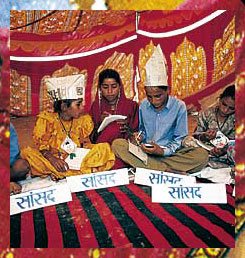
"...The Barefoot College came up with the idea of a Children ’s Parliament so that children could learn how a democracy functions,the importance of the vote, standing up for your rights and not letting yourself be exploited because you are poor. The children elect their own Parliament and their own Ministers. They can make decisions about the running of their schools and dismiss teachers who neglect their duties. The children can also have their say in matters concerning their villages,such as the supply of water and electricity..."
Sustainable Fishing Villages
Six thousand artisanal fishermen in Kayar, Senegal are fighting back against West Africa’s perilous trend toward depletion of fish and seafood stocks with an innovative system of community-based fisheries and environmental management. By establishing and enforcing catch limits, Kayar’s fisherman have increased profits, improved hygiene at landing and processing sites...[continue reading]For further information take a look at the work of WASSDA which supports the sustainable development of the West African fisheries and seafood sector
Updating Foreign Aid
Carol Adelman writes:
Remittances now exceed official aid from all donor countries to developing nations combined — they are a global social security system that works. Studies show they reduce poverty and boost health and literacy. Private banks, setting up accounts for immigrants in America to send money back home to families and villages, help poor people earn interest, and establish credit worthiness for loans. Remittances also play a crucial role in strengthening poor countries' balance of payments, which improves credit ratings, allowing them to tap into international financial markets on better terms.