
-
Students are already peer reviewing each other's work using kibin.
-
Flat Classroom brings world closer - Pelican Press
Another great local press coverage of how our amazing Flat Classroom teachers are collaborating. This is a story that our communities are hungry for. Social media is great but social learning is transformational. The best teachers are attracted to the Flat Classroom projects - apply now at www.flatclassroomproject.net
-
The 35 Best Web 2.0 Classroom Tools Chosen By You - Edudemic
Awesome! RT @FlyontheCWall for later: The 35 Best Web 2.0 Classroom Tools Chosen By You : http://ht.ly/5CXkW #5thchat
-
College Readiness with Knewton's Adaptive Learning Platform™
Colleges are struggling because incoming students aren't ready for the rigors of college. Here is a clip of a press release about how some colleges are using Knewton.
"Today, educational technology company Knewton announced that its award-winning Adaptive Learning PlatformÔ has been selected by Penn State University (PSU), University of Nevada, Las Vegas (UNLV), the State University of New York (SUNY), and Mount St. Mary’s University to power college readiness courses that will help condition incoming students for the rigors of college-level academics and identify and address academic areas of improvement for each student. Recognizing the successful implementation of blended learning at ASU, both state universities with large student bodies like SUNY, Penn State, and UNLV, and small selective private universities like Mount St. Mary’s are turning toward Knewton’s Adaptive Learning PlatformÔ to power their college readiness programs.
College preparedness continues to be an issue that impacts students across the nation and can hinder a student’s chance of completing a four-year university program. According to the Alliance for Excellence in Education, 50 percent of students who enter college remediation programs fail to reach graduation. " -
Create, Share and Learn with a Global Repository of Tests
Online test site for homework or review. Let the computer do what it does best.
-
Digital Scholastic is free for the rest of this summer and is being marketed for your IWB. Looks like some interesting content.
-
The Kids Are Ready | Classroom Applications
Nice write up on how Brad Flickinger is running his elementary classroom with a lot of high-quality technology equipment where the students serve as mentors for each other. Love this model.
Hat tip: Robert Madden -
Multimedia Learning Resources - Educaplay
There are some free activities here but this is a tool to develop multimedia activities for LMS systems. It is in beta.
-
This website helps US public schools install and pay for solar power.
-
Best College Scholarships and Grants. Compare, reviews & ratings.
Search tool to help you find the best scholarships online. With a high school junior, I'll be working here.
-
Website by a 17 year old high school students in a Silicon Valley incubator. Looks interesting. "Find and share notes with your friends."
If we don't help them share - they will. If they learn is it cheating? -
Educator Application « 140 Character Conference
Got a note that if you want to go to the 140 character conference for education and are an educator you can attend for $1.40. Here is the application, it is coming up August 2/3rd.
"Your readers / subscribers may join us for a special price of $1.40 (seriously) if they apply here and prove they are part of the education community. Otherwise, participation is $140.00 for the two-day event. " -
DEN Research | Discovery Education
Membership study of Discovery Educators network and the impact on their professional development. While I have just become someone that you CAN book through Discovery for speaking (to be on their website soon) I do learn a lot from DEN.
-
Global World History Project: And We're Off...
A teacher is working on a global world history project and is looking for friends and partners. If you teach history in high school, he's looking for more partners.
-
Beginners » The Krazy Coupon Lady
This isn't related to teaching but IS related to managing a household and saving money. I have some friends who are going crazy about how the krazy coupon lady is saving money. Times are tight and I think my teacher friends out there will like this website.
-
Design presentations automatically - VisualBee PowerPoint plugin
Visual bee looks at the words and text on your slides and helps "soup up" your powerpoint presentation for you. There is a free plug in for PowerPoint. If you've gotta use it, perhaps some of the intelligence in here would be beneficial for you
-
Apps are emerging like marble jar to help give children rewards and promote long term behavior improvements. This may work for some kids. I prefer the hug and kiss method myself. ;-)
-
Museum of Science and Industry | About The Museum | Press | Month at the Museum 2
I love this! Apply to spend a month at the museum and win $10,000 in the process. Here is the info:
"The Museum of Science and Industry, Chicago is once again holding a nationwide search for a live-in roommate for Month at the Museum 2, an innovative experiment where one curious and adventurous individual will have full reign of the Museum for 30 days and win $10,000. Last year’s roommate captured the imagination of people around the world. " -
How to Send a Direct or Private Message on Google+ ~ LockerGnome Social Media & Technology
(Hat Tip to Danita Russell for sending this to me)
Here is how you private message people on Google+ -
Philips' Luminous Wallpaper Will Create the Mood Lighting of the Future | Popular Science
Excited about the LED wallpaper and the potential it has for making learning spaces more powerful and engaging. This self-luminating wallpaper takes "mood lighting" to a whole new level.
-
Cool article on 3D printing in the classroom. There are so many great applications for this! I'm excited it is finally coming.
Hat tip for this one to the president of our tech support contractor, Paul Blough from Bloughtech - great company to work with. -
Kids News and News Articles for Kids - GoGoNews -
"Big news for little people" this website is targeted news for kids aged 7-14 and may be something you can use in your classroom. What a fascinating discussion you could have about July 13th's topic the "crazy basketball court."
-
A childhood obesity program centering around some really cute puppets. These guys are cute. They have a program you can use in health class too.
Daily Education & Technology News for Schools 07/14/2011


Daily Education and Technology News for Schools 01/04/2012
-
Leverage Social Media's Potential - Room for Debate - NYTimes.com
Eric Sheninger tackles social media in schools. Way to go Eric.
-
The Frontier of Classroom Technology - Room for Debate - NYTimes.com
The New York Times is running a piece on the Frontier of Classroom technology. (I wanted to write on some of the other topics but they asked me to tackle adaptive learning, so that is what they got.) Ann Leanness, Will Richardson and others. Feel free to share your opinions.
-
Embrace Adaptive Testing - Room for Debate - NYTimes.com
I have to admit that it was very hard to put into a few short words my thoughts on adaptive learning. I didn't really intend for it to center on the testing piece but I guess that is what the editors thought hadn't already been covered, although I do agree with everything I said on it. Of course, many will say we need much more than testing but I think the big point is that pencil and paper don't cut it. We are wasting time with how we test now and can be much more targeted in terms of what students know and how we can teach. Your thoughts?
The biggest thing that bothers me about all these apps is that we have no learning analytics - no feedback loop at all to parents or teachers. I literally have to watch my son play his ipad learning games to really understand where he is and what I need to do to fill things in.
Learning about Learning: Research and Edreform News and Views 01/04/2012
-
Drape's Takes: Refining Purpose for 1:1
Darren Draper has a concise, well written explanation of the 4 reasons schools should move to 1:1 with research cited. I think the part I like best isthat we are no longer saying 1:1 laptop but, instead 1:1 technology. I am forwarding this one to my technology committee.
-
Embrace Adaptive Testing - Room for Debate - NYTimes.com
I have to admit that it was very hard to put into a few short words my thoughts on adaptive learning. I didn't really intend for it to center on the testing piece but I guess that is what the editors thought hadn't already been covered, although I do agree with everything I said on it. Of course, many will say we need much more than testing but I think the big point is that pencil and paper don't cut it. We are wasting time with how we test now and can be much more targeted in terms of what students know and how we can teach. Your thoughts?
The biggest thing that bothers me about all these apps is that we have no learning analytics - no feedback loop at all to parents or teachers. I literally have to watch my son play his ipad learning games to really understand where he is and what I need to do to fill things in. -
Intergenerational Learning Changes Learning, Changes Lives | Edutopia
This Edutopia article is on intergenerational learning. we cover this innour Flat Classroom book because we believecflat learning spans regions, generations, and time itself.
Standardized Testing: The Modern Bloodletting?
 |
| Helen Keller and Anne Sullivan - It should be about the student! |
What if we had a modern doctor that practiced bloodletting?
Protests. An angry outcry against a practioner who had ingnored the past 200 years of medicine to go back to the archaic and harmful habit of draining a sick person's blood into a bowl in order to remove the body of impurities. Complete and utter nonsense. Not only nonsense, harmful.
Is standardized testing a modern day bloodletting? Perhaps not that extreme, but extreme enough to have an outcry from the masses demanding that education system be reformed. At the heart of this outcry is perhaps the standardized testing-centric curricula and methods we've adapted in order to "improve our scores."
So you want to know why this overtesting has made so many mad?
Here are the reasons I think that the modern implementation of the archaic standardized test scrapes at the sensibilities of a modern parent and teacher.
1 - The intense "drill and kill" leading up to the test themselves.
Runners know that in order to prepare for a big run, they must first scale back. In fact, no runner competing in a big race would schedule another big race in the two weeks prior. This is because the body needs time to recover. If you give everything you have, you don't have anything to give in the big race, especially when you need that extra kick. So, you drill and work hard and then a week prior you begin your taper, which is enough work to get you ready for the big day.
There is no taper in this activity. In fact, some schools give their own versions of the standardized test throughout the year to try to diagnose problems. Some even the day before. They figure if they give a monstrous test the day before the big test that things will be fresh on the student's minds. Perhaps there is some truth to that, but the fact is that the student who is supposed to do well on the test is exhausted.
2 - The intense pressure adults put on the kids about the tests
We do pep rallies, we lecture. We cajole. We bribe. We do everything we can to get the kids to take the test "seriously." In doing so, we perk up the ears of the majorly rebellious and perhaps all the kids. Except for graduation tests or advancement tests, the kids rarely have any "skin in the game" the only way the tests are high stakes is when the school is involved. Many parents don't have "skin in the game" either. Those who care have kids who make better test scores.
This is kind of like having a group of runners and telling them that if they can finish as a group, first, that their coaches will get a ribbon. The students won't get a trophy on their wall or a picture or anything. Just the coaches. While some students love their coaches enough to do this, it is rare.
Additionally, we don't even tell the kids if they won or not. We don't show them their test scores. They don't know how they did. It is a black box of agony and they don't see the point.
3- Measures of improvement are unrealistic
Our football team right now is entering the playoffs. While the coaches want to win as much as the students, these playoffs are about the kids on the field. Coaches know that some years they have more talent than others and do the best to win with what they have. We've had 23 games of winning in a row. Our coaches have done a great job advancing our kids and improving every single game.
But to tell them that they have to keep winning forever and always be better. Is that realistic. All schools go through an ebb and flow. For whatever reason, we don't know, some of our classes at school are full of boys and others are a mix of boys and girls. We don't know why. Sometimes the same happens with academics. We have a strong class one year and the next year the class isn't so strong.
4- We're not measuring the delta but rather a raw, unscientific measure of scores
To be fair, you should measure a single class all the way through and how that class advances. To compare one year of eighth graders to the next isn't an apples to apples comparison. A set of kids may have a great test score but compared to their prior year, they fell back. To compare this year's 8th grade to last year's 8th grade (unless you have an incredibly large "sample size") in most schools just isn't a fair comparison of whether the school improved. A measure of this year's 8th grade to the scores of the same students last year is a better measure. We're not looking at the delta.
The delta is the change. To be the most fair, a student's test scores would travel with him/her no matter what school the child went to. Each year, a child would have their scores this year versus their scores last year compared and the delta would be calculated. (The increase or decrease.) The addition of all of those deltas would help us see if those students were improving or not improving.
You'd also have to factor in that at some age levels kids naturally improve more than at others. (During puberty, for example, a child has a problem learning a lot and you're lucky if they hold steady - their body is just too busy doing other things to learn a lot. -- Geil Browning of Emergentics told us this at a Leadership Georgia workshop some time back.)
Material is everything. My husband runs several production lines.He runs the same line every day. Sometimes everything goes wrong in the line. It might be the temperature or a certain person who is out who is a key player but most often it is something subtle wrong with the materials.
You can't always blame it on the kids. But the fact is that some classes are smarter than others. For whatever reason, who knows. But the fact is there. So it becomes a matter of punishing a school when they have a class that doesn't measure up to the prior year.
5 - The test is standard
When you have a standard test, you make it easy to cheat. Everyone is given the same test. The stakes are high. The kids don't care. This class of kids is not as smart. I may lose my job. My husband lost his job and I can't afford to lose my job. What can I do? I've taught them everything I can. What is going to happen?
There is no excuse for cheating. None. But when met with a hopeless situation there are very few people who will fall on their sword. There just are. Teaching is noble and when teachers cheat it brings us all down. If you're perfect, please message me on Twitter, so I can meet you. I am not excusing the cheating but I am saying that good teachers make bad mistakes every day. Usually when we're tired or upset or under a lot of pressure but it happens.
The real world isn't standard.
One year I was upset about one of my children's K4 performance on the "environment section" of the standardized test. The teacher showed me what he missed. He didn't properly identify a SUBWAY TURNSTILE. He also didn't identify a judge (shown in a gray english style wig with a gavel) and he didn't know what a bus stop was. While my urban counterparts may argue that every 4 year old should have been on a subway, we are in a rural community and that is simply unimportant for a 4 year old to know here.
Schools teach different things. They are in different environments. The things that call out words and experiences that most kids have in urban areas penalize rural students and vice versa. There should be a way to control for this, however, we are trying to standardize.
The real world isn't multiple choice.
There are only 4 answers - multiple choice. In the real world when a factory worker needs to use a gauge to measure, there are no multiple choice answers. I know a local plant that turns away 80% of applicants because they don't know fractions. Even more than that they have to take metric, convert to inches and go back to metric again.
The reason we did multiple choice in the first place was so a computer could grade it an we could test cheaply. The only reason we keep doing it is because the testing companies prefer it that way. There is no reason at all to keep having multiple choice as the only mode of input. That is ludicrous.
Why don't we have adaptive testing?
Right now, if a child doesn't know decimals he/she may still have to answer 10 decimal questions. How many questions does it take to know a child doesn't know decimals? Probably just two or three. At that point, a computer could start going "down" to see if a child knows fractions. It should adapt and say "OK, what does this child know?"
If a child is reading below grade level, the test is on grade level. If they can't read it, they can't answer the questions. At all. The entire reading section is pointless. Instead, the test should adapt and say, "OK, what reading level IS this child on?" The same with every subject.
The fact is paper and pencil can't adapt. And adaptive testing is really about personalizing the knowledge of the student. It is about understanding the individual student. If we can understand enough individual students and then aggregate that together then a school can create a plan to help those students progress and move ahead.
But it isn't about really understanding and helping an individual student at all. No. It seems to be more about finding more heads to put on pikes than it is about helping every child get ahead.
A paper, standard, non adaptive test is a waste of time for a child who is underperforming. It is also a waste of time for a child who is overperforming. One of mine scores 99% on math every year. Well, how high is this child in math, anyway? We do not know, "because the test only goes up to a certain grade level and then it stops." We could have some real math prodigies among us and not know it. If a child is exceptionally gifted in an area, that test should adapt and go up to the level so we can see where that child really is.
Teach well and test when it is time.
At our school we just teach away, take a few days to test and then we keep teaching. Not much of a lead in. Not a big fanfare. We just work hard to teach exceptionally well and then we take a look at what happened. Our leaders look at the teachers to see if a class of kids drops from one year to the next to see if there is a weak link.
The parents get a copy of the test scores. I always tell my children their strengths and their areas where they are going to have to work.
Standardized Testing: The Modern Bloodletting
So, all of these things add together to go against the modern sensibilities of parents. When they see questions that don't line up to experiences and to the curriculum of the local school. When they see their children stressing out. When they see test prep starting earlier and earlier and even going year around. They realize that the customer is wrong.
The customer of education should be the individual child about 5-10 years after getting out of high school. Is that child thankful and feel well prepared for being successful in the world? Did that child learn something to make their life better.
The customer of education has become the DOE and the standardized testing data keepers who determine the money and resources that flow to a school because of a test score that is flawed at its very core.
Many of us are sick and tired of what public education has become because we see that the students coming out are not well educated.
Perhaps I should go back and restate. I think that perhaps standardized testing is the modern bloodletting of education. We are zapping our resources, our time, and our energy on something that is not truly measuring what our kids are learning. We are bringing all of the kids to the middle and bringing down our gifted and we are missing a valuable opportunity to really personalize learning for students.
The fact is that we are falling behind in international test scores. Is it because we're so busy testing that we've hurt learning? Is our desire to improve our test scores actually having the opposite effect because we're focusing on the wrong thing? We have to get better, but how.
If you improve every student in the country then the entire country will improve.
But some will say that this isn't about the student anyway.
And such is my point.
Militant Capitalists? The Mourides
In 2007 Nick Tattersall of Reuters reported on the endlessly adaptive Mourides:
More hereMany traders are members of the Mouride brotherhood, a branch of African Sufi Islam which has become Senegal's most influential religious, political and economic force.A unique mix of militant capitalism and moderate Islam, its central doctrine of hard work as a means to paradise has led thousands to leave Senegal's sunny shores with one goal -- to earn money and send it back to the holy city of Touba.

Photo courtesy of Reuters
Building Bottom-up Democracies
How do we evolve grassroots democracy with regional characteristics? Hierarchical systems within most of Sub-Saharan Africa have proven to be almost completely removed from the citizens they claim to govern, the following statements/initiatives offer varying perspectives on the subject, firstly Fred Foldvary suggests that:
Democracy must start small. Each village and city neighborhood elects a local council. These would be the cells of the political body. Where a traditional clan leadership is in place, it would be recognized as the local authority. The cell would be small enough so that the people can hold meetings and know the candidates personally. There would be no need for large amounts of campaign money.While an effort in Puntland Somalia, emphasizes the devolving of power:
Decentralisation of government by devolving decision making down to the lowest constituencies is a fundamental principle of the Puntland administration. Evidence shows that smaller, more local bodies are generally more efficient, but also that taking the process of decision making down to the community level gives rise to a more responsive organization on the one hand, and greater community involvement and buy-in on the other.Hu Jintao building on the "Democracy with Chinese characteristics" model proposes that:
The most effective and extensive way for the people to be masters of the country is that they directly exercise their democratic rights in accordance with the law to manage public affairs and public service programs at the primary level, practice self-management, self-service, self-education and self-oversight, and exercise democratic oversight over cadres. Such practices must be emphasized and promoted as the groundwork for developing socialist democracy.
In summation we can postulate the need for indigenous, adaptive, fractal governing systems that are imbued with continuous reactive input from a representative citizenry.
![Reblog this post [with Zemanta]](http://img.zemanta.com/reblog_e.png?x-id=1470e1f6-1083-4894-86c6-eba11fcb4f70)
Adaptive Diasporan Communities - The Mourides
 The Economist reports on a thriving resourceful expatriate Senegalese community- The Mourides:
At his home in Touba, a pious but cosmopolitan place where local businesses boast of branches in every corner of the earth, one of Bamba's (founder of the Mourides) grandsons, Cheikh Ka, explains the doctrine of self-reliance. “If you depend on others,” he says, “you are not free—it is our philosophy of life.” Before he died Bamba expressed several wishes: in particular he hoped Touba, which he founded, would be a holy city. His extended family, the Mbacke, includes many marabouts, or religious teachers. What they teach includes hard work, self-reliance and solidarity. These ideas have propelled his followers out of their country in search of work, to send money back to their families, to support their marabouts (many of whom tour the world to visit disciples) and to develop Touba.The formalization of informal networks and institutions such as these must be pursued. Too often what really works is is ignored because it doesn't wear the cloak of 'legitimacy'.
All these factors have helped make the Mourides one of the more successful African communities, at home and abroad. Wherever they are, they club together to acquire a mosque and community centre. Their networks help migrants leave Senegal, find work and procure documents. Far from being helpless victims of fate, many Mourides are shrewd operators in a complex, cross-border network. Take Alioune Ka, the owner of a wholesale shop close to Rome's Termini station: he is a brother of Cheikh Ka in Touba, who takes care of the Senegal-based members of the family. Alioune sells “ethnic” items to Senegalese (and others) who hawk them on streets or beaches. Some stock is from Senegal; a lot from Indonesia, Thailand or India.
photo courtesy of the Economist
Questioning Liberal Democracy
Sholto Byrnes argues for adaptive political systems, liberal democracy should not be seen as a complete panacea:
"...Our faith in western liberal democracy, and our unshakeable belief that it is the unique possessor of a superior moral truth, have blinded us time and again to the realities in countries with other traditions...If the west doesn't try to understand the forces that swirl through societies which have not drawn deeply from the wells of Athenian democracy and the European Enlightenment, it will never be able to engage with them...Seeing different countries' value systems and cultural customs in the context of their own implicit social contracts enables us to relate to them more easily. Then you can accept, for instance, that in many countries there is sufficient attachment to tribal solidarity and hereditary rule as to make a different form of government appropriate. The western liberal sees no merit in such considerations because he has long ceased to give them any weight, but others do..."
via Bill Totten
Indigenous Science for Education and Development : A Boot-strapping Approach
Ron Eglash, Egondu Onyejekwe,Christian Sina Diatta and Nfally Badiane (ENDA) are working on an initiative that:
...suggests that pre- modern, non-state societies were neither utterly anarchic, nor frozen in static order, but rather utilized an adaptive flexibility that took advantage of the nonlinear aspects of ecological dynamics. How might this potent formulation of indigenous knowledge be applied to problems in education and development? One method is to encourage its dissemination in development agencies. But decades of research have shown that a top-down approach to development, even that making use of indigenous knowledge, is often less effective than a bottom-up, "grass roots" approach. This project will create a framework in which to test the possibility that indigenous knowledge can be used in a boot-strapping approach to development. The term boot-strapping is typically applied to computer systems ("boot up the disk"), where a small program is able to self-install a larger system (from the phrase "pulling yourself up by your own bootstraps"). Similarly , we view a boot-strapping approach to development as one which begins with indigenous knowledge under local control, and self-installs modern technological abilities.
Fractal design for Kitwe community clinic

African Fractals
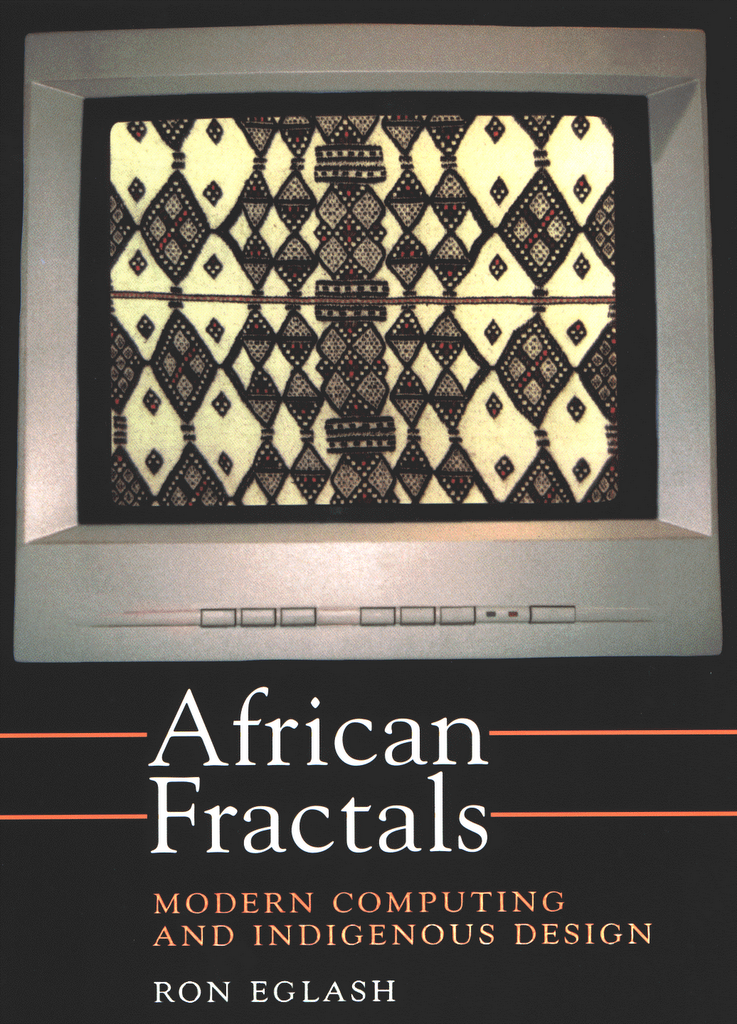 Abdul Karim Bangura reviews 'African Fractals: Modern Computing and Indigenous Design' by Ron Eglash:
Eglash's research began in the 1980s while investigating settlement architecture in Central and West Africa. Aerial photographs of various settlement compounds revealed that many were composed of circular structures enclosed in other circles, or rectangles within rectangles, and that the compounds were likely to have street patterns in which broad avenues branched into very small footpaths. As Eglash notes, at first he thought it was just from unconscious social dynamics. But during his fieldwork, he found that fractal designs also appear in a wide variety of intentional designs--carving, hairstyling, metalwork, painting, textiles--and the recursive process of fractal algorithms are even employed in African quantitative systems. Eglash adds that in the design rationales and cultural semantics of many African geometric figures, as well as in indigenous quantitative systems (additive progression, doubling sequences, binary recursion) and symbolic systems (iconic symbols for feedback loops, equiangular spirals, infinity), there are abstract ideas and formal structures that closely parallel some of the fundamental aspects of fractal geometry. These results, Eglash concludes, are congruent with recent developments in complex systems theory, which suggest that pre-modern, non-state societies were neither utterly anarchic, nor frozen in static order, but rather utilized an adaptive flexibility that capitalized on the nonlinear aspects of ecological dynamics.
Also mentioned at BazungaBucks
Distributed Leadership-Lessons for Grassroots African Democracy?
Marshall Ganz in an MIT lecture titled 'Distributed Leadership in the Obama Campaign' stated:
Leaders recruit, motivate and develop others, constructing a community around common interests, and building capacity from within the community. And unlike businesses, which tend to rely on rigid hierarchies, and systems and procedures, effective volunteer-based organizations must engage and enable lots of people to become innovators, adaptive in the face of uncertainty.
What could African democratic movements learn from the promise of organically grown grassroots organizations? Grandiose Parlor points us to a quote by Abba Kyari where he discusses options available to Nigeria's opposition parties:
There is no royal ride to success. The people properly enlightened, educated, mobilised and adequately led will reject and revolt against a situation that has all but enslaved them and condemned them to poverty. Sardines do not applaud their can.
Climate Change and Africa
 Katharine Vincent asserts that treating Africa as the victim in the Climate Change debate is wrongheaded:
It is true that at the continental scale Africa may suffer because of it is geographic and economic vulnerability. But branding Africa as a victim does a disservice to the many examples of small-scale resilience and adaptive capacity in evidence throughout the continent.
Furthermore, perpetuating the 'Africa as victim' myth runs the risk of deflecting attention away from a systematic investigation into how such resistive measures could be expanded to reduce vulnerability.
Standing on the Sun - New Rules of Capitalism
Quoting the authors who emphasize the power of the maker, open-source world view:

“Because we believe that in economies driven by innovation and growth, populated by digital natives, and not indoctrinated with regard to controlling intellectual property, such behavior will become the mainstream, not the fringe—and will confer an important advantage. Is it a dynamic that will come to characterize the entire economy? It’s hard to tell. Surely much collaboration will continue to be done explicitly, with clearly delineated contributors joining forces to achieve carefully architected outcomes.”Continuing:
This is the invisible handshake.This handshake has more power potentially in emerging economies, which is one of their main points. These new capitalist thinkers don’t have the US baggage of what a business or company should look like. This isn’t to say that some in the US can’t or won’t be as innovative, disruptive, and adaptive.
“It’s a little fanciful, but think of a 3-D printer as a seed. Plant one in a village. If it’s a RepRap seed (and you have the raw materials to fertilize it with), it will yield more seeds. And if there’s a network, the village can have access to all the designs in Neil Gershenfeld’s (MIT Center for Bits and Atoms) open source libraries—and everyone else’s. To sum it all up, if information can be free and if goods are just information plus resin, then goods can be pretty close to free.”