RSS
Menampilkan postingan yang diurutkan menurut relevansi untuk kueri Gbagbo. Urutkan menurut tanggal Tampilkan semua postingan

Gbagbo is pushing Ivory Coast to the brink of war

Laurent Gbagbo, Président de la République (Cô...Image via WikipediaChika Unigwe writing in the Guardian:

When, on 28 November – after Ivory Coast's elections had been postponed several times by the then president, Laurent Gbagbo – Ivorians took to the polls, there was a very real expectation that Gbagbo's government had come to an end. Unfortunately, they had miscalculated Gbagbo's determination to hang on to the post he had held since 2000 and which he – and his cohorts – see as his birthright...[continue reading]
Enhanced by Zemanta

  • Digg
  • Del.icio.us
  • StumbleUpon
  • Reddit
  • RSS

Côte d’Ivoire: The Difficult Legacy of Houphouët-Boigny

In Global Voices:
Left, Alassane Ouattara, right: Laurent Gbagbo.images by Stefan Meisel, copyright Demotix 
In order to better understand the origins of the current political crisis in Côte d'Ivoire, it is necessary to place recent events within the context of the post-colonial era.
Post-Colonial Politics
Félix Houphouët-Boigny was the first president of Côte d'Ivoire from its independence in 1960 to his death in 1993. Henri Konan Bédié, president of the national assembly succeeded the deceased president in accordance with the Ivorian constitution. In 1995, Henri Konan Bédié remained in power, having been elected with 96.44% of the vote.
Politician Laurent Koudou Gbagbo called a boycott of this presidential election due to reforms that had been implemented to the electoral code. He was elected as a member of parliament in his constituency after his party, the FPI (Ivorian Popular Front), won five of the eight seats in the elections.
General Robert Guéï overthrew President Bédié on December 24, 1999, after the latter attempted to change the constitution in his favor.
Presidential elections were then held in 2000 and Guéï was beaten by Laurent Koudou Gbagbo. The elections were marred however, by the elimination of several candidates by the Supreme Court including former president Bédié and politican Alassane Ouattara because of ”dubious nationality”, forgery and use of a false identity. During Ouattara's prime ministerial rule under President Houphouët-Boigny, Gbagbo was imprisoned as a political opponent in 1992 and sentenced to two years in jail, although he was released after seven months...[continue reading]
Enhanced by Zemanta

  • Digg
  • Del.icio.us
  • StumbleUpon
  • Reddit
  • RSS

Ivory Coast, the war against civilians

In the FP an Open Letter:
The Gbagbo mafia is struggling first and foremost for power; for an exclusive hold on power, for the very enjoyment of power, with all its attendant material benefits. How, one might ask, can civilians freely and openly express dissent when the thugs of the outgoing regime exact merciless reprisals against anyone expressing overt opposition or who is even suspected of voting for the wrong candidate?
More here
Enhanced by Zemanta

  • Digg
  • Del.icio.us
  • StumbleUpon
  • Reddit
  • RSS

"Ivory Coast desperately needs a healing figure..."

Craig Murray writes:
In the short term, military force might be able to install Ouattara as President of Ivory Coast. But the ethnic and religious divisions of the civil war have been reopened, and deepened. Ivory Coast desperately needs a healing figure, somebody who is not Ouattara or Gbagbo. Having been imposed on Abidjan by force, Ouattara will only stay there by force. The future looks bleak...[continue reading]
Enhanced by Zemanta

  • Digg
  • Del.icio.us
  • StumbleUpon
  • Reddit
  • RSS

What next for Ivory Coast?

Adekeye Adebajo in the Guardian:
The Republican forces loyal to Alassane Ouattara, the internationally recognised winner of Ivory Coast's election last November, are, as I write, in the final stages of a violent showdown in the capital, Abidjan, to oust the recalcitrant losing president, Laurent Gbagbo. This is proving to be a bloody last stand as the former history professor, Gbagbo, seems to have ignored the lessons of the past. In 1990 the Liberian autocrat Samuel Doe was captured by rebels in Monrovia and tortured to death; a year later the Somali strongman Siad Barre fled into exile as a rebellion approached Mogadishu; the Zairean despot Mobutu Sese Seko also fled his capital in 1996 as rebels approached.
More here
Enhanced by Zemanta

  • Digg
  • Del.icio.us
  • StumbleUpon
  • Reddit
  • RSS

Covering Cote d'Voire

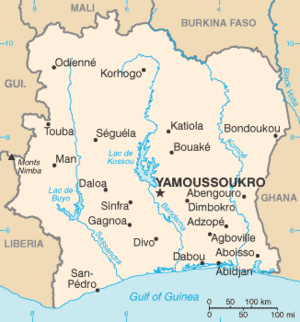
Map of Ivory CoastImage via WikipediaIn Sahara Reporters Gary K. Busch provides a contrarien view about the crisis in Ivory Coast:

The civil war which broke out between the North and the South in the Ivory Coast was largely about the efforts of the Gbagbo government seeking to achieve real independence; a breakaway from the colonial dominance of the French which controlled almost every aspect of national life. He had the support of the Ivorian people. However now, after all the fighting and suffering by both sides, the current policy of Gbagbo seemed to veer away from confrontation to a policy of restoring the status quo ante; French neo-colonialism. This didn’t work. It fostered is a level of bitterness and rancour among a people who were watching the yoke placed on their necks again and, despite their current apathy and discouragement after years of fighting and sacrifice, they realised that, North and South, they had nothing to lose by sweeping the board clean of their black Frenchmen and installing genuine Ivorian patriots in their place...[continue reading]
While Jordanna Matlon writing in Africa Report discusses the "high stakes" for southern loyalists:
In a country of long-term and soaring unemployment, these men found that their political activities gave them slight leverage in an atmosphere of otherwise dwindled opportunities. As one of my respondents astutely remarked, in a crisis-ridden Côte d’Ivoire, “the one business that works is politics.” Admittedly these men were far from gorging themselves off the fat of party politics. Instead, situated at the bottom of the hierarchy, they received little more than its crumbs. But crumbs – to appear as a guest speaker here, to get help to pay a medical bill or a child’s tuition there and to be relatively immune to the informalised state extraction in the form of the regular bribes – are all heavy incentives in the absence of gainful employment. Moreover, each speaker boasted of meeting warm congratulations after a speech, having his name called when walking down the street or being bought a beer from an admiring spectator he encountered when out on the town...[continue reading]
Enhanced by Zemanta

  • Digg
  • Del.icio.us
  • StumbleUpon
  • Reddit
  • RSS

Mugabe's survival and “liberation solidarity”

Peter Godwin in the NYTimes:
The parallels between Ivory Coast and Zimbabwe are striking: both were once viewed as the singular successes in their respective regions, the envy of their neighbors. Both Mr. Gbagbo, a former history professor, and Mr. Mugabe, a serial graduate student, are highly educated men who helped liberate their countries from authoritarian regimes.Both later clothed themselves in the racist vestments of extreme nativism. Mr. Gbagbo claimed that his rival Alassane Ouattara couldn’t stand for president because his mother wasn’t Ivorian; Mr. Mugabe disenfranchised black Zimbabweans who had blood ties to neighboring states (even though his own father is widely believed to have been Malawian)
 The invocation of "liberation solidarity"
Most of the political parties still in power in southern Africa were originally anti-colonial liberation movements — like those in South Africa, Mozambique, Namibia and Angola — and they tend to abhor the aura-diminishing prospect of seeing any of their fellows
More here

Enhanced by Zemanta

  • Digg
  • Del.icio.us
  • StumbleUpon
  • Reddit
  • RSS

Ivorians Should Fight it Out-Andrew Mwenda

Andrew Mwenda advocates a military solution between Ivorians:
I see no better way to destroy the entrenched corrupt elite interests in the body politic of the Ivorian state other than a protracted civil war. For war destroys old centres of power, discredits old forms of social control, undermines the legitimacy of old politics, etc. All these processes allow new and more enlightened forces to emerge and gain control. The most successful nations in Africa today – Ghana, Ethiopia, Rwanda and to an extent the early Uganda under Museveni – had all gone through this process of social shredding. It is this social shredding that Ivory Coast desperately needs.
Neither UN nor AU intervention is good for Ivory Coast. The best solution for that country is to allow Ouattara and Gbagbo to contest in the real court of effective state formation – the military. The winner will have to be the one who is able to organise people and mobilize resources to secure victory. Only an organisation with such capacity can reconstruct the Ivorian state. The UN and AU intervention may achieve short term humanitarian objectives. But this will most likely be at the price of disabling the mechanisms, however destructive in the short term, that can produce a durable solution.
More here


Enhanced by Zemanta

  • Digg
  • Del.icio.us
  • StumbleUpon
  • Reddit
  • RSS

Quick Hits

Why Haiti Remains Poor-The Root
Cote D’Ivoire: From grandiose lifestyle to Gbagbo’s madness-Ghana's Trash Basket
Learn about the mechanics of business and more, take a peek IFC's "SME Toolkit"
An indictment of a diminished culture-Zambian Economist
Africa needs more air routes
Venture funding for science-based African health innovation-BMC
Paul Collier reviews Dambisa Moyo's new book "How the West Was Lost".

  • Digg
  • Del.icio.us
  • StumbleUpon
  • Reddit
  • RSS

Gaddafi’s Demise, a Lesson for the African Union and Dictators

Jacob Sax Conteh writing in Cocorioko
After months of diplomacy led by President Koroma and others, it was the French that finally backed the forces loyal to Alassane Qattara, the legitimate leader of the country, to snuff the illogical and pompous Laurent Gbagbo from power. When the Libyan conflict started six months ago and the liberation fighters took over Benghazi, instead of taking an active role to mediate, the Union simply wanted the freedom fighter to surrender to Gaddafi. That made AU representatives very unpopular throughout the conflict.For Sierra Leoneans, the fall of Gaddafi should bring out celebration from all quarters. For years, the Libyan dictator has been meddling with Sierra Leone. During the Siaka Stevens regime, the rogue Libyan leader fermented trouble in Freetown when he saturated the city with his infamous Green Book and called for the overthrow of the government. Later, it was Gaddafi that trained Sierra Leonean terrorists Foday Sankoh, Sam Bockarie and Issa Sesay to cause unfathomable atrocities in Sierra Leone. To cover his tracts, the flamboyant bizarre leader visited Sierra Leone after the war and donated rice and cash to the defunct SLPP regime.
More here

  • Digg
  • Del.icio.us
  • StumbleUpon
  • Reddit
  • RSS