RSS
Menampilkan postingan yang diurutkan menurut relevansi untuk kueri Mwenda. Urutkan menurut tanggal Tampilkan semua postingan

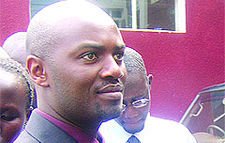
Museveni and Repression-Andrew Mwenda Arrested

The TED Blog reports on the recent arrest of Andrew Mwenda:

Reuters Africa is reporting that Andrew Mwenda and two other staffers of the Independent have been arrested by Ugandan officials. Reuters reports:
KAMPALA (Reuters) - Ugandan security forces on Saturday raided the offices of a magazine seen as critical of President Yoweri Museveni's government, arresting three journalists and taking computers, a lawyer said.
Read more >>

The story in the Independent has more detailed coverage of this second raid since the launch of the newspaper in October.

In March, Andrew Mwenda was named a Young Global Leader for 2008 by the World Economic Forum. Watch the recent BBC World Debate in which Mwenda participated at this year's TED.


For further coverage see Jen Brea's posting
And the Free Andrew Mwenda Facebook page here

  • Digg
  • Del.icio.us
  • StumbleUpon
  • Reddit
  • RSS

Andrew Mwenda's, Independent Online

The TED Blog reports the launch of Andrew Mwenda's paper:

You can now read journalist Andrew Mwenda's newspaper, The Independent, online. Based in Kampala, Uganda, the paper promises "uncensored news, views and analysis" -- a promise that has already led to government threats against the paper's printer.

  • Digg
  • Del.icio.us
  • StumbleUpon
  • Reddit
  • RSS

Mwenda on Traditional Aid


Recently detained Andrew Mwenda, addresses the Progressive party of Norway on Traditional Aid

  • Digg
  • Del.icio.us
  • StumbleUpon
  • Reddit
  • RSS

Mwenda on Museveni

While President Museveni laments about the ineptitude prevalent amongst his fellow African 'leaders' (he's ruled for 20 years mind you):

Museveni has said Africa is lagging behind in development because the leaders lack wisdom....Mr Museveni said he has been "struggling" with his counterparts and other leaders to appreciate that Africans need to export processed materials in order to benefit from international trade.
"Exporting raw materials is the greatest curse of Africa. How can it be that the leaders in Africa do not know what to do? Everything is upside down," Mr Museveni lamented.

Andrew Mwenda focuses on Museveni's own glaring leadership shortcomings:
I do not have any personal differences with President Museveni. On the contrary, I like the person of Museveni and I used to have good relations with him. Remember that I am a product of a lot of President Museveni’s teachings.
In his early speeches, he castigated African rulers for flying in executive jets when their populations walked on bare feet. Now he flies his daughters to Germany in executive jets to deliver babies when 98 percent of Ugandans depend on firewood for energy. My job as a journalist is to remind him of his first address to the nation, and hold him to account for his actions.
I disagree with Museveni’s politics, with the way he runs the country. I believe that he has increasingly come to treat the nation’s Treasury as his personal bank account and its physical assets as his family estate. The evidence is overwhelming: he personally has been giving preferred businessmen public funds and other assets without going through the formal institutions of state.

  • Digg
  • Del.icio.us
  • StumbleUpon
  • Reddit
  • RSS

Mwenda on Obama's Speech-"Stop the Lectures"

Andrew Mwenda writes in FP:

The lesson for Obama is that Africa is likely to get better with less meddling in its affairs by the West, not more -- whether that meddling is through aid, peacekeeping, or well-written speeches. Africa needs space to make mistakes and learn from them. The solutions for Africa have to be shaped and articulated by Africans, not outsiders.

More here.
Reblog this post [with Zemanta]

  • Digg
  • Del.icio.us
  • StumbleUpon
  • Reddit
  • RSS

Ivorians Should Fight it Out-Andrew Mwenda

Andrew Mwenda advocates a military solution between Ivorians:
I see no better way to destroy the entrenched corrupt elite interests in the body politic of the Ivorian state other than a protracted civil war. For war destroys old centres of power, discredits old forms of social control, undermines the legitimacy of old politics, etc. All these processes allow new and more enlightened forces to emerge and gain control. The most successful nations in Africa today – Ghana, Ethiopia, Rwanda and to an extent the early Uganda under Museveni – had all gone through this process of social shredding. It is this social shredding that Ivory Coast desperately needs.
Neither UN nor AU intervention is good for Ivory Coast. The best solution for that country is to allow Ouattara and Gbagbo to contest in the real court of effective state formation – the military. The winner will have to be the one who is able to organise people and mobilize resources to secure victory. Only an organisation with such capacity can reconstruct the Ivorian state. The UN and AU intervention may achieve short term humanitarian objectives. But this will most likely be at the price of disabling the mechanisms, however destructive in the short term, that can produce a durable solution.
More here


Enhanced by Zemanta

  • Digg
  • Del.icio.us
  • StumbleUpon
  • Reddit
  • RSS

Mwenda on Obama's Speech-"Stop the Lectures"

Andrew Mwenda writes in FP:

The lesson for Obama is that Africa is likely to get better with less meddling in its affairs by the West, not more -- whether that meddling is through aid, peacekeeping, or well-written speeches. Africa needs space to make mistakes and learn from them. The solutions for Africa have to be shaped and articulated by Africans, not outsiders.

More here.
Reblog this post [with Zemanta]

  • Digg
  • Del.icio.us
  • StumbleUpon
  • Reddit
  • RSS

Wealth creation is an Active process-Andrew Mwenda

Andrew Mwenda wrote in 2008:

Wealth creation is an active process. If we accept it as Africa’s challenge, it would follow logically to ask: who are the wealth seeking and wealth creating agents in society? The answer is: Private Enterprise! Enterprising people are always a minority, but the rule of capital is that it only survives by multiplying and multiplies by creating jobs and therefore incomes for many and taxes which governments use to provide social services – clean water, health and education to the poor. To be politically incorrect, the solution for Africa may be to invest in the enterprising few and make them richer. That will have laid the foundation to end the misery of the poor majority.
More here

  • Digg
  • Del.icio.us
  • StumbleUpon
  • Reddit
  • RSS

"Taking a New Look at Africa"-Andrew Mwenda


At TED Global Andrew Mwenda "...argued that aid makes objects of the poor -- they become passive recipients of charity rather than active participants in their own economic betterment...Too much of the aid from rich nations, he says, goes to the worst African countries to fuel war and government abuse. Such money not only never gets to its intended recipients, Africa's truly needy it actually plays a part in making their lives worse..."

  • Digg
  • Del.icio.us
  • StumbleUpon
  • Reddit
  • RSS

Debt Relief a Moral Hazard

Andrew Mwenda makes a case for turning off the Aid spigot:

“The best thing the West can do is nothing,” he says...“White society is being blackmailed. The white world looks at Africa from a position of guilt,” he told a seminar at IPN, the London think tank. The beneficiaries of aid are governments, politicians, the staff of aid agencies and charities, he says. Head in hands in mock despair, he reels off a list of “charities” that sprang into being when the Global Fund to Fight Aids, Tuberculosis and Malaria began to disburse its millions. “There was Children of Hope, there was Hope for Children, there was Help the Children.”
Continuing...
Aid is the problem, not the solution, he says. Debt relief is a Moral Hazard. What is the incentive for country “A” to continue paying interest on its borrowings if country “B” steals the money, defaults and then gets debt relief.

“Countries that are deserving don’t get aid,” says Mr Mwenda. Aid creates the wrong incentives, he argues. It makes objects of the poor, passive recipients of charity rather than active participants in their own economic betterment. Africans don’t need handouts, they need better institutions, land reform and access to cheap mortgages.

via TimesOnline

  • Digg
  • Del.icio.us
  • StumbleUpon
  • Reddit
  • RSS

Why is Africa Poor?

Chris Blattman writes and asks for suggestions:

That's the (informal) course title for my spring undergraduate lecture. Turns out that's too long and rambling a name for a transcript, and so the Yale powers that be had me shorten it to the duller, "African Poverty and Western Aid"...What can the West do? The course has students read the new canon of development: Sachs, Collier, Easterly, Rodrik, etc. Putting it together, I was struck with the preponderance of rich white male academics. Don't get me wrong. I aspire to be a rich white male academic myself (I am 3 for 4--and only held back from that goal by the preponderance of student debt). But it would be nice to have other perspectives.

So the course is now set up to read other points of view--mostly, admittedly, rich black male perspectives--and think critically about the new canon. Ayittey, Ake, Ekeh, Sawyer. Mamdani, Ndulu, Wainaina. Mwenda, Mkandawire and Soludo. And some optional Franz Fanon, just to appease Chris Udry...[continue reading]
Reblog this post [with Zemanta]

  • Digg
  • Del.icio.us
  • StumbleUpon
  • Reddit
  • RSS

What Would the Poor Say?

Excerpts from participants at a recent Development Research Institute conference:

Yaw Nyarko:
"No nation has ever developed because of aid and outside advice"
.
Andrew Mwenda:
“Aid money makes African governments accountable to the aid agencies rather than to their own people.”
June Arunga:
"Aid money is diverting African skilled professionals away from private enterprise to writing proposals for NGOs.”

  • Digg
  • Del.icio.us
  • StumbleUpon
  • Reddit
  • RSS

What is the Role of African Governments?-Dambisa Moyo

Damibisa Moyo on Charlie Rose, echoing Andrew Mwenda and others:

  • Digg
  • Del.icio.us
  • StumbleUpon
  • Reddit
  • RSS

Africa Must Fix Itself:China and the West Won't Do It

Andrew Mwenda writes in the WashingtonPost:

More aid to Africa, whether it comes from the West or China, should not give us too much hope because, at root, foreign aid is an ineffective instrument that distorts recipients' incentives for the worse. Aid is given with the assumption that its recipients lack the necessary resource base to generate tax revenue to meet their public expenditure needs. Yet in many African countries, the problem of insufficient tax revenue is caused by poor tax administration, bad policies, and institutions that undermine growth. Then, once taxes come in, there is poor prioritization of expenditures.

via AfricaWorks

  • Digg
  • Del.icio.us
  • StumbleUpon
  • Reddit
  • RSS

Lesson for Uganda from Tunisia’s crisis

Andrew Mwenda writing in the Independent:
...the Museveni administration is nourishing the social forces that have the potential to bring it down. Economic growth has led to an education explosion and rapid urbanisation. Add liberalisation of the economy which is spreading new communication technologies to the far reaches of the country. The mobile phone has penetrated every village; our country has over 200 private FM radio stations, 20 private television stations and 2.5 million people use the internet.
These developments are putting increasing strains on our body politic. As people get more educated and urbanised, they get more access to mass media. This expands their horizons. Yet the rate of economic growth is outpaced by growth in aspirations. The mismatch between expectations and opportunities breeds social frustration – hence the growth of militancy. The structural and technological foundations for democratic politics are therefore being laid; and the struggle for participation is only going to intensify.
More here
Enhanced by Zemanta

  • Digg
  • Del.icio.us
  • StumbleUpon
  • Reddit
  • RSS

Africans and Revolutions

Events in the Maghreb and Middle East are focusing attention on similarly moribund regimes and ruling classes south of the Sahara.We start with Akin who contends that "We are not suited for the usual revolutions":
Nigeria is by no means ripe for a revolution, there are no components in place to make it the success we desire with blind optimism, we can do well to educate ourselves, participate fully in the democratic process we have, deign to hold the elected accountable and become better and coherent activists that demand positive action or expect the said leaders to resign in disgrace.
Over to the CS Monitor where they pose the question "Why Tunisia's winds of change aren't blowing south to sub-Saharan Africa?".Reasons given include,weakness of civil society:
“In the absence of strong class identities, many African oppositions fail,” says Professor Mbembe of Witwatersrand University in Johannesburg. “If people identified as dispossessed and poor, then of course the majority would rebel against many nations of Africa. But people identify with ethnic affiliation, and so they remain quiet, or they rebel on a smaller scale and are easily dealt with.”
While over at 3QuarksDaily Robert P. Bair titles his post "TUNISIA, EGYPT, UGANDA?". Drawing upon a thread that paints a different picture to the seemingly placid societal dynamics in that east African country:
Andrew Mwenda and Charles Onyango-Obbo, two respected political commentators here, have both suggested that Museveni has already constructed the same kind of economic-demographic trap that brought down Ben Ali. They argue that too many educated youth, not enough jobs, and an environment of thoroughgoing corruption have set the stage for a revolutionary aggregate of dissatisfaction.
Africa's youth bulge
The primed powder keg that just exploded in the MENA region had an attribute that a good portion of Africa shares,a rapidly urbanizing, growingincreasingly educated and restive youth bulge.Furthermore this largely under/unemployed population is experiencing one of the fastest mobile communication growth rates in the world.In other words they arent as isolated from the news as some would like to think.Add these points up plus the fact that up until Tunisia and Egypt, passivity and apathy were considered unique to Arabic speaking countries. One would hope that for the sake of misgoverned African populations those perceiving innate inertness are wrong again.
Update: The Arab to Africa revolt meme continues with Tristan McConnell's piece "African leaders are warily watching Egypt"
Update 2 World bank "Africa has the largest share of young people" invest in them or reap the whirlwind:

Update 3 Meanwhile inhabiting a parallel universe "Far from revolts, African leaders talk shared values"
Update 4 Why Some African leaders are smiling at the storm in North Africa
Update 5 Young Sudanese Start Protest Movement
Update 5 Gabon: The Invisible Revolt
Update 6 A revolution is Coming-The Book
Update 7 Now that Egypt's Mubarak is out, could Gabon's Bongo be next?
Enhanced by Zemanta

  • Digg
  • Del.icio.us
  • StumbleUpon
  • Reddit
  • RSS

Africa is Democratising: Here is how

Andrew Mwenda contends that:

The most enduring democratic reforms in Africa over the last two decades have not been in the sphere of politics but the economy. Governments across our continent have liberalised our economies, privatised public enterprises and deregulated economic activity. These reforms have created sufficient economic freedom and with it, the structural and technological foundations of democracy are growing.
The growth of the private sector in Uganda, for example, is creating opportunities for many professional Ugandans outside of the state. Those who work for private companies have greater space to speak their minds than state employees. The spread of internet and telecommunications is rapidly liberating information flow from state control. The boom in education is producing an enlightened population who are using Facebook, Twitter, Linked-in and other social networking sites to debate public policy.
More here
Enhanced by Zemanta

  • Digg
  • Del.icio.us
  • StumbleUpon
  • Reddit
  • RSS