RSS
Menampilkan postingan yang diurutkan menurut relevansi untuk kueri Industrialization. Urutkan menurut tanggal Tampilkan semua postingan

Framework for Industrialization

Google Booksearch describes Framework for Industrialization in Africa By Thomas A. Taku:

This practical, solutions-oriented approach to African development provides a detailed overview of the steps needed for industrialization. It includes lessons from the developed world as well as descriptions of key facets of Africa's current environment

  • Digg
  • Del.icio.us
  • StumbleUpon
  • Reddit
  • RSS

Industrialization: Recipe for jobs and Wealth Creation

Bienvenu-Magloire Quenum of Africa Biz Online writes that the "...The industrialization process will create a larger consumers' base in each African country with higher purchasing power. Therefore, the dependence towards overseas markets would be less important in a first stage. Otherwise, selling raw agricultural products - cotton, coffee, cacao beans to name the few, will lead SSA countries to a dead end of continued poverty. Negotiation rounds at the World Trade Organization will not give any reprieve to African farmers. The solution is to process the agriculture products to satisfy national market first and second African regional markets. Overseas markets coming as a last conquest...".Intra-regional trade largly informal and unsupported is centerpiece to rebuilding a viable trading ecosystem.

  • Digg
  • Del.icio.us
  • StumbleUpon
  • Reddit
  • RSS

Industrialization and Sub-Saharan Africa:The Asian Experience

Charles C. Soludo wrote;

It is evident that the development challenge facing Africa requires major strategic, creative thinking. The SSA needs to do certain things very differently, but the question is how? A dominant view is that the best chance of sustained development in Africa should be pursued within the framework of a growth-promoting and market-accelerating model, but which is human-centred to address the pervasive poverty of the region...
With regard to specific area of strategies for rapid industrialization, several questions emerge. For example, where would Africa’s comparative advantage lie in the future, and how can such comparative advantage be “created” — a la the Asian way — without being constrained by the GATTified world? Should Africa start small (with little things that have lost competitiveness, and as Ojimi(Yoshishisa Ojimi a former vice-minister of MITI) argued in the case of Japan — areas that have lowest productivity and lowest returns), or, should it go high-tech. and seek to compete all the way? In the latter case, how would SSA do it, and with what technology and market penetration strategies?
It has become fashionable to suggest diversification of the export base into manufactures, but the challenge is to demonstrate how such an option is viable and that chosen sectors/products are potentially competitive. In essence, while it is important to learn how the Asians dealt with the past, it is even more important to understand how some of the countries (especially those in “transition”) are coping with current constraints and opportunities. For example, a lot of lessons could be learnt from other emerging industrializers (e.g., China, Vietnam, etc.) in terms of their innovations in interpreting and exploiting the provisions of the GATT/WTO and their strategies for “economic diplomacy.”
via IDRC

  • Digg
  • Del.icio.us
  • StumbleUpon
  • Reddit
  • RSS

Gratis Foundation & Industrialization

rack and pinion gears
"...The Gratis Foundation exists to promote industrialization by developing and disseminating technology to industry,particularly small and medium-scale enterprises...it evolved out of the Ghana Regional Appropriate Technology Industrial Service...To accomplish this mandate, GRATIS established Intermediate Technology Transfer Units (ITTUs) now designated Regional Technology Transfer Centres (RTTCs) in nine regions of Ghana to transfer appropriate technologies to small-scale industrialists through training, manufacturing and the supply of machine tools, plants and equipment..."-website

  • Digg
  • Del.icio.us
  • StumbleUpon
  • Reddit
  • RSS

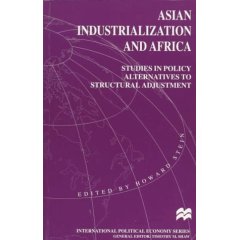
Asian Industrialization and Africa

Reviewed by Saha Santosh, Asian Industrialization and Africa is a collection of essays that offer a "directional" approach to achieving industrial growth within the continent. E. Wayne Nafziger's case study states the following:
"...Japan learned a lesson in the 1870's that many contemporary African countries have still not learned or only learned recently:that importing replicas of Western institutions and capital intensive technology may exacerbate unemployment and balance of payments problems if the local country lacks the capital and skills needed...Meiji Japan imitated,borrowed from, and modified techniques and approaches from advanced Western economies. Aquestion today is: Can Sub-Saharan Africa be as successful emulating,borrowing, and adapting innovations and procedures from the West and Japan?If anything, the contemporary Sub-Sahara has to be even more cautious than Meiji Japan in importing foreign capital and technology. Since present-day Sub-Saharan countries are even more technologically backward relative to the most technologically advanced economies than Japan was relative to the West in the late nineteenth century,it is probably more difficult to adapt technology to local conditions and indigenous production.For example some foreign productivity-raising textile technologies available to early developing Japan were labor-using while most technologies for today's latecoming Sub-Saharan African countries are labor-saving..."

  • Digg
  • Del.icio.us
  • StumbleUpon
  • Reddit
  • RSS

Industrialization As a Tool for Job Creation in Nigeria

From Africa Industrialization Day where Thomas Mattig of Friedrich-Ebert-Stiftung in conjunction with the Garment and Tailoring Workers of Nigeria stated:
Nigeria is experiencing solid economic growth for several years now. However, employment remains low and can hardly catch up with population growth. The sectors of the economy that are booming such as the banking, telecommunications and insurance industries, do not create many jobs.
 continuing:
...even a large bank branch will only employ a handful of people, while a factory can give employment to a whole town.
regarding the oil industry:
The prosperous petroleum sector is built virtually on extraction and not value addition as Kaduna, Warri and Port Harcourt refineries remain comatose.
and the critical informal sector:
It is also widely acknowledged that the informal sector provides over 70 percent of employment in the country, yet many workers daily face harassment and intimidation from Government officials at all level whilethere is no systematic programme of training and re-training in the face ofchanging technologies and market dynamics, credible programmes ofaccess to credits as well as decent workspaces.. This must change, workersin the informal economy need state support in capacity building, finance and patronage and social protection.
More here
via All Africa

  • Digg
  • Del.icio.us
  • StumbleUpon
  • Reddit
  • RSS

Industrializing Africa

Gregory Clark questions Jeffery Sach's Millenium Project:

The long history of living standards suggests that the Sachs plan is more likely to further impoverish Africa than enrich it. The promised health improvements and one-time gains in crop yields cannot create sustained improvement of living conditions.
Industrializing Africa is the only way to solve its poverty. The industrialization of coastal China — accompanied by declining public health provision, a neglect of agriculture, and environmental degradation — ultimately transformed the lives of the Chinese

via AltNigeria

  • Digg
  • Del.icio.us
  • StumbleUpon
  • Reddit
  • RSS

An appeal to African Elites for Cottage Scale Industries

In 1999 V. K. Desai of TinyTech Plants wrote:

I have painfully observed that most of the elite class of every African country is under illusion that model of development and progress imposed on them by developed countries is correct and path of development and progress shown by developed countries is real path. So all the Governments of Africa follow the same pattern of development as Europe and U.S.A. followed. So every African country is trying to establish big industries, is trying to develop highways, cities, power stations, ports, airports and infrastructure required by giant industries...If you want homogeneous development and progress of entire society of millions of masses,you have to evolve your own economic strategy based on local self reliance at least for primary needs of people i.e. for food, cloth and shelter. Very evidently this type of local self reliance can be achieved through cottage scale family size industries based on small and simple technology...[continue reading]

Reblog this post [with Zemanta]

  • Digg
  • Del.icio.us
  • StumbleUpon
  • Reddit
  • RSS

The Deep South & Northern Nigeria, A Parallel?

Pius Adesanmi writes in Sahara Reporters:

The lack of exclusive dependence on illegal slave labor and plantations by the North created a pluralistic conceptualization of the material base of society in that part of the United States. This in turn led to a diversification of the sources of wealth creation and a boundless spirit constantly seeking more diverse ways of societal progress and advancement that would later eventuate in manufacturing and industrialization. Theirs was a philosophy of building society yourself...[continue reading]
Photo courtesy of Sahara Reporters

  • Digg
  • Del.icio.us
  • StumbleUpon
  • Reddit
  • RSS

Traditional Gun Manufacturer's vs Bureaucrats

Togbui Kwaku Ahiam IV makes a case (view video) for supporting local gun manufacturer's. Another case of us throwing the baby out with the bathwater? Reread if you have not already "How Africa Missed its Industrialization"
via Africa News

  • Digg
  • Del.icio.us
  • StumbleUpon
  • Reddit
  • RSS

Selections from the New Book Making Do

In The Atlantic excerpts from the Steve Daniels book Making Do:


Images by Steve Daniels

Leonard is one of millions of entrepreneurs who rely on informal mechanisms in Kenya, where the informal sector comprises a full three quarters of the non-agricultural economy and produces over 90 percent of new jobs annually. Under severe material constraints, they are forced to improvise solutions to everyday problems that, from time to time, result in game-changing innovations that better address local needs. Informal artisans who engage in the production of goods are known as jua kali (Swahili for "hot sun") and have established entire ecosystems of production, from scrap sourcing to repair. The most advanced jua kali like Leonard have designed and built capital goods, such as lathes, that propel indigenous production forward. The jua kali have been largely ignored by formal institutions, regarded as a second-rate economy. Yet their drive for innovation, understanding of indigenous networks, and ability to work under extreme constraints make them ideal agents of industrialization.
More here
Enhanced by Zemanta

  • Digg
  • Del.icio.us
  • StumbleUpon
  • Reddit
  • RSS

The Challenges of Informal Economies

In Foreign Affairs Nicolas van de Walle reviews Kate Meagher's new book "Identity Economics: Social Networks and the Informal Economy in Nigeria":

Within development circles, conventional wisdom has it that successful manufacturing sectors often develop in low-income countries thanks to identity-based social networks made up of producers working together. These networks are said to generate the social capital that can be used to overcome many of the shortcomings of underdevelopment. Meagher's careful study of two such networks in southwestern Nigeria -- of small, undercapitalized garment and shoe manufacturers -- suggests that the advantages for producers within the networks are being undermined by an increasingly dysfunctional state. Meagher shows that these networks, whose roots go back to the colonial era, bring in hundreds of millions of dollars in revenue and export their goods to states throughout West Africa. But in recent years, they have proved vulnerable to Asian imports and have largely failed to develop economies of scale, invest in new machinery, or generate new lines of production; these networks, it turns out, stifle innovation and consolidation, even as they protect their members. Informed by theory as well as sustained fieldwork, Meagher's study is a useful antidote to the purveyors of magic-bullet solutions for African development. It should be read by anyone interested in Africa's industrialization.
via Loomnie
Enhanced by Zemanta

  • Digg
  • Del.icio.us
  • StumbleUpon
  • Reddit
  • RSS

The Deep South & Northern Nigeria, A Parallel?

Pius Adesanmi writes in Sahara Reporters:

The lack of exclusive dependence on illegal slave labor and plantations by the North created a pluralistic conceptualization of the material base of society in that part of the United States. This in turn led to a diversification of the sources of wealth creation and a boundless spirit constantly seeking more diverse ways of societal progress and advancement that would later eventuate in manufacturing and industrialization. Theirs was a philosophy of building society yourself...[continue reading]
Photo courtesy of Sahara Reporters

  • Digg
  • Del.icio.us
  • StumbleUpon
  • Reddit
  • RSS

Is Africa is Becoming the New Asia?

Jerry Guo reporting from Newsweek:

Many experts believe Africa, with its expansive base of newly minted consumers, may very well be on the verge of becoming the next India, thanks to frenetic urbanization and the sort of big push in services and infrastructure that transformed the Asian subcontinent 15 years ago. Just as India once harnessed its booming population of cheap labor, Africa stands to gain by the rapid growth of its big cities. Already the continent boasts the world's highest rate of urbanization, which jump-starts growth through industrialization and economies of scale. Today only a third of Africa's population lives in cities, but that segment accounts for 80 percent of total GDP, according to the U.N. Centre for Human Settlements. In the next 30 years, half the continent's population will be living in cities.
More here
Reblog this post [with Zemanta]

  • Digg
  • Del.icio.us
  • StumbleUpon
  • Reddit
  • RSS

Mayan Civilization Destroyed by Man Made Global Warming?

David Stahle, a geoscientist at the University of Arkansas, Fayetteville,  has just published a new study which used tree rings to add many hundreds of years to the region's climate record and has discovered that the Mayan civilization faced a severe drought for 25 years around the year 900 and accompanied the end of a flourishing era of Mayan city-states. This intense and prolonged drought was worse than anything ever seen in modern meteorological records, but the key question is, was this drought caused by human activity such as industrialization and the driving of SUV's?

"Clearly the drought in 1400 was not caused by the accumulation of heat-trapping gasses in the atmosphere because it precedes the industrial revolution," Stahle said. "But something caused it that stimulated very unusual climate conditions elsewhere in the world. This may allow us to determine the dynamics of drought-forcing over Mexico."
Although it may clear to this researcher that the industrial revolution is not behind the draught that led to the fall of the Mayan civilization, I am sure there are many other scientists who remain convinced that human activity controls climate patterns and that the best way to have regular and positive climate patterns is then to control humans. To be honest, I'm surprised that this tree ring data wasn't manipulated like other tree ring data to demonstrate global warming and therefore create a 'consensus' in favor of environmentalfasism.

Other findings from the study are that
...one of the most severe periods of drought occurred between 897 and 922, the researchers reported in the journal Geophysical Research Letters, just as the Terminal Classic period (of the Mayans) came to an end. Another 19-year drought around 1150 coincided with the fall of the Toltec state, which was the dominant civilization of central Mexico at the time. The most severe drought of the last 1,000 years, which lasted from 1378 to 1404, actually occurred though during a period of rapid Aztec expansion (possibly due to the weakness of other states?). (Also) a drought from 1514 to 1539 led up to and continued through the arrival of Cortez and the Spanish conquest. It's possible, the researchers speculate, that the climate, along with epidemic disease, led to the rapid decline of Aztec Mexico as the Colonial period began.
It is becoming increasingly clear to me that the climate of the entire globe is an incredibly complicated issue that is beyond the understanding or computer modeling of humans today. That isn't to say that we should not be environmentally friendly- on the contrary, the best way to protect the environment is to continue to build stronger and stronger private property rights within society and vigorously oppose efforts by governments to violate private property rights and thereby increase the tragedy of the commons. But this is to say that the Mayan civilization was clearly not destroyed by man made global warming.

  • Digg
  • Del.icio.us
  • StumbleUpon
  • Reddit
  • RSS

Industrialisation from the Bottom-up

Bright B. Simons writes:

...one thread runs through the post-colonial experience of African industrialization. Upon attaining independence, most African states rushed to implement industrial policies that vastly overstated the capacity of existing infrastructure, market development, and sometimes even managerial and technical resources...Frequently the drive towards installing manufacturing capacity was fuelled by the grandiosity of political dreams and the strategies themselves were usually left to the smothering care of hand-wringing bureaucrats.

He hopes that the enhancement of 'Suame Magazine' an informal industrial cluster covered earlier initiates the process of reversing the failed top-down philosophy:
Suame is a major suburb in Kumasi. "Suame Magazine" (SM) is a huge sprawl somewhat plastered centrally across a huge swathe of Kumasi's middle. As far as most folks can remember, SM has been an amazing labyrinth of garages, workshops, tool shacks, machine mini-marts, outdoor laboratories, greasy foundries, and assorted furnaces-on-wheels. It is a place awash with urban myth, and steeped in a changeless flux of activity. What that means is that the hum may never stop, yet regardless how long one stays away, on return SM always feels and looks the same...The long-term strategy of SMIDO is to turn Suame Magazine into an industrial village befitting the 21st century...[continue reading]

photo courtesy of travelwebshots

  • Digg
  • Del.icio.us
  • StumbleUpon
  • Reddit
  • RSS

Despite Debt Relief, Poor Nations Back In the Red

Let us not pretend to be suprised by this, a number of assessments have warned about the futility of debt relief policies.

The report by the Washington-based Independent Evaluation Group (IEG) says that in half the countries that received debt relief under the programme known as the Highly Indebted Poor Countries (HIPC) initiative, debt has in fact climbed back up to where it was before the debt relief plan.So far, the HIPC initiative has eased 19 billion dollars of debt in 18 countries, halving their debt ratios. However, the IEG found that in 11 of the 13 countries the report studies, and which graduated from the programme that qualifies them to start receiving debt forgiveness, called the completion-point, external debt has actually risen.
Wealth creation,industrialization and broad culture of ownership are the keys to climbing out of poverty.The sooner Sub-Saharan Africa accepts that this inescapable fact relates entirely to self-reliance the better.

via DENIAfrica

  • Digg
  • Del.icio.us
  • StumbleUpon
  • Reddit
  • RSS

Accelerating Industrialisation

A Goldman Sachs report highlights the quickening pace of industrialization worldwide.It states:

That the pace of development in today’s emerging economies is accelerating, intensifying the speed with which the associated changes in demand in those economies occur.The result is said to be a “compressing of the development process, with unprecedented levels of infrastructure investment squeezed into a shorter timeframe than occurred in already-developed economies, followed by a more rapid transition into consumer economies.”

via Ft Alphaville
What may the significance of this be for under-industrialized Africa?
Zemanta Pixie

  • Digg
  • Del.icio.us
  • StumbleUpon
  • Reddit
  • RSS

Just who exactly are 'The People'? Völkisch!

On this blog and around the internet, 'The People" is one of the most frequent justifications that are provided by liberals and Democrats for taxing the rich, forcing people to join a healthcare plan, stopping a mining company from mining for minerals on land that it purchased, and generally controlling people's choices and taking away their property.

So just who exactly are 'The People' who benefit when those who are successful are forced to pay higher tax rates when their investments do well or who gain when oil companies are not allowed to safely drill for oil?

I'm sure they don't mean that humanoid extraterrestrials who have paranormal powers will benefit- that would just be silly. (Zenna Henderson?)

What these liberals and Democrats usually mean when they cite 'The People' is that the so-called national community will benefit when the state gains the power to take away peoples property and choices, and that for the good of the people we need to return back to the land through green living and urban farming, lead more self-sufficient lives, and fight back against Big Business which is grinding us under its crushing foot of industrialization. Liberals and Democrats believe that 'The People' will benefit from an enlightened government that helps to progress society, and if this means that the principles of the free market or even popular elections are broken, than so be it- the People are more important than these concepts.

To liberals and Democrats, 'The People' mean the proletariat and traditional middle classes- union workers- who will benefit from a more government that is more progressive and friendly to workers.

As someone famous once said, when liberals talk about 'The People', they are talking about the basic ideas of a national government based on building social safety nets for 'The People' because 'The People' are the national government of progressive socialism.

The way that liberals throw around 'The People' is not new- in fact, the concept was pretty well established by the early 1900's. The German's called the concept of 'The People' the Völkisch movement, and it was one of the motivating factors behind Adolf Hilter and his fascist Nazi national socialist progressive party, which attempted to co-opt private industry for the good of 'The People' in order to provide national socialized healthcare, make people eat healthier food, make industries produce goods for the good of the state, and support the workers with strong union rights in a Big Business-Big Union-Big Government partnership.

What is old is new again, and we have been down this path before, so just be careful that you know what you mean when you start throwing around the term 'The People' in the future.

  • Digg
  • Del.icio.us
  • StumbleUpon
  • Reddit
  • RSS

"Poverty a Bigger Problem Than Global Warming"

China states what many in the developing world feel, but have been uncomfortable to voice publicly,this and the developing green protectionism gives food for thought:

Most developing countries are in the process of industrialization and urbanization, and they face the arduous task of poverty reduction," Zhang (Vice Foreign Minister) said. "So they need a large period of time for continuous energy demand growth with the growth of greenhouse gas emissions.

  • Digg
  • Del.icio.us
  • StumbleUpon
  • Reddit
  • RSS