
Kofi Akosah-Sarpong writes:
Prof. Ali Mazrui’s address at the 30th anniversary celebration of the Dakar, Senegal-based CODESRIA on the theme “Intellectuals, Nationalism and the Pan-African Ideal” reveals the growing talks, African-wide, about the implications of the African culture and the continent’s development process. The central theme of Mazrui, currently Chancellor of Kenya’s Jomo Kenyatta University of Agriculture and Technology, address is twofold. Why African intellectuals are mediocre and why this informs their inability to appropriate Pan-Africanism ideals into Africa’s development process. I would prefer why African elites have not being able to appropriate African cultural values into Africa’s development process as other elites in other parts of the world have done in their development process.
Using the East African region as a continental reference, Mazrui, known globally as one of Africa’s leading thinkers, reveals how undemocratic political climates undermined Africa’s intellectual growth, and how, by extension, this impacted on the continent’s development process. Unlike other ex-colonies, such as Japan, of which Mazrui used greatly as an example to show how African elites failed to match their Western education with their African values in both their intellectual development and the continent’s progress, the trouble with African elites and the continent’s development process is that, the elites play with ideas are not informed by Africa’s innate, indigenous values or ideas by rather the Western ideas that they have had in formal schools.
Mazrui himself shows this contradicting and confusing state of the African elites in this statement: “Uganda had for Head of Government a person who had changed his name because of admiration of the author of the great English poem, Paradise Lost. Obote became Milton Obote out of admiration of John Milton.” While in the spirit of universal intellectuality Obote could admire Milton, his admiration for a non-African poet and the fact that he is a Head of State, may have let Ugandan and African youth to admire more non-African elites than indigenous Ugandan and African elites. The central issue here is role model, values, and inspiration in the development process. In this sense, Obote did not deeply help the growth of African values and her progress. If Obote had done so, and by implications of Mazrui’s own account of the mediocrity of African intellectuals, and greatly touted a non-African value not because he was educated in Western paradigms but, like most African elites, because either he did not understand African values deeply enough or was mesmerized by Western values or did not respect African values or was confused about African values in relations to the continent’s progress.
Still, Mazrui’s argument that “The capacity to be curious and fascinated by ideas has to start early in the educational process. The spirit of intellectualism has to be nourished from primary school onwards, but it can die at the university level if mediocrity prevails,” reveals that the problem of Africa’s intellectual growth is not only at the university level but also at the primary school level; where the values, images and examples which are heavily European-centred are formed. So, if the African primary education system is heavily Western structured, it flows and grows to the high school level, and then later to the university level; thus sowing a culture of mediocrity, in terms of African values not predominantly dictating the intellectual life of the African child early enough. It is in this sense, that Ghana’s Dr. Y.K. Amoako, the former UN Economic Commission for Africa executive secretary, has observed that Africa is the only region in the world where foreign development paradigms dominate her development process. Not only does this indicate that Africa’s development process is not “culturally close” to Africans, but also a revelation that African elites are mediocre in both their intellectualizing and their direction of the continent’s progress.
This has made the African elite mediocre in their own innate environment and in their development process struggles. The mediocrity has come about because Africa’s elites do not think deeply from within Africa’s values first and the enabling aspects of their colonial legacies second in the continent’s development process. Mazrui himself testify of the Japanese elites doing so in their country’s development process. “In this connection it is worth bearing in mind important differences between the westernization of Africa and the modernization of Japan after the Meiji Restoration of 1868. Japan’s original modernization involved considerable selectivity on the part of the Japanese themselves (“Western Technique, Japanese Spirit”). The whole purpose of selective Japanese westernization was to protect Japan against the West, rather than merely to submit to western cultural attractions. The emphasis in Japan was therefore on the technical and technological techniques of the West, rather than on literary and verbal culture. The Japanese slogan of “western technique, Japanese spirit” at the time captured this ambition to borrow technology from the West while deliberately protecting a substantial part of Japanese culture. In a sense, Japan’s technological westernization was designed to reduce the danger of other forms of cultural dependency.”
This process should starts from childhood to adulthood based on a curriculum skillfully cast in African values first and any other borrowed ones second; more especially, in preparing African elites’ minds at an earlier stage: from primary and high schools levels. It is in this process that African elites, from their early formation to their university crystallization, will be “culturally close” to the African society, will be culturally close to the African’s progress in the continent’s development journey. By not being culturally close to the African society, African elites could not undertake the Japanese cultural selectivity in relations to their colonial legacies and the enabling aspects of the global culture, and, have, therefore, become both heavily technologically and culturally dependent upon the Western world despite their superb innate culture having huge technological and cultural values for progress. Writes Mazrui, “The nature of westernization in Africa has been very different. Far from emphasizing western productive technology and reducing western life-styles and verbal culture, Africa has reversed the Japanese order of emphasis. Among the factors which have facilitated this reversal has been the role of the African university as a vehicle of Western influence on African culture.”
The challenge for African elites today is how to overturn the contradiction they have caused in Africa’s progress by thinking first from within African values first, by matching African values with the enabling aspects of their colonial legacies and the global values, and by intellectually linking this “to the wider world of scholarship and science.”
Mazrui, African Intellectuals and Values


Pan Africa Chemistry

How Africa Lost Libya
The revolution has moved Libya into the democratic wave of the Arab spring. There will be continued interactions between Libya and Africa; but culturally, ideologically and financially, Libya has moved towards a greater identification with its north African, Middle Eastern and south Mediterranean neighbours. Libya is embracing its Arab heritage.More here
In a way this should be no surprise: Gaddafi's embrace of pan-Africanism, while popular south of the Sahara, had little backing from Libyans. But the question of support for Libya's revolution has divided sub-Saharan Africa....The momentous changes of the Arab spring herald the emergence of a new African dynamic. Pan-Africanist ideals of solidarity and African empowerment continue to resonate; but we may also be moving towards a "post-Africanism" – an Africa which sees itself as part of an interlinked global community. In some ways, we are moving towards an Africa without borders – a globalised Africa. Thus Africa should not wallow in Afro-pessimism about "losing Libya". We never "had" Libya. The new Libya, warts and all, is an opportunity for Africa, not a threat to be punished. Africa should engage with the new Libya and, in so doing, with itself.
The Colonialism-Imperialism Paradigm Is Kaput (1 of 2)
The Colonialism-Imperialism Paradigm Is Kaput
George B. N. Ayittey, Ph.D.
June 26, 2005.
Africas paradox is galling: immense mineral wealth yet inexorably mired in steaming squalor, misery, deprivation, and chaos. A few countries have sprinted ahead but Africas overall economic performance remains abysmal, lagging behind those of other regions in the Third World. The United Nations Development Program (UNDP) has warned that at the prevailing rates black Africa would take another 150 years to reach some of the development targets agreed by UN members for 2015. (Financial Times, July 9, 2003; p.1). Who ruined Africa?
The causes of Africas lack of development have always evoked heated emotional debates. On one hand are those who portray Africa as a victim of powerful external forces and conspiracies a group that may be described as externalists.On the other are those who believe that the causes of Africa's crisis lie mostly within African in the nature of government (governance) or how Africa runs its own affairs. This group may be described as the internalists.
The Externalists
The externalists believe that Africa's woes are due to external factors such as the lingering effects of Western colonialism and imperialism, the pernicious effects of the slave trade, racist conspiracy plots, exploitation by avaricious multinational corporations, an unjust international economic system, inadequate flows of foreign aid, the neo-liberal policies of the World Bank, IMF, and deteriorating terms of trade. Disciples of the externalist creed include most African leaders, scholars, and intellectual radicals. For decades, the externalist position held sway, attributing the causes of almost every African problem to such external factors.
In his book, The Africans, African scholar and historian Professor Ali Mazrui, examining Africas crises, attributed most of Africas woes to Western colonialism and imperialism. "The West harmed Africa's indigenous technological development in a number of ways" (164). Africa's collapsing infrastructure (roads, railways, and utilities) is due to the "shallowness of Western institutions," "the lopsided nature of colonial acculturation" and "the moral contradictions of Western political tutelage" (202). In fact, "the political decay is partly a consequence of colonial institutions without cultural roots in Africa" (199). Therefore, self congratulatory western assertions of contributing to Africa's modernization are shallow: "The West has contributed far
less to Africa than Africa has contributed to the industrial civilization of the West" (164). Decay in law enforcement and mismanagement of funds can be traced to Western colonialism too. "The
pervasive atmosphere in much of the land is one of rust and dust, stagnation and decay, especially within those institutions which were originally bequeathed by the West signal the slow death of an alien civilization" (204) and Africa's rebellion "against westernization
masquerading as modernity" (211). Western institutions are doomed "to grind to a standstill in Africa" or decay. "Where Islam is already established, the decay of western civilization is good for Islam since it helps to neutralize a major threat" (19).
Many African leaders also subscribed to and espoused similar views ascribing the causes of Africa's crises to external factors. In fact, since independence in the sixties, almost every African malaise was alleged to have been caused by the operation or conspiracy of extrinsic agents. This externalist doctrine totally absolved the leadership of any responsibility for the mess in Africa. The leadership was above reproach and could never be faulted. President Mobutu even blamed
corruption on European colonialism. Asked who introduced corruption into Zaire, he retorted: "European businessmen were the ones who said, 'I sell you this thing for $1,000, but $200 will be for your (Swiss bank) account'" (New African, July, 1988, 25).
In his address to the third Congress of the Democratic Union of Malian People recently, President Moussa Traore observed that, The world economy is passing through a period characterized by monetary disorder and slow trade exchanges. The worsening crisis is affecting all countries, particularly developing countries. Due to the difficult situation, which is compounded by the serious drought, socio economic life has been affected by serious imbalances
that have jeopardized our country's development growth. Debt servicing, characterized mainly by state to state debts are a heavy burden on the state budget. The drop in the price of cotton which accounts for much of the country's foreign earnings, has led to a great reduction in export
earnings" (West Africa, 16 May 1988, 876).
President Danial arap Moi accused the IMF and other development partners of denying Kenya development funds, thus triggering mass poverty (The Washington Times, June 3, 1999; p.A12). According to the Chairman of Ghanas ruling NDC, Issifu Ali, whatever economic crisis the nation was going through had been caused by external factors. He said the NDC has since 1982 adopted pragmatic policies for the progress of Ghana, adding that the macro-economic environment of 1999 has been undermined by global economic developments" (The Independent, Nov 18, 1999; p.3). Said the Zimbabwe Independent (April 27, 1999), Mugabe
rejects the criticism of those who blame the government for the economic crisis. It is, he says, the fault of greedy Western powers, the IMF, the Asian financial crisis and the drought (p. 25).
Naturally, African leaders would deny any responsibility and blame everybody else except themselves for the mess in Africa. The New Economic Partnership for African Development (NEPAD) echoes this orthodoxy when it claims that Africas impoverishment has been accentuated by the legacy of colonialism and other historical legacies, such as the Cold War and the unjust international economic system. Colonialism subverted the "traditional structures, institutions and values," creating an economy "subservient to the economic and political
needs of the imperial powers" (para 21). Colonialism, according to NEPAD, retarded the development of an entrepreneurial and middle class with managerial capability. At independence, Africa inherited a "weak capitalist class," which explains the "weak accumulation process, weak states and dysfunctional economies." (para 22). More recent reasons for Africa's dire condition include "its continued marginalization from globalization process." (para 2). NEPAD seeks $64 billion in investments from the West.
Frankly, this colonialism-imperialism card has been so overplayed that it has lost its relevance and credence. Even Africas children dont buy it. Chernoh Bah, president of the Children's Forum asserted that Africa's socio economic problems are a direct repercussion of incompetent and corrupt political leaders who usurped political office via the gun. "Some blame colonialism for Africa' plight while others blame the continent's harsh climatic conditions. I think the reason is the kind of political systems we have had over the past decades, he said. (Standard Times [Freetown], April 2, 2003; web posted). At the United Nations Children's Summit held in May 2002 in New York, youngsters from Africa ripped into their leaders for failing to improve
their education and health. "You get loans that will be paid in 20 to 30 years and we have nothing to pay them with, because when you get the money, you embezzle it, you eat it, said 12-year-old Joseph Tamale from Uganda (BBC News, May 10, 2002).
The Internalists
Internalists are the new and angry generation of Africans, who are fed up with African leaders who refuse to take responsibility for their own failures and, instead use colonialism and other external factors as convenient alibis to conceal their own incompetence and mismanagement.
Internalists believe that, while external factors have played a role, internal factors have been far more significant in causing Africas crisis. This school of thought maintains that while it is true Western colonialism and imperialism did harm Africa and continues to do so, Africa's condition has been made immeasurably worse by such internal factors as misguided leadership, misgovernance, systemic corruption, capital flight, economic mismanagement, declining investment, collapsed infrastructure, decayed institutions, senseless civil wars, political
tyranny, flagrant violations of human rights, and military vandalism. In fact, one can identify a whole lot of them but these will suffice. U.N. Secretary-General, Kofi Annan, himself an African, lashed out at African leaders at the Organization of African Unity (OAU) Summit in Lome in July 2000. He pointedly told them that they are to blame for most of the continent's problems. Instead of being exploited for the benefit of the people, Africas mineral resources have been so
mismanaged and plundered that they are now the source of our misery (Daily Graphic, July 12, 2000; p.5). Earlier in the year at a press conference in London in April, 2000, Kofi Annan, lambasted African leaders who he says have subverted democracy and lined their pockets
with public funds, although he stopped short of naming names (The African-American Observer, April 25 May 1, 2000; p.10). During a brief stop-over in Accra, he disclosed in a Joy FM radio station interview that "Africa is the region giving him the biggest headache as the
Security Council spends 60 to 70% of its time on Africa. He admitted sadly that the conflicts on the continent embarrasses and pains him as an African" (The Guide, July 18-24, 2000; p.8).
Ordinary people are speaking out too. Said Akobeng Eric, a Ghanaian, in a letter to the Free Press (29 March - 11 April 1996): "A big obstacle to economic growth in Africa is the tendency to put all blame, failures and shortcomings on outside forces. Progress might have been achieved if we had always tried first to remove the mote in our own eyes" (2). Angry
at deteriorating economic conditions in Ghana, thousands of Ghanaians marched through the streets of the capital city, Accra, the economic crisis is due to external forces and therefore, beyond his control, then he should step aside and allow a competent person who can
manage the crisis to take over," Atta Frimpong demanded (The Ghanaian Chronicle, Nov 29, 1999; p.1). Appiah Dankwah, another protestor blamed the NDC government for mismanaging the resources of the nation.
By the 1990s, African governments had completely lost touch with their people; in fact, they were at war with their people. Citing "the credibility gap between the people and the leadership built up through years of mismanagement," Mr. Mohammed Boudiaf, the head of Algeria's
High Executive Council (HEC), lamented: "A large segment of the population has, I am afraid, lost confidence in the capacity of the leadership to provide jobs, housing, health care and its ability to combat corruption" (Financial Times, June 17, 1992; p. 4). Indeed, said Simon Agbo, a farmer in Ogbadibo, south of Makurdi, Benue state capital in Nigeria: "I heard we have a new government. It makes no difference to me. Here we have no light ( electricity), we have no water. There is no road. We have no school. The government does nothing for us (The
Washington Times, Oct 21, 1999; p.A19).
Rafael Marques, a journalist, jailed and convicted of defamation for a 1999 article in which he characterized President Jose Eduardo dos Santos of Angola as a dictator, wrote: "The government has created a stateless state here in Angola. Each citizen is responsible for his own health and welfare while the government is accountable to no one. The MPLA and
UNITA are like two gangs and the people of Angola are innocent bystanders caught in the middle of a drive-by shooting" (The Washington Post, Sept 18, 2000; p.A1).
As a result of the failure to provide the basic necessities of life, the state and those in power have increasingly alienated themselves from those they rule and from whom they claim to derive their legitimacy. The growing gap between the leaders and the people has made the leaders increasingly insecure, sensitive, repressive and less responsive to the wishes of society. The mass of the people in turn regard the state and its organs with fear, suspicion and cynicism because as far as they are concerned, they are no longer legitimate or relevant in their lives. The government does nothing for them. Insecure African despots spend inordinate amounts on the military and security forces, subverting other state institutions squelch dissent, prop them up in power, and serve their parochial interests. The masses on the other hand, sensing their
inability to meaningfully influence the policies of the state and the behaviors of those in positions of power, develop apathy and withdraw from participation in the political process for safety reasons.
Government, as an institution that cares about its people and attends to their needs, has ceased to exist in many African countries. What exists is a vampire state, where the government has been hijacked by a phalanx of unrepentant bandits and crooks, who use the machinery of the
state to enrich themselves, their cronies and tribesmen, while excluding everyone else (the politics of exclusion). The richest persons in Africa are heads of state and ministers. Quite often, the chief bandit is the head of state himself.
At an African civic groups meeting in Addis Ababa, Ethiopia, Nigeria's President, Olusegun Obasanjo, claimed that corrupt African leaders have stolen at least $140 billion (95 billion) from their people in the decades since independence (The London Independent, June 14, 2002. Web
posted at www.independent.co.uk). In August 2004, an African Union report claimed that Africa loses an estimated $148 billion annually to corrupt practices, a figure which represents 25 percent of the continent's Gross Domestic Product (GDP). But these are gross underestimates. According to one UN estimate, $200 billion or 90 percent of the sub-Saharan part of the continent's gross domestic product was shipped to foreign banks in 1991 alone (The New York Times, Feb 4, 1996; p.4). Nigeria's past rulers stole or misused 220 billion ($396 billion) -- that is as much as all the western aid given to Africa in almost four decades. The looting of Africa's most populous country amounted to a sum equivalent to 300 years of British aid for the
continent (The London Telegraph, June 25, 2005; web posted). If this sum had been divided equally among Nigerias 120 million people, its income per capita would be at least $3,000, instead of the miserable $265, which is about the same as it was when it gained its independence in 1960. Between 1970 and 2004, more than $400 billion in oil money
flowed into Nigerian governments coffers. What happened to the oil money?
Eventually the vampire state metastasizes into what Africans call a coconut republic and implodes when politically-excluded groups rise up in rebellion: Somalia (1993), Rwanda (1994), Burundi (1995), Zaire (1996), Sierra Leone (1998), Liberia (1999), Ivory Coast (2000), and
Togo (2005). Only reform intellectual, economic, political and institutional will save Africa but the leadership is not interested. Period.
Ask these leaders to develop their countries and they will develop their pockets. Ask them to seek foreign investment and they will seek a foreign country to invest their booty. Ask them to cut bloated state bureaucracies or government spending and they will set up a Ministry of
Less Government Spending. Ask them to establish better systems of governance and they will set up a Ministry of Good Governance (Tanzania). Ask them to curb corruption and they will set up an Anti-Corruption Commission with no teeth and then sack the Commissioner if he gets too close to the fat cats (Kenya). Ask them to establish democracy and they will empanel a coterie of fawning sycophants to write the electoral rules, hold fraudulent elections with opposition leaders either disqualified or in jail, and return themselves to power (Ivory Coast, Rwanda). Ask them to reduce state hegemony in the economy and place more reliance on the private sector and they will create a Ministry of Private Enterprise (Ghana). Ask them to privatize inefficient state-owned enterprises and they will sell them off at fire-sale prices to their cronies. In 1992, in accordance with World Bank loan conditionalities, the Government of Uganda began a
privatization effort to sell-off 142 of its state-owned enterprises. However, in 1998, the process was halted twice by Ugandas own parliament because, according to the chair of a parliamentary select committee, Tom Omongole, it had been derailed by corruption, implicating three senior ministers who had "political responsibility" (The East African, June 14, 1999). The sale of these 142 enterprises was initially projected to generate 900 billion Ugandan shillings or $500
million. However, by the autumn of 1999 the revenue balance was only 3.7 billion Ushs.
Now, their recalcitrance has transmogrified into extortion. Ask them to move a foot and they will demand foreign aid in order to do so. In 2003, some 30,000 ghost names were discovered on the payroll of the Ministry of Education, costing the government $1.2 million a month in salaries heisted by living workers. When Ghana demanded foreign aid to purge these ghost names, Japan ponied up $5 million.
The reform process has stalled through vexatious chicanery, strong-arm tactics, deception, and vaunted acrobatics. Only 16 out of the 54 African countries are democratic and fewer than 8 African countries can be described as economic success stories. Intellectual freedom remains
in the Stalinist era: only 8 African countries have a free and independent media. But without genuine reform, more African countries will implode -- Chad, Cameroon, Central African Republic, Equatorial Guinea, Guinea, Togo and Zimbabwe are already teetering on the brink
The slave trade, Western colonialism, imperialism and external factors have nothing to do with the naked plunder and wrong choices made by bad African leaders. The World Bank has nothing to do with monumental leadership failure in Africa. The IMF, which most African leaders relish
vilifying, has nothing to do with petrol (gasoline) shortages in Nigeria. Nor do Western agricultural subsidies have anything to do with why African governments cant supply reliable electricity and safe drinking water to their people. The slave trade has nothing to do with
Nigeria turning itself into the scam capital of the world.
The Flaws in the Externalist Position
The issue of Western culpability or complicity in causing Africas woes evokes such intense emotionalism that it often clouds rational analysis of our problems in Africa. Let us strip the issue of its emotionalism and examine it rationally.
Historical Wrongs Committed by the West
The Slave Trade/Colonialism
Everyone agrees that the slave trade was at once a brutally inhumane treatment that can ever be meted out to a people. The horrors of capture, the trans-shipment, the loss of millions of able-bodied men, the atrocities that were committed by European slave traders, etc. are all documented. We all agree to the humiliating experience of colonial subjugation. The discrimination against African natives, the exploitation of Africa's mineral wealth and artifacts, etc. -- we also agree on that.
Remedies
We may seek compensation (reparations) for the harm that slavery did to us. We may seek the return of the stolen booty. Ethiopia has just received its ancient obelisk, stolen by the Italian colonialists. But even here, African leaders have debauched the issue.
Back in August 1999, representatives of African governments met in Accra and issued a declaration: "Africa is demanding $777 trillion from Western Europe and the Americas in reparation for enslaving Africans while colonizing the continent" (Pan African News Agency, August 18, 1999). It added that the money would be demanded from ''all those nations of Western Europe and the Americas and institutions, who participated and benefited from the slave trade and colonialism''. Dr. Hamet Maulana and Debra Kofie, co-chairpersons of the commission, urged that worldwide monitoring and networking systems be instituted to ensure
that reparation and repatriation will be achieved by 2004. Problem is, U.S. GNP is only $12 trillion and amount asked- $777 trillion- exceeds the combined sum of the GNPs of the entire Western world! According to the British governments Office of National Statistics, The United
Kingdom -- that is England, Wales, Scotland and Northern Ireland -- is officially valued at $8.8 trillion, a sum that includes all of its property and buildings, machinery, roads, bridges, planes, trains and automobiles. It also includes all the money deposited in its banks and other financial institutions. Plus everything on the shelves at Harrods (The New York Times, Jan 1, 2004; p.A4). So how do African leaders hope to collect $777 trillion?
We may argue all we want about the size of reparations but these historical wrongs cannot repeat, cannot -- be used to justify the cruel atrocities and grotesque misdeeds African leaders commit against their own people. Winning independence for their respective countries gives no African leader -- none of them -- the license to do what they want with their people and countries.
European slave traders or colonialists did not tell President Mugabe to raze down shanty-towns, destroying the propertied of hundreds of thousands of Zimbabweans and rendering more than 1.5 million HOMELESS. American imperialists did not tell President Meles Zenawi of Ethiopia
to order his security forces to open fire on student demonstrators, killing more than 40 of them on June 15, 2005. British racists did not tell President Isaiah Afwerki of Eritrea to shut down all the private newspapers in Eritrea and jail all their editors and journalists.
These leaders must be held ACCOUNTABLE for their actions. Historical wrongs by the West do not factor in here because they are a separate issue and CANNOT be used to excuse wrongful actions taken by African leaders TODAY.
Colonial Legacies
It is also agreed that the colonial legacies bequeathed to Africa were pitiful. What the Portuguese left behind in Guinea-Bissau, after 200 years of colonial rule, was a small brewery for their local servicemen. There was no social development; industry was not encouraged. African colonies were to serve as sources of raw material and cheap labor for the industrial machines of Metropolitan Europe. The colonial economies were based on export mono-culture: the export of one or two cash crops.
Colonial education was geared toward training male clerks for the colonial administration. The Belgians and Portuguese never encouraged university education as that would teach African natives of their political rights. When Tanzania gained its independence in 1964, it had only 4 university graduates.
Infrastructure was Spartan. Few roads and railways were built. Even where built in West Africa, they exhibited a dendritic pattern: Straight from the coast to the hinterland to evacuate some mineral or cash crop.
All this is true but heres the problem: After independence, we, African elites, did not maintain, let alone keep the little infrastructure we inherited from the colonialists. In fact, we destroyed them! Infrastructure crumbled in the post colonial period. The few universities we got in Ghana and Nigeria decayed. In Uganda, Makerere University used to be called the Harvard of Africa in the 1950s. By 1980, it was a shambles. In Zaire, the Belgian colonialists put down only 2,000 miles of paved road appalling for that huge country the size of Texas. By 1990, only 200 miles were usable. So who do you blame: the Belgian colonialists for not laying down enough roads OR Mobutu for failing to maintain the little that Zaire got? Later, we learned that Mobutu allowed the roads and infrastructure to crumble in Zaire because it made it difficult for the opposition to organize against him!
(contd)
"There Are Still too Many Non-Africans Speaking for Africa"
More hereWhat was the inspiration behind the Tony Elumelu Foundation?
After retiring from UBA Mr Elumelu wanted to give back something to the next generation of entrepreneurs and business leaders in Africa. Tony’s story is the kind you don’t often hear. He was born and raised here in Nigeria, where he did all his education and has spent all his career, and he has still been able to be very successful and build a pan-African business that’s worth several billion. His vision is that if you can remove the obstacles that are preventing other African businesses from emerging, then a lot more companies like UBA can be built in Africa, become pan-African and help transform the continent.
The Foundation is quite unique in that although there are a growing number of foundations in Africa founded by Africans, we are African-founded, African-funded, in Africa and pan-African focused. I don’t actually know of any other like that. And part of what we want to do is set the policy so that if people set up foundations like this they get some kind of tax benefit.

"How to write about Africa - don't"
 In a Guardian review of Richard Dowden's Africa: Altered States, Ordinary Miracles John Ryle calls for a halt to generalizations:
People shouldn't write books about Africa. Not the whole of Africa. When was the last time you read a book about Eurasia? Never. The vastness of the European-Asian landmass precludes useful generalisation. And Africa is just as various, if not quite as huge. There are almost as many countries, rather more languages and a comparable degree of environmental diversity...In an important sense, "Africa" is a western invention. Despite attempts by visionaries to promote unity among the states that inherited dominion from Europe's retreating empires, African politicians have never paid anything more than lip-service to the pan-African ideal. African writers have an uphill task reclaiming the term "Africa" from the mythic associations it has in western literature. Most of these writers don't write about continental aspirations but about the worlds within a single country, leaving generalisations to World Bank experts, grandstanding politicians and Hollywood stars...[continue reading]
via Africa Works
10 Commandments for African Intellectuals
George Ayittey of the Free Africa Foundation writes:
1) Never Forget Your Roots
Africa's traditions, institutions, and customs are integral part of your heritage. This heritage includes participatory democracy based on consensus, free village markets, free enterprise and free trade. You cannot reject this heritage and remain African.
2) Seek Ye First the Economic Kingdom in the Private Sector
There is nothing wrong in wanting to be rich, but nobody became rich working for a wage/salary, unless he was prepared to steal or embezzle, like the African kleptocrats. But that does not pay in the long run. Earn your wealth in the private sector by actually producing something, even charcoal. If capital is a problem, do as the illiterates do by pooling savings as in the revolving credit schemes.
3) Privatize the Universities
Africa's universities should be privatized. They may be given a fixed annual government subvention and then allowed to raise their own revenue and manage their own affairs. This way, they can uphold academic freedom, which is currently not possible with the head of state, often a military imbecile, as the chancellor.
4) Demand and Defend Freedom of statement/Media
Recall that the first critical step in problem resolution is the exposure of the problem. Without freedom of statement this is nearly impossible... "African governments are responsible for the underdevelopment of African literature. Among the four main problems inhibiting the development of African literature is the expulsion of prominent African writers . . . the absence of African writers in international debates, absence of integrative policies and lack of publishing infrastructure" . All African intellectuals must demand the right to free speech and defend the rights of others for the freedom to speak, publish and write...
5) Practice Intellectual Solidarity
Respect and assist members of your own profession, regardless of differences of opinion. If one is under siege, all wherever they may be --- in or out of government, in or out of the country -- must go his or her aid. You may need group assistance yourself in the future. And extend this solidarity to other groups fighting the same cause as well...
6) Demand National Conferences
When a national crisis erupts, demand that a national dialogue or conference be set up to resolve it, as is done in African villages. The national conference must be sovereign and its decisions binding on all parties, including the government...
7) Disband the Military or Cut It in Half
No African intellectual with an iota of intelligence and a modicum of Pan-Africanist spirit would support, much less serve, a barbarous military regime. Ever! All those African countries that imploded were ruined by the military.
8) Pan-Africanism
Pan-Africanism, originating from the belief that African countries share common problems, common solutions, and common destinies will remain a dream unless you learn more about African countries other than your own.
9) Set Up a Rival AU
The time has come for the useless OAU(nowAU) to be disbanded or for a rival body, the Organization of Free African States to be set up. It should be made up of strictly democratic countries. OFAS can be set up under the aegis of President Nelson Mandela of South Africa.
10) Selectively Repudiate Foreign Debt
Insist that foreign aid be given only to democratic African countries. Time and again, foreign loans are taken by corrupt, illegitimate and repressive African regimes without the approval of the people.
Africa Needs an Al Jazeera, Contd.
 The role an Al Jazeera type organisation would play in Sub-Saharan Africa is undeniable, from investigative journalism to re-education its effect could be profound. Africast reports on an effort to realise this vision with the establishment of "Africa TV", "...Driven by the vision of Africans reporting on Africa for the world, a group of professional broadcasters, business people and reporters is setting up a pan-African satellite television network, to be launched within a year.Modelled on Arabic satellite network al Jazeera and led by Salim Amin, son of legendary Kenyan photojournalist Mo Amin, Africa TV aims to be an independent voice reporting on all events - good and bad - to the continent and the rest of the world."My vision is to give a more balanced view of Africa by Africans rather than by foreign correspondents,"..."The way the international 24-hour news machine works the big networks have a lot of other big stories that need to be covered and they can't devote the resources that I believe are necessary to cover Africa properly..."
The Bandying of Cliche's
Nicholas Kristof's Africa, Andrea Bohnstedt writes in the Star
Kristof tells a story of ‘Africa’ firmly through the lense of a humanitarian NGO fundraiser – there is little notion of a continent turning itself around in this succession of people whose condition improves from wretchedness to bare survival thanks to Western-funded charities. He could have come to Kenya: there’s a good bit of wretchedness here, too, what with the famine in the Horn, and Kibera is a tried and tested (in fact, internationally famous) showcase for urban poverty. But Kristof and his travel mates could have also met up with Martin Oduor Otieno to hear a bit more about KCB’s regional expansion, with Airtel’s team to hear about their pan-African plans, with Vimal Shah to learn about a regional agricultural and agroprocessing firm. Maybe visited the NSE? Chatted to Stella Kilonzo about regional capital market integration, or asked Suzanne Kilolo Kedenge about digital investor relations management, or perhaps listened to Isis Nyong’o talk about mobile advertising? Kenya has some kickingly capable women and no, they don’t all excel at grinding millet. As it stands, the article is one neatly executed piece of pan-continental character assassination.More here

‘Public resources will never be enough’
An FT report on African infrastructure finance states:
Passions run high over all forms of privatisation and private-sector involvement in public utilities. But many experts and officials at international institutions say there is no option between public and private sectors. Infrastructure needs, they argue, will never be met without the resources of both...It has become clear that areas such as transport will continue to depend heavily on injections of public investment and donor support, but public money will have to used in different ways to combine with commercial interests. Mobilisation of capital, including private-sector capital, is one of the “pillars” of the New Partnership for Africa’s Development (Nepad), the economic revival initiative launched five years ago...Africa can also bring to bear its own private savings. South Africa’s Public Investment Corporation, which manages pension funds, is backing a Pan-African Infrastructure Development Fund, aiming initially to raise $1bn for long-term equity investments with participation from other pension funds and the AfDB.
Thanks Pablo!!
Quick Hits
'David Cameron, homosexuality, and HIV/AIDS in sub-Saharan Africa' by Seye Abimbola
Africa rising, but not necessarily in democracies
Medical devices save lives, but only if they are appropriate and functional: It's the challenge of ensuring quality care in limited-resource settings.
Women scientists honored at the launch of the Pan-African university
Richard Dowden on transforming Nigeria
"The Chinese are not respected by whites because they wear expensive clothes or drink expensive whisky, but because they produce and innovate"-Prince Mashele
Its about time...Nigerians Should Now Ignore the Church
Jacobs Cross-A Drama Series
More hereHave a brief look at this South African TV drama series titled Jacob’s Cross, which centers on powerful oil magnates fighting control over Africa’s vast off-shore oil resources. At the heart of the narrative is businessman Jacob Makhubu (played by Hlomla Dandala) and his quest to build the “next great African empire.”...The series, now in its 4th season, set in both South Africa and Nigeria, and is broadcast weekly, on channels throughout the African continent.
The series has won some international acclaim, including star, Hlomla Dandala, who recently received a Creative Achievement Award, on behalf of the show, at the Los Angeles-based The Pan African Film Festival in mid-February; and it’s received 3 nominations in the upcoming Monte-Carlo Television Festival which takes place in June.


Gulf invests in Sub-Sahara
The Ft reports:
Gulf-based private and public equity fund managers have this year shifted some of their vast wealth from Asia and the Middle East/North Africa region to the world’s poorest region: sub-Saharan Africa. These portfolio flows to a half-dozen countries have been accompanied by direct investment in property and other sectors...The Gulf push into the sub-Sahara reinforces pioneer efforts, notably by Saudi Arabia’s Prince Alwaleed bin Talal whose Kingdom Holdings created a $125m joint venture in 2004 with New York-based Zephyr Investment for African private equity. Its best-known success was a $20m stake in the pan-regional mobile provider Celtel, which was later acquired at a hefty premium by Kuwait owners. The prince has joined HSBC in a separate dedicated vehicle.
As petrodollars head towards these locations, western wealth advisers who have shunned them may re-examine their assumptions and consider participation a viable emerging market option.
Nollywood & Culture
David Kaiza writing in the East African discusses the wider cultural impact of Nollywood:
The future impact of this is beyond what Pan Africanists a generation ago would have dared dream: Almost at one stroke, these films have ring-fenced the African world. Once, not too long ago, scholars looked at the African world as a fractured existential context in which Africans craved for Western objects by which to present themselves.
Elaborating on the burgeoning cultural capital of West Africa in comparison to East and Southern Africa he asks:
Were they more gifted? No. They had the advantage that the pre-colonial cultures their peoples developed remain, to this day, intact and wholesome. Along the length and breadth of Nigeria, annual cultural festivals provide a rich heritage of types, symbols, language, narratives and drama that creative Nigerians dip into time and again.
Knowledge Economic Communities before Single African Currency
TED Fellow Ndubuisi Ekekwe writes in Nkpuhe:
More HereLet us we focus on advancing technology and knowledge capital in Africans to mitigate the impacts of trade shocks across the continent. This will help the continent better prepare for the cyclical ups and downs. Let Africa build technology clusters and advance knowledge. It is a better idea of having integration when regions join resources to create Knowledge Economic Communities (KEC). If African regions are connected through technology partnerships and networks, we will realize that currency integration will evolve naturally in this already interconnected world. Our monetary structures are weak and a single currency could hurt Africa deeply since our national budgets are still deficits-prone. Greece has offered a practical lesson for African scholars of current integration and we have to plan very well.

![Reblog this post [with Zemanta]](http://img.zemanta.com/reblog_e.png?x-id=feca073e-f200-4271-a85a-0cb27a49405c)
Nigeria’s Iron Lady
More here“THE gele is my trademark,” says the Nigerian finance minister, Ngozi Okonjo-Iweala, describing the colourful head wrap she puts over her short, greying hair before she allows pictures to be taken. “I am very Nigerian from dress to everything.” Some of her critics disagree. During anti-reform protests in January, demonstrators focused their anger on the finance minister. They called her an unwelcome outsider because she spent long periods abroad. She was a managing director at the World Bank before coming home last year.
Pan-African News Wire File Photos
Sitting in her half-moon-shaped office overlooking Nigeria’s dusty capital, Abuja, Ms Okonjo-Iweala faces an unenviable task. President Goodluck Jonathan has given her just three years to overhaul sub-Saharan Africa’s second-biggest economy, one riven with corruption and inefficiencies, carved up by political bosses and vulnerable to bursts of communal violence.

The African Woman and Invention
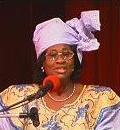 Speaking at the Pan-African Women Invent and Innovative (PAWII) Exhibition Hajia Alima Mahama stated that "...Several trends in global restructuring present challenge for African women in particular, challenges of competitive pressures of globalisation, rapid changes in technology and emerging dominant pressures of IT...it is most appropriate as it (GWIIN) provides a platform to showcase and market ideas, innovations and inventions initiated and implemented by women in Africa who contribute immensely to the socio economic development of their countries...This potential is largely constrained and their ingenuity mostly go unnoticed and un-rewarded..."
Unsustainable FESPACO Movies vs Nollywood
In a Reuters report Katrina Manson contrasts the viability of rough and ready Nollywood fare with the art house but utterly dependent-on-subsidies 'FESPACO movies':
In the time it takes for a lovingly crafted art house movie to emerge as winner of the top prize at Burkina Faso's pan-African FESPACO cinema festival, Nigeria's prolific producers will already have churned out another 50 films.
They might be tales of cannibalism, sorcery and jealous girlfriends who shrink their errant boyfriends into bottles, but Nigeria's $450 million home video industry is the third biggest in the world, after America's Hollywood and India's Bollywood.
By contrast, FESPACO's filmmakers -- considered the best on the continent -- rely on dwindling donations, and scrabble for private financing and poor distribution deals amid a spate of cinema closures...[continue reading]
![Reblog this post [with Zemanta]](http://img.zemanta.com/reblog_e.png?x-id=dc53c303-47fb-4682-997a-0ca0fde4097c)
Neo Pan-Afrikansm required
From the African Executive:
In search of development, African states have adopted all language requirements such as good governance, human rights and so on, to be able to access aid from the West. While many of the values of human rights, good governance and rule of law are fundamental and appropriate democratic norms in Africa and elsewhere, the parroting of these terms without critical analysis and contextual application of same is quite concerning...[continue reading]
The PanAfrican Cultural Festival
Via the VOA:
Algeria is preparing to host the second Pan-African Culture Festival, and the first in 40 years. The event hopes to draw hundreds of thousands of people to Algiers this July to celebrate Africa's artistic renaissance...[continue reading]