More hereThe South African Informal City is an initiative of the Architects’ Collective and forms parts of the technical site visits offered by the Local Government Programme for COP17...Looking at South Africa’s most relevant and innovative design and research projects in terms of urban migration issues, the 20 works featured in the exhibition aim to promote dialogue around informality and urban development.
Informal city. Photo: Tanya Zack.
Inner city informality, in-situ upgrading, catalytic projects, un-built projects and backyard interventions are the five categories in which the projects are presented.
Cooperation, information sharing and positive action between policy makers, practitioners, academics and civil society is what the exhibition aims to promotion, together with taking a critical look at informality and urban development. “The exhibition will provide opportunities for peer-to-peer knowledge sharing, and for existing research and realised projects to become part of a greater public debate,” says Karen Eicker, Architects’ Collective director.
Issues of Informality
"Sharon Stone in Abuja"-The Art of Nollywood
CNN reports:
More here
Artist Talk with Zina Saro-Wiwa, Moderated by Claudia Calirman from Location One on Vimeo.
A group of artists is bringing Nigerian movie making to a new audience with a New York exhibition paying tribute to the "Nollywood" film industry.The exhibition is called "Sharon Stone in Abuja," after a 2003 Nollywood film, and is taking place at Location One gallery in the Soho district of New York.Its creator, Zina Saro-Wiwa, a Nigerian-British artist and filmmaker, said: "Sharon Stone in Abuja pays homage to Nollywood. It looks at Nollywood narrative conventions and explores African emotional landscape."
Related articles
- That Screwy, Ballyhooey Nollywood (reason.com)
- Nigeria's burgeoning film industry (economist.com)
Building and Art Ecosystem contd
In conversations with Art-World acquaintances I had asserted: "Till we develop economically and build thriving economies a vibrant indigenous Art Market is dead on arrival". a post by Bunmi Oloruntoba echoes those thoughts of mine:
The dream of sustainable development, i guess, is for African economies to grow to empower and expand an Africa bourgeoisie, and to see, in terms of art, Africa's institutions and exhibition spaces grow in response to this growing bourgeoisie, their increased buying power and thirst for new affirmations and identities. Until then, Africa's artists will forecast the weather of their societies in response to and as an extension of the exhibition spaces and appreciative centers of WestMore here
.
Related articles by Zemanta
- Startup Funding contd. (timbuktuchronicles.blogspot.com)
- Achebe "On Nigeria" contd (my-beauty-best-teacher.blogspot.com)
- The African sculptures mistaken for remains of Atlantis (cnn.com)
‘Heroic Africans’ at Metropolitan Museum of Art
More here...a quick stroll through this exhibition’s eight sections, each devoted to a different West or Central African art tradition, confirms African art’s variety, in a stylistic spectrum stretching from detail-perfect representation to near-abstraction. And as to African art’s pertinence to Western concerns, suffice it to say that almost all the sculpture in this exhibition is asking a question that is foremost on the mind of many Americans in the early stages of the presidential campaign: what are the qualities we want and need in our political leaders?
Courtesy of the Metropolitan Museum
via Africa Works
The "As it Is!" Contemporary Art Exhibition
The National Dubai reports on the Mojo Gallery "As it Is" show curated by Annabelle Nwankwo-Mu'azu.
....a four-part exhibition that draws in some of Africa's most dynamic artists working today... At its root, this series of shows, running monthly until then, may only tease at the breadth of expression coming out of the continent, but it does offer an inroad to a scene that can often appear too vast and diverse to penetrate for newcomers...[continue reading]
Not For Export – Blacksmiths by Uche James Iroha
Related articles
- Global Africa Project contd (my-beauty-best-teacher.blogspot.com)
- African Christmas Decorations from the African Art Centre (awesomesa.co.za)
- Senegalese artist Viyé Diba At Columbia (harlemworldblog.wordpress.com)
The Other Africa
![]() |
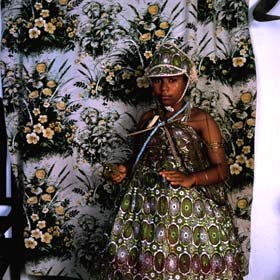
| Image of Marie Georgina courtesy of The Other Africa |
The African Woman and Invention
Speaking at the Pan-African Women Invent and Innovative (PAWII) Exhibition Hajia Alima Mahama stated that "...Several trends in global restructuring present challenge for African women in particular, challenges of competitive pressures of globalisation, rapid changes in technology and emerging dominant pressures of IT...it is most appropriate as it (GWIIN) provides a platform to showcase and market ideas, innovations and inventions initiated and implemented by women in Africa who contribute immensely to the socio economic development of their countries...This potential is largely constrained and their ingenuity mostly go unnoticed and un-rewarded..."
Nnenna Okore:
The October Gallery presents the first London solo exhibition of Nnenna Okore:
Emerging, young artist Nnenna Okore will be exhibiting new works in her debut London solo show.A former student of El Anatsui, whose magnificent bottle-top cloths were the highlight of the 52nd Venice Biennale, Nnenna Okore also transforms discarded materials into cultural objects, forms, and spaces...[continue reading]
via NaijaBlog
Street Kitchens
Treehugger points us to a show about the ingenuity behind "Global Street Food":
“Global Street Food” is dedicated to the fascination with improvised kitchens in public places. Urban fast food stations navigate the contrast between pragmatic dilettantism and complexity in the smallest of spaces. Mike Meiré presents a variety of objects and street foods from different areas of the world in a classic white cube. This exhibition explores the sculptural quality of authentic objects and their cultural identity...[continue reading]
photo courtesy of Mike Meire
Should I Insure My Oil Paintings?
Art insurance is a must if expensive oil paintings are to yield compensation should damage or theft occur. Peace of mind is priceless whilst a valuable painting is in transit, hung in an exhibition or in storage. But what is the best way to get an oil painting insured?
Art Insurance for Artists
| Dealing with Oils click to buy from Amazon |
- Becoming an art collector and/or dealer makes art insurance crucial.
- An oil painting that has been in the family for years may not only have sentimental value, but monetary value. The rule often holds that the older an oil painting, the more valuable it is likely to become, particularly if the artist is of some note.
- An oil painting that has taken hours of painstaking work to achieve from the artist’s point may have personal value.
- An oil painting that has won prizes, received critical acclaim from official sources, and has been widely published, reviewed or recognised.
- An old oil painting may have been acquired from a house clearance, an auction or even (as in my case) from a car boot may have monetary value.
In the case of an old oil painting, a certificate of authenticity from an official antique dealer (a service that may also offered by a fine art insurance company) is vital. Specialised art insurance companies such as Loveart Insurance or Axa Art Insurance Limited might be the best option.
An oil painting that is not listed within Christie’s, Millers’ or Phillips’ books and schedules may only be worth the cost of the art materials to produce (the canvas, oil paint and the varnish). Thirty or forty pounds or so does not reflect the hours of labour to produce the painting. In such cases, a realistic appraisal of the oil painting’s value and itemising the artwork within the house contents schedule might be a better option.
Insuring Valuable Art
For costly art, extra diligence may be required. Photograph the artwork and keep copies within the insurance package. Record vital information about the painting, such as the dimensions, medium, style and the artist etc. Keep receipts, certificate of authenticity and any other paperwork pertaining to dealings with the artwork.
Very valuable oil paintings deserve as much insurance as possible. If the worst happens, and the painting is stolen, as least there is monetary compensation. Some is better than nothing, and the oil painting collector may use the cash to eek a little revenue from publicity, installing a security system or even offering a ransom for the painting’s return.
Cheap Art Insurance
| Make Money from Art click to buy from Amazon |
Adding valuable oil paintings to house insurance will often work out cheaper, particularly if the house has a good security system. Otherwise, using specialised antique insurance is worth paying out for if the oil painting is priceless, such as an old master.
Useful Links on Paintings
Quick Hits
Adrian Wood recommends the capping of aid-FT
Craft Potters’ Association of Nigeria work highlighted at The Clay without Borders exhibition.
More on Africa's allure to foreign investors.-Washington Post
How Tunisia followed a blueprint to create wealth.-BNET
Benin1897.com
In 234Next Akintayo Abodunrin reports on an exhibition -Benin1897.com- that highlights the sacking of the Benin Empire:
In February 1897, a ‘punitive expedition' was sent to Benin to capture the king and destroy his kingdom in retaliation for the killing of a British Counsel and his party on their way to investigate reports of ritual human sacrifice in the city. But the punitive expedition not only went beyond its brief - capturing and destroying the city - it also engaged in large scale looting of artifacts. Among other war ‘booties', about 900 Benin bronze works were taken from the city to "defray the cost of the war." Many of these are held at the British Museum in London, and have been the subject of long standing contention between Britain and Nigeria.More here
The 'To Egypt with Love' Exhibition
The recent popular uprising and resulting democratic revolution in Egypt inspired many people around the world. Many visual artists who’s work focus on the everyday living conditions in transforming societies have actively participated in the historical evens and through their creative work ensured that it was captured for generations to come. One such artist is Hossam Hassan who took to the streets and documented the trying and tense moments of the revolution...[continue reading]
We Changed Egypt by Hossam Hassan
Global Africa Project contd
via PBS
Paula Zahn speaks with Lowery Stokes Sims, the Charles Broadman International Curator at the Museum of Arts and Design; she is also a co-curator of the Global Africa Project an unprecedented exhibition which explores the broad spectrum of contemporary African art, design and craft worldwide.Watch the full episode. See more SundayArts.
Related articles
- Art of Africa (my-beauty-best-teacher.blogspot.com)
- African Christmas Decorations from the African Art Centre (awesomesa.co.za)
'African classical art' - Inside the Kingdom of Ife
In the Guardian, art of the Ife Kingdom:
This is an exceptional exhibition, even by the high standards the British Museum has established in recent years. It is extraordinary because it brings together such a large number of masterpieces that have rarely or never been exhibited outside Nigeria before – and when I say masterpieces, I mean artworks that rank with the Terracotta Army, the Parthenon or the mask of Tutankhamun as treasures of the human spirit.More here
For European artists a century ago, African sculpture was powerful precisely because it did not conform to the smooth idea of beauty that Picasso's generation had been brought up on – ideas that went back to classical Greece. But they had not seen the art of Ife, a medieval city state that flourished from the 12th to 15th centuries in West Africa, trading across the Sahara with the Islamic Mediterranean world.
African Diaspora in the Indian Ocean World
More hereOver the course of nearly 20 centuries, millions of East Africans crossed the Indian Ocean and its several seas and adjoining bodies of water in their journey to distant lands, from Arabia and Iraq to India and Sri Lanka.
Image courtesy of the NYPL
Called Kaffir, Siddi, Habshi, or Zanji, these men, women and children from Sudan in the north to Mozambique in the south Africanized the Indian Ocean world and helped shape the societies they entered and made their own.
Free or enslaved, soldiers, servants, sailors, merchants, mystics, musicians, commanders, nurses, or founders of dynasties, they contributed their cultures, talents, skills and labor to their new world, as millions of their descendants continue to do. Yet, their heroic odyssey remains little known.
The African Diaspora in the Indian Ocean World traces a truly unique and fascinating story of struggles and achievements across a variety of societies, cultures, religions, languages and times.
Markets and the Informal Economy
The Made in Africa Exhibition stated that:
In Mali and Senegal, those who have work in what we call the formal sector of the economy are almost wholly limited to the urban elite...The informal economy includes much of the trade that takes place in the markets and that offers possibilities for those who are inventive and possess sufficient "go-ahead" spirit
Esther Mahlangu's Artwork
Pattern by Texture reports on the work of Esther Mahlangu:
Esther Mahlangu is an important proponent of this tradition. She draws freehand, without first measuring or sketching, using luminous and high-contrast vinyl paints that lend extraordinary vigor to her murals. While at a glance purely abstract, her compositions are built upon a highly inventive system of signs and symbols. Mahlangu is the first Ndebele artist to transpose wall paintings onto canvases and to take the conventions of her artwork into the larger arena. In 1989 she came to Paris to create murals Magiciens de la Terre exhibitionMore here
African Voices
"...African Voices is a permanent exhibition that examines the diversity, dynamism, and global influence of Africa’s peoples and cultures over time in the realms of family, work, community, and the natural environment..."
via Sociolingo
photo courtesy of the Smithsonian
Urban Africa-A Show
The 'Urban Africa and Sustainable Futures' photography exhibition by David Adjaye
will:
"...reveal a unique snapshot of life in Africa today, documenting the nature of urban life in a developing country, a unique geo-cultural survey profiling the African city in a global context...he has captured the urban development of cities including Kigali, the capital city of Rwanda showing traces of its Colonial past, Tripoli in Libya, very much invaded by the energy of the present, the informal settlements on the edges of new cities like Abuja, Nigeria and the traces of apartheid still inscribed on Pretoria, South Africa."-creative boomHT! @digitalafrican
Related articles by Zemanta
- David Adjaye's photographs of Africa (telegraph.co.uk)


![Reblog this post [with Zemanta]](http://img.zemanta.com/reblog_e.png?x-id=2b179449-ff1d-40a7-9ca4-7cb7a70f6b3e)