


Nnena Nwoke Kalu's Food Security Magazine examines issues which include food production,sustainability and commercialization.Its aim is to "...assist in achieving increased food availability and increased purchasing power and in addition the attainment of the overall goal of sustainable household and national food security..."
Menampilkan postingan yang diurutkan menurut relevansi untuk kueri food security. Urutkan menurut tanggal Tampilkan semua postingan
Menampilkan postingan yang diurutkan menurut relevansi untuk kueri food security. Urutkan menurut tanggal Tampilkan semua postingan
Establishing Food Security


Read User's Comments(0)

Street Foods in Africa
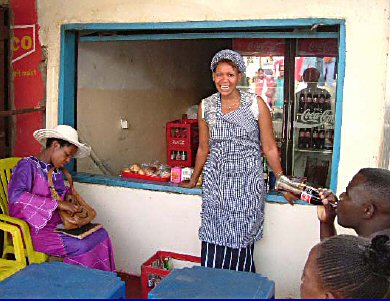 Underappreciated "...Street-vended and informally vended food can contribute significantly to the food security of those involved in its production, particularly suppliers of raw produce, food processors and vendors. Women are often owners or employees of street food businesses. In certain countries (Benin, Ghana, Lesotho, Togo and Democratic Republic of Congo), they represent 70 to 90% of vendors. In Ghana and most developing countries, most women sell food in the street primarily to improve the food security of their household and also to have some degree of financial independence.Despite its growing presence, it is a sector that has rarely been the focus of strategic research initiatives that determine the importance and potential hazards of street-vended food, and what contribution it makes to the livelihoods of the urban and peri-urban poor (both producers and consumers)..."
via Natural Resources Institute
We need an African Common Agricultural Policy
Aboyeji E Iyinoluwa writes in Project Diaspora:
...when one looks closely at the CAP, the objectives are very Euro-centric - and rightly so. The entire point of the subsidies are to enable Europe be self sufficient in the production of its food. For food import loving Africans, this might seem like a strange idea, but in a world of genetic modification, bio terrorism and Monsanto, food is becoming a national security issue and there are several good reason for keeping its production domestic. In fact, a lot of the developed countries we aspire to (including the United States) have subsidies in the spirit and style of the CAP. In a perfect world, much of Africa’s chronic food shortage problems could be solved by adopting a CAP style arrangement for Agricultural production. There is no sense is trying to open a European market for African agricultural products when even with huge volumes of food imports, we can barely satiate the starving people on our own continent.More here

Agricultural Challenges-Florence Wambugu
 Yara Prize winner Florence Wambugu discusses impediments to African agriculture.In an answer to a question about her focus on Bananas she stated:
Bananas are an orphan crop, like cassava, sorghum or sweet potato. It hasn't received the same attention as the crops used for export. But it is very important for food security, very important for women and children. When I was growing up, for example, banana was a baby food.
I realised when I looked around that the technology existed to double the yield and help poor farmers come out of poverty. So I brought together people from all along the value chain — businesses, farming communities, scientists — in what I call a participatory bottom-up approach. It is this holistic approach in linking farmers to the market that has brought success...[continue reading]
via Scidev
photo courtesy of Ole Walter Jacobsen
![Reblog this post [with Zemanta]](http://img.zemanta.com/reblog_e.png?x-id=a19830bd-baa3-40f6-a0fe-7d0d13c7951a)
Does Africa really need new innovation idealism? Yes it does...
In SciDev Linda Nordling asks "Does Africa really need new idealism?" in its innovation policy.Commenting on a recent 'Knowledge Swaraj' manifesto which:
...suggests countries establish 'innovation fora' to debate technology investments and choices more broadly. And it wants funding for scientific 'centres of excellence' to give way to support for science that addresses local needs.In addition it:
...will go a step further in promoting the 'domestication' of science in Africa, says ATPS executive director, Kevin Urama.He says that Africa's confidence in its own science — traditional knowledge — dropped with colonialism and the arrival of Western science traditions. He argues that this cultural loss underpins Western-sponsored science's inability to improve the lives of ordinary Africans.More here
If this is "Idealism" I would suggest we have further doses of it. The lack of a self-reinforcing scientific culture can be traced to the very lack of a local intrinsic need and or connection to research as its currently practiced.

The "Colonialism-Imperialism" Paradigm Is Kaput (2 of 2)
PART II (see part I)
Modern Grievances against the West
External Props of African Despots
Historically, every foreign entity that goes to Africa does so to pursue their own interest, not those of Africans. Witness the scramble for Africa in the 1880s. The Chinese do not go to Africa because they love black people soo much. They go there to pursue their interests. Exactly the same can be said of the Cubans. This competition for influence in Africa became pronounced during the Cold War, when super-power rivalry led to the establishment of client states across Africa. The West supported the likes of Mobutu Sese Seko, Samuel Doe, Hastings Banda, Felix Houphouet-Boigny, etc. etc. The East supported the likes of Mengistu, dos Santos, Mattieu
Kerekou, Sassou Nguesso, Samora Machel, etc. etc. Arab countries also backed their clients in Africa: Sudan, Mauratania, Chad, etc.
Cold War Intrigues and Machinations
Each side in the Cold War provided billions in aid to their clients to protect their security interests in Africa. Angola, Ethiopia, and Mozambique all received substantial amounts of Soviet military hardware. For example, Mengistu Haile-Mariam of Ethiopia received more than $11 billion in military weapons between 1975 and 1990. Angola received at least $2 billion annually
in military assistance from the Soviet Union in the 1980s (The Independent, London, Feb 19, 1992). In 1991, $4 billion of Angola's $8.7 billion foreign debt was owed to the former Soviet Union. On July 1, 1991, President Eduardo dos Santos said: "military debts were not usually honored," implying that Angola would not pay it (The New York Times, July 8, 1991). Soviet aid was stingy.
The economic aid the Council for Mutual Economic Assistance (Comecon) provided to sub-Saharan Africa in 1985 was $300 million. Of this, Ethiopia received by far the most (57.9 percent). Next were Mozambique (13.8 percent), Egypt (6.6 percent), Madagascar (4.2 percent), Angola (2.8 percent), and Tunisia (2.1 percent) (West Africa, Dec 12-28, 1988; p. 2320). Angola and Mozambique benefited more from arms supplies. The $300 million aid was only 5 percent of total Comecon bilateral disbursements and only 3 percent of the total aid flow to sub-Saharan Africa.
Furthermore, the little Soviet economic aid that did flow to Africa had strings rigidly attached. Loans and trade credits supplied could only be spent in the Soviet Union and Comecon countries (100 percent tied aid). In addition, the Soviets supplied the technical personnel and the equipment for project construction. Repayments of loans were often by barter, but to the
decisive advantage of the Soviet Union. For example, in Guinea, Soviet help in building a bauxite plant at Kindia was to be repaid with deliveries of two million tons of bauxite ore a year for 30 years.
Barter arrangements also hurt Soviet clients in Africa in a different way. For example, repayments of loans Nkrumah of Ghana took from the Soviet Union were to be made in kind with exports such as cocoa. But the Soviet Union had little use for Ghana's cocoa. Re-export of cocoa by the Soviet Union helped depress the world market price of cocoa in the mid-1960s.
China, an active player in Africa, sought to win adherents to the Chinese brand of socialism. Zhao Ziyang, China's foreign minister in the early 1960s, reminded African leaders of the presence of Chinese coolies in Africa. China's perception was that Moscow, not Washington, was its principal enemy. Its strategy was therefore to weaken "social imperialism at the expense of monopolistic capitalism" (Snow, 1988). West Africa observed that "in Africa, China increased assistance to old friends such as Tanzania and Zambia. The 2000km Tan-Zam railroad was meant to overshadow the Soviet-built Aswan High Dam in Egypt. China also made friends with old enemies such as Mobutu, helping him during the Shaba uprising in 1978-79; in 1980 they helped him build a naval base at Kinkuzu in southern Zaire to threaten Angola" (Aug 15, 1988; p. 1473).
China's fortunes in Africa quickly turned into mirages, however. At first, China's anticolonial stance was welcomed by African liberation movements. But as independence was gained, China's emphasis on subversion and its intense enmity toward the Soviet Union became less and less appealing or relevant to Africans. In fact, as early as 1963 Julius Nyerere of Tanzania
complained of a new scramble for Africa between the Soviet Union and China. Because their actions were anti-Soviet rather than pro-African, the Chinese themselves did not achieve much by way of influence.
Furthermore, China was no less immune to blunders than the Soviets. Less wisely than the Soviets, China meddled in Burundi ethnic feuds. In 1963 China backed the Tutsi expedition by training a number of Tutsi in guerrilla warfare in China. The subsequent massacres in Burundi earned China much opprobium. China also supported the Biafran secessionists in Nigeria's civil
war (1967 to 1970) simply because Moscow backed the Federal Government of Nigeria. Similarly, in Angola, China supported the FNLA (National Front for the Liberation of Angola) because Moscow was backing the ruling MPLA.
In Mali and Congo-Brazzaville, China made some headway. But a spate of military coups brought to power new rulers distrustful of China. Only in Tanzania did China achieve some diplomatic and ideological success. China agreed to fund and build the 1,200-mile Tan-Zam railway line at a cost of 166 million pounds sterling, free of interest. The railway was both an
engineering and a political achievement. It was completed two years ahead of schedule and was much touted as a model of what foreign aid could do for Africa. But it was one thing to build the railway and quite another to run it efficiently. Maintenance was poor, services degenerated, and the Dar es Salaam terminal became chronically clogged to the point of immobility. Although the Chinese had nothing to do with these shortcomings, their reputation suffered.
Zimbabwe received technical and military aid from North Korea and China. For its part, the West also poured billions into Zaire, Liberia, Kenya, Nigeria, and other African countries.
Each side also sought to undermine African regimes that were hostile to it. Lumumba was assassinated by the CIA operatives and the 1966 coup against Nkrumah was orchestrated by the CIA. In this sphere, the French were the worst, intervening directly to remove African leaders they did not like in Francophone Africa. For the French, independence did not mean a retreat from Africa. France left hundreds of officials in Africa as advisers. Behind the doors of many key ministries in the Ivory Coast and Senegal or Gabon, discreet but powerful French officials kept a close eye on policy. The French also sent teachers to Africa and brought African students and civil servants to France for training. France secured the right to maintain a
heavy military presence in Africa. In 1989, for example, France had a significant number of military advisers in 16 African countries and permanent Forces d'Intervention in seven. Total strength of French troops in Africa exceeded 12,000 in 1990. In France itself, the Forces d'Action Rapide, numbering 47,000, could be mobilized in less than 48 hours for action anywhere in Francophone Africa. These forces played an economic policing role and backed up French diplomacy and paternalism. They supported "approved" Francophile governments such as those of Leopold Senghor of Senegal and Felix Houphouet-Boigny of Cote d'Ivoire.
After 1960 the French intervened on many occasions to prop up unpopular African regimes against internal dissatisfaction and disorders. The most notorious such occasion was in Gabon in 1964, when French troops were used to reinstate President Mba after a coup. Noting that the French did not intervene to save President Youlou in Brazzaville in 1963, critics charged that intervention was predicated on mineral wealth. (Gabon is rich in oil.)
Now, each foreign entity operating in Africa pursues its own interests. It was ONLY the West which propped up hideous dictators in Africa. A foreign prop is a foreign prop is a foreign prop, regardless of its origin. An African leader is supposed to pursue the interests of his PEOPLE. If he doesn t, remove him from power but did we? Instead, we argued ad nauseam that, since the West put Mobutu, for example, in power, it was the responsibility of the West to remove him. This was ridiculous because if Mobutu was serving Western interests, why would the West remove him? And even if the West removed him, who do you think the West would have installed as a replacement? Another Mobutu !
It is clear that we have drawn no historical lessons from our dealing with the West and other foreign blocs. Here s a popular adage: If someone cheats you once, he is the fool but if he cheats you again, you are the fool. If you agree, then why are we talking about the Second Scramble for Africa ? And have we not learned that if you give an African problem to the Americans, Brits, French or the Chinese to solve it, each would solve it to their advantage? Does the mantra, African solutions for African problems, make sense to you?
Again, prop or no prop,
You cannot claim that it was the West which told Mobutu to loot the Zairean treasury. Nor claim that it was the North Koreans who told Mugabe to butcher over 20,000 Ndebele in 1980 (Matabeleland massacre). Neither can you claim that it was the Arabs who ordered Idi Amin to
butcher over 200,000 Ugandans. Nor can you claim that tell me it was the French who ordered Gnassingbe Eyadema to cling to power for 34 years and amass a personal fortune worth $3
billion.
True, the French and indeed the World Bank knew these African despots were stealing money and looked the other way. But who is an African leader accountable to? To the French, the World Bank or his PEOPLE? Prop or no prop, these leaders must be held accountable for their actions.
In fact, these days the charge of foreign meddling in African affairs and the specter of sinister and greedy multinational corporations lurking in the dark, waiting for a chance to pounce and exploit Africa confute reality. Foreign investors have fled Africa as the continent remains unattractive. Is it not African governments who have been drawing up elaborate and fancy
investment codes to ATTRACT them back? And is it not African governments themselves who take their budgets to foreign capitals for approval in order to get foreign aid? So who ALLOWS the meddling in African affairs?
Even then, the West has shown little interest in meddling in African affairs in the past few decades. If anything, the West has been in retreat from Africa! Recall the statement by presidential candidate, George Bush, that Africa was not of strategic importance to the U.S. And was it not the same African leaders who were complaining after the Cold War that Africa was
being marginalized ? So which is which: Is the West meddling in African affairs or the West marginalizing Africa?
In case you did not know, the West is thoroughly fed up with Africa, which it regards as a cry-baby, hopelessly incapable of solving any of its problems and is constantly crying out for help. What do you think the expression donor fatigue means? That is the diplomatic way of saying that the international community is fed up with incessant African appeals and begging. Today, there is famine in Ethiopia, tomorrow, there is a refugee crisis created by war in Liberia, or Somalia. Then there is genocide in Rwanda, starvation among refugees in eastern Congo, Ivory Coast, and on and on. Haba. Africa is now synonymous with war, destruction, famine, refugees, starvation, instability and chaos. Year after year since 1985, one African country after another has imploded, scattering refugees in all directions: Ethiopia (1985), Angola (1986), Mozambique (1987), Sudan (1991), Liberia (1992), Somalia (1993), Rwanda (1994), Zaire (1996), Sierra Leone (1997), Congo DRC (1998), Ethiopia/Eritrea (1998), Angola (1999), Ivory Coast (2000), Togo (2005).
The implosion of these countries had nothing absolutely nothing to do with the slave trade, nothing to do with Western colonialism or imperialism, nothing to do with artificial colonial borders, nothing to do with an unjust international economic system; in short, nothing to do with so-called external factors. They all had to do with one thing: POWER the adamant refusal to relinquish or share political power. If GENERAL Siad Barre of Somalia, GENERAL Juvenal Habryimana of Rwana, GENERAL Pierre Buyoya of Burundi, GENERAL Mobutu Sese Seko of Zaire, GENERAL Samuel Doe of Liberia, GENERAL Joseph Momoh of Sierra Leone, GENERAL Robert Guie of Ivory Coast, GENERAL Gnassingbe Eyadema, etc. etc. had been willing to step down or put in place power-sharing arrangements, each of their countries would have been
saved. Note the frequency of the title, GENERAL.
The rule is this and you can call it Ayittey Law: "The adamant refusal of an African head of state to step down or share political power will ultimately lead to the destruction of his country." If Mubarak of Egypt, Museveni of Uganda, Mugabe of Zimbabwe, Ghaddafi of Libya refuse to leave the political scene or share power, their countries will be destroyed. This is not rocket
science and it has nothing to do with the West. It is a personal or political failure that cannot be blamed on Americans, Chinese or Martians.
Back in 1986, President Museveni of Ugana said that no African leader should be in power for more than 10 years. What happened to him? He has been in power for more than 16 years and still counting. Finally in the late 1990s, African leaders wrote Constitutions in which they inserted the two-term limits. What happened? They are the very same ones who are now using their parliamentary majority and various devious maneuvers to override or repeal the two-term limits in Chad, Guinea, Namibia (Nujoma before he retired), Uganda, and even Nigeria.
Benin, Cape Verde Islands, Sao Tome & Principe, South Africa and Zambia all saved themselves from implosion because their leaders agreed to power-sharing arrangements crafted out of sovereign national conferences. South Africa would have blown up if the whites had not sat down with the blacks in a Convention for a Democratic South Africa (CODESA) to craft a new
political dispensation for the country. Rwanda blew up because the Hutu-dominated government of GENERAL Juvenal Habryimana refused to share power with the Tutsi minority and, instead, decided to exterminate them. "No Tutsis, nobody to share power with" was the macabre and brutal logic. More than 800,000 Tutsis were slaughtered in a orgy of violence and brutal massacre. That, in itself, was an excellent example of "intellectual astigmatism".
We could see with eagle-eyed clarity all the repugnant and inhumane brutalities of the white apartheid system in South Africa but we were hopeless blind to the equally heinous tribal apartheid regime in Rwanda. If the racist apartheid regime in South Africa had butchered just 2,000 blacks, even Idi Amin, who himself slaughtered more than 200,000 Ugandans, would
have arisen from his grave to attack South Africa with 3 dilapidated helicopters! But we said nothing when 800,000 Tutsis were slaughtered. Instead, we blamed the WEST for NOT intervening to stop the genocide. In fact, at its July 2000 Summit in Lome, Togo, the defunct OAU demanded a Marshall plan style compensation package for Rwanda. The demand for
compensation was part of the OAU inquiry into the 1994 Rwandan genocide, which blamed Western powers for failing to intervene to stop the mass slaughter. Naturally.
The OAU inquiry singled out France and the United States for particular blame for failing to prevent the genocide in addition to the United Nations Security Council as a whole. France was culpable because, having high level contact within Rwanda s Hutu-led government, the OAU report argued, could have exerted pressure to prevent the death of 800,000 people. The OAU
enquiry also blamed the US for failing to use its influence in the Security Council to authorize a military intervention to prevent the killing. The report argued that the West failed Africa despite the availability of copious evidence that the mass killing had been about to begin. In
conclusion, the report noted, a simple apology as already made by the United Nations was not enough and called for compensation, alluding to the $13 billion Marshall Aid plan the U.S. launched for the reconstruction of Europe after World War II. And what did these self-righteous leaders do to prevent the killings going on right under their very noses? And how can these
leaders complain about foreign meddling in African affairs and at the same time blame the West for NOT INTERVENING in an African problem to stop a massacre?
These days appeals by African leaders fall on deaf ears. OECD aid to Africa fell by 22 percent between 1990 and 1996, decreasing by 18 percent to sub-Saharan countries between 1994 and 1996 alone. (DeYoung, 2000a; p.A1). Even humanitarian aid to Africa has been shrinking. Contributors to United Nations aid and development programs have provided slightly more than half of the $800 million requested in 1999 for African countries suffering from "complex emergencies" -- the term is applied when war and failed institutions, often combined with a natural disaster, leave vast numbers of people homeless and starving. Specific programs for some particularly problematic areas, such as the Great Lakes region of Central Africa
including the two Congos, Rwanda and Burundi, have fared even less well (DeYoung, 2000b; p.A1).
In Sept 1999, the U.N.'s World Food Program announced it would curtail its feeding program for nearly 2 million refugees in Sierra Leone, Liberia and Guinea after receiving less than 20 percent of requested funding. An emergency appeal during the summer to feed and shelter at least 600,000 Angolans who had been displaced in that country's long-standing civil war
brought minimal initial response and predictions of mass starvation. In Africa's Great Lakes region of Congo, Burundi and Rwanda, where wars have produced nearly 4 million refugees, the United Nations estimated it would need $278 million to take care of them. By Oct 1999, only 45 percent of that amount had been donated. Nearly 80 percent of the United Nations humanitarian appeals in 2004 were to address African problems, but the response was disappointing as to be non-existent. "I remember sitting in this very room last summer (2004) asking for five helicopters to save thousands of lives in Darfur (Sudan). In the end we had to hire helicopters commercially as no Member States were willing to provide them," Under-Secretary-General Jan Egeland, head of the UN Office for the Coordination of Humanitarian Affairs (OCHA), the chief of the UN humanitarian office told the Security Council meeting on humanitarian challenges in Africa in January 2005 (http://www.un.org/apps/news/story.asp?). Even Irish rock star, Bob Geldof, who organized Band Aid and Live Aid to provide famine relief to starving victims in Ethiopia in 1985 is now fed up with Africa. He said this on Jan 31, 2005, of his work in Africa: "I'd dearly love not to have to go there the day after tomorrow. More often than not, it bores me profoundly - the pace of change is far too slow, and Africans excuse their own complicity in exactly the same way as our politicians (http://news.bbc.co.uk/1/hi/entertainment/music/4222373.stm).
Private organizations are also having difficulty raising funds for African relief operations. According to Mario Ochoa, executive vice president of the Maryland-based Adventist Development and Relief Agency (ADRA), which operates relief projects out of its own donations and under contract with donor governments, If I were to go now and make an emergency appeal for, say, Rwanda, for $500,000 for food, I'd probably get about seventy or eighty
thousand" in contributions (The Washington Post, Nov 26, 1999; p.A1).
True, every now and then, a major effort is launched in the West to help Africa. Africa s plight follows a ten-year attention deficit cycle: 1985 (Live Aid to save famine victims in Ethiopia), 1996 (a Special U.N. Session to boost aid to Africa to $25 billion), and now (2005). It is so humiliating to have the salvation of Africa tied to the success of rock concerts. And 20
years later, Ethiopia still can t feed itself and is appealing for food aid. Who do you blame: The white kids who did not give enough charity at the rock concerts or the stupid policies of Ethiopia s leaders?
Unjust International Economic System
Back in the 1950s and 1960s, this argument had much validity: The international economic system, dominated by western multi-national corporations, was rigged in favor of the rich countries. Prices of cash crops were fixed at artificially low levels; markets were cornered by giant western corporations, paying low wages and raking huge profits. While prices Africa received for its exports remained low, the prices Africa paid for imported manufactures soared astronomically (declining terms of trade). But today, with the onset of globalization, this argument carries little validity.
First, there is much competition on the international market. Asian corporations are now some of the big players. Second, African governments have done next to nothing to add value to their exports. Ghana still exports much of its cocoa in raw beans form. Third, every market has its ups and downs. We complain when the markets are down but conspicuously silent when
the market booms. Did we complain about an unjust international economic system when copper prices reached record levels in the late 1970s? When gold prices soared in the 1980s, cocoa prices in the 1990s? May I mention oil prices? By the way, what did we do with the windfall we reaped from the high prices? We squandered it!
Fourth, Africa s share of world trade fell from more than 3 percent in the 1950s to less than 2 percent in the mid1990s and to only 1.2 percent, excluding South Africa (The World Bank, Can Africa Claim the 21st Century;p.20). This erosion of Africa s world trade share in current prices between 1970 and 1993 represents a staggering annual income loss of $68 billion. This loss is not due to an unjust international economic system. Fact is, Africa has not been producing and you can t trade on the international market if you have nothing to sell. The physical volume of exports has been declining and therefore it is not a question of Africa not being able to earn enough because of low prices. Burundi s coffee exports, Ivory Coast's cocoa exports, and Sierra Leone s diamond exports have been devastated not because of low world market prices but by senseless civil wars. Even with food, we don t produce enough to feed ourselves and spend $19 billion a year on food imports. Nigeria spends $3 billion a year on food imports and has now brought white Zimbabwean farmers to teach it how to become self-sufficient in food production. What a disgrace!
Much of the decline in agricultural production in Africa is due to price controls, naked exploitation of Africa s peasant farmers, and senseless civil wars that have devastated the countryside and uprooted millions of people. Refugee camps are full of women and children, who produce the bulk of Africa s foodstuffs. State marketing boards fixed at ridiculously low
prices to milk the peasant farmers and they REBELLED. In Senegal, peanut (groundnut) farmers were receiving less than 20 percent of the world market price for their produce; in Ghana, cocoa farmers were receiving less than 30 percent for their produce in the 1980s. Those who complain about the Western conspiracy to fix prices for African exports at artificially low levels obviously do not see the ridiculously low levels their own State Marketing
Boards fix prices for peasant farmers.
Unfair Trade Practices, Trade Barriers and Subsidies
To be sure, unfair trade practices -- trade barriers and agricultural subsidies -- are legitimate issues of concern for the Third World. It is hypocritical for the West to preach free trade to the developing countries and yet put barriers in its place. But there is hypocrisy on both sides.
According to Columbia University economist, Jagdish Bhagwati, there is greater tariff protection on manufacturers in the poor countries . . . and autarkic trade barriers make domestic markets more lucrative than exports, leading therefore to an incentive bias against exports. So even when the rich country markets are opened further, one s own trade barriers can prevent the penetration of these markets (The Wall Street Journal, Jan 18, 2005; p.A16).
More importantly, the rich countries protect themselves against unfair trade practices, so why shouldn t African countries? A case in point is U.S. s anti-dumping law. Known as the Byrd Amendment for its chief author, Senator Robert Byrd (D-W. Virginia), the law passed by Congress in 2001 provides that when foreign manufacturers are found to be dumping goods in the U.S. market that is, selling at unfairly low prices any anti-dumping duties that are imposed can be handed over to the U.S. companies that brought the dumping case, rather than to the Treasury. It has benefited U.S. firms in industries including steel and pasta, with one of the largest beneficiaries being Timken Co., an Ohio maker of bearings, which collected about $40
million in 2004 (The Washington Post, April 1, 2005; p.A4). So, what have African governments done to protect their countries against dumping? NOTHING!
Even then, trade barriers are peripheral to the core issue of Africa's under development. Africa s exports consist mainly of cash crops (cocoa, cotton, coffee, bananas, sisal, etc.) and minerals (gold, diamonds, oil, titanium, cobalt, copper, etc.). Trade barriers and agricultural subsidies in the West affect only a few African exports, such as cotton (Burkina Faso, Mali, Sudan), peanuts or groundnuts (Gambia, Senegal, Sudan), sugar (Mauritius, Mozambique, South Africa), tobacco (Malawi, Zimbabwe), and beef (from Botswana, Namibia). Only a few African countries such as Ivory Coast, Mauritius, and South Africa export manufactured goods, which can encounter
trade barriers in the West.
It is not Western agricultural subsidies, however, that have hurt African food agriculture. Food production per capita has been declining and Africa's food import amounts to some $19 billion annually. The recent civil war in Ivory Coast, for example, cut the country's cocoa exports by half and disrupted agricultural exports of neighboring countries that pass through Ivory Coast. In Burundi, coffee production has dropped by more than 50 percent because of civil war/strife that has engulfed that small country of 8 million people since 1993. In Malawi, crime has risen so sharply that some farmers have refused to grow crops. And while the U.S. maintains import
quotas against Zimbabwe's tobacco exports, the industry has virtually been destroyed by President Robert Mugabe's violent seizures of white commercial
farmland to remedy "colonial injustices .
Wailing over agricultural subsidies in rich countries amounts to shedding crocodile tears since it gives the false impression that African governments care much about agriculture. The erosion of Africa s share of world trade was caused not so much by trade barriers but rather a host of internal factors. Among them are the neglect of agriculture occasioned by the over-emphasis on industrialization, raging civil wars, crumbling infrastructure, and misguided socialist policies that exploited Africa's farmers through a system of marketing boards and price controls. For example, trade barriers do not block exports of oil, diamonds, gold, col-tan, and other minerals from Africa. Yet, paradoxically, countries that produce them -- Angola, Congo, Equatorial Guinea, Gabon, Nigeria, Sudan, among others -- have been wracked by war, poverty and social destitution. In fact, Africa's diamonds have fueled such barbarous civil wars in Angola, Congo, and Sierra Leone that human rights activists in the West have called for a boycott of Africa's "conflict diamonds.
A key note speech by the new African Union (AU) secretary-general, Amara Essy, to mark the New Year on Jan 3, 2002 in Addis Ababa, Ethiopia, did not provide Africans with hope or assurance. He "accused the international community of failing the continent; their refusal to alleviate Africa's huge
debt burden continues to compromise its development" (IRIN, Jan 03, 2002). Same old drivel. Rather, it is African leaders who have failed the continent. The externalist paradigm by which African leaders blame everyone else but themselves for Africa s woes, is now KAPUT. The African people no longer buy it. Why then does this paradigm still have avid adherents? Four
reasons.
First, it is naturally the credo of most African leaders since it exculpates them from any blame for the current mess. Some evil external force did it! But the people don t buy it. Witness the huge credibility gap between the rulers and the ruled. Second, advocacy or veneration of the externalist paradigm constitutes a passport to career advancement. Those African scholars and intellectuals who rail against the World Bank, IMF and other external enemies are often rewarded with ministerial posts and government appointments. Rail against British colonialists and President Robert Mugabe will reward you with a government post. Such was the case of Jonathan Moyo.
Outside Africa are the third and fourth groups. Black Americans, drawing upon their own horrific experience, unfortunately have a radically different perception and understanding of Africa s woes. Most black Americans do not distinguish between African leaders and the African people and see Africa as a victim of Western neo-colonialism and imperialism just as they see
themselves as victims of racism, white supremacy and the lingering effects of slavery. Given their history and experience, black Americans tend to see only white devils because their oppressors and exploiters in the past were all white. Black Americans have never lived under brutal tyrants such as Idi Amin, Samuel Doe or Sani Abacha and therefore cannot relate to black
tyranny. This partly explains why black American leaders led the campaign against the heinous apartheid system in South Africa but were conspicuously absent in the campaign against the equally heinous de facto apartheid regimes in Rwanda, Burundi, Uganda and elsewhere in Africa. It also explains the tendency of black American leaders to embrace those African leaders that spit venomous anti-West vitriol: Minister Louis Farrakhan and Moammar Ghaddafi of Libya. Thus, black American perspective on Africa often clashes with that of the people. In fact, when President Clinton appointed Rev. Jesse Jackson as special envoy to Nigeria in 1994 activists threatened to stone him if he ever stepped foot in Nigeria. Five years later, Sierra Leonians were outraged when Rev. Jackson compared Foday Sankoh to Nelson Mandela. Sankoh was the late leader of RUF (Revolutionary United Front), the murderous gang of savage rebels whose signature trademark was to chop off the limbs of those even children and breasts of women who stood in their way.
The final group of strict adherents to the externalist doctrine consists of some African scholars and intellectuals in the diaspora. They are mostly in academia and have made heavy emotional, personal and professional investment in the externalist paradigm. Their bible continues to be How Europe Under-developed Africa. Their careers have been advanced, promotions secured and books written, propagating the externalist doctrine. It would exceedingly difficult for them to admit that their books and scholarly works are no longer relevant to the immediate needs of Africa. Political correctness pervasive in academia and black American influence also make
it difficult and embarrassing for these African scholars to admit that African leaders have failed their people. They erroneously think such an admission would amount to washing Africa s dirty linen in public and provide ammunition to racists. But who is fooling who?
The African people know that the leadership and/or government are the primary obstacles that stand in the way of poverty reduction in Africa. Said a tribal chief in a rural farming community in Lesotho: "We have two problems: rats and the government" (International Health and Development, March/April 1989; p. 30). Amina Ramadou, a peasant housewife, came up with a
creative way of solving Zaire s economic crisis: "We send three sacks of angry bees to the governor and the president. And some ants which bite. Maybe they eat the government and solve our problems" (The Wall Street Journal, Sept 26, 1991; p. A14). When the presidents of Algeria, Nigeria, Senegal and South Africa traveled to Kananaski, Alberta (Canada) on June 26,
2002, to present NEPAD to the G-8 Summit for funding by the rich nations, Mercy Muigai, an unemployed Kenyan was irate: All these people [African leaders and elites] do is talk, talk, talk. Then if they do get any money from the wazungu [white men], they just steal it for themselves. And what about us? We have no food. We have no schools. We have no future. We are just left to die (The Washington Times, June 28, 2002; p.A17).
In July, African leaders will be heading to another G-8 Summit in Gleneagles, Scotland, to beg, beg, and beg for more foreign aid. I will be going there myself to represent Mercy Muigai. Let the other African scholars continue to read How Europe Under-developed Africa by Walter Rodney.
Modern Grievances against the West
External Props of African Despots
Historically, every foreign entity that goes to Africa does so to pursue their own interest, not those of Africans. Witness the scramble for Africa in the 1880s. The Chinese do not go to Africa because they love black people soo much. They go there to pursue their interests. Exactly the same can be said of the Cubans. This competition for influence in Africa became pronounced during the Cold War, when super-power rivalry led to the establishment of client states across Africa. The West supported the likes of Mobutu Sese Seko, Samuel Doe, Hastings Banda, Felix Houphouet-Boigny, etc. etc. The East supported the likes of Mengistu, dos Santos, Mattieu
Kerekou, Sassou Nguesso, Samora Machel, etc. etc. Arab countries also backed their clients in Africa: Sudan, Mauratania, Chad, etc.
Cold War Intrigues and Machinations
Each side in the Cold War provided billions in aid to their clients to protect their security interests in Africa. Angola, Ethiopia, and Mozambique all received substantial amounts of Soviet military hardware. For example, Mengistu Haile-Mariam of Ethiopia received more than $11 billion in military weapons between 1975 and 1990. Angola received at least $2 billion annually
in military assistance from the Soviet Union in the 1980s (The Independent, London, Feb 19, 1992). In 1991, $4 billion of Angola's $8.7 billion foreign debt was owed to the former Soviet Union. On July 1, 1991, President Eduardo dos Santos said: "military debts were not usually honored," implying that Angola would not pay it (The New York Times, July 8, 1991). Soviet aid was stingy.
The economic aid the Council for Mutual Economic Assistance (Comecon) provided to sub-Saharan Africa in 1985 was $300 million. Of this, Ethiopia received by far the most (57.9 percent). Next were Mozambique (13.8 percent), Egypt (6.6 percent), Madagascar (4.2 percent), Angola (2.8 percent), and Tunisia (2.1 percent) (West Africa, Dec 12-28, 1988; p. 2320). Angola and Mozambique benefited more from arms supplies. The $300 million aid was only 5 percent of total Comecon bilateral disbursements and only 3 percent of the total aid flow to sub-Saharan Africa.
Furthermore, the little Soviet economic aid that did flow to Africa had strings rigidly attached. Loans and trade credits supplied could only be spent in the Soviet Union and Comecon countries (100 percent tied aid). In addition, the Soviets supplied the technical personnel and the equipment for project construction. Repayments of loans were often by barter, but to the
decisive advantage of the Soviet Union. For example, in Guinea, Soviet help in building a bauxite plant at Kindia was to be repaid with deliveries of two million tons of bauxite ore a year for 30 years.
Barter arrangements also hurt Soviet clients in Africa in a different way. For example, repayments of loans Nkrumah of Ghana took from the Soviet Union were to be made in kind with exports such as cocoa. But the Soviet Union had little use for Ghana's cocoa. Re-export of cocoa by the Soviet Union helped depress the world market price of cocoa in the mid-1960s.
China, an active player in Africa, sought to win adherents to the Chinese brand of socialism. Zhao Ziyang, China's foreign minister in the early 1960s, reminded African leaders of the presence of Chinese coolies in Africa. China's perception was that Moscow, not Washington, was its principal enemy. Its strategy was therefore to weaken "social imperialism at the expense of monopolistic capitalism" (Snow, 1988). West Africa observed that "in Africa, China increased assistance to old friends such as Tanzania and Zambia. The 2000km Tan-Zam railroad was meant to overshadow the Soviet-built Aswan High Dam in Egypt. China also made friends with old enemies such as Mobutu, helping him during the Shaba uprising in 1978-79; in 1980 they helped him build a naval base at Kinkuzu in southern Zaire to threaten Angola" (Aug 15, 1988; p. 1473).
China's fortunes in Africa quickly turned into mirages, however. At first, China's anticolonial stance was welcomed by African liberation movements. But as independence was gained, China's emphasis on subversion and its intense enmity toward the Soviet Union became less and less appealing or relevant to Africans. In fact, as early as 1963 Julius Nyerere of Tanzania
complained of a new scramble for Africa between the Soviet Union and China. Because their actions were anti-Soviet rather than pro-African, the Chinese themselves did not achieve much by way of influence.
Furthermore, China was no less immune to blunders than the Soviets. Less wisely than the Soviets, China meddled in Burundi ethnic feuds. In 1963 China backed the Tutsi expedition by training a number of Tutsi in guerrilla warfare in China. The subsequent massacres in Burundi earned China much opprobium. China also supported the Biafran secessionists in Nigeria's civil
war (1967 to 1970) simply because Moscow backed the Federal Government of Nigeria. Similarly, in Angola, China supported the FNLA (National Front for the Liberation of Angola) because Moscow was backing the ruling MPLA.
In Mali and Congo-Brazzaville, China made some headway. But a spate of military coups brought to power new rulers distrustful of China. Only in Tanzania did China achieve some diplomatic and ideological success. China agreed to fund and build the 1,200-mile Tan-Zam railway line at a cost of 166 million pounds sterling, free of interest. The railway was both an
engineering and a political achievement. It was completed two years ahead of schedule and was much touted as a model of what foreign aid could do for Africa. But it was one thing to build the railway and quite another to run it efficiently. Maintenance was poor, services degenerated, and the Dar es Salaam terminal became chronically clogged to the point of immobility. Although the Chinese had nothing to do with these shortcomings, their reputation suffered.
Zimbabwe received technical and military aid from North Korea and China. For its part, the West also poured billions into Zaire, Liberia, Kenya, Nigeria, and other African countries.
Each side also sought to undermine African regimes that were hostile to it. Lumumba was assassinated by the CIA operatives and the 1966 coup against Nkrumah was orchestrated by the CIA. In this sphere, the French were the worst, intervening directly to remove African leaders they did not like in Francophone Africa. For the French, independence did not mean a retreat from Africa. France left hundreds of officials in Africa as advisers. Behind the doors of many key ministries in the Ivory Coast and Senegal or Gabon, discreet but powerful French officials kept a close eye on policy. The French also sent teachers to Africa and brought African students and civil servants to France for training. France secured the right to maintain a
heavy military presence in Africa. In 1989, for example, France had a significant number of military advisers in 16 African countries and permanent Forces d'Intervention in seven. Total strength of French troops in Africa exceeded 12,000 in 1990. In France itself, the Forces d'Action Rapide, numbering 47,000, could be mobilized in less than 48 hours for action anywhere in Francophone Africa. These forces played an economic policing role and backed up French diplomacy and paternalism. They supported "approved" Francophile governments such as those of Leopold Senghor of Senegal and Felix Houphouet-Boigny of Cote d'Ivoire.
After 1960 the French intervened on many occasions to prop up unpopular African regimes against internal dissatisfaction and disorders. The most notorious such occasion was in Gabon in 1964, when French troops were used to reinstate President Mba after a coup. Noting that the French did not intervene to save President Youlou in Brazzaville in 1963, critics charged that intervention was predicated on mineral wealth. (Gabon is rich in oil.)
Now, each foreign entity operating in Africa pursues its own interests. It was ONLY the West which propped up hideous dictators in Africa. A foreign prop is a foreign prop is a foreign prop, regardless of its origin. An African leader is supposed to pursue the interests of his PEOPLE. If he doesn t, remove him from power but did we? Instead, we argued ad nauseam that, since the West put Mobutu, for example, in power, it was the responsibility of the West to remove him. This was ridiculous because if Mobutu was serving Western interests, why would the West remove him? And even if the West removed him, who do you think the West would have installed as a replacement? Another Mobutu !
It is clear that we have drawn no historical lessons from our dealing with the West and other foreign blocs. Here s a popular adage: If someone cheats you once, he is the fool but if he cheats you again, you are the fool. If you agree, then why are we talking about the Second Scramble for Africa ? And have we not learned that if you give an African problem to the Americans, Brits, French or the Chinese to solve it, each would solve it to their advantage? Does the mantra, African solutions for African problems, make sense to you?
Again, prop or no prop,
You cannot claim that it was the West which told Mobutu to loot the Zairean treasury. Nor claim that it was the North Koreans who told Mugabe to butcher over 20,000 Ndebele in 1980 (Matabeleland massacre). Neither can you claim that it was the Arabs who ordered Idi Amin to
butcher over 200,000 Ugandans. Nor can you claim that tell me it was the French who ordered Gnassingbe Eyadema to cling to power for 34 years and amass a personal fortune worth $3
billion.
True, the French and indeed the World Bank knew these African despots were stealing money and looked the other way. But who is an African leader accountable to? To the French, the World Bank or his PEOPLE? Prop or no prop, these leaders must be held accountable for their actions.
In fact, these days the charge of foreign meddling in African affairs and the specter of sinister and greedy multinational corporations lurking in the dark, waiting for a chance to pounce and exploit Africa confute reality. Foreign investors have fled Africa as the continent remains unattractive. Is it not African governments who have been drawing up elaborate and fancy
investment codes to ATTRACT them back? And is it not African governments themselves who take their budgets to foreign capitals for approval in order to get foreign aid? So who ALLOWS the meddling in African affairs?
Even then, the West has shown little interest in meddling in African affairs in the past few decades. If anything, the West has been in retreat from Africa! Recall the statement by presidential candidate, George Bush, that Africa was not of strategic importance to the U.S. And was it not the same African leaders who were complaining after the Cold War that Africa was
being marginalized ? So which is which: Is the West meddling in African affairs or the West marginalizing Africa?
In case you did not know, the West is thoroughly fed up with Africa, which it regards as a cry-baby, hopelessly incapable of solving any of its problems and is constantly crying out for help. What do you think the expression donor fatigue means? That is the diplomatic way of saying that the international community is fed up with incessant African appeals and begging. Today, there is famine in Ethiopia, tomorrow, there is a refugee crisis created by war in Liberia, or Somalia. Then there is genocide in Rwanda, starvation among refugees in eastern Congo, Ivory Coast, and on and on. Haba. Africa is now synonymous with war, destruction, famine, refugees, starvation, instability and chaos. Year after year since 1985, one African country after another has imploded, scattering refugees in all directions: Ethiopia (1985), Angola (1986), Mozambique (1987), Sudan (1991), Liberia (1992), Somalia (1993), Rwanda (1994), Zaire (1996), Sierra Leone (1997), Congo DRC (1998), Ethiopia/Eritrea (1998), Angola (1999), Ivory Coast (2000), Togo (2005).
The implosion of these countries had nothing absolutely nothing to do with the slave trade, nothing to do with Western colonialism or imperialism, nothing to do with artificial colonial borders, nothing to do with an unjust international economic system; in short, nothing to do with so-called external factors. They all had to do with one thing: POWER the adamant refusal to relinquish or share political power. If GENERAL Siad Barre of Somalia, GENERAL Juvenal Habryimana of Rwana, GENERAL Pierre Buyoya of Burundi, GENERAL Mobutu Sese Seko of Zaire, GENERAL Samuel Doe of Liberia, GENERAL Joseph Momoh of Sierra Leone, GENERAL Robert Guie of Ivory Coast, GENERAL Gnassingbe Eyadema, etc. etc. had been willing to step down or put in place power-sharing arrangements, each of their countries would have been
saved. Note the frequency of the title, GENERAL.
The rule is this and you can call it Ayittey Law: "The adamant refusal of an African head of state to step down or share political power will ultimately lead to the destruction of his country." If Mubarak of Egypt, Museveni of Uganda, Mugabe of Zimbabwe, Ghaddafi of Libya refuse to leave the political scene or share power, their countries will be destroyed. This is not rocket
science and it has nothing to do with the West. It is a personal or political failure that cannot be blamed on Americans, Chinese or Martians.
Back in 1986, President Museveni of Ugana said that no African leader should be in power for more than 10 years. What happened to him? He has been in power for more than 16 years and still counting. Finally in the late 1990s, African leaders wrote Constitutions in which they inserted the two-term limits. What happened? They are the very same ones who are now using their parliamentary majority and various devious maneuvers to override or repeal the two-term limits in Chad, Guinea, Namibia (Nujoma before he retired), Uganda, and even Nigeria.
Benin, Cape Verde Islands, Sao Tome & Principe, South Africa and Zambia all saved themselves from implosion because their leaders agreed to power-sharing arrangements crafted out of sovereign national conferences. South Africa would have blown up if the whites had not sat down with the blacks in a Convention for a Democratic South Africa (CODESA) to craft a new
political dispensation for the country. Rwanda blew up because the Hutu-dominated government of GENERAL Juvenal Habryimana refused to share power with the Tutsi minority and, instead, decided to exterminate them. "No Tutsis, nobody to share power with" was the macabre and brutal logic. More than 800,000 Tutsis were slaughtered in a orgy of violence and brutal massacre. That, in itself, was an excellent example of "intellectual astigmatism".
We could see with eagle-eyed clarity all the repugnant and inhumane brutalities of the white apartheid system in South Africa but we were hopeless blind to the equally heinous tribal apartheid regime in Rwanda. If the racist apartheid regime in South Africa had butchered just 2,000 blacks, even Idi Amin, who himself slaughtered more than 200,000 Ugandans, would
have arisen from his grave to attack South Africa with 3 dilapidated helicopters! But we said nothing when 800,000 Tutsis were slaughtered. Instead, we blamed the WEST for NOT intervening to stop the genocide. In fact, at its July 2000 Summit in Lome, Togo, the defunct OAU demanded a Marshall plan style compensation package for Rwanda. The demand for
compensation was part of the OAU inquiry into the 1994 Rwandan genocide, which blamed Western powers for failing to intervene to stop the mass slaughter. Naturally.
The OAU inquiry singled out France and the United States for particular blame for failing to prevent the genocide in addition to the United Nations Security Council as a whole. France was culpable because, having high level contact within Rwanda s Hutu-led government, the OAU report argued, could have exerted pressure to prevent the death of 800,000 people. The OAU
enquiry also blamed the US for failing to use its influence in the Security Council to authorize a military intervention to prevent the killing. The report argued that the West failed Africa despite the availability of copious evidence that the mass killing had been about to begin. In
conclusion, the report noted, a simple apology as already made by the United Nations was not enough and called for compensation, alluding to the $13 billion Marshall Aid plan the U.S. launched for the reconstruction of Europe after World War II. And what did these self-righteous leaders do to prevent the killings going on right under their very noses? And how can these
leaders complain about foreign meddling in African affairs and at the same time blame the West for NOT INTERVENING in an African problem to stop a massacre?
These days appeals by African leaders fall on deaf ears. OECD aid to Africa fell by 22 percent between 1990 and 1996, decreasing by 18 percent to sub-Saharan countries between 1994 and 1996 alone. (DeYoung, 2000a; p.A1). Even humanitarian aid to Africa has been shrinking. Contributors to United Nations aid and development programs have provided slightly more than half of the $800 million requested in 1999 for African countries suffering from "complex emergencies" -- the term is applied when war and failed institutions, often combined with a natural disaster, leave vast numbers of people homeless and starving. Specific programs for some particularly problematic areas, such as the Great Lakes region of Central Africa
including the two Congos, Rwanda and Burundi, have fared even less well (DeYoung, 2000b; p.A1).
In Sept 1999, the U.N.'s World Food Program announced it would curtail its feeding program for nearly 2 million refugees in Sierra Leone, Liberia and Guinea after receiving less than 20 percent of requested funding. An emergency appeal during the summer to feed and shelter at least 600,000 Angolans who had been displaced in that country's long-standing civil war
brought minimal initial response and predictions of mass starvation. In Africa's Great Lakes region of Congo, Burundi and Rwanda, where wars have produced nearly 4 million refugees, the United Nations estimated it would need $278 million to take care of them. By Oct 1999, only 45 percent of that amount had been donated. Nearly 80 percent of the United Nations humanitarian appeals in 2004 were to address African problems, but the response was disappointing as to be non-existent. "I remember sitting in this very room last summer (2004) asking for five helicopters to save thousands of lives in Darfur (Sudan). In the end we had to hire helicopters commercially as no Member States were willing to provide them," Under-Secretary-General Jan Egeland, head of the UN Office for the Coordination of Humanitarian Affairs (OCHA), the chief of the UN humanitarian office told the Security Council meeting on humanitarian challenges in Africa in January 2005 (http://www.un.org/apps/news/story.asp?). Even Irish rock star, Bob Geldof, who organized Band Aid and Live Aid to provide famine relief to starving victims in Ethiopia in 1985 is now fed up with Africa. He said this on Jan 31, 2005, of his work in Africa: "I'd dearly love not to have to go there the day after tomorrow. More often than not, it bores me profoundly - the pace of change is far too slow, and Africans excuse their own complicity in exactly the same way as our politicians (http://news.bbc.co.uk/1/hi/entertainment/music/4222373.stm).
Private organizations are also having difficulty raising funds for African relief operations. According to Mario Ochoa, executive vice president of the Maryland-based Adventist Development and Relief Agency (ADRA), which operates relief projects out of its own donations and under contract with donor governments, If I were to go now and make an emergency appeal for, say, Rwanda, for $500,000 for food, I'd probably get about seventy or eighty
thousand" in contributions (The Washington Post, Nov 26, 1999; p.A1).
True, every now and then, a major effort is launched in the West to help Africa. Africa s plight follows a ten-year attention deficit cycle: 1985 (Live Aid to save famine victims in Ethiopia), 1996 (a Special U.N. Session to boost aid to Africa to $25 billion), and now (2005). It is so humiliating to have the salvation of Africa tied to the success of rock concerts. And 20
years later, Ethiopia still can t feed itself and is appealing for food aid. Who do you blame: The white kids who did not give enough charity at the rock concerts or the stupid policies of Ethiopia s leaders?
Unjust International Economic System
Back in the 1950s and 1960s, this argument had much validity: The international economic system, dominated by western multi-national corporations, was rigged in favor of the rich countries. Prices of cash crops were fixed at artificially low levels; markets were cornered by giant western corporations, paying low wages and raking huge profits. While prices Africa received for its exports remained low, the prices Africa paid for imported manufactures soared astronomically (declining terms of trade). But today, with the onset of globalization, this argument carries little validity.
First, there is much competition on the international market. Asian corporations are now some of the big players. Second, African governments have done next to nothing to add value to their exports. Ghana still exports much of its cocoa in raw beans form. Third, every market has its ups and downs. We complain when the markets are down but conspicuously silent when
the market booms. Did we complain about an unjust international economic system when copper prices reached record levels in the late 1970s? When gold prices soared in the 1980s, cocoa prices in the 1990s? May I mention oil prices? By the way, what did we do with the windfall we reaped from the high prices? We squandered it!
Fourth, Africa s share of world trade fell from more than 3 percent in the 1950s to less than 2 percent in the mid1990s and to only 1.2 percent, excluding South Africa (The World Bank, Can Africa Claim the 21st Century;p.20). This erosion of Africa s world trade share in current prices between 1970 and 1993 represents a staggering annual income loss of $68 billion. This loss is not due to an unjust international economic system. Fact is, Africa has not been producing and you can t trade on the international market if you have nothing to sell. The physical volume of exports has been declining and therefore it is not a question of Africa not being able to earn enough because of low prices. Burundi s coffee exports, Ivory Coast's cocoa exports, and Sierra Leone s diamond exports have been devastated not because of low world market prices but by senseless civil wars. Even with food, we don t produce enough to feed ourselves and spend $19 billion a year on food imports. Nigeria spends $3 billion a year on food imports and has now brought white Zimbabwean farmers to teach it how to become self-sufficient in food production. What a disgrace!
Much of the decline in agricultural production in Africa is due to price controls, naked exploitation of Africa s peasant farmers, and senseless civil wars that have devastated the countryside and uprooted millions of people. Refugee camps are full of women and children, who produce the bulk of Africa s foodstuffs. State marketing boards fixed at ridiculously low
prices to milk the peasant farmers and they REBELLED. In Senegal, peanut (groundnut) farmers were receiving less than 20 percent of the world market price for their produce; in Ghana, cocoa farmers were receiving less than 30 percent for their produce in the 1980s. Those who complain about the Western conspiracy to fix prices for African exports at artificially low levels obviously do not see the ridiculously low levels their own State Marketing
Boards fix prices for peasant farmers.
Unfair Trade Practices, Trade Barriers and Subsidies
To be sure, unfair trade practices -- trade barriers and agricultural subsidies -- are legitimate issues of concern for the Third World. It is hypocritical for the West to preach free trade to the developing countries and yet put barriers in its place. But there is hypocrisy on both sides.
According to Columbia University economist, Jagdish Bhagwati, there is greater tariff protection on manufacturers in the poor countries . . . and autarkic trade barriers make domestic markets more lucrative than exports, leading therefore to an incentive bias against exports. So even when the rich country markets are opened further, one s own trade barriers can prevent the penetration of these markets (The Wall Street Journal, Jan 18, 2005; p.A16).
More importantly, the rich countries protect themselves against unfair trade practices, so why shouldn t African countries? A case in point is U.S. s anti-dumping law. Known as the Byrd Amendment for its chief author, Senator Robert Byrd (D-W. Virginia), the law passed by Congress in 2001 provides that when foreign manufacturers are found to be dumping goods in the U.S. market that is, selling at unfairly low prices any anti-dumping duties that are imposed can be handed over to the U.S. companies that brought the dumping case, rather than to the Treasury. It has benefited U.S. firms in industries including steel and pasta, with one of the largest beneficiaries being Timken Co., an Ohio maker of bearings, which collected about $40
million in 2004 (The Washington Post, April 1, 2005; p.A4). So, what have African governments done to protect their countries against dumping? NOTHING!
Even then, trade barriers are peripheral to the core issue of Africa's under development. Africa s exports consist mainly of cash crops (cocoa, cotton, coffee, bananas, sisal, etc.) and minerals (gold, diamonds, oil, titanium, cobalt, copper, etc.). Trade barriers and agricultural subsidies in the West affect only a few African exports, such as cotton (Burkina Faso, Mali, Sudan), peanuts or groundnuts (Gambia, Senegal, Sudan), sugar (Mauritius, Mozambique, South Africa), tobacco (Malawi, Zimbabwe), and beef (from Botswana, Namibia). Only a few African countries such as Ivory Coast, Mauritius, and South Africa export manufactured goods, which can encounter
trade barriers in the West.
It is not Western agricultural subsidies, however, that have hurt African food agriculture. Food production per capita has been declining and Africa's food import amounts to some $19 billion annually. The recent civil war in Ivory Coast, for example, cut the country's cocoa exports by half and disrupted agricultural exports of neighboring countries that pass through Ivory Coast. In Burundi, coffee production has dropped by more than 50 percent because of civil war/strife that has engulfed that small country of 8 million people since 1993. In Malawi, crime has risen so sharply that some farmers have refused to grow crops. And while the U.S. maintains import
quotas against Zimbabwe's tobacco exports, the industry has virtually been destroyed by President Robert Mugabe's violent seizures of white commercial
farmland to remedy "colonial injustices .
Wailing over agricultural subsidies in rich countries amounts to shedding crocodile tears since it gives the false impression that African governments care much about agriculture. The erosion of Africa s share of world trade was caused not so much by trade barriers but rather a host of internal factors. Among them are the neglect of agriculture occasioned by the over-emphasis on industrialization, raging civil wars, crumbling infrastructure, and misguided socialist policies that exploited Africa's farmers through a system of marketing boards and price controls. For example, trade barriers do not block exports of oil, diamonds, gold, col-tan, and other minerals from Africa. Yet, paradoxically, countries that produce them -- Angola, Congo, Equatorial Guinea, Gabon, Nigeria, Sudan, among others -- have been wracked by war, poverty and social destitution. In fact, Africa's diamonds have fueled such barbarous civil wars in Angola, Congo, and Sierra Leone that human rights activists in the West have called for a boycott of Africa's "conflict diamonds.
A key note speech by the new African Union (AU) secretary-general, Amara Essy, to mark the New Year on Jan 3, 2002 in Addis Ababa, Ethiopia, did not provide Africans with hope or assurance. He "accused the international community of failing the continent; their refusal to alleviate Africa's huge
debt burden continues to compromise its development" (IRIN, Jan 03, 2002). Same old drivel. Rather, it is African leaders who have failed the continent. The externalist paradigm by which African leaders blame everyone else but themselves for Africa s woes, is now KAPUT. The African people no longer buy it. Why then does this paradigm still have avid adherents? Four
reasons.
First, it is naturally the credo of most African leaders since it exculpates them from any blame for the current mess. Some evil external force did it! But the people don t buy it. Witness the huge credibility gap between the rulers and the ruled. Second, advocacy or veneration of the externalist paradigm constitutes a passport to career advancement. Those African scholars and intellectuals who rail against the World Bank, IMF and other external enemies are often rewarded with ministerial posts and government appointments. Rail against British colonialists and President Robert Mugabe will reward you with a government post. Such was the case of Jonathan Moyo.
Outside Africa are the third and fourth groups. Black Americans, drawing upon their own horrific experience, unfortunately have a radically different perception and understanding of Africa s woes. Most black Americans do not distinguish between African leaders and the African people and see Africa as a victim of Western neo-colonialism and imperialism just as they see
themselves as victims of racism, white supremacy and the lingering effects of slavery. Given their history and experience, black Americans tend to see only white devils because their oppressors and exploiters in the past were all white. Black Americans have never lived under brutal tyrants such as Idi Amin, Samuel Doe or Sani Abacha and therefore cannot relate to black
tyranny. This partly explains why black American leaders led the campaign against the heinous apartheid system in South Africa but were conspicuously absent in the campaign against the equally heinous de facto apartheid regimes in Rwanda, Burundi, Uganda and elsewhere in Africa. It also explains the tendency of black American leaders to embrace those African leaders that spit venomous anti-West vitriol: Minister Louis Farrakhan and Moammar Ghaddafi of Libya. Thus, black American perspective on Africa often clashes with that of the people. In fact, when President Clinton appointed Rev. Jesse Jackson as special envoy to Nigeria in 1994 activists threatened to stone him if he ever stepped foot in Nigeria. Five years later, Sierra Leonians were outraged when Rev. Jackson compared Foday Sankoh to Nelson Mandela. Sankoh was the late leader of RUF (Revolutionary United Front), the murderous gang of savage rebels whose signature trademark was to chop off the limbs of those even children and breasts of women who stood in their way.
The final group of strict adherents to the externalist doctrine consists of some African scholars and intellectuals in the diaspora. They are mostly in academia and have made heavy emotional, personal and professional investment in the externalist paradigm. Their bible continues to be How Europe Under-developed Africa. Their careers have been advanced, promotions secured and books written, propagating the externalist doctrine. It would exceedingly difficult for them to admit that their books and scholarly works are no longer relevant to the immediate needs of Africa. Political correctness pervasive in academia and black American influence also make
it difficult and embarrassing for these African scholars to admit that African leaders have failed their people. They erroneously think such an admission would amount to washing Africa s dirty linen in public and provide ammunition to racists. But who is fooling who?
The African people know that the leadership and/or government are the primary obstacles that stand in the way of poverty reduction in Africa. Said a tribal chief in a rural farming community in Lesotho: "We have two problems: rats and the government" (International Health and Development, March/April 1989; p. 30). Amina Ramadou, a peasant housewife, came up with a
creative way of solving Zaire s economic crisis: "We send three sacks of angry bees to the governor and the president. And some ants which bite. Maybe they eat the government and solve our problems" (The Wall Street Journal, Sept 26, 1991; p. A14). When the presidents of Algeria, Nigeria, Senegal and South Africa traveled to Kananaski, Alberta (Canada) on June 26,
2002, to present NEPAD to the G-8 Summit for funding by the rich nations, Mercy Muigai, an unemployed Kenyan was irate: All these people [African leaders and elites] do is talk, talk, talk. Then if they do get any money from the wazungu [white men], they just steal it for themselves. And what about us? We have no food. We have no schools. We have no future. We are just left to die (The Washington Times, June 28, 2002; p.A17).
In July, African leaders will be heading to another G-8 Summit in Gleneagles, Scotland, to beg, beg, and beg for more foreign aid. I will be going there myself to represent Mercy Muigai. Let the other African scholars continue to read How Europe Under-developed Africa by Walter Rodney.
Using Value Chains to Alleviate Poverty
From Terry Talks Duncan McNicholl of Engineers without Borders discusses value chains:
Cassava is an excellent crop for conditions in Malawi and has the potential to vastly improve food security in famine-prone regions of the country. The difficulty is that the crop has little market value and many farmers are not interested in producing it because of this.Click here to watch the video
However, cassava has the potential to be processed into flour, which can be used as a substitute for wheat in baking products and also for the traditional Malawian meal, nsima. With rising wheat prices and crop failures limiting the production of maize flour, processed cassava is beginning to have promising market potential...[continue reading]

Achieving an Indigenous Green Revolution
In SciDev:
"When the new African Agricultural Revolution is eventually implemented, it is likely to be built on Africa's own indigenous technology and knowledge requirements and the nutrition and food security needs of its people," says an UNCTAD report...It recommends strengthening the 'innovation systems' — a wide range of interconnecting issues, from providing financial incentives and ensuring technology transfer to promoting education — for agriculture in each country in Africa. "This means enhancing links between knowledge research institutes to make sure any innovation they come up with is diffused to the farmer,"More here

Fort Jackson Five Story- US Army Catches Five Muslims Poisioning Soldiers
While lefty blogs are trying to make out this nut who ran his plane into a building into a 'teabagger', they are all ignoring a breaking story- the U.S. Army is investigating allegations that five Muslim soldiers were attempting to poison the food supply at Fort Jackson in South Carolina. All of the suspects were part of a Arabic translation program called "09 Lima" and use Arabic as their first language. Coming on the heels of the Fort Hood shooting, this is an important story to follow.
A source with intimate knowledge of the investigation, which is ongoing, told CBN News investigators that they suspected that the "Fort Jackson Five" may have been in contact with the group of five Washington, DC area Muslims that recently traveled to Pakistan to wage jihad against U.S. troops in December. That group was arrested by Pakistani authorities, also just before Christmas.
UPDATE: Keep following this blog for more details: Stakelbeck on Terror: Erick Stakelbeck :
The Army is investigating allegations that a group of soldiers from the 09 Lima program (more on that later in this post) at Fort Jackson--which is based in South Carolina--had talked about poisoning food in the base's mess hall. The men were questioned about two months ago, around Christmas. Gray said that to protect the integrity of the investigation, he could not comment further. He stressed that the investigation is "open and continuing."
CBN News also spoke to a Department of Homeland Security official with knowledge of the investigation who wished to remain anonymous. The official confirmed that the investigation was ongoing and said that someone in the Lima 09 program overheard five Muslim colleagues talking about poisoning food at the base. The person then reported the men, who were brought in for questioning.
The DHS official stressed that after the terrorist massacre at Fort Hood, the Army is taking a zero tolerance policy towards any potential threatening statements and is now extremely sensitive about any allegations in that regard.
Seeds of Hope for Somalia
Iman in the HP:
Somali people like me are angry, frustrated and heartbroken, but we don't give in to despair. Somalia's problems are systemic, complex and interwoven, not susceptible to easy, instant fixes. Yet we must not sit down and do nothing in the face of misery. We must plant seeds of hope, so that the Somali people may begin to re-envision how food security is linked to a durable peace and respect for human rights...[continue reading]
courtesy of NNDB

The 'Agro Mindset' Organization
In Ghana:
The Agro Mindset organisation was founded with a clear mission to advocate the youth in the diaspora to pursue agriculture and related sciences, its entrepreneurial excellence and rural development. One component of this work is to train new interdisciplinary generation of agriculturist who think innovatively about the challenges that lie ahead in this field…
The future of agriculture relies on the younger generation coming through to provide succession, add enthusiasm, bring fresh ideas and drive innovation. To us, as long as agricultural growth in Sub-Saharan Africa remains below 3% annually, Food Security is wishful thinking.
The vision of the Agro Mindset Organisation is to build the green revolution where the youth having attained academic skill and knowledge relating to agribusiness can develop the knowledge and skill towards career requirements and industry expectation, apply and transfer the knowledge, skill and technology in a variety of settings.


America's Youth Will Rue the Day They Voted for Obama
Yesterday I wrote a post on how Obama's debt, and to a lesser degree the debt that would be piled up even under the GOP's 'extreme' proposal, is going to be destroy the life, liberty, and property of my children and grandchildren. They are going to grow up in a world less secure because our nation will owe money to nations ranging from Middle Eastern oil dictatorships to communist China, our children will have lesser fire and police and hospital and library services than we enjoy today, inflation will destroy savings and inheritances and businesses passed on, Social Security will be gone (or exist in a much diminished manner), Medicare will be gone (or exist in a much diminished manner), higher education will be too expensive except for the richest of the youth, and our society will be one which rewards those children whose parents have political connections and not those children who work hard and innovate. A Leviathan will rule over my children and grandchildren, controlling their actions and dictating to them in a poor society that is yet a shadow of what America used to be, all thanks to liberal and progressives and their failed policies which have destroyed the financial and moral foundations of nations, states, and cities already.
Robert Knight at the Washington Post summarizes Obama’s energetic war on the young, who continue to support Obama even though these naive college kids don’t realize that big-government servitude awaits them. Here is what Obama is passing on to our next generation, the most treasured resource we have, our youth and posterity:
Students and parents seeking to borrow for college are now denied a private option, with Uncle Sam taking over all federally backed student loans courtesy of sleight of hand in the Obamacare bill. The Department of Education is harassing for-profit colleges such as the University of Phoenix and Strayer University, which provide useful courses for prospective employees, particularly young people without a standard college degree.It takes a while to develop energy resources- decades to explore, drill, and transport oil, or to build cutting-edge nuclear power plants, or to build hydroelectric dams, and yet under Obama, all of these sorts of projects have been slowed or even halted, damaging the near and long term future of our nation- if he remains President for another 6 years, our nation will fall father and farther behind in developing energy and be forced to transfer more and more wealth to tyrants overseas just because Obama and the Democrats are slaves to a failed Green God religion and its corrupting influence.
Unemployment was 25.7 in February for teenagers and 15.7 percent for those 20 to 24 years old, according to the Bureau of Labor Statistics. Recent college grads are despairing of landing anything above the fast-food counter, where they face stiff competition from millions of recent immigrants. Businesspeople won’t hire because they know the Obamacrats see the rule of law as merely a speed bump on the way to more top-down management by Uncle Sam.
Our relatively healthy stock market reflects not so much a recovery as an indicator that businesses are happier with their bottom lines now that they have fewer employees. Benefits are disappearing as well as employers run scared from Obamacare and regulation-crazed bureaucrats. With every employee representing a plethora of federal, state and local obligations, you can’t blame businesses for trying to do more with fewer. This is not good for those kids clutching their degrees and entering the job market.
The national deficit is careening upward of $1.6 trillion this year, with a projected debt of $24 trillion by 2021. Those young people applauding Mr. Obama so heartily are the very ones with bull’s-eyes on their backs for ruinous tax increases in their prime earning years. They also are going to find out that Social Security has been a huge Ponzi scheme, with them as the “marks.”
Young people love the Internet. It is one of the last unfettered, cutting-edge technologies. Well, enjoy it while you can, kids. Mr. Obama’s Federal Communications Commission Chairman Julius Genachowski and two Democratic commissioners decided in December that they needed no congressional authority to begin issuing net-neutrality regulations that could cripple innovation. If unchecked, this also could lead to government meddling with Internet content.
The very nature of Obamacare is to transfer wealth from young to old, by forcing healthy members of society who are choosing not to buy healthcare to buy healthcare and subsidize the old people in society who use it. The promise is there that someday they'll also get to join in the intergenerational theft, but when America's debt soars ever higher, that promise will not be followed through on, and besides, promises of intergenerational theft are still nothing more than theft.
America's youth will rue the day that they voted for Barack Obama on a naive promise of hope and change and togetherness. They will rue the day.
1930's Are Root of All That is Wrong
The last time our nation had such a progressive President was back when FDR ran the US through the Great Depression, and not surprisingly, that's the last time we had a recession last this long and this deep. It was during the 1930's that communism and fascism were popular around the world. And it was during this time when the Republicans were discredited by the trauma of the stock market collapse and the start of the Depression, and so Democrats under FDR could put in place all of their progressive policies.
At one time, I thought the 1930's were at the root of all that is wrong about America, and compiled a list of all of the laws and taxes and liberal decisions passed during that time. For history's sake, here is that list:
Unemployment Compensation Tax (MI), 1936
Oil and Gas Severance Tax (MI), 1929
Horse Race Wagering Tax, (MI), 1933
Sales Tax (MI), 1933
Use Tax (MI), 1937
Beer Tax (MI), 1933
Wine Tax (MI), 1933
Intangibles Tax (MI), 1939
Commercial Forest Tax (MI), 1925
Gasoline Tax (MI), 1925
Diesel Fuel Tax (MI), 1947
Motor Carriers Privilege Tax (MI), 1923
Aviation Gasoline Tax (MI), 1929
Aircraft Weight Tax (MI), 1923
Employment Security Act (MI), 1936
Social Security Act (USA), 1935
Wagner-Peyser Act (USA), 1933
Fair Labor Standards Act (USA), 1938
US v Miller (US Supreme Court), 1939
National Firearms Act (USA), 1934
Federal Reserve Act (USA), 1913
Motor Carrier Act (MI), 1933
Smoot-Hawley Tariff Act (USA), 1930
Crime Control Laws (USA), 1934
Hoover Tax Hike (USA), 1932
Amendment 16 (USA), 1913
Amendment 17 (USA), 1913
Baron-Davis Act (USA), 1931
National Labor Relations Act (USA), 1935
Walsh-Healy Act (USA), 1936
Copeland Act (USA), 1934
Food, Drug, and Cosmetic Act (USA), 1938
Michigan Labor Unions, Act 176 of 1939 (MI), 1939
Private Schools, Act 302 of 1921 (MI), 1921
Insurance Regulation, Act 66 (MI), 1933
Regulation of Hospitals, Act 108/109 (MI), 1939
Roosevelt moves traditional Thanksgiving Day, 1939
Regulating Firearms, Act 373 (MI), 1927
Liquor Control Act, PA 8 (MI), 1933
Sidewalk Regulation, Act 246 (MI), 1931
Government ownership of sewers, Act 316 (MI), 1931
US moves off gold standard, 1933
Ownership of private gold now a crime, 1933
State Printing Act, Act 153 (MI), 1937
Look through that list and think of how much America was changed by one generation, by one President, by one party, by one decade (mostly). What the heck happened to allow that? The rise and influence of communism and fascism? Trauma from WWI? Some sort of generational cycle? Did something happen to the children in 1900 so they were fools when they came to power in the 1930's? Was it just Great Depression freak out? The lack of expansion of our borders? The rise and feminization of society? Some new invention? A religious movement? Something in the water? Email me if you have any theories.
UPDATE: Also add Reapportionment Act of 1929 to the list.
President Obama Diverting Military Aircraft to Help in His Bid to Remain in Power?
On the lighter side of things, apparently you and I are working hard right now to help re-elect President Barack Obama, donating millions through taxes to his campaign to help transport security vehicles, armored limousines, and communications gear into cities ahead of his various campaign appearances. President Obama has decided to fly around the nation giving speech after speech instead of working hard to rebuild our economy, right-size government, lower the deficit, bring efficiency to operations, root out waste and fraud, and working to strike the compromises and deals needed to reform our bankrupt entitlement programs- and you're gonna pay for it.
Via The Daily Caller, Obama campaign gets more Air Force aircraft:
The U.S. Air Force is pulling nine cargo aircraft from military operations to support President Barack Obama’s stepped-up visits to campaign events.So, to sum up, rather than protecting our nation, or carrying food to poor starving children, or just sitting and not wasting expensive jet fuel, the President has ordered that military assets be used to supplement his already extensive fleet in ferrying people and supplies around the nation, costing taxpayers hundreds of thousands.
The five medium-capacity C-130s and four heavyweight C-17s will be used to ferry security vehicles, armored limousines and communications gear into cities ahead of Obama’s campaign appearances.
In the months before November, the president is expected to fly into multiple cities per week, and speak at multiple sites per day. On Mar. 8, for example, the president will fly to Richmond, and then drive over to a Rolls-Royce aircraft-parts factory. That evening, he’ll fly down to Houston, Texas.
His wife, Vice President Joe Biden and many of his cabinet secretaries are using the Air Force’s fleet of VIP aircraft to visit more states as the election season speeds up.
The nine cargo aircraft will begin operations in April, said Maj. Michelle Lai, communications officer for the Air Force’s 89th Airlift Wing. “They’ll stand down in November 2012,” she said...
...The cargo aircraft have been used to fly troops, weapons and supplies into U.S. bases in Afghanistan, Iraq and other sites in the Middle East during the decade-long operations in Afghanistan and Iraq...
...The squadrons will supplement the existing fleet of VIP passenger aircraft at Andrews. Those aircraft include two giant Boeing 747s — which are tagged Air Force One while they’re carrying the president — as well as five Boeing 757 wide-body passenger jets, and 11 Gulfstream executive jets.
Those passenger aircraft are already helping shuttling cabinet secretaries to their election-related events, many of which are in critical swing-states...
It's kind of hard for liberals and progressives to argue that President Obama's actions as demonstrated here are anything other than wrong. On the other hand, I kind of feel like this borders on criminal- it's the utter misuse of government resources to support a person's political ambitions and fly friends and family around the nation in taxpayer paid luxury.
Daley Statements Demonstrate He and the President are Either Idiots or Liars
According to the AP, President Barack Obama's new chief of staff William Daley respond to the proposal from congressional Republicans to cut $55 billion from the federal budget by going on CBS' 'Face the Nation' and asking the "Where's the beef?" He then elaborated that he is very curious to see exactly where those cuts will come from, implying that Republicans are playing the same sort of game that Obama plays often where he makes vague statements with no details to back them up. Both President of the United States Barack Obama (Democrat) and him apparently can't find the details for these cuts and so think that this is some sort of trick.
This is really sad, because I opened up internet explorer, went to google, searched 'details of gop plan', and the very first site that was listed was "A Roadmap for America's Future: The Budget Committee Republicans," which links to the GOP's detailed plans to cut $55 billion from the federal budget. That I was able to find the details to the plan so easily and yet the President of the United States and his chief of staff were not able to speaks to one of two things- one, they're all incompetent idiots who lack basic computer and research skills because they are all stuck in the pre-internet past, or two, they are disingenuous liars who are knowingly trying to scam and fool the American people because they know they are not decent or honest or truthful people so they can't find any refuge there.
Daley is thus either an incompetent idiot or a disingenuous liar- either way, the fact that he was chosen to be the main advisor to our President speaks to the kind of people that our President has chosen to surround himself with.
In case Obama or Daley ever do figure out how to use the internet and read by blog, I'll help them out by putting the apparently hard to find information on where 'the beef' is below:
- LEGISLATIVE BRANCH...............................$1,283,000,000. (23%)
- Notes: The Government Printing Office is abolished.
- JUDICIAL BRANCH......................................$2,434,000,000. (32%)
- AGRICULTURE............................................$42,542,000,000. (30%)
- The Agriculture Research Service, National Institute of Food and Agriculture, Resources Conservation Service, and Foreign Agricultural Service are abolished. The Forest Service gets a $1.2 billion haircut.
- COMMERCE...................................................$5,322,000,000. (54%)
- National Oceanic And Atmospheric Administration (NOAA) is cut by $857,000,000.
- DEFENSE.......................................................$47,500,000,000. (6.5%)
- EDUCATION..................................................$78,000,000,000 (83%)
- Only the Pell grant program survives.
- ENERGY............................................................$44,200,000,000 (100%)
- The Defense Department takes over all of Energy's remaining functions (nuclear waste, for example) and about $18 billion of its budget.
- HEALTH AND HUMAN SERVICES..............$26,510,000,000. (26%)
- Notes: FDA is cut by $230,000,000; Indian Health Service is cut by $650 million; CDC is cut by $1.17 billion; NIH by $5.8 billion.
- HOMELAND SECURITY.................................$23,765,000,000. (43%)
- Notes: Coast Guard is shifted to Defense. TSA's funds are cut by $900 million.
- HOUSING AND URBAN DEVELOPMENT....$53,100,000,000. (100%)
- Notes: Completely eliminated. Veterans' housing programs are transferred to the VA
- INTERIOR........................................................$10,934,000,000. (78%)
- Bureau of Reclamation and Bureau of Indian Affairs are abolished.
- JUSTICE.............................................................$9,057,000,000. (28%)
- Note: Office of Justice Programs is abolished.
- LABOR....................................................$2,803,000,000. (2%)
- OSHA, MSHA, and the The Employment and Training Administration are spared all cuts (no cuts to unemployment benefits)
- STATE...................................................................$20,321,000,000. (71%)
- Note: Massive foreign aid cuts. All international commissions and organizations are defunded.
- TRANSPORTATION............................................$42,810,000,000. (49%)
- Notes: Amtrak is completely de-funded.
- VETERANS’ AFFAIRS..........................................No cuts
- CORPS OF ENGINEERS......................................$1,854,000,000. (27%)
- EPA..............................................................$3,238,000,000. (29%)
- GENERAL SERVICES ADMINISTRATION.....$1,936,000,000. (85%)
- INTERNATIONAL ASSISTANCE PROGRAMS...$24,300,000,000 (100%)
- NASA.........................................................................$4,500,000,000 (25%)
- NATIONAL SCIENCE FOUNDATION...............$4,723,000,000. (62%)
- OFFICE OF PERSONNEL MANAGEMENT.......$9,070,000,000.
- SOCIAL SECURITY ADMINISTRATION.........No cuts
- FCC...........................................................$2,150,000,000. (22%)
- ABOLISH...............................................................$2,050,000,000. (100%)
- (1) Affordable Housing Program.
- (2) Commission on Fine Arts.
- (3) Consumer Product Safety Commission.
- (4) Corporation for Public Broadcasting.
- (5) National Endowment for the Arts.
- (6) National Endowment for the Humanities.
- (7) State Justice Institute.
- MISC
- Collect delinquent taxes from Federal Employees........$3,000,000,000.
- Freeze Federal Government employee pay...................$2,000,000,000.
- Reduce Federal Government travel..............................$7,500,000,000.
- Repeal Davis-Bacon..................................................... $6,000,000,000.
- Prohibit union project labor agreements......................$2,000,000,000.
- TARP repeal.................................................................$4,481,000,000.
- Sell Federal Buildings..................................................$19,000,000,000.
- Reduce Federal vehicle budget..........................................$600,000,000.
Note the one cut close to the end: "Collect delinquent taxes from Federal Employees." $3 BILLION??? Good grief. How are they still federal employees at all?
10 Consequences of an Obama Win in 2012
Here are ten consequences of a victory by President Barack Obama in November 2012 over Mitt Romney:
- Obamacare will not be repealed. It is already being demonstrated to raise costs of healthcare and as its taxes and regulations sink deeper through the system, it will cause our healthcare system to increasingly be in a crisis, likely resulting in greater and greater government control to 'fix', until we have a massively inefficient and expensive and bad healthcare system.
- The unprecedented levels of spending in Obama’s first four years will become the new floor, as America continues its experiment in reckless spending and adding up massive debt. The new normal of debt that Obama has established- $1 trillion a year of living beyond our means as a nation- will erode the value of our currency, lead to higher interest rates, lessen our national security, and eventually cause our nation to collapse. Four more years at our current levels might just about do it.
- Job creators will face massive tax increases and more Americans will come off the tax rolls—resulting in fewer citizens with a stake in keeping taxes low and more with a stake in protecting benefits. The Bush tax cuts and other tax cuts may be allowed to expire while Obama and the Democrats who still support his failing policies will push for more taxes, fees, and fines to pay for the exploding cost of employing more and more government workers and providing ever more 'free' services and products to citizens.
- Government dependency, already at record levels, will continue to grow. Based on the results of his first 4 years as President in which record numbers of people went on welfare, more people will go on food stamps and bridge cards and lifelong unemployment and other government programs. They will not gain job skills and any skills they have will be eroded by time, rendering them unemployable, unhappy, and dependent on elites above to provide them with what they need to live. They'll become slaves to the state, living in permanent poverty, and I don't think we can afford four more years of accepting this.
- Four more years that we have already lost in dealing with the looming and inevitable entitlement crisis will become eight. The reforms needed for strong and healthy Social Security and Medicare programs will need to be in place many years to avoid the collapse that is coming, and the delay of electing Obama on a myth of hope and change has already set our nation back a critical 4 years- another 4 years of Obama might change the conversation from 'implement reforms to keep these programs' to 'its a crisis and we're facing a collapse.'
- Obama, unworried about the impact of gas and electricity prices on his reelection, will finally wage the regulatory war on fossil fuels the Left demands. As Obama stated in March, no President wanting to win re-election wants high gas prices- but a President not needing to win re-election because he is a lame duck for four years will not need to worry about high gas prices, and he is sure to wage a war to drive up the cost of gas. The cost of gasoline is a very regressive tax, which means when it goes up it hurts the poor more than the rich, and the effects of 4 more years of Obama will be a more unequal society where the rich get richer and the poor get poorer.
- He will unleash the Environmental Protection Agency to impose crushing new burdens on U.S. business. Already the EPA is an agency just barely under control, in every way it can waging its green communist war against freedom and liberty and property. Another 4 years of executive orders and ever expanding budgets will make this agency uncontrollable and its regulations and policies will be a corrupting influence on any potential economic growth.
- President Obama will continue and heighten his administration’s assault on religious freedom, expanding it into other areas in his effort to wipe out the influence of Christians in our nation. Already liberals and progressives speak about removing the 'tax-exempt' status from Churches, closing down all religious schools, and increasing the wall of separation that already exists between church and state. Eventually, once organized religion- mainly Christianity, especially Catholicism- is walled off and isolated, personalized and demonized, he can finally kill God and replace him with himself or one of his idols.
- Another 4 more years of Obama will gut the Defense Department, with cuts so deep that America will no longer be a superpower. Already under Obama we have abandoned our long-held policy of fighting two wars; another 4 years of Obama may lead to our inability to fight one war successfully. While the military is cut, Obama as commander-in-chief focuses on making it more gay-friendly and more green, and another four more years of this may result in the US losing its ability to protect its citizens and interests around the globe.
- Obama could have the opportunity to appoint more Supreme Court justices, and we have seen from President Obama's past two picks for the judicial branch that he does not even pretend to try to appoint moderates and independents, rather fighting hard to advance and appoint the most partisan and extreme judges in our system. If he is given another four more years by winning re-election in November, we could be looking at a majority of the court that agrees with current liberal Justices who argue that the US Constitution is inferior to the constitutions of other states and that we should use international law instead of US law when making decisions for our nation. This extreme and rogue and partisan Court of unaccountable and unelected lawyers will be a great threat to your life, liberty, and property.
UPDATE: Thank you for linking Right Wing News and Adrienne's Catholic Corner!
Outsourcing the Superintendent?
Public school districts are facing a major budget crisis in Michigan after almost a decade of disastrous fiscal management and poor policy decisions and school budgets are now facing considerable pressure. Almost every school district in the state is looking at cutting teachers salaries and benefits and many are also considering outsourcing or privatizing support services including custodial, food service, or transportation. Although these options likely do need to be considered, very few districts are looking at another potential source of savings- outsourcing school administration services.
In our district, our administration building supports teachers in many important ways, including budgeting and financial reporting, taking care of accounts payable and accounts receivable, managing the payroll, taking care of grant reporting, keeping track of banking and investments, and service the debt in the district. Administration runs the human resources office, which hires employees, keeps their paperwork current so they remain highly qualified, manages benefits, and provides other services to employees in the district. We have a purchasing office which oversees purchases in the district, whether they be big or small, and we have a technology department to provide technical support to teachers and staff. This whole operation is managed by an expensive and highly paid Superintendent, who works with the community and school board and manages the whole operation.
All of these jobs can easily be provided by private businesses that may possibly cost the district less money or provide them with better services.
Private management firms are out there, providing these sort of purchasing, payroll, HR, and management services to small businesses in our nation so that those businesses can focus on doing what they know best. These firms have many clients and because of the large numbers of clients they can provide more efficiency based on economies-of-scale, lowering the costs of providing these services to a district. They also can draw on substantially more experience and resources than found in school districts, potentially providing better services than would be found in-house. And because these firms would be hired by the district, they would always fear losing their contract and thus be more responsive to the concerns and pressures of the district, perhaps more so than the districts own employees, many whom view their jobs as virtual lifetime guarantees.
If teachers and custodians and bus drivers are being asked by administration to consider all options and are being looked at to see if they can be outsourced, administration also needs to know that there are companies out there that can do what they do and that they do not have some sort of monopoly on job security and pay. If I were a union official in a tough bargaining fight, I'd make sure that I brought to the table this line of thinking, because perhaps a district could save vital dollars by privatizing or outsourcing its school administration and spare cuts to teachers and other support staff who actually work with students.
This post was inspired by something that I read on Pamela Hornberger's blog, Pamela Hornberger for L'Anse Creuse School Board, which itself was inspired by a report from the Mackinac Center. One possible company that I found that may provide the sort of services I imagine is The Leona Group.
55 Taxes on the Wall, Add 2 More, Spread the Wealth Around, 57 Taxes on the Wall...
Jack McHugh put together a stunning list. Maybe you are old enough to remember back when every aspect of your life or business wasn't taxed. Or maybe you remember starting your own business, without getting a license from the government. Maybe, but I don't remember those days. I have grown up in tyranny and seen it only increase as I have gotten older. This is no longer the land of the free and the home of the brave. Our Founding Fathers fought and died for less than this.
Here is a list of 55 Taxes On You and 116 Licensure Mandates for those who want to start a business in Michigan. First, here are all the taxes that government has slapped on us to steal our money: Accounts Receivable Tax, Business income tax, Business Gross Receipts Tax, Business Tool and Equipment Property Tax, Building Permit Tax, CDL license Tax. Cigarette Tax, Corporate Income Tax, Dog License Tax, Excise Taxes, Federal Income Tax, Federal Unemployment Tax (FUTA), Fishing License Tax, Food License Tax, Fuel Permit Tax, Gasoline Tax, Hunting License Tax, Inheritance Tax, Inventory Tax, IRS Interest Charges, IRS Penalties, Liquor Tax, Luxury Taxes, Marriage License Tax, Medicare Tax, Property Tax, Real Estate Transfer Tax, Service Charge Tax....
Seriously, are you still reading this list of taxes? Do you think the government taxes all these for the money, or is it just to control us and do a little social engineering? You know, pick winners and losers like government is God or something?
Here are more taxes: Social Security Tax, Road Usage Tax, Sales Tax, Recreational Vehicle Tax, School Tax, State Income Tax, State Unemployment Tax (SUTA), Telephone Federal Excise Tax, Telephone Federal Universal Service Fee Tax, Telephone Federal/State/Local Surcharge Taxes, Telephone Minimum Usage Surcharge Tax, Telephone Recurring and Non-recurring Charges Tax, Telephone State and Local Tax, Telephone Usage Charge Tax, Use Tax, Utility Taxes, Vehicle License Registration Tax, Vehicle Sales Tax, Watercraft Registration Tax, Well Permit Tax, and Workers Compensation Tax...
As if those aren't enough taxes, the Democrats and Obama are proposing two new giant taxes- Cap and Trade and taxing employer provided health care benefits.
I'm not going to go through all the license requirements here- you get the picture. Check them all out though if you want, and email me and let me know which license requirement you think is the most insulting. Personally, I'm a little surprised that you can't clean out a sewage tank without paying the government money for a license (Sewer Pipe Cleaners License). Oh well.
Kind of makes you look longingly at the days of a Stamp Tax, doesn't it?
A Lesson in Property Rights
Imagine that you lived in a state of nature- your plane crash landed on some previously unclaimed island that has no inhabitants and there is no hope of being rescued or contacting your previous home nations. Or you go to the moon, or an asteroid, or the bottom of the ocean, or some other location where there are no laws and no legal rights are written down. What sort of rights would you have?
Another way of asking this question is for you to think of things that others would do to you that you would think are wrong- that you would believe are wrong because you know that to do these things are wrong, with or without a government or any sort of legal authority telling you that they are wrong. These are what are called your natural rights.
What sort of natural rights would you have, whereby you would feel violated and wronged by others, even if there were no government or state or authority? Let's say you crash land on the island or find yourself on the moon- would you feel that you had been horribly wronged and violated if your fellow citizens didn't pay for your healthcare insurance in case you got injured? You're on an asteroid, and you demand that the other people on the asteroid buy a house for you or subsidize your loan, and they say no- have you been wronged and your natural rights violated? Of course not- you don't have any sort of right to have others pay for your healthcare insurance, house, car, food, or anything of that sort.
Imagine that you begin to work on your island, tilling a field and growing a crop, where others lay around and do nothing other than to watch you. After you are done growing your crop, they all band together in a large group and vote to have you distribute your crop to everyone, with everyone getting an equal share, even though you contributed all the labor. Were you wronged? Did someone violate your rights? Or let's say on the moon, you provide some sort of service that is essential- taking care of the banking, entertaining others by playing a sport, taking a risk and thinking up a new product- and you work hard at your service and in return others pay you some sort of compensation, that they voluntarily pay for your service because they recognize its worth; and after this, someone else comes along and demands a share of your 'money' in order to pay for someone else to conduct a study of the effects of drinking in prostitutes in China, or to build a road that you will never travel on the other side of the moon, or to cut a check to the older people stranded on the moon, or to hire a bureaucrat to supervise you and tell you all the things you are doing wrong. Would you be wronged then?
Of course you would have been wronged- your labor is yours, and the profit from your labor is yours, and the government does not have any 'right' to your labor, not unless you are a slave to the state. You are okay with voting to provide a military to protect your property from outside aggression, or police or fire service to protect it from theft or fire, or to create a court system to resolve any disputes that may arise regarding your property. But for the government to come and demand the fruits of your labor and lay claim to it is tyranny- it is your property, it existed before government, it will exist after government, and you are the only person who can lay any sort of right to that property. This in your natural right to property.
The purpose of our government is to protect these natural rights- life, liberty, and property. There is no such thing as a 'tax cut for the rich'- the government does not have any sort of claim on the rich citizens' property, so a more proper name for this would be a 'lessening of the unequal taxes levied on those earning high incomes'. You do not have any sort of right to healthcare or housing; but neither do you have any sort of right to social security or medicare- those are provided to some in our society by violating my rights and the rights of other young people in society to keep and earn property in order to provide forced charity to those who have had ample opportunity to earn and pay for their own retirement and healthcare- but they have no right to this sort of forced charitable giving.
Understanding property rights and the nature of them is important, because once the state becomes destructive to these property rights that state is on the road to tyranny. We can see it already in our nation, where our government has arbitrarily violated contracts because a car company is going bankrupt, failed to properly issue permits to energy companies who have gone through the (excessive and capricious) permit process, or the forcing someone young and healthy and full of life to buy a product like health insurance in order to subsidize the costs for others in society. Once it has been established that your property rights can be violated by a government- that rights to keep and earn property that existed before government was around and would be around even if government was not around- then the next step is to go after your freedoms and liberties, and lastly, your life.
Fight for the right to keep and earn property, and stop engaging in class warfare, because it will only lead to tyranny and injustice.
For more, check out John Locke, property rights, and economic theory.: An article from: Journal of Economic Issues

Langganan:
Postingan (Atom)