
As I listened to liberal talk radio today (1310 AM), what I was hearing made me laugh out loud. According to the dwellers in the fever swamp, the problem with the current election, and the reason that McCain has opened up a 3 point lead (poll here), is that the media is biased towards conservatives.
Their argument is that conservatives have Fox News and talk radio. These are bad things. Even though liberals have NBC, CBS, ABC, CNN, CNBC, and MSNBC, control the AP and most of the liberal newspapers, and run most of the major magazines out there, the media is biased because conservatives have a single radio station and talk radio. Wow. The solution is that the government needs to step in and stop FOX and talk radio. Apparently as long as conservatives have a voice, it needs to be silenced, using government power.
Furthermore, the arguments on liberal radio, both by the host Ed Schultz and the callers, was that the problem is that FOX News and conservative radio, Rush and Hannity specifically, get too high ratings- their ratings are judged as 'too high' and be lowered or liberal radio's must be inflated using government action. People and their choices is what liberals hate.
This fits with my earlier posts about liberals starting to fear into dangerous territory, specifically my post about Happy-Nicing Ourselves into a Dictatorship and Dragged Kicking and Screaming.
Conservatives Control the Media?


Sudan Radio
The Sudan Radio Service, which has been operating since 2006, recently began incorporating mobile technology into its work to both monitor the reach of its broadcasts and to solicit reader feedback...Jacob Korenblum of SoukTel, the company that designed both mobile services, explains that the radio service, which is based out of Nairobi, Kenya and Juba, Sudan, wanted to make sure that the broadcasts were being heard by its target audience. He explains, “The power of radio is that it can reach millions of people; the challenge of radio is that you don't know if people are listening. […] So I think that there was a big need for ways to get feedback from listeners across southern Sudan."
courtesy of Sudan Radio

Obama Waited Two Months to Call CEO of BP After Oil Spill; Only Waited Two Days to Call Sandra Fluke
If someone has been wronged or there is some sort of problem, a personal phone call from the President of the United States can be an important piece to improved understanding of the problems and can help to get past any sort of communication issues that are out there. The office of the President is one that is filled with prestige and honor, and a phone call from him that carries the weight of that august office can go far in putting pressure on people to overcome problems or calm down inflamed emotions and right wrongs. But the President's time is valuable and important, so it understandable if his personal touch isn't applied to every situation in the form of a personal phone call and it is okay if he sometimes waits several days before talking to people who are important or who have been wronged.
The important quality for the President of the United States to have is the judgement and decision-making skills to determine who he should take the time to call and when he should decide to just sit it out and not get involved. It is important that the President have the sound judgement to focus on the important issues facing our nation and use his office and the power that goes with it to improve situations and smooth past difficult issues. It is important that the President be able to decide when to use his office to bring light to issues and focus public attention on them with a phone call.
President Barack Obama (Democrat) lacks sound judgement and proper decision making when it comes to making personal phone calls and when to make them.
On April 20, 2010, the oil rig Deepwater Horizon exploded, resulting in a severe oil spill from the ruptured well. BP, which had employed Deepwater Horizon to drill on its Macondo Prospect, immediately began to work with the a range of U.S. federal government agencies and assets to try to reduce the flow of oil into the Gulf, figure out what happened, and try to assess blame and responsibility for the large oil spill. There were a lot of moving and complicated aspects of the US government tied up in this effort, and to coordinate them and make sure that they were used properly at some point the President of the United States should have talked with top level decision makers in BP, including its CEO Tony Hayward.
But for over two months, President Obama did not talk to the CEO of BP and did not make a personal phone call to him to discuss efforts to limit the oil spill, to figure out why the oil spill happened, or to figure out how to overcome the important issues that the spill brought up. This represented an important failure in judgement and a bad decision; a phone call between the President and the CEO of BP could have resulted in more coordination between BP and the US and more understanding of how and why the accident happened, resulting in less oil spilled, less wildlife killed, and a quicker resumption of drilling in the gulf and the lower oil prices and greater economic growth that would have resulted form this. Obama eventually did meet with the CEO, but it took him over two months to do so.
In contrast, two days after radio show host Rush Limbaugh called community activist Sandra Fluke a slut, President Obama took time out of his busy day to make a personal phone call to her to "offer his support to her, he wanted to express his disappointment that she has been the subject of inappropriate personal attacks and to thank her for exercising her rights as a citizen to speak out on an issue of public policy."
The quick personal phone call, especially in light of his two month long wait before calling the CEO of BP after the oil spill earlier, and the fact that he would use the office of the President to call a private citizen and apologize to her for the comments of a private radio host represents a failure of President Barack Obama's judgement and decision making with who receives a personal phone call from the President of the United States. His office phone, rather than being used to coordinate the assets of the United States or figure out how to avoid oil spills in the future, was used instead to make a quick phone call to a private citizen to give official support for their views and to side with her in a controversy between her and a radio host who is trying to generate ratings.
President Obama, rather than following important events around the world and with our economy, clearly is just sitting in the White House listening to talk radio and making phone calls to people mentioned on talk radio stations. The President did not call the CEO of BP earlier about the oil spill, even though he was called many names by bloggers, radio show hosts, and comedians, further demonstrating his poor judgement and poor decision making skills.
Our nation needs someone who understands how and when and why the President of the United States should call people, and these two examples clearly indicate that Barack Obama is lacking in judgement and decision making. We need to- and can- replace him in 2012 with someone with better judgement and decision-making skills, someone who understands that the CEO of BP should have been called in two days and that a private citizen who is called a name by a radio show host should not receive a phone call from the President.
Does Everyone Need to Understand Technology? You be the Judge
 Image via WikipediaWe don't just need tech geeks who understand technology we need doctors, lawyers, lawmakers, teachers, workers, and my goodness we need judges.
Update on July 5: I have a backchannel conversation going on with a lawyer who is helping me understand the nuances of what this judge has written. I still admit that I don't understand how radio is not radio, but what I'm learning is that the original law is written in such a way that it did not even consider that wi-fi could emerge and now we're stuck with archaic laws and trying to make modern technology work through. My intent was not to demean this particular judge or this profession. My favorite uncle is a lawyer.
A judge has just segmented radio communications in a way that has many in technology circles scratching their heads. According to the Technology & Law marketing Blog:
This case is a fairly typical "technological convergence" case where we try to interpret technological terms in a statute in light of unanticipated technological evolution. Congress couldn't conceive of private WiFi back in 1986, so the statute doesn't fit the technology very well. Personally, in light of modern sensibilities, I think "radio" most naturally means the entire wireless spectrum. Judge Ware saw it differently and found reasons to separate out pieces of the spectrum for differential statutory application. I could see other judges reading the term more broadly on appeal.
This reminds me of when someone spoofed my email and sent over 100,000 email messages to people in my state saying "come see me here nude" (trying to defame me) back in 1996 and no one would do anything because no one understood what I was talking about. We need people of all professions to understand and work with technology.
The bottom line is that we now have laws written some time a go and judges who have to struggle with the technology to interpret those laws and we're coming up with pretty convoluted, hard to understand things that go against common sense.
How do we update? I think it starts with us as educators.We have to make sure our students understand technology so that they can go on to be lawmakers, lawyers, judges, teachers, and all professions who can help us upgrade our world (including the laws that govern us.)
Do your students understand?
The question for you as an educator is: if a student graduated from your high school would they understand what wi-fi is and how it works?
If they graduated from your college would they know this?
One who does not understand technology increasingly looks uneducated no matter their field. This includes education, my friends.
This is increasingly important if for nothing else, the nature of the blogerati who by-nature are techno-literate, cover non technology fields like law or politics and a person makes an obvious technology bumble, they are all over it like flies on yesterday's watermelon rind.
Those who have labeled such things "geek" and put them in a box that shall only be opened by those social misfits who dare not show their face at Friday night's football game- are doing their schools, families, and friends a disservice. It is time to stop talking "geek" and just talk about things we need to know. We didn't call a person who liked to fix cars a geek when that revolution happened. They were welcomed as people who brought benefit to us all.
We also need to have people who don't think they know everything and can look for more information when they are lacking. While talking to my husband about this in the car, he said,
"A truly educated person is one who recognizes his limitations and knows when to go find answers."Exactly.
Time to stop labeling and start learning. Technology is here to stay and just going faster. It isn't that hard to understand if you take the time to look past the jargon and know that this is understandable even though it is invisible.
Update: I rarely edit posts, however, when I do I let you know. I have been talking to someone who feels that I disrespected the judge in this case in a way that was demeaning and that I did not have a full grasp on the issue. First of all, I admit that this case is a bit more confusing that it seemed to be initially from my reading. However, I also want to point out that others are much more harsh than I was on this case.
That being said, it is important that all people are treated with respect. I do think this judge spent hours and is trying to do a good job. He is working with an antiquated law. Does it mean that the law is to blame or the judge or anyone? I was once in a wreck where a lady hit me because she was playing with her poodle. My car was damaged even though it wasn't my fault. I do think that this could be one of those lose-lose circumstances. Judge Ware may be right as rain but the original law stinks and thus his interpretation which may be truer to justice still smacks of a misunderstanding of radio.
The most important thing is that I choose to be respectful here. I'm not perfect nor will I ever be. If I make a mistake, I'll work hard to correct it. I cannot guarantee that I'll agree with you nor you with me but we can disagree in a way that brings honor to the human race.
I've edited, but the point still stands: we all need to understand technology. We are living in a society that is having a struggle transitioning to a digital world and we all need to know not only how technology works but how to treat people in a respectful manner.

Ed Schultz: Racist and Sexist?
This post was halfway written last week before I got bored with it and moved on... but it appears that my point was very relevant. My original point was that Ed Schultz, a liberal and a Democrat who supports Barack Obama, as a small man who wants to use the power of the government to control your life, liberty, and property, and demonstrates his smallness in his thoughts and actions, which are thuggish, racist, and sexist.
Last week, Ed Schultz heard the word 'food stamps,' and immediately pictured a black guy! Schultz, like many liberals and demonstrates, screams racism at everyone because in their hearts, people are divided by color and you can stereotype their personalities based on their color and (to him) the job of government is to protect the weaker/poorer/lesser people in society which (to him) are always people of color. No need for Thuggie Eddie to actually get to know people and judge them based on the quality of their character- nope, instead he sees a black guy and thinks 'food stamps', and vice-versa, whenever he hears 'food stamps' he thinks 'this is code for black people 'cause all black people are the kind of people who are all on food stamps and white people are too good for food stamps so food stamps must mean black people.' Ed Schultz is a racist.
Today I heard that Ed Schultz called a woman radio host a 'slut'. Laura Ingraham, a popular conservative radio host and author, criticized President Barack Obama for taking a trip to Ireland and enjoying a Guinness and taking in the sights and going to fancy parties while the Midwestern United States was being hit by severe weather. She felt that this was yet more evidence that Obama was out of touch with the common man.
Soon after, on his radio program (which I sometimes listen to on 1310AM when I want to hear what bizzaro world sounds like), Ed Schultz said
And what do the Republicans thinking about? They’re not thinking about their next-door neighbor. They’re just thinking about how much this is going to cost. President Obama is going to be visiting Joplin, Mo., on Sunday but you know what they’re talking about, like this right-wing slut, what’s her name?, Laura Ingraham? Yeah, she’s a talk slut. You see, she was, back in the day, praising President Reagan when he was drinking a beer overseas. But now that Obama’s doing it, they’re working him over.Ed is a great example of liberalism- not even pretending to understand the other side, personally attacking the other side, using offensive language that puts down minorities and women and Jews and anyone outside of the ruling elite white class that he wants to empower, getting everything wrong (Ingraham wasn't even on the radio when Reagan was President), and never even failing to address Ingraham's whole point (that Obama is out of touch with the common man).
Ed Schultz is a liberal and a Democrat and supports Barack Obama and is employed by MSNBC and frequently is invited as a guest to speak at liberal events, and demonstrates through his actions just exactly what a liberal Democrat really is- people who want to use the power of the government to control your life, liberty, and property, and aggressively attack with personal and vulgar actions anyone who does not bow to their thuggish, racist, sexist, anti-Semitic demands. It isn't your father's Democratic party anymore.
Laura's books can be found here- check out The Obama Diaries
 or Shut Up & Sing: How Elites from Hollywood, Politics, and the UN are Subverting America
 .
SW Radio Africa
George Ayittey recently reissued a call for a Radio Free Africa Wikipedia describes a related effort SW Radio Africa as:
...an independent Zimbabwe radio station broadcasting from London in the United Kingdom. With the government of Robert Mugabe keeping a tight reign on the airwaves, the station produces and presents news and current affairs programmes for broadcast in Zimbabwe on short wave and medium wave. Staffed and run by Zimbabweans in exile it aims to promote democracy and free speech and to counter the mis-information and hate speech broadcast by the state mediaWatch related video:
via SmartMobs
Award winning Okapi Radio
In Global Voices:
...the International Press Institute (IPI) granted the “Free Media Pioneer” to Okapi Radio, the UN radio in the Democratic Republic of Congo, created by the UN Organization Stabilization Mission in the D.R. of Congo MONUSCO and the Swiss NGO Fondation Hirondelle. The radio has been broadcasting since 2002 in an effort to contribute to the peace building process in the country...[continue reading]


SW Radio Africa
George Ayittey recently reissued a call for a Radio Free Africa Wikipedia describes a related effort SW Radio Africa as:
...an independent Zimbabwe radio station broadcasting from London in the United Kingdom. With the government of Robert Mugabe keeping a tight reign on the airwaves, the station produces and presents news and current affairs programmes for broadcast in Zimbabwe on short wave and medium wave. Staffed and run by Zimbabweans in exile it aims to promote democracy and free speech and to counter the mis-information and hate speech broadcast by the state mediaWatch related video:
via SmartMobs
Podcasting in the Classroom
I thought I'd already talked about this, but apparently I was wrong. So...here we go! Let's learn about one of my favorite things to do in the classroom: podcasting.
 |
| Source |
What are podcasts?
Podcasts are downloadable audio broadcasts. If you have iTunes on your computer, you've probably seen the "podcast" tab. Those podcasts can come with video, too, but my podcasts are audio-only.
Benefits to podcasting in the classroom
- Kids who are absent (for whatever reason) can still listen to your presentation in the comfort and convenience of their own home.
- Kids who are slower readers or thinkers can not only listen to your lecture/whatever multiple times, but they can pause your speaking so they can comprehend.
- Kids who left their book or notes at school can still get SOME information by listening to your podcasts, so they're not completely in the dark about an assignment or text.
I used podcasting quite regularly at my old school. A fellow teacher (she taught history) was using them, and I followed suite. She set me up with an account at mypodcast.com, gave me a set of headphones (like these) with a microphone attached, and I was rockin' and rollin' before she could say "go."
Unfortunately, I dropped the ball when I moved to my southwest OK school. First, mypodcast.com pretty much shut down. I mean, I think you can still access it, but it's no longer accepting new members, and it won't let its existing users post anything! So it's pretty much useless. In fact, I let my account expire because it was so useless to me. I was pretty discouraged by this, so I gave up on podcasting for awhile. I tried to get back into it around November, when we started reading our first classic novel of the year, Of Mice and Men. I was using a program on my Mac laptop called GarageBand to record podcasts (it specifically has an option labeled "podcasts"). I was able to record and post seamlessly using mypodcast.com the year before, so I figured I could do the same thing with a similar podcast-hosting website this year. ...No such luck. Turns out, GarageBand records in a funky format (.band, I think?), and very few podcast hosting websites can interpret that format. So no hosting site I was seeing (that was free) was working. I got so frustrated that I just burned my podcasts onto CDs and was done with it.
(By the way, burning your podcasts onto CDs is a good way to not only preserve your podcasts in case something happens to your files, but it's also a good way to allow students with no internet access to listen, as well. But I digress.)
The CD-thing wasn't nearly as helpful as the actual podcasting, though, so I kept looking for a way. I finally figured out how to convert the .band files to mp3s on my laptop...but it takes awhile. I started creating a different classroom website, using Wix, and that hosting site actually supports audio files! So I uploaded a few of my podcast-mp3 files to Wix's audio player and was super-excited! (To see the podcasting page of my Wix English website, click here.) My principal approached me about doing a presentation to my coworkers over technology in the classroom, and suddenly, I was fired up again about podcasting. There had to be another, easier way. I didn't want to go to the trouble of explaining all those steps to people who probably wanted the simplistic version. So I did some Googling.
I know how to record on Macs, but I don't know how to record on PCs, since Mac computers come with a recording program. So I found this free program called Audacity that is compatible with both Mac and PC (rare!), AND it's free. Jackpot! My laptop memory is running low so I'm not privileged enough to be able to download anything right now...and downloads are blocked at my school computer, so I haven't tried Audacity for myself yet. However, this instruction blog over Audacity, complete with screenshots, makes it seem like a pretty easy program to use! So I'm excited for someone to download Audacity and let me know how it goes! Of course, you'll still need a microphone, but if your computer didn't come with one, you can purchase one quickly and easily at Walmart, Best Buy, Radio Shack, etc. You might even be able to ask your on-campus IT guy -- maybe there's an old one, lurking in a closet of the school somewhere! :) The external microphone I had looked like a headset with an attached microphone -- I felt like a pilot when I used it. :) You just plugged it into the computer, pressed the record button of the recording program, and began speaking. Simple as that.
Eventually, I'd like to get a battery pack that attaches to the back of my pants, and an omnidirectional microphone for my shirt, so that I could broadcast live during class. I think it would be so neat for students (or parents!) at home to be able to hear EXACTLY what is going on in my classroom...and since the microphone is omnidirectional, listeners could hear the students' questions and comments, too. That'd be great, because the Q&A section of a lecture or lesson is the most important part! I saw an advertisement for this portable recording system with multiple microphones. If it records in a .mp3 format, I'm totally buying this!
What to post on your podcast
- Lectures, notes, or project explanations
- Reading material
- "Radio shows"
- Book reviews
- Student projects/presentations
The "reading material" category might sound a little ambiguous, so let me explain. As an English teacher, we read lots of short stories and novels. Some of these contain large vocabulary words and/or are very long in length. My slower readers have a hard time staying caught up with us AND understanding what's going on. Kids who are struggling readers oftentimes prefer to listen and learn that way. A friend I have is dyslexic. Even though he wasn't the best reader in school, he adapted by being an excellent listener. His memory is amazing when he gets to listen to things! Maybe you have students like this. Podcasts can help them. A friend of mine, who is a copyright guru at OSU, told me last year that I could only post about 15-20% of a text before it became plagiarism. Last year, I figured that 15-20% of the our current class novel was about 3 chapters. So I would post myself reading chapters 1-3, wait until we were completely done with those sections, take those chapters down, and then post chapters 4-6. You have to be careful, and it can be mildly time-consuming, but it's worth it to 1) make it available for your students and 2) set a good example by avoiding plagiarism! Of course, another alternative to avoiding plagiarism is to write to the publisher/author and request permission to post the entire thing for educational purposes. As long as you don't post the whole book and you're not selling the portion you've posted, you're in the clear, according to my friend. I just like to tread lightly around plagiarism issues, especially since I'm an English teacher!
As for items #3-5, those are some student-centered ways to use podcasting in the classroom. When I taught an applied communications class, my students and I talked about various mediums with which humans communicate. The radio naturally came up on our list. My students ended up creating their own radio show to communicate headlines in various topics (weather, news, etc.) while I recorded it via my laptop. But you could create a classroom radio show that "airs" on your class website once a week...or whatever works for you!
I love the idea of students doing book reviews via podcast. While I push, push, push reading in my classroom, I know that it is a dirty chore for most students. Reading is just not the "cool" thing to do, unfortunately, and many secondary students are not interested in it. So while I love the idea of using Shelfari, blogging, or some other web-writing tool in order to post book reviews, I know the majority of classmates are more likely to pay attention if they don't have to read the review. Therefore, doing book reviews as a podcast and allowing the students to listen to the recommendations might be a good idea.
As for projects and presentations, I'm sure you can think of more ideas, but what about using them in a speech class? Or for an oral report that must be given? You could record the student as he/she speaks. Then you could either post the recording online for others to hear, or you could even let the student listen to his/her speech and critique the presentation!
I've also heard of elementary classrooms allowing their students to create their own podcasts. It's mostly the elem. student reading, and then being able to listen to him/herself and see where the mistakes are. I really wanted my communications students to make a podcast whenever we were studying media communication, and I'd assigned them the task of making their own radio show! So there are some interactive ways students can use podcasting, as well -- it doesn't just have to be the teacher's voice on the broadcast.
I think that's all the info I have about podcasting for now. When I get more, I'll update this post. Until then, happy podcasting!
::Edit:: I found an extensive list of ways to use podcasting in this 11 page PDF document. Check it out.
Radio Free Africa?-Ayittey@State Department

George Ayittey recently attended a dinner at the State Department. Its purpose was to:
...to reach out of the bureaucratic cocoon to independent “gurus” and seek alternative viewpoints before her trip to Africa...in addition I told the group that there was no need to re-invent the wheel and that the West should deal with Africa the way it dealt with the former Soviet Union. There it didn't form partnerships with communist regimes and hand over money to them on promises of reform. It helped Solidarity movements and established Radio Free Europe. Why not Radio Free Africa? Sec. of State Hillary Clinton said it is a great idea and she likes it.
More here
Poo Pooing on 9/11
Yesterday I was listening on the radio to Ed Schultz, the self-described voice of progressive radio, and one of the more popular liberal radio shows in the country. Many Democrats and liberals go on his show and talk about how much they value his opinions and encourage him to keep doing what he does. So when he states his opinions on things, I think it carries some weight about what liberals and Democrats are really thinking.
Yesterday, Ed went off on a rant after talking to a caller, and started to talk about how their is not going to be anything new going on at the Republican Convention next week- there it is going to the usual Republican hate-and-fear mongering fest. Then he adopts a mocking voice, dripping with sarcasm, and mocks the idea that things have changed since 9/11- in fact, he mocks the fact that Republicans even remember, care about, and bring up 9/11 still. This 'voice of the liberal left' goes on then to poo-poo the notion that our security situation changed after 9/11, and states that the world is the same it was and that we should go back to doing things the old way before Bush was in office.
This is change we can believe in- go back to the security situation of the Clinton years, and stand by while terrorists grow bolder and bolder in attacking us. This is what an Obama presidency will look like- weak responses and 'strong talking' as terrorists attack our civilians in our homeland once again. If Ed Schultz got his way, and the Democrats he talks to who agree with his ideas, he would pretend the real world didn't exist, and go on putting his head in the sand, calling it change.
Smallholders Farmers Rural Radio
Founded by Nnaemeka Ikegwuonu, Smallholders Farmers Rural Radio intends:
To reach rural poor farmers living in rural Nigeria with sustainable agricultural, environmental management skills and daily market information derived from internet sources and established networks in the local Igbo Language. Generate feedback from them with advancement through interactive radio mobile devices. Boosting their agricultural productivity and income.Watch Nnaemeka provide an overview of his organization here:
Radio Free Africa Update

Open Society Initiative for West Africa
 "...OSIWA is dedicated to supporting the creation of open societies in West Africa marked by functioning democracy, good governance, the rule of law, basic freedoms, and widespread civic participation. OSIWA believes that it best serves by sustaining catalytic and innovative initiatives that add value to the efforts of West Africa's civil society. OSIWA seeks to collaborate with advocacy groups, like-minded foundations, governments and donors..." OSIWA recently launched the West Africa Democracy Radio (WADR)"...conceived to be the hub of a West African network of public, private and community radio stations, creating an avenue for networking between the radio stations and a channel for dialogue among the peoples of the respective countries they serve...",Pambazuka.
Radio Free Africa?-Ayittey@State Department
George Ayittey recently attended a dinner at the State Department. Its purpose was to:
...to reach out of the bureaucratic cocoon to independent “gurus” and seek alternative viewpoints before her trip to Africa...in addition I told the group that there was no need to re-invent the wheel and that the West should deal with Africa the way it dealt with the former Soviet Union. There it didn't form partnerships with communist regimes and hand over money to them on promises of reform. It helped Solidarity movements and established Radio Free Europe. Why not Radio Free Africa? Sec. of State Hillary Clinton said it is a great idea and she likes it.
More here
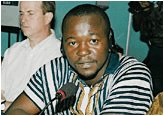
Tecee Boley | Reporter
Tecee Boley is a leading radio and print reporter in Liberia. She works at Liberia Women Democracy Radio as a reporter and presents programs on gender education and rural women. She also contributes to FrontPage Africa newspaper and Front Page Africa, Liberia’s most widely read newspaper and website, and is regularly heard on United Nations radio.
Image courtesy of New Narratives


New Narratives Fellow - Tecee from New Narratives on Vimeo.
In her own words:
‘I am already living out my dream, to broadcast voices that are rarely heard. But I don’t just want those voices to be heard, I want authorities worldwide to take action.’
Smallholders Farmers Rural Radio
Founded by Nnaemeka Ikegwuonu, Smallholders Farmers Rural Radio intends:
To reach rural poor farmers living in rural Nigeria with sustainable agricultural, environmental management skills and daily market information derived from internet sources and established networks in the local Igbo Language. Generate feedback from them with advancement through interactive radio mobile devices. Boosting their agricultural productivity and income.Watch Nnaemeka provide an overview of his organization here:
Dividing Up the Pie Differently or Grow the Pie: You Decide in 2012
The coming year will give voters a real choice of visions- divide up the wealth in our nation differently or grow the amount of wealth in our nation.
UPDATE: I see via RealClearPolitics that Michael Barone has written the same article as me today (posted after mine). Here is Voters Want Growth, Not Income Redistribution:
...a recent Gallup poll showing that while 82 percent of Americans think it's extremely or very important to "grow and expand the economy" and 70 percent say it's similarly important to "increase equality of opportunity for people to get ahead," only 46 percent say it's important to "reduce the income and wealth gap between the rich and the poor" and 54 percent say this is only somewhat or not important...
...I believe that historians have taught the wrong lessons about the 1930s. And I believe there is a plausible and probably correct reason why economic distress has apparently moved Americans to be less rather than more supportive of big government....
...The New Deal historians attributed these gains to Roosevelt's economic redistribution measures -- high tax rates on high earners, the pro-union Wagner Act, Social Security. These laws, the so-called Second New Deal, were passed in 1935. They replaced the different, non-redistributionist policies of the First New Deal that stopped the deflationary downward spiral underway when Roosevelt took office....
...Lesson: If you want redistribution, you better first produce growth. Which the Obama Democrats' policies have failed to do.
Spoken Word Artists go from Page to Podcast
It began as an annual festival to host local poets in and around Cape Town but thanks to the power of technology the ancient art of African story-telling is spreading around the world.A poetry collective decided to set up Badilisha Poetry Radio, which in Swahili means change. Its aim is to celebrate the spoken and written word through online radio and live performance.Broadcasting from South Africa, poet Malika Ndlovu and her colleagues are spreading their reach far beyond this corner of the continent...[more]
Banat wa Bas-Girls Only Radio
ITNsource reports on a community radio initiative:
Amani al-Tunisy, who founded Binat Ou Bas in July 2008, says she was initially inspired by a conversation she overheard in a coffee shop in which three young Egyptian women were discussing the issue of marriage. Al-Tunisy says she was shocked at how much society's expectations seemed to govern their lives, and saw radio as one way to get people talking about issues like marriage, harassment of women, inequality and the need for change.via Mnet