RSS
Menampilkan postingan yang diurutkan menurut relevansi untuk kueri dependence. Urutkan menurut tanggal Tampilkan semua postingan

Ending Aid Dependence

Yash Tandon writes in Ending Aid Dependence:

Developing countries reliant on aid want to escape from this dependence, and yet they appear unable to do so. This book shows how developing countries can liberate themselves from the aid that pretends to be developmental but is not. Exiting aid dependence should be at the top of the political agenda of all countries...[continue reading]

  • Digg
  • Del.icio.us
  • StumbleUpon
  • Reddit
  • RSS

'Riches to Rags' the commodity dead-end


The cautionary tales of commodity dependence continue.In Pambazuka Khadija Sharife writes about Zambia's copper straitjacket:
Once perceived as an icon of progress in Africa thanks to wealth from its copper mines, today over 75 per cent of Zambia's population lives below the poverty line...Khadija Sharife recounts the country’s ‘riches to rags’ story – a story that is being repeated in former resource colonies across the continent, which although ‘politically liberated’ have ‘remained economically chained’.
More here
Even Russia's Medvedev rails against commodity dependence.

  • Digg
  • Del.icio.us
  • StumbleUpon
  • Reddit
  • RSS

Food crisis: Where is the African strategy?

Mammo Muchie writes in Pambazuka:

Over half century has passed; Africa suffers from myopia of a particularly pernicious 'fragmentation-dependence.' The root problem for this unchanging predicament lies in the state of fragmentation that invites dependency that conversely continues to prevent the evolution of an African national spirit, purpose, project and strategy.There is need for a fresh approach, a new departure to embark on a roadmap to convert the 'fragmentation-dependence' dilemma into an enabling integration-self-sustaining, innovative, learning, capabilities building' national project - and re- launch African development on a secure pedigree with confidence and inspiration...[continue reading]


Reblog this post [with Zemanta]

  • Digg
  • Del.icio.us
  • StumbleUpon
  • Reddit
  • RSS

The Resource Curse

The [African] blog wars writes about the 'Resource Curse':

It is widely suspected that the ‘curse’ is largely caused by the effects of over-dependence on resources. Governments, perhaps believing resources will never run dry (in their time), fail to wean economies off these commodities. One of the consequences of this is that in times of high prices, the real exchange rate rises making local industries less competitive, while encouraging borrowing as it becomes relatively cheaper to do so.
The danger though is when prices fall, exchange rates fall and debt repayments soar, and this is after industries have contracted, which dramatically decreases tax revenues. Sure, taxes could be pushed up to compensate, but this wouldn't do much for competitiveness.
Over-dependence is the big issue though. Botswana still gets 70 percent of its export revenues from diamonds, while Burundi, Rwanda and Uganda all earn more than 50 of their export earnings from coffee. Looking west to cotton producing nations, the picture isn’t really any better. And, then, of course, there’s oil, which earns Nigeria 95 percent of its export income. Perhaps part of Chad’s defection to China was because the Asian giant is more likely to be able to buy all of Chad’s oil than Taiwan is.

The [African] blog wars

  • Digg
  • Del.icio.us
  • StumbleUpon
  • Reddit
  • RSS

The Future of Universities

Writing about the African University Donald Ekong stated that"...Emphasis will have to be on the formation of graduates who have the flexibility to respond to changing demands in the economy and who are capable of self-employment. With the rapid advances in knowledge, structures will be required to provide a space in the university as well as encouragement for life-long learning. The implication is that the university should be able to cater for a variety of learners and a variety of learning needs through diversification of its programmes, curriculum contents, and mode of delivery. Currently in much of Africa the university has a virtual monopoly as the source of learning. But this will change and should change as other forms of higher education are developed and have already begun to be developed in some countries. Only through creativity, innovation, and flexibility in catering for diverse learning needs will the university be able to retain a leading position in terms of relevance to the needs of society.
A further challenge for Africa is the danger of new forms of dependence which could be just as devastating as the current forms if not even more so, that is, dependence on knowledge and knowledge application processes from elsewhere. The challenge for the African university is to contribute new useful knowledge and application processes that derive from the African environment and draw from African experience and ingenuity. There is also an urgent need to increase participation in higher education from all sections of the population-currently participation in higher education in Africa is the lowest in the world-with a view to raising the collective capacity and productivity of African society. Both aspects are essential for enhancing African competitiveness in the global market place..."

  • Digg
  • Del.icio.us
  • StumbleUpon
  • Reddit
  • RSS

We must breed tigers in Africa

Matthew Lockwood writes on the need for non-standard remedies in Africa, he states "...What Africa needs is to shake off its dependence on primary commodity exports, a problem underlying not only its marginalisation from world trade but also its chronic debt problems. Many countries rely today on as narrow a range of agricultural and mineral products as they did 30 years ago, and suffer the consequences of inex orably declining export earnings. Again, the campaigners' remedy - to improve market access for African exports to Europe and America - is wide of the mark. While imperfect, various preferential schemes already give the poorest African countries excellent market access.To understand how Africa might diversify we must look elsewhere, to the experience of east and south-east Asia. Not only have these countries revolutionised their trade performance in the last four decades to become world leaders in everything from clothing to computers, they have also achieved the holy grail of broad-based growth. The "Asian miracle" has seen countries poorer than their African counterparts in the 1960s virtually eradicate $1-a-day poverty today. If you really want to know how to make poverty history, it is this transformation that you must grasp..."

  • Digg
  • Del.icio.us
  • StumbleUpon
  • Reddit
  • RSS

Higher Prices for Cocoa and contd. Commodity Dependence

G. Paschal Zachary on the advent of higher prices for cocoa and the consequent higher income for farmers:

A cacao tree with fruit pods in various stages...
Image via Wikipedia
The benefits to African farmers should be significant over time. Unlike some other crops, new gardens can require years of planning and labor. Existing trees are subject to blight and aging and must be worked intensively to maintain yields. When I visited Ghana’s cocoa-growing region a year ago, I was struck by the prosperity of farmers I met but also the relative inflexibility of growing cocoa. Expansion of output is hard to achieve. Inputs, such as fertilizers, are expensive and are used less than they should be by non-organic growers. New trees take years to reap fruit. Field labor is surprisingly costly. Producers also fear a glut; they can benefit from stagnant production too...[continue reading]
Shouldn't the farmers be exploring ways collectively or otherwise to add value to their primary product? The irony of having to purchase chocolate derivatives in the West for usage back on a continent is simply inexcusable 50 years after independence.
Enhanced by Zemanta

  • Digg
  • Del.icio.us
  • StumbleUpon
  • Reddit
  • RSS

The Deep South & Northern Nigeria, A Parallel?

Pius Adesanmi writes in Sahara Reporters:

The lack of exclusive dependence on illegal slave labor and plantations by the North created a pluralistic conceptualization of the material base of society in that part of the United States. This in turn led to a diversification of the sources of wealth creation and a boundless spirit constantly seeking more diverse ways of societal progress and advancement that would later eventuate in manufacturing and industrialization. Theirs was a philosophy of building society yourself...[continue reading]
Photo courtesy of Sahara Reporters

  • Digg
  • Del.icio.us
  • StumbleUpon
  • Reddit
  • RSS

Rejuvenating the Mozambican knowledge factory

Luca Bussotti writing over at Pambazuka:

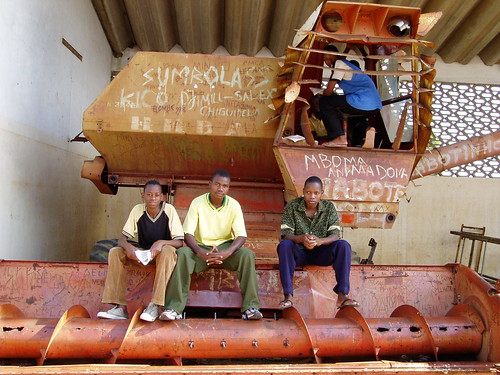
Students at Escola Agrária in Chokwé
CC Afronie
Firing up the local production of knowledge is crucial to escaping the ‘industry of development
He goes on to say:
...it appears rather obvious that few people have an interest in promoting local knowledge and knowledge in general as a key to exiting structural dependence. Rather, as Mozambican sociologist Elísio Macamo wrote, the ‘industry of development’ continues to work, and it doesn't seem to be in the interest of the leading classes to get rid of it.
More here

  • Digg
  • Del.icio.us
  • StumbleUpon
  • Reddit
  • RSS

Amsatou Sow Sidibe- Peacemaker

Malena Amusa over at WomensEnews:

Fifteen years ago Amsatou Sow Sidibe, a lawyer and one of Africa's most vocal human rights activists, co-founded the African Network for the Promotion of Women Workers, based in Senegal's capital Dakar.The group, with branches throughout French-speaking Africa, focuses on training women in job skills and the law. In Wolof, the dominant language of Senegal, the group is called Rafet, which means beautiful
On her ability to handle prickly subjects:
Part of Sidibe's success is her flexible way of handling tough situations. When talking about the Muslim practice of marrying multiple wives, for example, many women's rights activists take a strong stand against polygamy. They see it as destroying a woman's self-esteem and causing financial dependence.However, instead of trying to ban polygamy, which is controversial but legal in Senegal, Sidibe tries to make peace with the practice. In a national magazine interview she suggested that polygamy be promoted in cases when a man takes up a mistress. At least that way, she reasoned, a man could keep the relationship out of the shadows and help the woman secure authority over property, children and finances.
More here
Enhanced by Zemanta

  • Digg
  • Del.icio.us
  • StumbleUpon
  • Reddit
  • RSS

Industrialization: Recipe for jobs and Wealth Creation

Bienvenu-Magloire Quenum of Africa Biz Online writes that the "...The industrialization process will create a larger consumers' base in each African country with higher purchasing power. Therefore, the dependence towards overseas markets would be less important in a first stage. Otherwise, selling raw agricultural products - cotton, coffee, cacao beans to name the few, will lead SSA countries to a dead end of continued poverty. Negotiation rounds at the World Trade Organization will not give any reprieve to African farmers. The solution is to process the agriculture products to satisfy national market first and second African regional markets. Overseas markets coming as a last conquest...".Intra-regional trade largly informal and unsupported is centerpiece to rebuilding a viable trading ecosystem.

  • Digg
  • Del.icio.us
  • StumbleUpon
  • Reddit
  • RSS

Aid:A failure of purpose

Jeevan Vasagar writes "...What exactly are the NGOs trying to achieve? If the purpose of aid work is to diminish poverty, the past decade looks like a dramatic failure...Reliance on aid can be dangerous. Ultimately, it threatens to sever the political contract between the government and those it governs...Ending poverty appears to have little to do with overseas aid or the activities of NGOs. It has to do with pragmatic governments that create a business-friendly environment and place a heavy emphasis on education.By contrast, Africa has suffered from rulers who are parasites on their people, where the elites loot resources to line their own pockets and create an environment where investors fear to tread.Dependence on aid will only prolong the lives of these parasite states..."
photo courtesy of the Guardian Unlimited

  • Digg
  • Del.icio.us
  • StumbleUpon
  • Reddit
  • RSS

World Social Forum

Tajudeen Abdul-Raheem writes about the recently concluded WSF in Kenya.

This dependence on foreigners, both financially and ideologically, is so pervasive that it cannot be ignored anymore. There are signs that an increasing number of Africans are not only outraged by it but becoming ashamed by it, and are looking for ways and means of freeing our activism from the clutches of donor funding and donor-driven agendas. These issues were frankly and honestly discussed at many forums before and during the summit

and asks:
How many of our busy-body, noise-making NGOs qualify in this sense? It is similar to our governments being dependent on the aid of outsiders, and we demanding that they should be accountable to us. We do not pay taxes but demand representation and wonder why the leaders are more responsive to any noise that comes from outsiders?

  • Digg
  • Del.icio.us
  • StumbleUpon
  • Reddit
  • RSS

The Deep South & Northern Nigeria, A Parallel?

Pius Adesanmi writes in Sahara Reporters:

The lack of exclusive dependence on illegal slave labor and plantations by the North created a pluralistic conceptualization of the material base of society in that part of the United States. This in turn led to a diversification of the sources of wealth creation and a boundless spirit constantly seeking more diverse ways of societal progress and advancement that would later eventuate in manufacturing and industrialization. Theirs was a philosophy of building society yourself...[continue reading]
Photo courtesy of Sahara Reporters

  • Digg
  • Del.icio.us
  • StumbleUpon
  • Reddit
  • RSS

China and India: What's in it for Africa?

A summary of the OECD publication "The Rise of China and India - What's in it for Africa" makes a number of points:

In order to avoid being trapped into the unpromising corner of vulnerable, capital-intensive and high-risk raw material dependence, resource-rich Africa will have to balance the need to match the promotion of job-rich sectors with the desire to capitalise on a windfall gain generated by higher commodity prices. Monetary authorities will have to lean against the real currency appreciation in order to avoid burdening industries competing with imports, and exporters outside the resource sector. Central banks need to be supported by fiscal authorities, which are required to limit public spending on services and construction to keep non-tradables prices in check.Investment abroad of export proceeds will further insulate the local economies from ‘DutchDisease’ effects.
Furthermore, in low-tech activities like clothing or footwear, growing FDI into China and India is likely to crowd out investment in Africa, although geography and preferential tariff treatment may still provide some African countries with a competitive edge. Head-on competition, however, is unlikely to be the main channel through which the Asian drivers impact on FDI flows into (and out of) Africa.

  • Digg
  • Del.icio.us
  • StumbleUpon
  • Reddit
  • RSS

Africa’s urban revolution in the 20th century

In Memory Bank:

...Africa’s new leaders thought they were generating modern economies, with ambitions for public expenditure to match, but in reality they were erecting fragile states whose economic base was the same backward agriculture as before. As Frantz Fanon predicted, this weakness inexorably led them to exchange the democratic legitimacy of the independence struggle for dependence on foreign powers. These ruling elites first relied on revenues from agricultural exports, then on loans contracted under dubious circumstances, finally on the financial monopoly that came from being licensed to supervise their country’s relations with global capitalism. But this bonanza was switched off in the 1980s, when foreign capital felt that it could dispense with the mediation of local state powers and concentrated on collecting debts from them. Many governments were made bankrupt and some simply collapsed into civil war.
More here

  • Digg
  • Del.icio.us
  • StumbleUpon
  • Reddit
  • RSS

Welfare and Taxes- Democrats Back to Work

Now that the healthcare bill has been passed, I see that the news is getting a little more honest about reporting just exactly what the healthcare bill is. For example, the Detroit News says:

The landmark legislation that Obama signed Tuesday would provide health care to 32 million uninsured people. The $938 billion, 10-year price tag would be financed largely by culling savings from Medicare and imposing new taxes on higher income people and the insurance, pharmaceutical and medical device industries.

That's exactly what this healthcare bill was at its heart- a massive expansion of government welfare paid for by raising taxes (the 'savings' from Medicare are fake savings- the government telling doctors that they are going to accept less money for procedures and drugs doesn't affect the real cost of those procedures or drugs).

Welfare and tax raises- that's the Democrats solution to everything, and you can just put 'healthcare reform' in that same boat and that basically is what it is. But, Democrats are still in Washington, so today they went right back to the Obama/Pelosi Democrat plan for America- more welfare spending, more 'construction' spending, and more taxes to pay for this government largess.

A bill passed Wednesday in the House of Representatives would billions of more dollars for construction projects and welfare programs in selected states. Democrats characterized the $16 billion dollar bill as yet another stimulus program, but in reality it is more welfare and government make-work projects funded by increased taxes and fees or increased debt. This is the Democrat's only answer to every problem in society- increase dependence on the unaccountable state, increase the power of the government, increase the number of people in society working for the government, while taxes and fees and regulations go up on free people who are forced to carry the deadweight of government and its dependents around on their backs.

Democrats, like my Congressman Gary Peters, don't make it a secret that what you are voting for when you don't vote Republican is welfare and taxes.

  • Digg
  • Del.icio.us
  • StumbleUpon
  • Reddit
  • RSS

African Renaissance: Roadmaps to the Challenge of Globalization

Khalil Tian Shahyd reviews African Renaissance by Fantu Cheru he "...calls on us to rethink the concept of “decolonization of the African mindset”. Africa’s dependence on foreign aid, he says, has done the opposite of its claimed mission, but in fact has been used to keep Africa’s people disempowered through the support of dictatorships and undemocratic regimes. Further, the habits of import consumption and the rejection of products produced in Africa is the highest example of how deep the colonial ingraining has been.Further along, he challenges African universities, scholars and heads of state to commit to strengthen their people’s capacity in “all the relevant specializations” and improve the ability for sub-Saharan trade negotiators to engage in meaningful dialogue during WTO meetings, and other international negotiations..."

  • Digg
  • Del.icio.us
  • StumbleUpon
  • Reddit
  • RSS

"Screw You" is what Gary Peters, Barack Obama, and the Democrats in Congress Intend to Say to Voters by Passing Climate Bill

Via RealClearPolitics, Mike Allen broke this disgusting story yesterday:

Phil Schiliro, the White House congressional liaison, has told the Senate to aim to take up an energy bill the week of July 12, after the July 4 break (and after the scheduled final passage of Wall Street reform). Kagan confirmation will follow, ahead of the summer break, scheduled to begin Aug. 9. The plan is to conference the new Senate bill with the already-passed House bill IN A LAME-DUCK SESSION AFTER THE ELECTION, so House members don't ave to take another tough vote ahead of midterms.

A White House aide has the official word: "President Obama reiterated his call for comprehensive energy and climate legislation to break our dependence on oil and fossil fuels. In the coming weeks he will be reaching out to Senators on both sides of the aisle to chart a path forward. A number of proposals have been put forward from Members on both sides of the aisle. We're open to good ideas from all sources, and will be working with Senators on a comprehensive proposal. The tragedy in the Gulf underscores the need to move quickly, and the President is committed to finding the votes for comprehensive energy legislation this year."

Gary Peters, Democrats in Congress, and Democratic President Barack Obama know that the people don't want this cap-and-tax bill passed. They know without a certainty of a doubt that the voters DO NOT want the bill. The will of the people has been clearly expressed to them, and the Democrats totally understand that there is no way that voters want anything to do with this bill. And yet they intend on passing it anyway.

If you tell someone not to do something, you demonstrate through actions (like an election) that you don't want someone to do something, and then they look at you and do it anyways, what are they telling you? Gary Peters, Democratic Congressman from Michigan's 9th District, is telling his constituents "screw you." Barack Obama, Democratic President, is telling the people of the United States "screw you." They know that people don't want the bill passed, and yet are going to pass it anyway, in defiance of the public will, in disregard to the public will, and in disrespect to the public will.

This isn't Bush surging troops in Iraq when the 'public was against it'- polling data was pretty inconclusive on the War in Iraq, and if it was unpopular, it was marginally so (although vocally so in a certain segment of the population). And Bush was proud of the surge- he thought it would work and that voters would reward his party in the coming elections from its success (it did work but voters are idiots and punished him for winning an 'unwinnable' war). The cap and tax bill is different- voters are solidly against it , and have been for a long time, and in a consistent manner, and getting more and more against, and Democrats know it won't work, are not proud of it, and don't want to run on its success because they know it is going to be a failure. And yet they'll pass it anyway.

"Screw you America" is the new slogan of the Democrats. I'm not going to take this any more- everyone in my Congressman's district needs to know that this is how the Democrats think. Throw the bums out.

  • Digg
  • Del.icio.us
  • StumbleUpon
  • Reddit
  • RSS

Aid and the Undermining of Institutions

The Centre for Global Development publishes an essay on the paradox of international Aid. "...it is possible that aid could undermine long-term institutional development, particularly in sub-Saharan Africa. By reviewing the evidence of the potentially negative effects of aid dependence on state institutions, the authors provide a thorough analysis of the institutional effects of aid. The conclusions are two-fold: countries which receive a substantial portion of their revenues from foreign aid may be less accountable to their citizens, and they may face less domestic pressure to maintain popular legitimacy. The more aid countries receive from abroad, therefore, the less incentive they have to invest in effective public institutions... "
via PSD Blog

  • Digg
  • Del.icio.us
  • StumbleUpon
  • Reddit
  • RSS