RSS
Menampilkan postingan yang diurutkan menurut relevansi untuk kueri human capital. Urutkan menurut tanggal Tampilkan semua postingan

Rhee On Her Soap-Box Again, Shame On Anderson Cooper !

Much to my own discomfort, I forced myself to watch a clip of Anderson Cooper 360. Gag me with a spoon. Here's the video clip link. Just more of the same of Rhee on her soap box with unedited teacher bashing . Many who watched Michelle Rhee on Cooper's Thursday evening show were infuriated about the production of 'What's Next -Education ?' If you were watching, the answer to that question is more of the same. Stay tuned for more firings, more firings and more firings by Chancellor Michelle Rhee . It brings to mind Bill Turque's recent article in which he reported that Rhee vowed not to make teacher cuts despite a budget deficit that extends into 20011. Seems as though the WaPo had to offer a retraction to this mis- characterization as this isn't exactly what Rhee meant. The word 'vow' afterall just isn't in Rhee's vocabulary and gives us a hint of what's up ahead. So don't be surprised if DC teachers are amongst the group to get the axe along with security and central office staff in the upcoming RIF's.

The perpetual theme of Rhee's argument on and off the show seems to continue to be that ineffective teachers are to blame for all that's wrong in urban education. Of course the show infers that ineffective teachers are typically older teachers who stay beyond their time. Even the first snap shop is an adolescent student complaining about older teachers with connections. Bah humbug ! Most students I know consider all of their teachers old even when their teachers are only 26. Seems like this snapshot was intentionally staged by Cooper's producers unfortunately.
What ate at me most is this reference to teachers as 'human capital' as though teachers are something to be disposed of. Rhee's remarks lacked substance and had she been required to be a part of an educational panel, she would have been kicked to the curb quickly by anyone with a miniscule of knowledge about public education. Even a young student featured in a clip recognized the importance of having technology to enhance learning. Rhee quickly dismissed this yet when asked by Cooper what 3 things she neeed most, she commented among them, her email and prized laptop.
Of course the show's producers allowed Rhee time to give a shout out to her boss, Mayor Adrian Fenty and put in a good word especially given that this is an election year. What was noticeably absent was any questioning about accountability for Rhee and her management team. It left me wondering where's the accountability for this 6 figure salaried crew or are teachers the only ones responsible for the state of public education ?
Far be it from me to be the only one to criticize this mediocre 2 year teacher by her own admission known as Michelle Rhee. Here's what others are stating about Rhee's appearance on Cooper 360 as recently featured on Council member Kwame Brown's blog :

  1. DC parent & resident says:

    This is another example of Michelle Rhee bashing DC teachers all across the country rather than taking responsibility for the fact that she is an inept manager and only made student achievement in DC public school worse in her tenure. (Check out NAEP scores for DC black students and how the achievement gap is worse than when she came). Rhee has to go around on the talk circuit and convince others because no one in the DC area is listening anymore to her rhetoric. Rhee like the mayor only have one weapon which is to fire thousands of DC employees. Their goal is to destroy all unions in this city and privatize city government.

    The DC city council has promised long ago an independent evaluation of our public schools as well as an internal audit. To date we are still awaiting this to happen. Many of us believe that the results will demonstrate Rhee’s exaggerated claims of student achievement and fiscal MISMANaGEMENT.

    My question is what is taking so long City Council member Brown.

    Signed, sick and tired of being sick and tired of Rhee and Fenty

  2. Chancellor Michelle Rhee spoke about everyone being accountable but herself. I think her

    performance is more important than anyone she spoke of during the interview with Mr. Cooper.

  3. efavorite says:

    What I noticed was that Rhee’s answer to practically every question was “Human Capital” (I think that’s Rhee’s management-speak for “teachers.”)

    Cooper asks what’s next in education? And Rhee answers, “I think one of the things were going to see over the next few years is a real focus on teacher quality and human capital in schools.”

    Cooper asks about changes in education and Rhee answers, “I actually don’t think it’s going to be something in the realm of computers or smart boards…. I think the real innovation is going to happen around accountability for the adults in the system…with the focus on human capital…. How we change the ways teachers are thought about in society, how they’re compensated; how they’re evaluated…. That’s what’s really going to drive the innovation going forward.”

    Cooper asks about creative solutions to education and Rhee answers, “It’s absolutely the human capital. It’s the quality of educators in the classroom and leading our schools…. “

    Why even go to do the trouble of bringing in students to comment, when they were just used as shills for Rhee to put down teachers. When the first student commented on older teachers who “have connections,” Rhee saw an opening to blast unions: “It’s a significant problem that in this country right now we have a dynamic where you can be incredibly ineffective. You can, you know, actually take kids backwards in terms of their academic achievement, every year, year in and year out and still have a job.” [I think she should be required to present the data that proves she has kept teachers on the payroll who have taken kids backwards over a period of years, and then explain why she didn’t put those teachers on the 90 day plan and have them fired.]

    When the second student suggested more technology for the future, Rhee disagreed, suggesting more focus on human capital, of course.

    This interview was a farce. Anderson Cooper simply provided a forum for Rhee to publicize her only plan for reforming DC schools — firing teachers.

  4. When Chancellor Rhee arrived in town she did not create an education plan. After much criticism, she created an educational plan 18 months into her term. Her educational plan included a plan to get rid of a significant share of her teaching workforce through buyouts, layoffs, terminations, etc.

    Chancellor Rhee has since fired a significant share of teachers, administrators and school staff without due process and without regard to their performance ratings. Rhee believes in firing probationary teachers without regard to performance, seasoned administrators with schools that have made documented gains and the list is endless. Rhee recently terminated 388 teachers and school staff via a reduction in force in November ‘09 after school started which has created over sized classes & teachers teaching outside of their certification. Rhee hired over 900 teachers this year then argued that she had a budget deficit which caused her to terminate 266 teachers and over 100 school system employees, many of whom were highly qualified and certified. No credible school system in America terminates highly qualified and certified teachers & staff while continuing to hire mainly new teachers who lack experience and are at not highly qualified. This ensures that mostly students of color are more likely to be taught by an inexperienced and un-certified teacher thereby contributing to the increasing disparity in the achievement gap between black and white students. This is also a violation of NCLB. Students of color are more likely to be taught by a teacher who is provisionally certified, inexperienced and lacking in HQ credentials.

    Certainly the piece by Anderson Cooper was a farce. I agree with e-favorite that Rhee was simply given a platform to spew her lies and continue to bash public school teachers on CNN as well as give a plug to Mayor Fenty for his next election bid. This is about capitalism and privatization of public education through hefty million dollar contracts to groups like TFA and the New Teacher Project. This creates a revolving door workforce of inexperienced teachers who stay an average of 3 years and leave before gaining the experience, professional development, mentoring, coursework and professional certification to become better teachers.

    I do hope that the DC CIty Council in their oversight role of public education will take a stand and continue to investigate instances of fraud within DC public schools. Rhee is still hiring teachers despite the fact that she claims that there is a budget deficit and one that is continuing to grow under her leadership and will require more layoffs in 2010-2011. Rhee more than likely will fire more teachers within this next year.

    I support an immediate forensic audit by the DC City Council, like the one conducted in the Barbara Bullock union scandal. I also support getting on with the independent evaluation so that the results can be provided to the public before Mayor Fenty’s next election. What can you do to help facilitate this Mr. Brown and how can we be of help to support your efforts ? It is finally time for some real accountability of Michelle Rhee.

  5. Ronnie says:

    While there is some political hay to be made trashing the chancellor (especially by those who do not support the mayor), the vast majority of residents understand and respect that she came into a system that had been wrecked by adults for political gain. We know that WTU is part of the problem. Unions can be part of the solution and are a great resource for the country, but this union needs to dismantle and a new union formed with legit leadership.

  6. efavorite says:

    Sorry, Ronnie, I do not “understand and respect that [Rhee] came into a system that had been wrecked by adults for political gain.”

    I was very excited when she first came in, because I hoped she’d improve the school system. I could not longer support her when it became obvious that her goal was simply to bust the union for the political gain of adults and didn’t care at all about effects on kids (or she couldn’t have RIFd teachers mid-year, upsetting students learning environment)

  7. Jane Doe says:

    I believe the Michelle Rhee feature on Anderson Cooper 360 was both appalling, inaccurate, biased and an example of why I will NEVER support anything Anderson Cooper speaks on, produces, writes, edits, tweets, googles or affirms in any way. It is bad enough that the City Council has allowed her to manufacture RIFs, conduct massive layoffs and to badmouth the citizens and children of the District as well as its workforce. However, when a person like Anderson Cooper gives an educational dilletante so much exposure and allows a platform for her to lie about data with no one to represent the opposite side of the argument, something is very wrong. The only scores that have improved are white students’ scores and that translates to a problem for everyone because all children must succeed!!

    Councilman Brown, you were merely ‘present’ the day Peter Nickles became the Attorney General of our nation’s capital. We need you to be present and ACTIVE to rid the city of leaders who operate in the reptilian manner Rhee espouses. Ronnie above posts that the current union needs to be dismantled and reformed into a different organization. While I agree that all organizations have their problems, it is a serious issue that Rhee is unable to respect or follow ANY RULES of any organization and that she is allowed by the supreme legislative body to operate with impunity while breaking the Anti-Deficiency Law and other similar laws.

    Rhee cannot be trusted to be responsible for anyone’s children with the destructive decisions she has made while responsible for students in Sacramento. Ms. Rhee was made aware of sexual allegations against her fiance when she was in the position of being a mandatory reporter in Sacramento. She did not. There is no statute of limitations with respect to her failure to act appropriately within the confines of the law. Rhee also interfered in a federal investigation by contacting former Inspector General Gerald Walpin, the man whom President Obama chose to fire or have fired when allegations about her fiance came out. How is this at all acceptable?

    People say this has nothing to do with her current position. What a naive perception. It has everything to do with her current position. A woman who is amoral enough to protect a man who prefers little girls to women his own age is now engaged to a woman with a child’s body. If she can interfere with a federal investigation without reproach, what wouldn’t she do? It is clear she has no respect for the City Council or even for the President of the United States if she dares to interfere with an Inspector General. After all, the President did sponsor legislation to protect Inspectors General.

    Well, he is another of Rhee’s victims. Is she more powerful than the President? Her level of power reminds me of a poignant scene of the motion picture Malcolm X where a police officer commented “That’s too much power for one man to have.” Rhee is clearly more powerful than the mayor and we all know exactly what he thinks of the City Council, of which he was once a part.

    The proper way to effect change is to follow the rules in place while making changes to the process by which things are done. It is no better for a broken system to be replaced by a tyrant, his out-of-control undereducated and underexperienced chancellor and his police chief who allegedly bends the law for the privileged.

Crystal Proctor says:

Up until today I had been a fan of Anderson Cooper but now I must add him to the list of people that don’t really care about education and our kids, these people only care about allowing Michelle Rhee to push her agenda. This is the agenda that efavorite and The Washington Teacher touched on.

I am so tired of watching Michelle Rhee bash teachers. I must agree with efavorite, her whole interview was to talk about teachers and how bad they are and how unions will make the world crumble. I am a teacher that Michelle Rhee wrongfully terminated in October and I am tired. I am tired of defendeing myself in the Post, on blogs, and on the street. It continues to shock me how people believe her lies. Despite being told that I was being fired because of a budget shortfall she continues to hire. Despite her admiting under oath, in front of the City Council, that she found out about the budget in July and stoped hiring shortly thereafter, there is proof on the DC Government website that proves otherwise. I am really tired of people of power looking the other way. She is winning her war against teachers and the students are loosing. Mr. Brown what will you do!!!

Posted by The Washington Teacher featuring Candi Peterson, blogger in residence

  • Digg
  • Del.icio.us
  • StumbleUpon
  • Reddit
  • RSS

Asia and Africa in the Global Economy

Julius Court and Toru Yanagihara suggest strategy alternatives for African countries in a world of globalisation "...Most countries in Africa are small and poor, making an inward looking strategy unattractive. Significant advances in economic development in Africa in the future will depend in no small part on the success with which countries can exploit the opportunities and avoid the risks presented by globalisation. A viable outward oriented strategy for countries in Africa will have to reflect the structure of the economy and endowments relative to other parts of the world. On the first point, the primary sector dominates most economies in Africa. On the second, Africa has low levels of human capital in comparison to other regions. The familiar proposition seems to hold – for most countries in Africa comparative advantage lies in primary production and unskilled labour-intensive primary processing...Given the long gestation period of investments in human capital, this is likely to remain the situation for many years to come..."

  • Digg
  • Del.icio.us
  • StumbleUpon
  • Reddit
  • RSS

Strengthening Industrial Clusters

A recent World Bank report 'Industrial Clusters and Micro and Small Enterprises in Africa: From Survival to Growth' states that:
Existing studies on natural industrial clusters in Africa have found that the lack of managerial skills among entrepreneurs running micro and small enterprises is a major constraint for innovation and growth in the clusters. As a part of this study, pilot managerial skills training programs were conducted in two industrial clusters on an experimental basis, where a group of randomly selected entrepreneurs within the clusters were given three-week long crash course of based management such as bookkeeping, marketing, business planning, and production management. The impact evaluation of the experiments showed significant positive impacts of the training programs on value added and gross profits of enterprises.
Continuing:
Raising the current survival-type industrial clusters, which have been formed as a coping mechanism to weak investment climate, into more dynamic innovating clusters will be an important avenue for fostering growth of micro and small enterprises in Africa. While national efforts to improve investment climate and investments in human capital are undoubtedly important, there could be more targeted policies to be formulated, in complementing general policies, to support growth of micro and small domestic enterprises using existing industrial clusters as a natural springboard for their growth. In that context, the study discusses the merit of cluster-based managerial human capital development to build steps toward more innovation-oriented clusters, the importance of sound spatial planning policy, particularly at the local level in the context of urban planning, the need to expand market access and economic linkages for industrial clusters including regional integration and linkages with large enterprises
via TCI

  • Digg
  • Del.icio.us
  • StumbleUpon
  • Reddit
  • RSS

Rhee Rhee-acts to Taking A Lashing From DC Teachers !

Over the past several weeks, Chancellor Michelle Rhee has held meetings at the central office beginning at 4:30 p.m. Many contend that Rhee's recent "question and answer" style meetings are a 'direct response' after Deputy Chancellor Kaya Henderson took a beating on Rhee's behalf at the January 16, 2009 Human Capital Initiative hearings at the DC City Council. The hearings have played non-stop on DC television and on-line. For those who attended or watched it , it was clear that Ms. Henderson's 'head was in the clouds' when it came to what DC teachers, parents and other constituents have been saying about the Rhee administration's five year plan and human capital initiative. If you haven't already, I strongly encourage you to read the 5 year plan in its entirety on the DCPS website @ www.k12.dc.us

Many who testified expressed concerns about the five year plan and efforts to rid the system of such programs as the National Board Certification program for teachers as well as Rhee's plans to rid DCPS of a significant share of our teaching force and a buy-out of even more teachers from restructured schools. Approximately 3 teachers who had been fired without due process under Rhee's administration testified as well including blind teacher Fred Kamara. DC Teacher- Jeff Canady from Emery Education Center testified and answered questions from the council about being placed on a 90 day termination plan despite having the highest test scores at his school which by the way was recently ranked as # 7 city wide. Mr. Canady suggested that he has been the victim of retaliatory practices by Principal Ron Taylor, after contacting Rhee's office due to lack of working technology as well as being outspoken in the press. Another teacher who testified was nationally board certified and questioned the slashing of this program by Rhee later next school year.

The council members attested that in their talks with teachers, parents, and community members in schools and the community at large - that there are great concerns about the ongoing educational reform efforts. Charmian Gray pointed out that there is a disconnect between what Kaya Henderson reported and what the council is hearing. Chairman Gray suggested that it was indicative of a pattern that Rhee had not managed change very well. Gray admonished Henderson and strongly cautioned that Rhee needed to address this issue.

These last two Rhee meetings have generated approximately 40-50 teachers with promises of pizza and free parking at last week's meeting. Some teachers were upset when advised that the Chancellor's office would not pick up the tab on last week's parking especially since parking is quite expensive at the central office and off-street parking is limited during rush-hour. This week- DC principals were requested to ask their teachers to attend Rhee's meeting. Of course some complied. However, notices that were mailed out regarding details of this week's meeting clearly indicated that parking was available , however, there was no mention this time that it would be free.

A little birdie told me that Rhee assured veteran educators who attended the after school meetings that she does not want to get rid of them despite what is reported in the press . Rhee stated that she has been misquoted in the press. Funny, Rhee would state this given that DC's five-year plan reveals that she wants to rid our system of a significant share of teachers.

What's your take on the purpose of Rhee's recent meetings with DC teachers at the central office? Feel free to weigh in with your thoughts. (Posted by The Washington Teacher).

  • Digg
  • Del.icio.us
  • StumbleUpon
  • Reddit
  • RSS

The Story The Washington Post Won't Report

On Friday, January 16th a DC City Council hearing was held on the human capital initiative. Ten DC teachers testified at the hearing after school hours including three DC teachers who were terminated under Rhee's administration without due process. One teacher reported that she was fired via email by McKinley principal David Pender while teacher Fred Kamara never received notice of his termination . Denise Hamilton and Fred Kamara both appeared at the council hearing. Both are blind teachers and their stories were featured on this blog earlier in the year. The story- "DC Teachers Say Morale Is Low" as written by Bill Turque on the DC Wire blog on January 17, 2009 will not be reported by our local mainstream press. Here's the story in its entirety:

D.C. Teachers Say Morale Is Low

"At an 11-hour hearing Friday on the D.C. schools' "human capital" policies, teachers charged that Michelle A. Rhee's quest to reform the historically poor-performing system--which includes a pledge to replace significant numbers of them--has created a culture of fear. Morale, many said, has never been lower.Seemingly arbitrary and capricious performance evaluations, petty retribution for questioning authority, and just plain bungling were recurrent themes in the discussion with D.C. Council members, headed by Council Chairman Vincent C. Gray (D).


Fred Kamara, a special education teacher, said he worked for several weeks (without pay) before learning that he'd been fired. Kadesha Bonds said the principal never came to observe her classroom work before filling out her evaluation form. She was fired last summer.Jeff Canady, a third grade teacher at Emery Education Campus in Northeast, received "exceeds expectations" in multiple categories on his June 2008 evaluation, scoring 25 out of a possible 30 points. This fall, he was placed on the so-called "90-day plan," which puts instructors on notice to improve their performance or face dismissal. Canady said he is the same teacher he was last June, the only difference being that he complained to Rhee and other administrators about conditions at the school, including a lack of Internet service.Speaking in a soft but deliberate tone, Canady said that in 17 years, "I've never had one single principal or individual say anything about my teaching."Resources promised and not delivered was another frequently cited complaint. Crystal Silvia, a social worker at Bruce-Monroe Elementary School at Parkview, said the school was supposed to begin the academic year with an additional social worker and a psychologist. It hasn't happened."I feel like what I'm doing most of the time is crisis management," Silvia said.

Deputy Chancellor Kaya Henderson told council members she concurred that morale was bad. "I expect that some people will be frustrated with the rate and pace of change," she said. "It makes our job a lot more difficult when people are frustrated."But Henderson added that Rhee and her team were trying to reverse years of neglect and mismanagement within a short span of time. "If all of our teachers were great and wonderful, we wouldn't be the lowest performing school district in the country."Henderson said DCPS has been pushing to overhaul its personnel practices. The system's payroll, which had 9,933 employees when Rhee took over in 2007, is now just over 7,000, although only a few hundred jobs were actually eliminated. Most of them, including transportation, facilities management and food service, were off-loaded to other agencies or outside contractors.

A more sophisticated new teacher evaluation system will be rolled out in the spring and implemented next fall, Henderson said. Among the metrics to measure teacher effectiveness will be a new "value-added" category that measures the academic growth of their students year-to-year.But Gray cautioned Henderson that none of these innovations would amount to much if the Chancellor isn't more effective in fostering trust among teachers and managing the tensions triggered by change."If that doesn't change, this thing is going to drop of its own weight," he said." (Posted by The Washington Teacher). Article courtesy of the DC Wire.

  • Digg
  • Del.icio.us
  • StumbleUpon
  • Reddit
  • RSS

Intangible Capital

Ronald Bailey writes:

World Bank environmental economist Kirk Hamilton and his team in the bank's environment department have found that most of humanity's wealth isn't made of physical stuff. It is intangible. In their extraordinary but vastly underappreciated report, Where Is The Wealth Of Nations?: Measuring Capital for the 21st Century, Hamilton's team found that "human capital and the value of institutions (as measured by rule of law) constitute the largest share of wealth in virtually all countries."

  • Digg
  • Del.icio.us
  • StumbleUpon
  • Reddit
  • RSS

Why do some countries economies grow faster ?

MIT News on the economic growth theories of César Hidalgo and Ricardo Hausman,they contend amongst other things the importance of dense variegated clusters:
“Countries get trapped because they are in a sparse part of the product space.”-Ricardo Hausman
The standard theoretical framework for development economics was established more than 50 years ago by the MIT economist Robert Solow, who developed a mathematical model that predicts countries’ economic growth on the basis of labor and capital (the tools of production); subsequent work expanded the model to include factors such as land and human capital (expert knowledge). The model proved highly influential, ultimately earning Solow the 1987 Nobel Prize in economics.
Hidalgo argues, by lumping together a huge variety of resources under the general heading “capital,” it can obscure distinctions that are crucial to an accurate understanding of countries’ economies. In a series of papers cowritten with Ricardo Hausmann, director of the Center for International Development at Harvard’s Kennedy School of Government, Hidalgo has argued that, indeed, the best predictor of a country’s future economic health is not the magnitude but the diversity of its production capacity.
More here
After the jump watch César A. Hidalgo's overview of the  "Global Product Space"

via Next Big Future
Enhanced by Zemanta

  • Digg
  • Del.icio.us
  • StumbleUpon
  • Reddit
  • RSS

Economic Challenges

Larry Elliott writes about the continents economic challenges:

"...At the level of the firm, productivity tends to be weak because of a lack of investment in both physical and human capital. In countries such as Ghana, there is evidence of micro-financing initiatives to provide seed-corn capital for individual traders, but it is still early days. At the second level, governments need to think strategically about what their priorities are. The drive for universal primary education is welcome but there has been no similar expansion of secondary, let alone tertiary, education. The regional challenge is pretty straightforward. Africa needs three or four powerhouses - one in each part of the continent - to drag the rest along. South Africa, Nigeria and Kenya are the potential hubs for regional markets in which countries can exploit economies of scale and the potential to trade. Trade barriers within Africa are as serious an impediment to development as are unfair global trade rules..."

  • Digg
  • Del.icio.us
  • StumbleUpon
  • Reddit
  • RSS

Nonformal Education and Informal Economies in Sub-Saharan Africa

John R. Minnis asserts that;

Education policy in sub-Saharan Africa is predicated on human capital assumptions and therefore promotes the expansion of formal education as a way to promote economic growth. As a result, formal education is valued primarily as a private consumer good, a form of cultural capital that allows some to get ahead and stay ahead, rather than as a public good that also benefits the overall society. In the absence of vibrant industrial labor markets, job prospects for school leavers are poor, which places an inflated premium on educational credentials. The collapse of formal economies combined with high population growth rates suggests that higher social rates of return might accrue from more investments in nonformal adult education aimed at improving the skills and labor productivity of rural populations
,SAGEPub.In other words "Many governments in Sub-Saharan Africa continue to expand formal education in times of economic decline, in the hope that more investment in it will stimulate growth. Unfortunately the skills acquired by graduates cannot be used in the absence of vibrant labour markets. Instead, they compete for scarce white collar jobs in already bloated state bureaucracies...money would be better spent on nonformal education that does not lead to credentials but to useful skills and knowledge that could be used to improve agricultural production.",BritishLib.

  • Digg
  • Del.icio.us
  • StumbleUpon
  • Reddit
  • RSS

Socialism redistributes what Capitalism creates

Vuyo Jack writes in Business Report:

Production requires entrepreneurs who use infrastructural and human capital to bring their ideas into reality. Not everybody can create capital. Entrepreneurs are driven by their own interests, whether it is enlightened self-interest or greed.
Distribution comes afterwards, based on the level of effort and contribution made. If there is no equitable distribution then there would be no incentive to produce at all. So the key to reaching a balance is the fairness and equity in the system...[continue reading]

  • Digg
  • Del.icio.us
  • StumbleUpon
  • Reddit
  • RSS

NKA Foundation

"...Nka is an Igbo (African) word for artistry, its literary translation is “…of art”. It is also an Akan word that implies “may be” but in Akan, nká means “ancient”. We reckon the arts are the most ancient of human activities.Along these lines, Nka Foundation has a focus on human capital development through use of the arts, broadly defined to include visual arts, literary arts, performing arts, design, new media/film production, arts history, arts criticism, arts education, arts administration and curatorship, and emerging others..."-website
One of their projects is the "DESIGN+BUILD-AND-LIVE-IN PROJECT":

Mbacké NIANG(Architect, Researcher and Consultant in Dakar, Senegal)
... which welcomes artistic persons in the fields of architecture, engineering and the arts that include visual arts, literary arts, performing arts, design, new media/ film production, arts history, arts criticism, arts education, arts administration and curatorship, and emerging others to apply for residence. Length of residencies is usually from 1 month to 12 months. The applicant’s project plan may be to design and build dwellings or non-dwellings out of earth and other materials from the environment.
Enhanced by Zemanta

  • Digg
  • Del.icio.us
  • StumbleUpon
  • Reddit
  • RSS

The Meaning of Wealth

Mutumwa Mawere recently addressed the Nigerian diaspora he stated:


...There are countless examples of African entrepreneurs and professionals who have substantial amounts of money in Africa but it is evident that the prosperity has not been democratized to the extent of creating an African ownership class able to take the continent’s majority into a new and dynamically positive direction underpinned by new values of work, combined with saving, investment and an ownership mentality. It is also important to underscore that there is a distinction between being “rich” and being “wealthy”.
Yes, some Africans have made money but because financial literacy and “platinum rights” was not stressed as much as a sense of public justice and civil rights were by our founding fathers and we did not keep it (the money) and we certainly we did not grow it.
Many have made money but no one has really taught us how to keep it in our communities.
Imagine, after 13 years of South Africa’s democratic dispensation, we still do not have a new mutual for blacks? No one taught us about financial literacy and the basic tenets of a free enterprise system that appears universally to capture the imagination of many progressive and successful nations.
The challenge of understanding the free-enterprise system and making it work for the majority of Africans has to become a core part of any conversation among Africans concerned about wealth creation and creating sustainable wealth addresses for Africans. Most of our wealth addresses are not assignable and transferable let alone from one African generation to the next.
Any successful nation building enterprise must necessarily be sustained by a healthy, robust and growing tax base and not foreign aid. Africa’s post colonial budgets still remain principally funded by bilateral and multilateral sources of finance.
Africa must create its own dominant class of very successful entrepreneurs, at all levels. We should have our own wealth builders and not become a continent specialized in distributing other people’s wealth.
As we approach the 47th birthday of Nigeria, we must focus on converting ourselves from cash economy customers into banking (our own banks), tenants into homeowners, small business dreamers into small, medium and large scale business owners, minimum wage workers into living wage workers, economically illiterate into economically empowered citizens.
Many of us are consumed with directionless conversations that are primarily focused on what governments can do for us and not what we can go for ourselves. We tend to be good at being against something and not for something.
Literacy can be a sustainable instrument for poverty eradication. They often say that when you know better, you tend to do better.
Any when Africans know better, I have no doubt that we can transform ourselves from islands of affluence to oceans of hope and prosperity. We have not invested much in literacy and integrated the literacy challenge in our post colonial agendas.

Any nation is as good as the interests that inform it. The only power we have as Africans in any field on endeavor whether it is in politics or the wealth game is the power to organize ourselves. One hand cannot clap but two hands can surely make a noise.
Why then is it the case that we have not been able to use our collective spent to our advantage? Many of our African governments have benefited from the financial illiteracy of Africa’s intellectuals. Africa has invested in human capital and yet such investment has not been able to provide any leadership on the bread and butter issues.
Surely, it is evident to all of us that any consolidation of our pain and opportunities can create a critical mass that is missing in action. Imagine if all Nigerians resident in South Africa could consolidate their mobile phone expenses into one pool, how much impact would they have in the South African economy.
Equally, if all Zimbabweans resident in South Africa chose to use one bank, how much would that bank be worth? Even the obvious things that Africa needs to do are not so obvious to our leaders.
I think it is self evident that the poor need the rich in as much as the rich need the poor. Can you imagine a nation of only poor people with the same means and possibilities? On the key ideological questions, we have heard many people argue that a free enterprise system is not suited for Africa and many of our governments in Africa have perfected the skill of creating ideological and theoretical entrepreneurs/bureaucrats without asking the question whether in fact if all the rich people were eliminated, Africa would be any better.
The post colonial experience has confused many of us to the extent that we are now looking for intelligent leaders to govern us when leadership may have little to do with intelligence. Even in a family, it would not be normal for all the children to be the same. Those who do well in one generation inspire the next generation to do better.

Is Africa’s future safe with a system where the state thinks for its citizens or where the citizens think for themselves and act in their own self interest? Many believe that governments (created by the same citizens) can and should be expected to lead the anti-poverty crusade and yet human history has not given us any good examples of governments acting in the interests of citizens who are not in government.

We must take ownership of our destinies and we must be the change that we want to see in the continent. No one else is going to do it for us. We must sell ourselves as worthy of investment and we must change our attitudes because in the final analysis, our attitude to wealth determines our altitude.

Anyone can make money in a growing economy than can be stolen in a decaying and dysfunctional system. If we look at Africa’s unmet needs, then we can appreciate the possibilities that exist in the continent and yet we think and act in a fragmented and confused manner. Those who should ordinarily lead appear to be visionless preferring to focus on yesterday (which is gone) and not on actions that create a better Africa.
Before we can think of creating an African pool of wealth, we need to understand the meaning of wealth. Wealth has come to mean an abundance of items of economic vale or the state of controlling or possessing such items and encompasses money, real estate and any personal property.
In many countries wealth is also measured by reference to access to essential services such as health care or the possession of crops or livestock. Accordingly, an individual who has accumulated wealth relative to others is often described as wealthy.
Therefore, wealth refers to some accumulation of resources. In light of the above, Africa is not recognized as a wealthy continent because of the inferior relationship between the majority of us and items of economic value. We are generally challenged in the resource accumulation enterprise...

photo courtesy of ZimDaily

  • Digg
  • Del.icio.us
  • StumbleUpon
  • Reddit
  • RSS

What Makes Countries Corrupt

Richard Florida writing in The Atlantic:

Corrupt nations have more traditional economic structures, based on resource extraction or manufacturing; they have not yet made the transition to highly skilled knowledge economies. Corrupt nations are more likely to be intolerant; their citizens not only must endure lower material living standards but lower levels of happiness and life satisfaction.
If we really want to combat corruption we must deal with the broader and much harder challenges of economic development. When less developed nations begin to leverage their knowledge, skills, and human capital to raise their levels of economic output, then the battle is already won.
More Here

  • Digg
  • Del.icio.us
  • StumbleUpon
  • Reddit
  • RSS

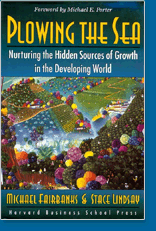
Plowing the Sea

In Plowing the Sea "...Michael Fairbanks and Stace Lindsay argue that the tremendous advantages developing nations have in natural resources, inexpensive labor, and fertile soil have actually kept these nations poor. Their advantages — easily imitated in other areas around the world — have not been sufficient engines for growth. Billions of dollars have been spent to eradicate poverty; still these regions remain as dependent as ever on volatile natural resource exports and foreign aid. Plowing the Sea is the authors’ attempt to unearth and nurture the hidden sources of growth — knowledge, innovation, and human capital — that remain untapped in developing countries..."
via On The Frontier

Thanks Gilbert Porku!

  • Digg
  • Del.icio.us
  • StumbleUpon
  • Reddit
  • RSS

Rethinking Nation-Building

Ashraf Ghani and Clare Lockhart ask

What functions need to be performed by a state if it is to have internal legitimacy and external credibility?
Their answers:
We have proposed a framework of the 10 most critical functions the modern state must perform, which was endorsed by a group of leaders of post-conflict transitions last year. The functions include maintenance of a monopoly on the legitimate means of violence, the nurturing of human capital, and creation and regulation of the market. We have also proposed that state-building or sovereignty strategies be devised to meet the goal of having the state perform each of the 10 functions -- strategies backed by compacts between the leadership of countries and the international community on the one side and citizens on the other to create capable states that deliver value to their citizens. And instead of thousands of reports, there should be a single global report on state effectiveness, compiled with the involvement of global and local civil societies and issued by a credible international organization.

  • Digg
  • Del.icio.us
  • StumbleUpon
  • Reddit
  • RSS

Microfinance or Enterprises?

Niranjan Rajadhyaksha asks at Livemint "What is the solution to poverty?":

Many have asked why Bangladesh continues to be mired in terrible poverty when it has such a large microfinance sector. The good ol’ basics matter more — property rights, open markets, human capital, innovation etc.
A new policy research paper, Who Gets Credit?, published by the World Bank shows that economies benefit more when money is lent to firms rather than households. India is one of the 45 countries the economists have covered in their study.
Quoting Milford Bateman
The East Asian countries managed to develop brilliantly through channelling much, if not most, of their savings into serious growth-oriented sustainable business projects. This is why many East Asian countries may have started at similar GDP levels as Bangladesh in the 1970s but have since massively outpaced Bangladesh in terms of growth and development. Economics 101 shows conclusively how critical savings are to development, but only if intermediated into growth and productivity enhancing projects. If it goes into rickshaws, kisoks, chicken farms, traders and so on, then the country simply will not develop and sustainably reduce poverty...[continue reading]
via World is Green

  • Digg
  • Del.icio.us
  • StumbleUpon
  • Reddit
  • RSS

Why Don't We Hang Pirates Anymore?

From the WSJ comes this impressive and timely post about how we USED to deal with the pirate issue compared to how we deal with it now, and it once again shows that as we try to be more politically correct and more fair, we create a world that is both more unfair and less right. With some editing, here is the article (try this link too), by Bret Stephens:

Year-to-date, Somalia-based pirates have attacked more than 90 ships, seized more than 35, and currently hold 17. Some 280 crew members are being held hostage, and two have been killed. Billions of dollars worth of cargo have been seized; millions have been paid in ransom. A multinational naval force has attempted to secure a corridor in the Gulf of Aden, through which 12% of the total volume of seaborne oil passes, and U.S., British and Indian naval ships have engaged the pirates by force. Yet the number of attacks keeps rising. Why?

The view of senior U.S. military officials seems to be, in effect, that there is no controlling legal authority. Title 18, Chapter 81 of the United States Code establishes a sentence of life in prison for foreigners captured in the act of piracy. But, crucially, the law is only enforceable against pirates who attack U.S.-flagged vessels, of which today there are few.

What about international law? Article 110 of the U.N.'s Law of the Sea Convention -- ratified by most nations, but not by the U.S. -- enjoins naval ships from simply firing on suspected pirates. Instead, they are required first to send over a boarding party to inquire of the pirates whether they are, in fact, pirates. A recent U.N. Security Council resolution allows foreign navies to pursue pirates into Somali waters -- provided Somalia's tottering government agrees -- but the resolution expires next week.

As for the idea of laying waste, Stephen Decatur-like, to the pirate's prospering capital port city of Eyl, this too would require U.N. authorization. Yesterday, a shippers' organization asked NATO to blockade the Somali coast. NATO promptly declined.

Then there is the problem of what to do with captured pirates. No international body similar to the old Admiralty Courts is currently empowered to try pirates and imprison them. The British foreign office recently produced a legal opinion warning Royal Navy ships not to take pirates captive, lest they seek asylum in the U.K. or otherwise face repatriation in jurisdictions where they might be dealt with harshly, in violation of the British Human Rights Act.

In March 2006, the U.S. Navy took 11 pirates prisoner, six of whom were injured. Not wanting to set a precedent for trying pirates in U.S. courts, the State Department turned to Kenya to do the job. The injured spent weeks aboard the USS Nassau, enjoying First World medical care.

All this legal exquisiteness stands in contrast to what was once a more robust attitude. Pirates, said Cicero, were hostis humani generis -- enemies of the human race -- to be dealt with accordingly by their captors. Tellingly, Cicero's notion of piracy vanished in the Middle Ages; its recovery traces the recovery of the West itself.

By the 18th century, pirates knew exactly where they stood in relation to the law. A legal dictionary of the day spelled it out: "A piracy attempted on the Ocean, if the Pirates are overcome, the Takers may immediately inflict a Punishment by hanging them up at the Main-yard End; though this is understood where no legal judgment may be obtained." Severe as the penalty may now seem (albeit necessary, since captured pirates were too dangerous to keep aboard on lengthy sea voyages), it succeeded in mostly eliminating piracy by the late 19th century -- a civilizational achievement no less great than the elimination of smallpox a century later.

Today, by contrast, a Navy captain who takes captured pirates aboard his state-of-the-art warship will have a brig in which to keep them securely detained, and instantaneous communications through which he can obtain higher guidance and observe the rule of law.

Yet what ought to be a triumph for both justice and security has turned out closer to the opposite. Instead of greater security, we get the deteriorating situation described above. And in pursuit of a better form of justice -- chiefly defined nowadays as keeping a clear conscience -- we get (at best) a Kenyan jail. "We're humane warriors," says one U.S. Navy officer. "When the pirates put down their RPGs and raise their hands, we take them alive. And that's a lot tougher than taking bodies."

Piracy, of course, is hardly the only form of barbarism at work today: There are the suicide bombers on Israeli buses, the stonings of Iranian women, and so on. But piracy is certainly the most primordial of them, and our collective inability to deal with it says much about how far we've regressed in the pursuit of what is mistakenly thought of as a more humane policy. A society that erases the memory of how it overcame barbarism in the past inevitably loses sight of the meaning of civilization, and the means of sustaining it.

This is a pretty good article, and matches my thoughts on it. I really do think that what we need is an awesome pirate war to clear out all that bothers us- a good old fashioned butt-whooping of real bad guys. Let's see the liberals spin that as a bad thing! As Commodore Decatur declared "We shall offer them liberal and enlightened terms, dictated at the mouths of our cannons." That's how we should take care of this problem. Here is what a liberal is going to say- we're being mean terrorists. William Eaton, commander of the Marines' march to Tripoli, said this about dealing with real terrorists: "There is but one language that can be held to these people, and this is terror." Chew on that.

  • Digg
  • Del.icio.us
  • StumbleUpon
  • Reddit
  • RSS

CheckBook Development

Michael Fairbanks co-founder of the Seven Fund writes:

Every nation needs money to upgrade and improve the lives of their citizens; and it is good when a rich nation helps a poor one after a devastating act of God, or to meet a basic human need. But, too often, when one nation aids another it is based on a massive infusion of financial capital in return for changing monetary, trade, investment, fiscal, sectoral, and wage policies. This is often the right advice, but there is a trade-off, too. The nation with all the money often assumes the decision rights; and the responsibility for a nation’s future must always reside with the citizens of that nation, not with foreign advisors, and certainly not with its creditors and donors.This sort of checkbook development confuses compassion and generosity with over-responsibility for fellow human beings. Explicitly or implicitly, the donor is telling them how to run their country, and in the process, without meaning to, can rob citizens of emerging nations of their most precious assets – dignity and self-reliance...[continue reading]-A Templeton Conversation

  • Digg
  • Del.icio.us
  • StumbleUpon
  • Reddit
  • RSS

Can Greed Save Africa?

Roben Farzad writes in Businessweek:

In many ways, Africa's economic situation seems hopeless. While $625 billion in foreign aid has poured in since 1960, there has been no rise in the region's per capita gross domestic product, notes William R. Easterly, economics professor at New York University. What's more, from 1976 to 2000, Africa's share of global trade dropped to 1%, from an already negligible 3%. The U.N.'s scale of human development, which considers health, education, and economic well-being, ranks 34 African nations among the world's 40 lowest. Thus far, foreign aid hasn't made a dent.
Greed, however, might. Thanks to the global commodities boom of the past few years, sub-Saharan Africa's economies, after decades of stagnation, are expanding by an average of 6% annually—twice the U.S. pace. And like bees to honey, investors are swarming into the region in search of the enormous returns that ultra-early-stage investments can bring. Blue Financial, for example, has already netted its early private equity backers a ninefold gain thanks to the 385% rise in its stock since its October, 2006, initial public offering in Johannesburg. Emerging Capital Partners has bought all or part of 42 African companies this decade and cashed out of 18, with gains on their investments averaging 300%. "The money we can make is matchless," says Emerging Capital Partners CEO Thomas R. Gibian, a former Goldman Sachs (GS) banker.

  • Digg
  • Del.icio.us
  • StumbleUpon
  • Reddit
  • RSS

The Colonialism-Imperialism Paradigm Is Kaput (1 of 2)

The Colonialism-Imperialism Paradigm Is Kaput
George B. N. Ayittey, Ph.D.
June 26, 2005.

Africas paradox is galling: immense mineral wealth yet inexorably mired in steaming squalor, misery, deprivation, and chaos. A few countries have sprinted ahead but Africas overall economic performance remains abysmal, lagging behind those of other regions in the Third World. The United Nations Development Program (UNDP) has warned that at the prevailing rates black Africa would take another 150 years to reach some of the development targets agreed by UN members for 2015. (Financial Times, July 9, 2003; p.1). Who ruined Africa?

The causes of Africas lack of development have always evoked heated emotional debates. On one hand are those who portray Africa as a victim of powerful external forces and conspiracies a group that may be described as externalists.On the other are those who believe that the causes of Africa's crisis lie mostly within African in the nature of government (governance) or how Africa runs its own affairs. This group may be described as the internalists.

The Externalists

The externalists believe that Africa's woes are due to external factors such as the lingering effects of Western colonialism and imperialism, the pernicious effects of the slave trade, racist conspiracy plots, exploitation by avaricious multinational corporations, an unjust international economic system, inadequate flows of foreign aid, the neo-liberal policies of the World Bank, IMF, and deteriorating terms of trade. Disciples of the externalist creed include most African leaders, scholars, and intellectual radicals. For decades, the externalist position held sway, attributing the causes of almost every African problem to such external factors.

In his book, The Africans, African scholar and historian Professor Ali Mazrui, examining Africas crises, attributed most of Africas woes to Western colonialism and imperialism. "The West harmed Africa's indigenous technological development in a number of ways" (164). Africa's collapsing infrastructure (roads, railways, and utilities) is due to the "shallowness of Western institutions," "the lopsided nature of colonial acculturation" and "the moral contradictions of Western political tutelage" (202). In fact, "the political decay is partly a consequence of colonial institutions without cultural roots in Africa" (199). Therefore, self congratulatory western assertions of contributing to Africa's modernization are shallow: "The West has contributed far
less to Africa than Africa has contributed to the industrial civilization of the West" (164). Decay in law enforcement and mismanagement of funds can be traced to Western colonialism too. "The
pervasive atmosphere in much of the land is one of rust and dust, stagnation and decay, especially within those institutions which were originally bequeathed by the West signal the slow death of an alien civilization" (204) and Africa's rebellion "against westernization
masquerading as modernity" (211). Western institutions are doomed "to grind to a standstill in Africa" or decay. "Where Islam is already established, the decay of western civilization is good for Islam since it helps to neutralize a major threat" (19).

Many African leaders also subscribed to and espoused similar views ascribing the causes of Africa's crises to external factors. In fact, since independence in the sixties, almost every African malaise was alleged to have been caused by the operation or conspiracy of extrinsic agents. This externalist doctrine totally absolved the leadership of any responsibility for the mess in Africa. The leadership was above reproach and could never be faulted. President Mobutu even blamed
corruption on European colonialism. Asked who introduced corruption into Zaire, he retorted: "European businessmen were the ones who said, 'I sell you this thing for $1,000, but $200 will be for your (Swiss bank) account'" (New African, July, 1988, 25).

In his address to the third Congress of the Democratic Union of Malian People recently, President Moussa Traore observed that, The world economy is passing through a period characterized by monetary disorder and slow trade exchanges. The worsening crisis is affecting all countries, particularly developing countries. Due to the difficult situation, which is compounded by the serious drought, socio economic life has been affected by serious imbalances
that have jeopardized our country's development growth. Debt servicing, characterized mainly by state to state debts are a heavy burden on the state budget. The drop in the price of cotton which accounts for much of the country's foreign earnings, has led to a great reduction in export
earnings" (West Africa, 16 May 1988, 876).

President Danial arap Moi accused the IMF and other development partners of denying Kenya development funds, thus triggering mass poverty (The Washington Times, June 3, 1999; p.A12). According to the Chairman of Ghanas ruling NDC, Issifu Ali, whatever economic crisis the nation was going through had been caused by external factors. He said the NDC has since 1982 adopted pragmatic policies for the progress of Ghana, adding that the macro-economic environment of 1999 has been undermined by global economic developments" (The Independent, Nov 18, 1999; p.3). Said the Zimbabwe Independent (April 27, 1999), Mugabe
rejects the criticism of those who blame the government for the economic crisis. It is, he says, the fault of greedy Western powers, the IMF, the Asian financial crisis and the drought (p. 25).

Naturally, African leaders would deny any responsibility and blame everybody else except themselves for the mess in Africa. The New Economic Partnership for African Development (NEPAD) echoes this orthodoxy when it claims that Africas impoverishment has been accentuated by the legacy of colonialism and other historical legacies, such as the Cold War and the unjust international economic system. Colonialism subverted the "traditional structures, institutions and values," creating an economy "subservient to the economic and political
needs of the imperial powers" (para 21). Colonialism, according to NEPAD, retarded the development of an entrepreneurial and middle class with managerial capability. At independence, Africa inherited a "weak capitalist class," which explains the "weak accumulation process, weak states and dysfunctional economies." (para 22). More recent reasons for Africa's dire condition include "its continued marginalization from globalization process." (para 2). NEPAD seeks $64 billion in investments from the West.

Frankly, this colonialism-imperialism card has been so overplayed that it has lost its relevance and credence. Even Africas children dont buy it. Chernoh Bah, president of the Children's Forum asserted that Africa's socio economic problems are a direct repercussion of incompetent and corrupt political leaders who usurped political office via the gun. "Some blame colonialism for Africa' plight while others blame the continent's harsh climatic conditions. I think the reason is the kind of political systems we have had over the past decades, he said. (Standard Times [Freetown], April 2, 2003; web posted). At the United Nations Children's Summit held in May 2002 in New York, youngsters from Africa ripped into their leaders for failing to improve
their education and health. "You get loans that will be paid in 20 to 30 years and we have nothing to pay them with, because when you get the money, you embezzle it, you eat it, said 12-year-old Joseph Tamale from Uganda (BBC News, May 10, 2002).

The Internalists

Internalists are the new and angry generation of Africans, who are fed up with African leaders who refuse to take responsibility for their own failures and, instead use colonialism and other external factors as convenient alibis to conceal their own incompetence and mismanagement.
Internalists believe that, while external factors have played a role, internal factors have been far more significant in causing Africas crisis. This school of thought maintains that while it is true Western colonialism and imperialism did harm Africa and continues to do so, Africa's condition has been made immeasurably worse by such internal factors as misguided leadership, misgovernance, systemic corruption, capital flight, economic mismanagement, declining investment, collapsed infrastructure, decayed institutions, senseless civil wars, political
tyranny, flagrant violations of human rights, and military vandalism. In fact, one can identify a whole lot of them but these will suffice. U.N. Secretary-General, Kofi Annan, himself an African, lashed out at African leaders at the Organization of African Unity (OAU) Summit in Lome in July 2000. He pointedly told them that they are to blame for most of the continent's problems. Instead of being exploited for the benefit of the people, Africas mineral resources have been so
mismanaged and plundered that they are now the source of our misery (Daily Graphic, July 12, 2000; p.5). Earlier in the year at a press conference in London in April, 2000, Kofi Annan, lambasted African leaders who he says have subverted democracy and lined their pockets
with public funds, although he stopped short of naming names (The African-American Observer, April 25 May 1, 2000; p.10). During a brief stop-over in Accra, he disclosed in a Joy FM radio station interview that "Africa is the region giving him the biggest headache as the
Security Council spends 60 to 70% of its time on Africa. He admitted sadly that the conflicts on the continent embarrasses and pains him as an African" (The Guide, July 18-24, 2000; p.8).

Ordinary people are speaking out too. Said Akobeng Eric, a Ghanaian, in a letter to the Free Press (29 March - 11 April 1996): "A big obstacle to economic growth in Africa is the tendency to put all blame, failures and shortcomings on outside forces. Progress might have been achieved if we had always tried first to remove the mote in our own eyes" (2). Angry
at deteriorating economic conditions in Ghana, thousands of Ghanaians marched through the streets of the capital city, Accra, the economic crisis is due to external forces and therefore, beyond his control, then he should step aside and allow a competent person who can
manage the crisis to take over," Atta Frimpong demanded (The Ghanaian Chronicle, Nov 29, 1999; p.1). Appiah Dankwah, another protestor blamed the NDC government for mismanaging the resources of the nation.

By the 1990s, African governments had completely lost touch with their people; in fact, they were at war with their people. Citing "the credibility gap between the people and the leadership built up through years of mismanagement," Mr. Mohammed Boudiaf, the head of Algeria's
High Executive Council (HEC), lamented: "A large segment of the population has, I am afraid, lost confidence in the capacity of the leadership to provide jobs, housing, health care and its ability to combat corruption" (Financial Times, June 17, 1992; p. 4). Indeed, said Simon Agbo, a farmer in Ogbadibo, south of Makurdi, Benue state capital in Nigeria: "I heard we have a new government. It makes no difference to me. Here we have no light ( electricity), we have no water. There is no road. We have no school. The government does nothing for us (The
Washington Times, Oct 21, 1999; p.A19).

Rafael Marques, a journalist, jailed and convicted of defamation for a 1999 article in which he characterized President Jose Eduardo dos Santos of Angola as a dictator, wrote: "The government has created a stateless state here in Angola. Each citizen is responsible for his own health and welfare while the government is accountable to no one. The MPLA and
UNITA are like two gangs and the people of Angola are innocent bystanders caught in the middle of a drive-by shooting" (The Washington Post, Sept 18, 2000; p.A1).

As a result of the failure to provide the basic necessities of life, the state and those in power have increasingly alienated themselves from those they rule and from whom they claim to derive their legitimacy. The growing gap between the leaders and the people has made the leaders increasingly insecure, sensitive, repressive and less responsive to the wishes of society. The mass of the people in turn regard the state and its organs with fear, suspicion and cynicism because as far as they are concerned, they are no longer legitimate or relevant in their lives. The government does nothing for them. Insecure African despots spend inordinate amounts on the military and security forces, subverting other state institutions squelch dissent, prop them up in power, and serve their parochial interests. The masses on the other hand, sensing their
inability to meaningfully influence the policies of the state and the behaviors of those in positions of power, develop apathy and withdraw from participation in the political process for safety reasons.

Government, as an institution that cares about its people and attends to their needs, has ceased to exist in many African countries. What exists is a vampire state, where the government has been hijacked by a phalanx of unrepentant bandits and crooks, who use the machinery of the
state to enrich themselves, their cronies and tribesmen, while excluding everyone else (the politics of exclusion). The richest persons in Africa are heads of state and ministers. Quite often, the chief bandit is the head of state himself.

At an African civic groups meeting in Addis Ababa, Ethiopia, Nigeria's President, Olusegun Obasanjo, claimed that corrupt African leaders have stolen at least $140 billion (95 billion) from their people in the decades since independence (The London Independent, June 14, 2002. Web
posted at www.independent.co.uk). In August 2004, an African Union report claimed that Africa loses an estimated $148 billion annually to corrupt practices, a figure which represents 25 percent of the continent's Gross Domestic Product (GDP). But these are gross underestimates. According to one UN estimate, $200 billion or 90 percent of the sub-Saharan part of the continent's gross domestic product was shipped to foreign banks in 1991 alone (The New York Times, Feb 4, 1996; p.4). Nigeria's past rulers stole or misused 220 billion ($396 billion) -- that is as much as all the western aid given to Africa in almost four decades. The looting of Africa's most populous country amounted to a sum equivalent to 300 years of British aid for the
continent (The London Telegraph, June 25, 2005; web posted). If this sum had been divided equally among Nigerias 120 million people, its income per capita would be at least $3,000, instead of the miserable $265, which is about the same as it was when it gained its independence in 1960. Between 1970 and 2004, more than $400 billion in oil money
flowed into Nigerian governments coffers. What happened to the oil money?

Eventually the vampire state metastasizes into what Africans call a coconut republic and implodes when politically-excluded groups rise up in rebellion: Somalia (1993), Rwanda (1994), Burundi (1995), Zaire (1996), Sierra Leone (1998), Liberia (1999), Ivory Coast (2000), and
Togo (2005). Only reform intellectual, economic, political and institutional will save Africa but the leadership is not interested. Period.

Ask these leaders to develop their countries and they will develop their pockets. Ask them to seek foreign investment and they will seek a foreign country to invest their booty. Ask them to cut bloated state bureaucracies or government spending and they will set up a Ministry of
Less Government Spending. Ask them to establish better systems of governance and they will set up a Ministry of Good Governance (Tanzania). Ask them to curb corruption and they will set up an Anti-Corruption Commission with no teeth and then sack the Commissioner if he gets too close to the fat cats (Kenya). Ask them to establish democracy and they will empanel a coterie of fawning sycophants to write the electoral rules, hold fraudulent elections with opposition leaders either disqualified or in jail, and return themselves to power (Ivory Coast, Rwanda). Ask them to reduce state hegemony in the economy and place more reliance on the private sector and they will create a Ministry of Private Enterprise (Ghana). Ask them to privatize inefficient state-owned enterprises and they will sell them off at fire-sale prices to their cronies. In 1992, in accordance with World Bank loan conditionalities, the Government of Uganda began a
privatization effort to sell-off 142 of its state-owned enterprises. However, in 1998, the process was halted twice by Ugandas own parliament because, according to the chair of a parliamentary select committee, Tom Omongole, it had been derailed by corruption, implicating three senior ministers who had "political responsibility" (The East African, June 14, 1999). The sale of these 142 enterprises was initially projected to generate 900 billion Ugandan shillings or $500
million. However, by the autumn of 1999 the revenue balance was only 3.7 billion Ushs.

Now, their recalcitrance has transmogrified into extortion. Ask them to move a foot and they will demand foreign aid in order to do so. In 2003, some 30,000 ghost names were discovered on the payroll of the Ministry of Education, costing the government $1.2 million a month in salaries heisted by living workers. When Ghana demanded foreign aid to purge these ghost names, Japan ponied up $5 million.

The reform process has stalled through vexatious chicanery, strong-arm tactics, deception, and vaunted acrobatics. Only 16 out of the 54 African countries are democratic and fewer than 8 African countries can be described as economic success stories. Intellectual freedom remains
in the Stalinist era: only 8 African countries have a free and independent media. But without genuine reform, more African countries will implode -- Chad, Cameroon, Central African Republic, Equatorial Guinea, Guinea, Togo and Zimbabwe are already teetering on the brink

The slave trade, Western colonialism, imperialism and external factors have nothing to do with the naked plunder and wrong choices made by bad African leaders. The World Bank has nothing to do with monumental leadership failure in Africa. The IMF, which most African leaders relish
vilifying, has nothing to do with petrol (gasoline) shortages in Nigeria. Nor do Western agricultural subsidies have anything to do with why African governments cant supply reliable electricity and safe drinking water to their people. The slave trade has nothing to do with
Nigeria turning itself into the scam capital of the world.

The Flaws in the Externalist Position

The issue of Western culpability or complicity in causing Africas woes evokes such intense emotionalism that it often clouds rational analysis of our problems in Africa. Let us strip the issue of its emotionalism and examine it rationally.

Historical Wrongs Committed by the West

The Slave Trade/Colonialism

Everyone agrees that the slave trade was at once a brutally inhumane treatment that can ever be meted out to a people. The horrors of capture, the trans-shipment, the loss of millions of able-bodied men, the atrocities that were committed by European slave traders, etc. are all documented. We all agree to the humiliating experience of colonial subjugation. The discrimination against African natives, the exploitation of Africa's mineral wealth and artifacts, etc. -- we also agree on that.

Remedies

We may seek compensation (reparations) for the harm that slavery did to us. We may seek the return of the stolen booty. Ethiopia has just received its ancient obelisk, stolen by the Italian colonialists. But even here, African leaders have debauched the issue.

Back in August 1999, representatives of African governments met in Accra and issued a declaration: "Africa is demanding $777 trillion from Western Europe and the Americas in reparation for enslaving Africans while colonizing the continent" (Pan African News Agency, August 18, 1999). It added that the money would be demanded from ''all those nations of Western Europe and the Americas and institutions, who participated and benefited from the slave trade and colonialism''. Dr. Hamet Maulana and Debra Kofie, co-chairpersons of the commission, urged that worldwide monitoring and networking systems be instituted to ensure
that reparation and repatriation will be achieved by 2004. Problem is, U.S. GNP is only $12 trillion and amount asked- $777 trillion- exceeds the combined sum of the GNPs of the entire Western world! According to the British governments Office of National Statistics, The United
Kingdom -- that is England, Wales, Scotland and Northern Ireland -- is officially valued at $8.8 trillion, a sum that includes all of its property and buildings, machinery, roads, bridges, planes, trains and automobiles. It also includes all the money deposited in its banks and other financial institutions. Plus everything on the shelves at Harrods (The New York Times, Jan 1, 2004; p.A4). So how do African leaders hope to collect $777 trillion?

We may argue all we want about the size of reparations but these historical wrongs cannot repeat, cannot -- be used to justify the cruel atrocities and grotesque misdeeds African leaders commit against their own people. Winning independence for their respective countries gives no African leader -- none of them -- the license to do what they want with their people and countries.

European slave traders or colonialists did not tell President Mugabe to raze down shanty-towns, destroying the propertied of hundreds of thousands of Zimbabweans and rendering more than 1.5 million HOMELESS. American imperialists did not tell President Meles Zenawi of Ethiopia
to order his security forces to open fire on student demonstrators, killing more than 40 of them on June 15, 2005. British racists did not tell President Isaiah Afwerki of Eritrea to shut down all the private newspapers in Eritrea and jail all their editors and journalists.

These leaders must be held ACCOUNTABLE for their actions. Historical wrongs by the West do not factor in here because they are a separate issue and CANNOT be used to excuse wrongful actions taken by African leaders TODAY.

Colonial Legacies

It is also agreed that the colonial legacies bequeathed to Africa were pitiful. What the Portuguese left behind in Guinea-Bissau, after 200 years of colonial rule, was a small brewery for their local servicemen. There was no social development; industry was not encouraged. African colonies were to serve as sources of raw material and cheap labor for the industrial machines of Metropolitan Europe. The colonial economies were based on export mono-culture: the export of one or two cash crops.

Colonial education was geared toward training male clerks for the colonial administration. The Belgians and Portuguese never encouraged university education as that would teach African natives of their political rights. When Tanzania gained its independence in 1964, it had only 4 university graduates.

Infrastructure was Spartan. Few roads and railways were built. Even where built in West Africa, they exhibited a dendritic pattern: Straight from the coast to the hinterland to evacuate some mineral or cash crop.

All this is true but heres the problem: After independence, we, African elites, did not maintain, let alone keep the little infrastructure we inherited from the colonialists. In fact, we destroyed them! Infrastructure crumbled in the post colonial period. The few universities we got in Ghana and Nigeria decayed. In Uganda, Makerere University used to be called the Harvard of Africa in the 1950s. By 1980, it was a shambles. In Zaire, the Belgian colonialists put down only 2,000 miles of paved road appalling for that huge country the size of Texas. By 1990, only 200 miles were usable. So who do you blame: the Belgian colonialists for not laying down enough roads OR Mobutu for failing to maintain the little that Zaire got? Later, we learned that Mobutu allowed the roads and infrastructure to crumble in Zaire because it made it difficult for the opposition to organize against him!
(contd)

  • Digg
  • Del.icio.us
  • StumbleUpon
  • Reddit
  • RSS